






Why the D10 Group of Countries Matters and What Is India’s Position?
The D10 Group of Countries refers to a proposed coalition of ten leading democracies that work together to promote democratic values, economic cooperation, technological collaboration, and global security. The idea gained attention as global geopolitical tensions increased and there was a need for democratic nations to coordinate on trade, supply chains, and emerging technologies. For India, participation in such groupings strengthens its global influence and supports its strategic and economic interests. This article explains what the D10 is, its importance, member countries, objectives, and India’s position in the group.
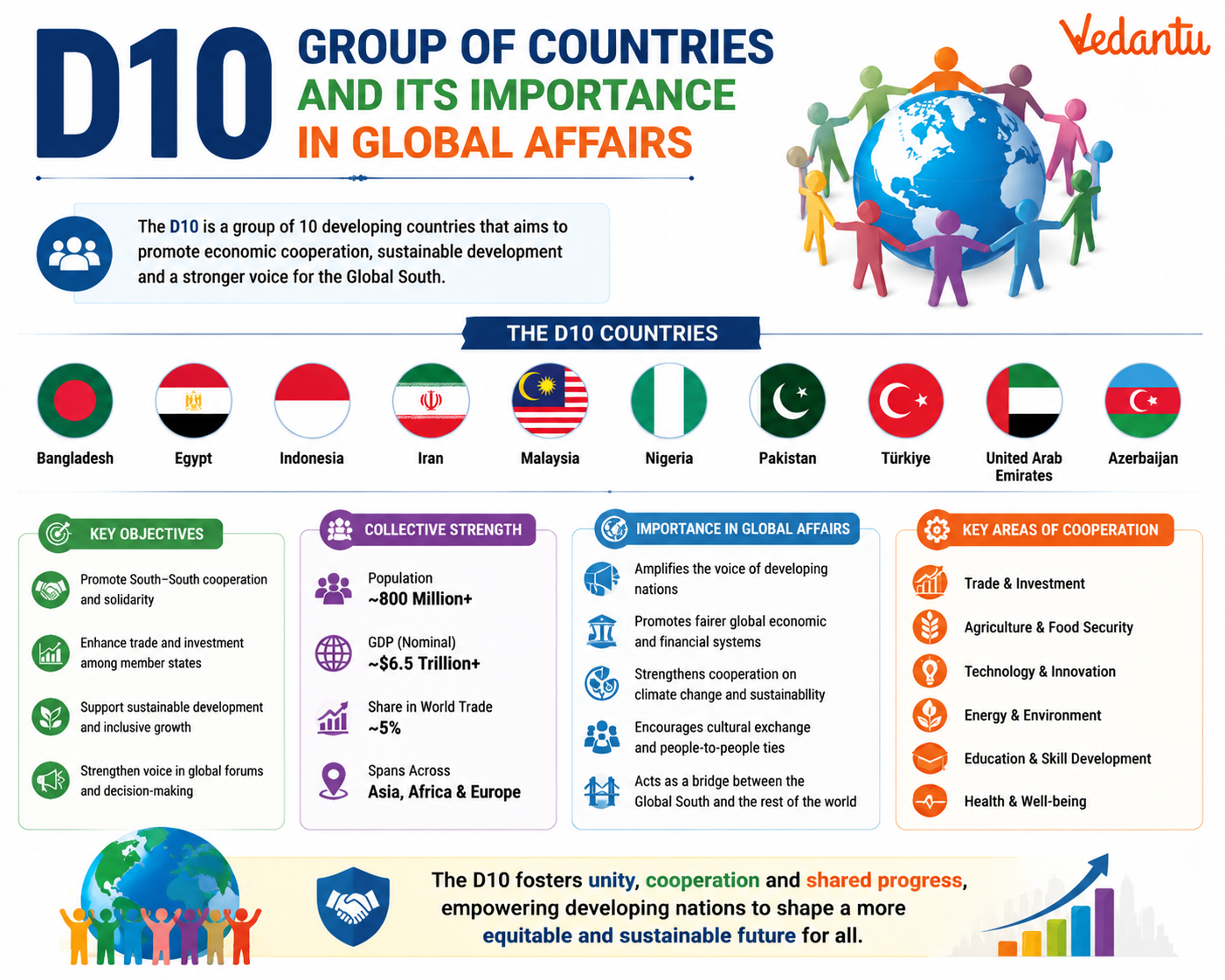
What is the D10 Group of Countries?
The D10 is an informal grouping of ten democratic nations. It evolved from the G7 framework, with the inclusion of other major democracies to broaden cooperation. The concept became prominent around 2020 when discussions focused on creating resilient supply chains, especially in critical sectors like telecommunications and semiconductors.
The group aims to strengthen collaboration among leading democracies in areas such as economic security, technology standards, trade, and global governance reforms.
D10 Member Countries
List of D10 Countries
| Country | Region | Global Significance |
|---|---|---|
| United States | North America | Largest economy and major defense power |
| United Kingdom | Europe | Financial and diplomatic influence |
| Canada | North America | Resource rich developed democracy |
| France | Europe | Permanent UNSC member |
| Germany | Europe | Economic powerhouse of Europe |
| Italy | Europe | Major European economy |
| Japan | Asia | Technology leader |
| Australia | Oceania | Indo Pacific strategic player |
| South Korea | Asia | Advanced manufacturing hub |
| India | Asia | Largest democracy and emerging power |
The D10 combines the traditional G7 countries with India, Australia, and South Korea, making it a broader democratic alliance with significant economic and geopolitical weight.
Objectives of the D10 Group
The D10 aims to enhance cooperation among democratic nations to address modern global challenges. Its objectives are centered on protecting democratic values and ensuring economic and technological security.
- Strengthening global supply chains, especially for critical technologies like semiconductors and 5G networks
- Reducing dependence on authoritarian regimes for strategic resources
- Promoting free trade and fair economic practices
- Supporting democratic governance and rule based international order
- Coordinating policies on cybersecurity and emerging technologies
Importance of the D10 in Global Politics
The D10 has emerged as a significant platform due to rising geopolitical competition and technological rivalry. It represents a collective effort by leading democracies to shape global standards in trade, digital governance, and security.
1. Economic Significance
Together, the D10 countries account for a large share of global GDP and trade. Cooperation among them ensures economic stability and strengthens global supply chains.
2. Strategic and Security Role
The grouping enhances strategic coordination in the Indo Pacific region and beyond. It supports maritime security, counter terrorism efforts, and defense collaboration among member states.
3. Technological Collaboration
The D10 focuses on setting global standards for emerging technologies such as 5G, artificial intelligence, and cybersecurity. This reduces risks associated with overdependence on a single country for critical technologies.
India’s Position in the D10 Group
India plays a crucial role in the D10 due to its status as the world’s largest democracy and a rapidly growing economy. Its strategic location in the Indo Pacific region makes it an essential partner in maintaining regional balance.
Why India Matters in D10
- India provides a strong democratic voice from the Global South
- It is a major market and manufacturing hub
- India plays a key role in Indo Pacific security frameworks
- It contributes to technology development and digital innovation
Benefits for India
Participation in the D10 enhances India’s global diplomatic standing. It strengthens economic partnerships, supports technological development, and helps India reduce supply chain vulnerabilities. It also aligns with India’s vision of a free, open, and inclusive Indo Pacific region.
D10 vs G7 - Key Difference
Comparison Between D10 and G7
| Feature | G7 | D10 |
|---|---|---|
| Number of Members | 7 | 10 |
| Member Composition | Mainly Western economies | Broader democratic coalition |
| Focus Areas | Economic and political coordination | Technology, supply chains, democracy protection |
While the G7 remains an influential economic grouping, the D10 expands its scope by including major Indo Pacific democracies such as India, Australia, and South Korea, making it more globally representative.
Challenges Facing the D10
Despite its strategic importance, the D10 faces certain challenges that may affect its effectiveness.
- Differences in national interests among member countries
- Economic dependencies on non member countries
- Lack of formal institutional structure
- Geopolitical tensions that may limit consensus
Conclusion
The D10 Group of Countries represents an important step toward deeper cooperation among leading democracies. It focuses on economic security, technological collaboration, and strengthening democratic values worldwide. For India, being part of the D10 enhances its global influence, supports its strategic goals, and strengthens its position in shaping the future global order. Understanding the D10 is essential for students and competitive exam aspirants as it reflects current developments in international relations and global governance.
FAQs on D10 Group of Countries and Its Importance in Global Affairs
1. What is the D10 Group of Countries?
The D10 Group is a proposed alliance of ten leading democracies aimed at strengthening cooperation on global challenges, especially in technology and geopolitics.
• The term D10 (Democracy 10) expands the G7 nations.
• It includes USA, UK, Canada, France, Germany, Italy, Japan plus India, Australia, and South Korea.
• Focus areas: 5G technology, supply chains, cybersecurity, and democratic values.
• It is discussed as a strategic alternative to growing influence from non-democratic powers.
2. Why was the D10 Group proposed?
The D10 Group was proposed to strengthen cooperation among major democracies in response to global strategic and economic challenges.
• To reduce dependency on China in critical technologies like 5G networks.
• To promote democratic governance and rule-based international order.
• To secure global supply chains and critical infrastructure.
• To counter rising geopolitical tensions in the Indo-Pacific region.
3. Which countries are members of the D10 Group?
The D10 countries include seven G7 nations plus three additional democracies.
• G7 Members: United States, United Kingdom, Canada, France, Germany, Italy, Japan.
• Additional Members: India, Australia, South Korea.
• These nations represent leading economic powers and strong democratic systems globally.
4. What is India’s position in the D10 Group?
India plays a crucial role in the D10 alliance as a major democratic and emerging economic power.
• India strengthens the group’s presence in the Indo-Pacific region.
• It supports cooperation in technology, cybersecurity, and digital infrastructure.
• India’s inclusion highlights its growing global strategic importance.
• It aligns with India’s vision of a free, open, and inclusive Indo-Pacific.
5. How is the D10 different from the G7?
The D10 expands the G7 Group by including three additional democracies to broaden global representation.
• G7: Focuses mainly on economic cooperation among seven advanced economies.
• D10: Adds India, Australia, and South Korea.
• D10 emphasizes technology partnerships, democratic alliances, and supply chain resilience.
• It has a stronger geopolitical and strategic focus.
6. What are the main objectives of the D10 Group?
The main objective of the D10 countries is to promote democratic cooperation and secure critical technologies.
• Strengthen 5G and next-generation telecom networks.
• Ensure cybersecurity and digital security.
• Reduce dependence on single-country supply chains.
• Promote global democratic values and economic stability.
7. Why is the D10 important for global politics?
The D10 alliance is important because it aims to balance global power dynamics and protect democratic interests.
• Acts as a strategic counterweight in global geopolitics.
• Enhances cooperation in the Indo-Pacific strategy.
• Encourages collaboration in technology innovation and trade.
• Supports a rules-based international order.
8. Is the D10 Group officially formed?
The D10 Group is currently a proposed strategic forum and not a formally established international organization.
• The idea was supported by the United Kingdom in 2020.
• Discussions have taken place among member nations.
• It may evolve into a formal platform depending on geopolitical developments.
9. How does the D10 benefit India?
The D10 membership benefits India by enhancing its global influence and technological partnerships.
• Access to advanced technology collaboration.
• Strengthens India’s role in global supply chain diversification.
• Boosts India’s strategic presence among leading democracies.
• Supports India’s ambition to become a global economic power.
10. How is the D10 related to the Indo-Pacific strategy?
The D10 Group is closely linked to the Indo-Pacific strategy as it promotes stability and democratic cooperation in the region.
• Supports a free and open Indo-Pacific.
• Encourages maritime security and regional stability.
• Aligns with initiatives like the Quad (India, USA, Japan, Australia).
• Aims to maintain balance in Asian geopolitics.
