Watch Video





Class 9 Science Chapter 13 Important Questions with Answers PDF
Important Questions and Answers for Class 9 Science Exploration Chapter 13 – Earth as a System: Energy, Matter, and Life| 2026–27


 ShareShare
These Chapter 13 Class 9 Science important questions test scientific understanding through real-life situations rather than definitions alone. The 24 questions include India's monsoon, atmospheric research, local winds, environmental changes and nutrient cycles. Students can practise MCQs, numerical problems, diagram-based questions and application-based answers.
Multiple Choice Questions on Earth's Energy and Natural Systems
Q1. After several warm years, a Himalayan glacier becomes smaller. Which group of Earth's spheres is directly involved when the glacier melts, and the resulting water flows into a river?
(a) Only the biosphere
(b) Cryosphere and hydrosphere
(c) Only the atmosphere
(d) Biosphere and outer space
Answer: (b) Cryosphere and hydrosphere.
Explanation: A glacier is part of the cryosphere, which includes frozen water. When it melts, the liquid water enters rivers and lakes belonging to the hydrosphere. The change may also affect the atmosphere, geosphere and biosphere.
Q2. Two identical metal trays are placed in sunlight. One is painted black and the other white. Which observation is most likely?
(a) The white tray absorbs more sunlight because it has a higher albedo.
(b) Both trays absorb the same amount of radiation.
(c) The black tray generally heats more because it absorbs a greater fraction of incoming sunlight.
(d) The black tray produces more solar radiation than the Sun.
Answer: (c) The black tray generally heats more because it absorbs a greater fraction of incoming sunlight.
Explanation: Dark surfaces generally have a lower albedo and absorb more incoming solar radiation. Light-coloured surfaces reflect more sunlight and usually heat less under otherwise similar conditions.
Q3. A student learns that the ozone layer protects Earth from harmful ultraviolet radiation. In which atmospheric layer is this protective ozone concentrated?
(a) Troposphere
(b) Stratosphere
(c) Hydrosphere
(d) Geosphere
Answer: (b) Stratosphere.
Explanation: The ozone layer is concentrated mainly in the stratosphere. It absorbs much of the Sun's harmful ultraviolet radiation. This is different from ground-level ozone, which is an air pollutant.
Q4. During daytime in a Himalayan valley, warm air rises along the mountain slopes. Which wind is produced when cooler valley air moves uphill to replace it?
(a) Mountain breeze
(b) Valley breeze
(c) Polar wind
(d) Cyclonic storm
Answer: (b) Valley breeze.
Explanation: Sun-facing slopes warm during the day, causing nearby air to rise. Cooler air moves uphill from the valley. At night, the slopes cool and denser air flows downhill, producing a mountain breeze.
Q5. A lake near farmland develops a thick layer of algae after heavy rainfall washes fertiliser into it. What is the most likely result?
(a) Dissolved oxygen must increase permanently.
(b) The lake becomes completely salt-free.
(c) Excessive algal growth and decomposition may reduce oxygen, harming fish.
(d) Nitrogen stops participating in natural cycles.
Answer: (c) Excessive algal growth and decomposition may reduce oxygen, harming fish.
Explanation: Excess nitrogen and other nutrients can cause eutrophication. Algal blooms may grow rapidly, and their decay can consume dissolved oxygen, creating conditions harmful to aquatic animals.
Very Short Answer Questions on Scientific Terms and Processes
Q6. What is insolation?
Answer: Insolation is the incoming solar radiation received at Earth's surface. It provides energy that heats land and water and supports several natural processes, including weather and the water cycle.
Q7. What does albedo measure?
Answer: Albedo is the fraction of incoming solar radiation reflected by a surface. A surface with high albedo reflects more sunlight, while a surface with low albedo generally absorbs more.
Q8. Name the Indian scientist known for mapping solar radiation across India.
Answer: Anna Mani was a pioneering Indian atmospheric scientist who carried out important work on solar radiation measurements and helped develop reliable solar-energy data for India.
Q9. Which microorganisms convert atmospheric nitrogen into forms that plants can use? Give one example.
Answer: Nitrogen-fixing microorganisms convert atmospheric nitrogen into chemically usable compounds. Rhizobium, found in the root nodules of many leguminous plants, is one example.
Short Answer Questions on Solar Energy, Winds and Earth's Spheres
Q10. An illustration shows mountains, glaciers, clouds, soil, rivers, forests and animals. Identify the five Earth spheres and explain how rainfall connects at least three of them.
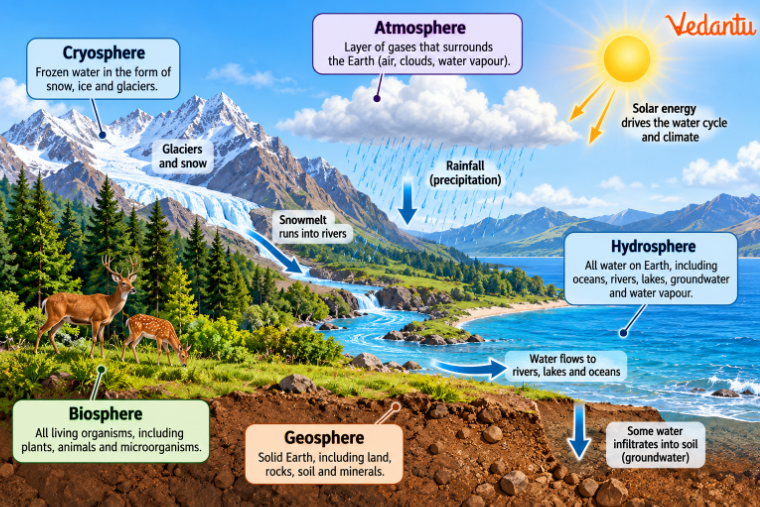
Answer:
Earth consists of five interconnected spheres:
How Rainfall Connects Them:
Water vapour condenses in the atmosphere to form clouds.
Rain enters rivers, lakes and soil, connecting the atmosphere with the hydrosphere and geosphere.
Plants absorb water from the soil, connecting the geosphere with the biosphere.
In cold regions, precipitation may accumulate as snow, connecting the atmosphere with the cryosphere.
Conclusion: Rainfall demonstrates that Earth's spheres continuously exchange matter and influence one another.
Q11. The solar constant is approximately 1.4 kW/m². Calculate the energy received by a 2 m² surface perpendicular to sunlight in 10 minutes at the top of Earth's atmosphere. Ignore changes in intensity during that time.
Solution:
Given:
Solar intensity = 1.4 kW/m² = 1400 W/m²
Area = 2 m²
Time = 10 minutes = 600 seconds
Formula:
Energy = Intensity × Area × Time
Calculation:
Energy = 1400 × 2 × 600
= 1,680,000 J
= 1.68 MJ
Answer: The surface receives approximately 1.68 megajoules of solar energy.
Explanation: The solar constant describes solar energy arriving at the top of the atmosphere on a surface perpendicular to the Sun's rays. Less energy generally reaches the ground because clouds, gases and dust absorb, scatter or reflect part of it.
Q12. Why can snow-covered land remain cooler than dark soil even when both receive sunlight? Explain the effect of albedo.
Answer:
Snow generally has a high albedo, often reflecting approximately 80–90% of incoming sunlight.
Dark soil has a lower albedo and absorbs a larger proportion of the radiation.
As a result, dark soil often warms more rapidly than snow under comparable conditions.
Albedo is important because it influences how much solar energy is absorbed by Earth's surface.
Further Understanding: When snow and ice melt, darker land or water may become exposed. These darker surfaces absorb more sunlight, causing additional warming. This is called the ice-albedo feedback.
Q13. Why does a city with concrete buildings and asphalt roads remain warmer at night than a nearby rural area?
Answer:
This is an example of the urban heat island effect.
During the day, roads, buildings and other artificial surfaces absorb solar energy.
These surfaces store heat and release it gradually, including during the night.
Cities also tend to have fewer trees and less exposed soil, which can reduce cooling through evaporation and transpiration.
Example: A densely built neighbourhood may remain warmer at night than a nearby area containing fields, vegetation and open soil.
Conclusion: Surface materials, vegetation cover and the arrangement of buildings influence local temperatures.
Q14. A student says, "The greenhouse effect is harmful and should disappear completely." Explain why this statement is scientifically incorrect.
Answer:
The natural greenhouse effect is essential for maintaining temperatures that support life on Earth.
Greenhouse gases such as carbon dioxide, methane and water vapour absorb part of the infrared radiation emitted by Earth's surface.
This helps keep the lower atmosphere and surface warm.
However, increasing greenhouse gas concentrations through activities such as fossil-fuel combustion strengthens this effect.
Difference:
Conclusion: The problem is not the existence of the greenhouse effect but its excessive strengthening.
Q15. Compare the troposphere and stratosphere. Why is each important for life on Earth?
Answer:
The troposphere contains most atmospheric water vapour and is the region where most clouds and weather phenomena form.
The stratosphere contains ozone that absorbs much of the Sun's harmful ultraviolet radiation.
Both layers contribute to the conditions necessary for life.
Q16. Two illustrations show air moving uphill during the day and downhill at night in a mountain valley. Explain the change in wind direction.
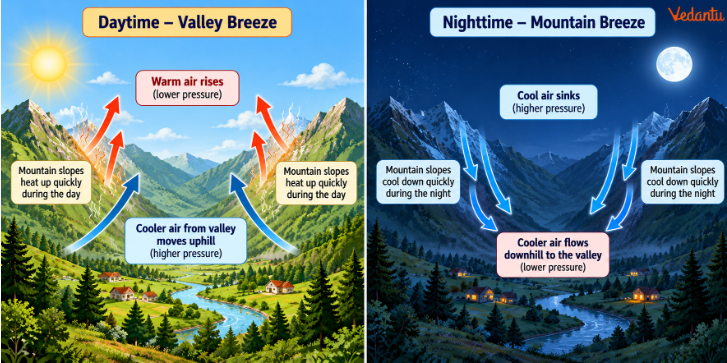
Answer:
Daytime – Valley Breeze
Sun-facing mountain slopes heat up.
Air near the slopes becomes warmer and less dense.
The warmer air rises.
Cooler air from the valley moves uphill to replace it.
This uphill movement is called a valley breeze.
Nighttime – Mountain Breeze
Mountain slopes lose heat after sunset.
Air near the slopes cools and becomes denser.
The cooler air moves downhill.
Air flows towards the valley floor.
This downhill movement is called a mountain breeze.
Conclusion: Differences in heating and cooling create pressure differences that cause local winds.
Q17. How does Earth's rotation change the direction of planetary winds?
Answer:
Solar heating creates differences in air pressure between the equator, subtropical regions and polar regions.
Air generally moves from high-pressure regions towards low-pressure regions.
However, Earth's rotation causes moving air to be deflected. This effect is called the Coriolis effect.
In the Northern Hemisphere, moving air is deflected towards the right of its direction of motion.
In the Southern Hemisphere, moving air is deflected towards the left.
Conclusion: Because of Earth's rotation, planetary winds follow curved paths rather than moving directly north or south.
Q18. Why can a warm ocean current keep some coastal regions of northwestern Europe relatively mild during winter?
Answer:
Ocean currents transport heat between different parts of the planet.
Warm currents carry energy from tropical and subtropical regions towards higher latitudes.
The North Atlantic Drift, associated with the Gulf Stream system, transfers heat towards northwestern Europe.
This heat influences the air above the ocean and contributes to the relatively mild maritime climate of some coastal regions.
Conclusion: Ocean circulation redistributes heat and helps reduce temperature differences between parts of Earth.
Long Answer and Application-Based Questions on Natural Cycles and Environmental Change
Q19. Explain how the southwest monsoon shows the interaction between solar energy, oceans and the atmosphere.
Answer:
The southwest monsoon is an important example of Earth's interacting systems.
1. Solar Heating
The Sun warms Earth's land and ocean surfaces.
Land and water respond differently to heating.
2. Seasonal Pressure Differences
During the summer, intense heating creates low-pressure conditions over large parts of the Indian subcontinent.
The surrounding ocean and atmosphere have different temperature and pressure conditions.
3. Movement of Moisture-Bearing Air
Large-scale atmospheric circulation carries moisture-laden air from the Indian Ocean towards India.
The Arabian Sea and Bay of Bengal are important moisture sources.
4. Cloud Formation and Rainfall
Moist air rises and cools.
Water vapour condenses to form clouds, and suitable conditions produce rainfall.
5. Role of Oceans
Ocean temperatures influence evaporation and the supply of moisture to the atmosphere.
6. Role of Mountains
When moist air encounters mountains such as the Western Ghats, it is forced upwards. Cooling can increase cloud formation and rainfall.
7. Agricultural Importance
Monsoon rainfall replenishes water resources and supports agriculture across India.
Indian Scientific Contribution
Scientists at the Indian Institute of Tropical Meteorology in Pune use observations and computer models of the atmosphere, oceans, land and ice to study and forecast the monsoon.
Conclusion: The monsoon demonstrates how solar energy, atmospheric movement, ocean moisture and Earth's landforms interact.
Q20. A forested region experiences unusually intense rainfall after several years of tree cutting. Explain how deforestation may affect runoff, soil erosion, groundwater and river flow.
Answer:
A forest influences the movement of water through several connected processes.
1. Interception of Rainfall
Tree leaves and branches intercept some rainfall before it reaches the ground.
Removing trees reduces this interception.
2. Surface Runoff
Vegetation and forest soils often help slow water movement.
When trees are removed, more rainwater may flow rapidly across exposed ground, especially during heavy rainfall.
3. Soil Erosion
Tree roots help bind soil.
Without this protection, flowing water can remove fertile topsoil.
4. Groundwater Recharge
Healthy soil and vegetation can support infiltration.
Deforestation and soil compaction may reduce the amount of water entering the ground.
5. River Flow
Rapid runoff may increase flood peaks during intense rainfall.
Reduced infiltration can also decrease groundwater contributions to streams during dry periods.
6. Effects on Living Organisms
Forest loss reduces habitats and can disturb food webs and local biodiversity.
Earth Spheres Involved
Biosphere: Loss of trees and habitat.
Geosphere: Soil erosion.
Hydrosphere: Changes in runoff and river flow.
Atmosphere: Changes in transpiration and local moisture exchange.
Conclusion: Deforestation does not affect only trees. It can change the water cycle, soil conditions, river behaviour and living ecosystems.
Q21. Explain how the carbon cycle works on short and long timescales. Why does burning fossil fuels disturb this balance?
Answer:
Carbon moves among the atmosphere, biosphere, hydrosphere and geosphere.
Fast Carbon Cycle
This operates over relatively short periods, from days to years.
Plants take in atmospheric carbon dioxide during photosynthesis.
Carbon becomes part of sugars and other organic compounds.
Animals obtain carbon by eating plants or other animals.
Respiration releases carbon dioxide into the surroundings.
Decomposers break down dead organisms and return carbon to the environment.
Slow Carbon Cycle
This operates over much longer periods.
Carbon can be stored in sediments, rocks and buried organic material.
Some buried organic matter may become fossil fuels over geological time.
Carbon can remain stored for millions of years.
Geological and chemical processes move carbon between reservoirs.
Human Impact
When coal, petroleum and natural gas are burned, carbon stored over long periods is released rapidly as carbon dioxide.
Deforestation also reduces the ability of vegetation to absorb carbon dioxide.
The increased concentration strengthens the greenhouse effect.
Conclusion: The problem is the unusually rapid movement of long-stored carbon into the atmosphere, disrupting the balance of the carbon cycle.
Q22. A graph shows atmospheric carbon dioxide increasing from approximately 315 ppm around 1960 to about 420 ppm in the early 2020s, with small seasonal rises and falls. Explain both patterns.
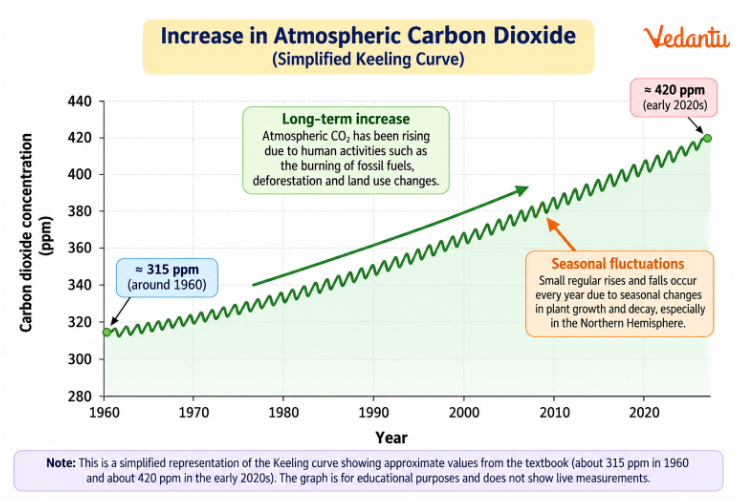
Answer:
The graph shows a long-term upward trend with seasonal variations.
1. Long-Term Increase
Atmospheric carbon dioxide has risen mainly because of human activities, including:
Burning fossil fuels.
Deforestation.
Certain industrial processes.
Land-use changes.
These activities release carbon dioxide or reduce its removal by vegetation.
2. Seasonal Fluctuations
The small repeated rises and falls reflect seasonal exchanges of carbon dioxide.
During the growing season in the Northern Hemisphere, plants absorb more carbon dioxide through photosynthesis.
At other times, reduced photosynthetic uptake and continuing respiration and decomposition contribute to seasonal increases.
3. Why the Trend Matters
A rising concentration of carbon dioxide increases the heat-trapping effect of the atmosphere.
This contributes to global warming and changes in climate patterns.
4. Effect on Oceans
Oceans absorb part of the excess atmospheric carbon dioxide.
This can change seawater chemistry and contribute to ocean acidification.
Conclusion: The long-term upward trend reflects an imbalance in carbon emissions and removal, while the smaller fluctuations show seasonal biological activity.
Q23. Explain the nitrogen cycle through five key processes. Include the role of microorganisms and why plants cannot directly use most atmospheric nitrogen.
Answer:
Nitrogen is required to make proteins, DNA and other important biological molecules.
Although nitrogen gas is abundant in the atmosphere, most plants cannot use it directly.
It must first be converted into suitable compounds.
1. Nitrogen Fixation
Certain microorganisms convert atmospheric nitrogen into ammonia or related compounds.
Examples include Rhizobium in legume root nodules and Azotobacter in soil.
2. Nitrification
Nitrifying microorganisms convert ammonia into nitrite and then nitrate.
Nitrosomonas is associated with the conversion of ammonia to nitrite.
Nitrobacter is associated with the conversion of nitrite to nitrate.
3. Assimilation
Plants absorb usable nitrogen compounds from the soil.
They use the nitrogen to form proteins and other molecules.
Animals obtain nitrogen by eating plants or other animals.
4. Ammonification
Decomposers break down nitrogen-containing organic matter from dead organisms and wastes.
This returns ammonia or ammonium compounds to the environment.
5. Denitrification
Certain microorganisms convert nitrates back into nitrogen gas.
This returns nitrogen to the atmosphere.
Additional Sources of Fixed Nitrogen
Lightning contributes to natural nitrogen fixation, while industrial processes such as the Haber–Bosch process produce ammonia for fertilisers.
Conclusion: Microorganisms are essential to nitrogen cycling because they convert nitrogen between forms usable by living organisms and forms returned to the environment.
Q24. A village pond receives fertiliser-rich runoff during the monsoon. Soon, green algae cover the water surface, and fish begin dying. Explain the complete scientific sequence and suggest practical solutions.
Answer:
The situation is an example of eutrophication.
Step 1: Entry of Excess Nutrients
Rainwater carries fertilisers containing nitrogen and phosphorus compounds from fields into the pond.
Step 2: Rapid Algal Growth
The additional nutrients promote excessive growth of algae.
This produces an algal bloom.
Step 3: Changes in Light Availability
A dense bloom may reduce the amount of sunlight reaching submerged plants.
Step 4: Decomposition
When algae die, microorganisms decompose their organic matter.
Step 5: Oxygen Consumption
Decomposition consumes dissolved oxygen in water.
Step 6: Harm to Aquatic Life
Low oxygen levels make it difficult for fish and other oxygen-dependent aquatic organisms to survive.
Some blooms can also produce harmful substances.
Solutions
Apply fertilisers according to crop needs and soil testing.
Avoid applying excess fertiliser immediately before heavy rainfall.
Maintain vegetated buffer strips near ponds and rivers.
Reduce untreated wastewater entering water bodies.
Monitor nutrient levels and water quality.
Conclusion
Eutrophication shows how agricultural activities can disturb nutrient cycles and harm aquatic ecosystems.
Important Concepts, Diagrams and Preparation Tips for Class 9 Science Chapter 13
Students practising Class 9 Chapter 13 Science important questions should focus on Earth's interacting spheres, solar radiation, atmospheric circulation, natural cycles and environmental change. Understanding how these systems influence one another is more useful than memorising each process separately.
Important Formula: Solar Energy = Intensity × Area × Time.
Preparation Tips: Practise Earth-system diagrams, wind-direction illustrations, nutrient-cycle flowcharts, environmental case studies and numerical questions involving solar radiation. Pay special attention to the Keeling curve, Himalayan breezes and the effects of fertiliser runoff.
The Class 9 Science Chapter 13 Important Questions PDF, once available, can support offline revision through solved questions, diagrams and explanations from Earth as a System: Energy, Matter, and Life for 2026–27.
Additional Study Materials for Class 9 Science Chapter 13 – Earth as a System: Energy, Matter, and Life
CBSE Class 9 Science Chapter-wise Important Questions
These chapter-wise resources help students revise concepts from the Exploration textbook for the 2026–27 academic session.
Other Important Related Links for CBSE Class 9 Science


FAQs on Important Questions and Answers for Class 9 Science Exploration Chapter 13 – Earth as a System: Energy, Matter, and Life| 2026–27
1. Why is Earth described as one interconnected system instead of five separate spheres?
The five spheres continuously exchange matter and energy. For example, water evaporates from oceans into the atmosphere, falls as rain, enters soil and supports living organisms. A change in one sphere can therefore affect several others. Studying these connections helps explain climate, ecosystems and environmental change.
2. How does Earth's tilt affect the amount of solar energy received in different regions?
Earth's tilted axis changes the angle and duration of sunlight received at different latitudes during the year. When sunlight strikes a surface more directly, its energy is concentrated over a smaller area. More slanted sunlight spreads similar energy over a larger area. Together with changes in daylight duration, this contributes to seasonal heating differences.
3. Why is the solar constant higher than the maximum sunlight intensity usually measured at ground level?
The solar constant represents solar radiation arriving at the top of Earth's atmosphere on a surface perpendicular to the Sun's rays. Before that radiation reaches the ground, atmospheric gases, dust and clouds absorb, scatter or reflect part of it. Consequently, the intensity reaching the surface is generally lower.
4. What was Anna Mani's contribution to understanding solar energy in India?
Anna Mani carried out pioneering work in atmospheric science and solar-radiation measurements. Her efforts helped improve information about the distribution of solar energy across India. Such measurements are useful for understanding the country's climate and evaluating the potential for solar-energy technologies.
5. Why does the ozone layer protect life while ground-level ozone can cause health problems?
Ozone has different effects depending on its location. In the stratosphere, it absorbs much of the Sun's harmful ultraviolet radiation. Near Earth's surface, ozone is an air pollutant that can irritate the respiratory system and harm vegetation. Therefore, protective stratospheric ozone and harmful ground-level ozone should not be confused.
6. Why can the southwest monsoon change when ocean temperatures change?
Ocean temperature affects evaporation, moisture availability and interactions between the ocean and atmosphere. These changes can influence atmospheric circulation and rainfall patterns. The monsoon is also affected by pressure systems, winds, land heating and other factors, so warmer ocean water does not always produce more rainfall everywhere.
7. How do ocean currents affect climate even in places far from the sea?
Ocean currents redistribute heat around the planet and influence the temperature and moisture of the air above them. These changes can affect atmospheric circulation and weather systems. Their influence may extend beyond coastal regions because the ocean and atmosphere constantly exchange energy.
8. What does the Keeling curve reveal about carbon dioxide in Earth's atmosphere?
The Keeling curve records changes in atmospheric carbon dioxide concentration over time. It shows a long-term increase together with regular seasonal fluctuations. The increasing trend reflects the influence of human carbon emissions, while seasonal variations are strongly influenced by the growth and decay cycles of vegetation, especially in the Northern Hemisphere.
9. Why are microorganisms essential to the nitrogen cycle?
Many plants cannot directly use nitrogen gas from the atmosphere. Microorganisms convert nitrogen between chemical forms that plants can absorb and forms that return to the atmosphere. Processes such as nitrogen fixation, nitrification, ammonification and denitrification therefore help maintain the availability of nitrogen in ecosystems.
10. How is the Haber–Bosch process connected to agriculture and the nitrogen cycle?
The Haber–Bosch process produces ammonia from nitrogen and hydrogen under industrial conditions. Ammonia is used to manufacture nitrogen fertilisers that support crop growth. However, excessive fertiliser use can disturb natural nitrogen cycling and contribute to water pollution, including eutrophication.
11. Why can melting glaciers increase flood risks and still create water shortages later?
Glacier melting may initially increase the amount of water entering rivers. However, if glaciers continue shrinking, the ice reserves that help supply water during warmer or drier periods also become smaller. Combined with changes in rainfall, this can increase short-term flood risks while threatening long-term water availability in some regions.
12. How does ocean acidification affect plankton and other marine organisms?
When seawater absorbs additional carbon dioxide, chemical reactions increase acidity and alter carbonate availability. This can make it harder for some shell-forming organisms to build and maintain shells. Changes in plankton communities may also affect marine food webs, because many aquatic organisms depend on plankton for food.
13. Where can students practise Class 9 Science Chapter 13 Important Questions with answers for 2026–27?
Students can practise the important questions of Chapter 13 Class 9 Science on this Vedantu page. The solved questions cover Earth's spheres, solar heating, winds, ocean currents, natural cycles and human environmental impacts. They also include numerical calculations, diagram-based explanations and real-life examples to support concept-based examination preparation.