Class 9 English Kaveri Chapter 5 Poem Important Questions with Answers PDF
This practice set contains 25 solved questions: five MCQs, five very short answers, eight short answers and seven long answers. The questions cover all eight stanzas, from the athletes' preparations to the emotional finish, along with vocabulary, imagery, suspense, contrast and the poem's message about compassion.
Class 9 English Kaveri Chapter 5 Poem Important Questions MCQ
Q1. Why had the nine athletes spent many weeks and months training?
(a) To prepare for a long-distance walking competition
(b) To compete for medals in the games
(c) To become coaches for younger athletes
(d) To perform at the opening ceremony
Answer: (b) To compete for medals in the games.
Explanation: The athletes had trained for a long time and arrived from different parts of the country hoping to win gold, silver or bronze medals. Their preparation highlights the importance of the competition before the unexpected event changes their priorities.
Q2. What was the distance of the race described in Nine Gold Medals?
(a) Fifty yards
(b) One hundred yards
(c) Two hundred metres
(d) Four hundred metres
Answer: (b) One hundred yards.
Explanation: The poem describes a hundred-yard dash. It is a short sprint in which speed is normally important, making the runners' later decision to slow down especially meaningful.
Q3. What happened to the smallest runner immediately after the race began?
(a) He reached the finishing line first.
(b) He stopped to adjust his shoes.
(c) He stumbled, lost his balance and fell.
(d) He left the field before the signal.
Answer: (c) He stumbled, lost his balance and fell.
Explanation: When the starting signal was given, the runners charged forward. However, the smallest athlete stumbled, staggered and fell onto the asphalt, interrupting his attempt to complete the race.
Q4. Which action best demonstrates the sportsmanship of the other eight athletes?
(a) They continued running to secure the medals.
(b) They asked the spectators to leave the field.
(c) They stopped, turned back and helped the fallen runner.
(d) They requested another race.
Answer: (c) They stopped, turned back and helped the fallen runner.
Explanation: Although the eight athletes had trained hard, they chose to support someone in difficulty. Their response shows empathy, cooperation and the belief that helping another person can matter more than winning individually.
Q5. Why is the ending of Nine Gold Medals different from that of an ordinary race?
(a) The race was cancelled because of bad weather.
(b) Only one runner received a medal.
(c) All nine athletes finished together and received gold medals.
(d) The spectators competed in place of the athletes.
Answer: (c) All nine athletes finished together and received gold medals.
Explanation: The runners joined hands and walked to the finish line. Their shared achievement changed the race from a competition for individual victory into a demonstration of compassion and unity.
Class 9 English Kaveri Chapter 5 Poem Very Short Answer Questions
Q6. Who wrote Nine Gold Medals?
Answer: Nine Gold Medals was written by David Roth. The poem presents a race in which kindness and cooperation become more important than finishing first.
Q7. Who are spectators in the poem?
Answer: Spectators are the people who gather around the field to watch and cheer for the athletes. At the end, they stand and applaud the runners' act of kindness.
Q8. What does the word 'poised' mean in the context of the starting line?
Answer: 'Poised' means ready and prepared to act. The nine athletes were waiting attentively for the starting signal.
Q9. What is meant by the expression 'pulled up on their heels'?
Answer: It means that the runners stopped suddenly. The eight athletes stopped racing when they realised that the smallest runner had fallen.
Q10. What is a standing ovation, and why did the athletes receive one?
Answer: A standing ovation is applause given by people while standing. The spectators stood and applauded because they were deeply moved when all nine athletes finished together after helping the fallen runner.
Class 9 English Kaveri Chapter 5 Poem Short Answer Questions
Q11. How does the poet create excitement before the hundred-yard dash begins?
Answer: The poet describes athletes arriving from different parts of the country after months of training. They are eager to compete for gold, silver and bronze medals.
Spectators gather around the field to cheer for the competitors. The final event of the day approaches; starting blocks are arranged, and nine determined runners wait for the gun. These details build anticipation and make the race seem like a serious competition.
Q12. Why does the poet describe the nine runners as determined athletes?
Answer: The runners have spent many weeks and months preparing for the event. They have travelled to participate in the games and hope to win medals.
Their determination becomes especially important later. When the smallest athlete falls, the other eight are willing to interrupt the race despite their preparation. This makes their decision to help him more meaningful because they are giving up a chance at individual victory.
Q13. Explain the difference between 'stumbled' and 'staggered' in the poem.
Answer: Both words describe difficulty in maintaining balance, but they refer to slightly different actions.
The two words together help readers imagine the sudden accident and understand why the runner falls to the ground.
Q14. What is the meaning of the smallest athlete's dreams and efforts being 'dashed in the dirt'?
Answer: The expression means that his hopes of succeeding in the race appear to have been destroyed.
The athlete has trained for a long time, but his fall makes him believe that his opportunity has disappeared. His cry reflects frustration, disappointment and emotional pain.
The expression is figurative. His dreams do not literally fall into the dirt; it is his hope of achieving his goal that seems shattered.
Q15. What makes the decision of the eight runners particularly surprising?
Answer: The eight runners have trained for months and are competing in an event where speed normally decides the winner. They could have continued running after the smallest athlete fell.
Instead, they stop, turn around and return to help him. Their action is surprising because they place another runner's well-being above their own chance of winning. The poem uses this unexpected decision to change the meaning of the race.
Q16. Why does the hundred-yard dash become a walk towards the end?
Answer: After helping the fallen runner stand, all nine athletes join hands and continue towards the finishing line together.
They cannot sprint normally while holding hands and moving as a group, so the dash becomes a walk. This change shows that completing the race together has become more important than speed or individual ranking.
Q17. What is the significance of the Special Olympics banner in the poem?
Answer: The banner identifies the event as part of the Special Olympics. The poet suggests that it is especially appropriate when the athletes choose to support one another.
Their actions reflect values such as inclusion, friendship, courage and respect. The banner therefore gains a deeper meaning: the event becomes memorable not merely because medals are awarded, but because the runners demonstrate genuine sportsmanship.
Q18. What do the nine smiling faces and the spectators' applause reveal about the ending?
Answer: The nine smiling faces show that the runners feel happy and proud of completing the race together. Their satisfaction comes from helping one another rather than defeating their competitors.
The standing ovation shows that the spectators recognise the importance of their actions. They celebrate kindness and cooperation, making the finish more meaningful than an ordinary sporting victory.
Class 9 English Kaveri Chapter 5 Poem Long Answer Questions
Q19. Describe the sequence of events in Nine Gold Medals, from the athletes' preparation to the finish of the race.
Answer: David Roth presents an exciting sporting event that takes an unexpected emotional turn.
1. Preparation for the Competition
Nine athletes travel from different parts of the country after spending weeks and months training. They hope to compete successfully and win medals.
2. The Atmosphere at the Field
Spectators gather around the old field, ready to cheer. The hundred-yard dash is the final event of the day, and excitement grows as the runners prepare.
3. The Start of the Race
The runners wait behind the starting line. When the pistol signals the beginning, they charge forward.
4. The Unexpected Accident
The smallest runner stumbles, staggers and falls onto the asphalt. He cries out because he believes his hopes and efforts have been wasted.
5. The Decision to Help
The other eight runners stop. One by one, they turn around, return to their fallen companion and help him stand.
6. The Walk to the Finish Line
Instead of restarting their individual race, all nine athletes join hands and walk together towards the finishing line.
7. The Final Celebration
The race ends with nine gold medals, nine smiling faces and a standing ovation from the spectators.
The poem shows that while the race begins as a competition for medals, it ends by celebrating compassion, friendship and shared achievement.
Q20. How does the poet develop the contrast between competition and compassion in Nine Gold Medals?
Answer: The poem begins by highlighting the importance of competition and gradually shifts towards the importance of human values.
1. The Desire to Win
The athletes have trained hard and hope to receive gold, silver or bronze medals. Their preparation shows that winning is initially an important goal.
2. Speed and Individual Performance
The hundred-yard dash is a sprint. Each athlete begins the race with the intention of reaching the finishing line as quickly as possible.
3. The Moment of Difficulty
When the smallest runner falls, he is unable to continue normally. His disappointment creates a situation in which the other athletes must decide whether to keep racing or help him.
4. Compassion Takes Priority
The eight athletes stop and return to their companion. Their choice shows that another person's difficulty matters more to them than individual success.
5. A Shared Finish
All nine runners complete the event hand in hand. Their speed no longer matters because the purpose of the race has changed.
6. A Different Meaning of Victory
The athletes receive gold medals, but the deeper reward is the respect and admiration they earn through their kindness.
The contrast teaches readers that competition and ambition are valuable, but compassion should not be forgotten in the pursuit of personal achievement.
Q21. Explain the meaning and importance of the eight stanzas of Nine Gold Medals.
Answer: Each stanza contributes to the progression of the event and helps develop the poem's central message.
Stanzas 1–3: Building Expectations
The opening stanzas present a normal competitive setting. The athletes have trained, spectators are excited, and the starting signal is approaching.
Stanzas 4–5: An Unexpected Problem
The smallest runner falls and experiences frustration. His accident creates emotional tension and prepares readers for a turning point.
Stanzas 6–7: A Change in Priorities
The other runners give up their individual pursuit of victory to help him. By joining hands, they transform the race into an act of cooperation.
Stanza 8: A Meaningful Finish
The medals, happy faces and standing ovation show that the runners' shared achievement is more important than finishing first.
The structure takes readers from anticipation to disappointment and finally to admiration.
Q22. Examine the poetic devices and storytelling techniques used in Nine Gold Medals.
Answer: David Roth uses vivid action, sound, contrast and an unexpected ending to communicate the poem's message.
Imagery
The description of the athletes waiting at the line, charging forward and finally joining hands helps readers picture the changing scene.
Sound
The starting pistol and the spectators' applause create two different moments. The first marks the beginning of competition, while the second celebrates kindness.
Contrast
One of the most important techniques is the change from a hundred-yard dash to a walk. Speed is replaced by cooperation.
Symbolism
The gold medals represent more than sporting success. They recognise the values demonstrated by all nine athletes.
Suspense and Resolution
The smallest runner's fall creates tension, but the unexpected response of the other runners produces a moving ending.
These techniques make the poem an engaging story while encouraging readers to reflect on the meaning of sportsmanship.
Q23. Why are the actions of the eight runners more important than the medals they receive?
Answer: The eight runners demonstrate a quality that cannot be measured by speed or a finishing position.
1. Their Training Required Sacrifice
The athletes have spent months preparing for the event. Stopping during a race means giving up the opportunity to compete normally for an individual medal.
2. They Recognise Another Athlete's Distress
When the smallest runner falls, the others understand that he needs help. They respond to his difficulty instead of ignoring it.
3. Their Decision Is Voluntary
The poem presents the runners as choosing to stop and return. Their kindness is meaningful because it comes from concern for their companion.
4. They Support Him Practically
The runners do not simply express sympathy. They go back, help him rise and ensure that he can complete the race with them.
5. They Create a Shared Achievement
The nine athletes cross the finishing line holding hands. Their unity becomes the most memorable part of the event.
6. They Inspire the Spectators
The crowd's standing ovation shows that people value the runners' kindness. Their actions leave a stronger impression than an ordinary result.
The medals recognise the outcome of the race, but the athletes' compassion is what makes the achievement meaningful.
Q24. Study the illustration of nine athletes holding hands near the finish line. How does this scene explain the central message of the poem?
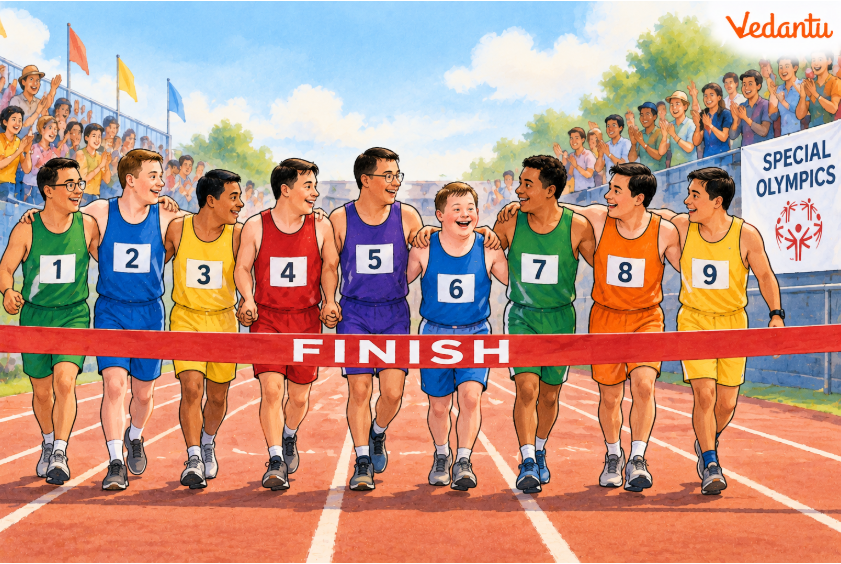
Answer: The illustration shows the poem's most important moment: all nine runners completing the race together.
1. Joined Hands
The runners holding hands represent friendship, unity and cooperation. They show that the athletes have chosen to support one another.
2. Shared Movement
The group moves towards the finish line together rather than competing separately. This reflects the change from a race based on speed to a shared achievement.
3. The Importance of the Fallen Runner
The smallest athlete is no longer left behind. The others have helped him recover and continue the race.
4. The Finish Line
In an ordinary race, the finish line is used to decide who comes first. In this poem, it represents the successful completion of a journey together.
5. Spectators' Response
The applauding spectators show public appreciation for an act of compassion and sportsmanship.
The illustration makes the poem's message clear: helping another person and achieving something together can be more meaningful than winning alone.
Q25. Why is the title Nine Gold Medals appropriate? Explain how the ending changes the meaning of winning.
Answer: The title is appropriate because all nine athletes receive gold medals at the end of the race. However, the medals have a deeper significance than they would in an ordinary competition.
1. Expectations Created by the Title
Readers may initially expect a sporting event in which different athletes compete for medals based on their performance.
2. An Unexpected Accident
The smallest runner falls shortly after the race begins. His disappointment makes the other athletes' response particularly important.
3. Compassion Changes the Event
The remaining eight runners stop, return and help their companion. Their decision makes cooperation more important than individual speed.
4. Nine Winners Instead of One
All nine finish together, holding hands. The race does not end by celebrating a single fastest runner.
5. A New Meaning of Gold
The gold medals symbolise kindness, solidarity and the ability to value others.
6. The Spectators' Appreciation
The standing ovation and smiling athletes show that the final result has emotional importance beyond the competition itself.
The title therefore reminds readers that true victory is not always about defeating others. Sometimes, the greatest achievement is ensuring that no one is left behind.
Important Topics and Preparation Tips for Class 9 English Kaveri Chapter 5 Poem
Vedantu's Nine Gold Medals important questions help students understand the poem's key events, important expressions, emotional turning point and deeper message about helping others.
How to Prepare Class 9 English Kaveri Chapter 5 Poem Important Questions?
Understand the eight stanzas: Revise the events in the correct sequence.
Learn important expressions: Focus on 'stumbled', 'staggered', 'anguish ', and 'dashed in the dirt'.
Practise poetic devices: Explain how imagery, contrast and suspense strengthen the poem.
Prepare interpretation-based answers: Understand why the eight athletes return and why the spectators applaud.
Solve MCQs and descriptive questions: Practise factual and analytical answers before checking the solutions.
Download Class 9 English Kaveri Chapter 5 Poem Important Questions PDF
The Class 9 English Kaveri Chapter 5 poem important questions PDF, once available, will help students revise Nine Gold Medals through solved MCQs, vocabulary, stanza meanings, poetic devices and detailed answers. Students can use these questions for independent practice and preparation for the 2026–27 English examinations.
Additional Study Material for Class 9 English (Kaveri) Chapter 5 Poem
Important Questions Class 9 English Kaveri (Poem)
Important Questions Class 9 English Kaveri (Prose)
Important Study Materials for Class 9 English
FAQs on Important Questions and Answers for Class 9 English Kaveri Chapter 5 Poem – Nine Gold Medals | 2026–27
1. What is the central message of Nine Gold Medals by David Roth?
The poem teaches that compassion, friendship and cooperation are more important than winning at someone else's expense. When one runner falls during a hundred-yard dash, the other eight stop and help him. All nine complete the race together, showing that true sportsmanship includes caring for others.
2. Why did the eight runners stop instead of continuing the race?
The runners noticed that the smallest athlete had fallen and was unable to continue normally. Rather than concentrating on their own medals, they returned to help him. Their decision shows empathy and respect for another participant.
3. What are the most important topics in Class 9 English Kaveri Chapter 5 poem important questions?
Important topics include the athletes' preparation, the hundred-yard dash, the smallest runner's fall, the reaction of the eight runners, the Special Olympics banner, the hand-in-hand finish and the nine gold medals. Students should also revise the eight stanzas, vocabulary, poetic devices and the poem's message about sportsmanship.
4. How should students prepare for Class 9 English Kaveri Chapter 5 poem important questions MCQ practice?
Students should revise the poet's name, the number of athletes, the race distance, the order of events and the meaning of important expressions. They should also practise questions about the runners' decisions and the spectators' response. Understanding the sequence of events will help students answer both factual and inference-based MCQs.
5. Why is the hundred-yard dash important to the story?
A hundred-yard dash is a short sprint in which speed normally determines the result. In the poem, the athletes abandon the usual focus on speed after one runner falls. The dash becomes a walk, showing that cooperation has taken priority over individual victory.
6. What does 'dashed in the dirt' mean in Nine Gold Medals?
The expression means that the smallest runner feels his dreams and efforts have been destroyed. After months of preparation, he falls and believes his chance of success has disappeared. The phrase communicates deep disappointment rather than describing his dreams literally.
7. What is the difference between stumbling and staggering?
Stumbling means tripping or losing one's footing, while staggering means moving unsteadily and struggling to maintain balance. In the poem, the smallest athlete stumbles, staggers and finally falls. The words create a clear picture of his accident.
8. Why is the Special Olympics banner meaningful in the poem?
The banner identifies the sporting event, but it becomes especially meaningful when the runners help their fallen companion. Their actions reflect friendship, inclusion and mutual respect, making the ending a powerful example of sportsmanship.
9. Why did all nine athletes receive gold medals?
The poem ends with all nine runners receiving gold medals after completing the race together. Their shared achievement celebrates the choice to help one another instead of competing solely for individual recognition.
10. What is the significance of the standing ovation in Nine Gold Medals?
The standing ovation shows that the spectators are deeply moved by the athletes' kindness. The applause celebrates an act of compassion rather than merely recognising the fastest runner. It reinforces the poem's message that human values deserve admiration.
11. Which poetic devices are important in Nine Gold Medals?
Students should prepare visual and auditory imagery, alliteration, metaphorical expressions, symbolism, contrast and suspense. For example, the runners' movement creates vivid imagery, while the change from sprinting to walking highlights the difference between competition and cooperation.
12. How does the mood change during the eight stanzas of the poem?
The mood begins with excitement as the athletes prepare for the race. It changes to distress when the smallest runner falls. The other runners' decision creates a feeling of hope, and the poem ends with happiness and admiration as all nine finish together.
13. What makes the title Nine Gold Medals meaningful?
The title refers to the nine medals awarded at the end of the race. It also suggests that all nine athletes deserve recognition because they demonstrate unity and compassion. The medals symbolise a shared victory rather than individual competition.
14. Where can students find Class 9 English Kaveri Chapter 5 poem important questions PDF for revision?
Students can practise solved MCQs, vocabulary questions, short answers and detailed explanations on this Vedantu page. The Class 9 English Kaveri Chapter 5 poem important questions PDF can support offline practice once the downloadable file becomes available.
15. How should students write detailed answers for Class 9 English Kaveri Chapter 5 poem important questions and answers?
Students should explain the relevant event first, describe the characters' actions and then connect the incident with the poem's message. For longer answers, they can refer to the athletes' training, the fall, the decision to help, the walk to the finish line and the spectators' applause. Using specific examples will make their answers clearer and more complete.