Class 8 Social Science Chapter 8 Important Questions and Answers on Cultural Currents: 13th to 17th Centuries
The Class 8 Social Science Chapter 8 Important Questions PDF download contains 15 solved questions from Cultural Currents: 13th to 17th Centuries. These questions cover religious traditions, music, painting, learning, scientific achievements and cultural exchanges.
Students can use the Class 8 Social Science Chapter 8 Important Questions and Answers PDF to revise the parts that require extra attention from an exam point of view.
Class 8 Social Science Chapter 8 Important MCQs with Answers
Q1. Which bhakti saint spoke of one God and criticised rituals followed in both Hinduism and Islam?
(a) Mirabai
(b) Kabir
(c) Purandaradasa
(d) Chaitanya Mahaprabhu
Answer: (b) Kabir
Q2. Which musician became one of the nine ratnas in Emperor Akbar's court?
(a) Amir Khusro
(b) Purandaradasa
(c) Tansen
(d) Namdev
Answer: (c) Tansen
Q3. What was the main feature of the Persian charbagh design adopted in Mughal gardens?
(a) Gardens divided into four parts with waterways
(b) Gardens built only around temples
(c) Gardens without fountains or water channels
(d) Gardens with no geometrical pattern
Answer: (a) Gardens divided into four parts with waterways
Q4. What was Dara Shikoh's contribution to the exchange of knowledge between Hindu and Muslim traditions?
(a) He established the Kerala School of Mathematics.
(b) He developed the dhrupad style of music.
(c) He wrote the Ganitakaumudi.
(d) He helped translate 52 Upanishads from Sanskrit into Persian.
Answer: (d) He helped translate 52 Upanishads from Sanskrit into Persian.
Q5. Which statement correctly describes Nilakantha Somayaji's planetary model developed in 1500?
(a) He proposed that every planet moved directly around the Earth.
(b) He proposed that Mercury and Venus moved around the Sun in orbits that did not enclose the Earth.
(c) He rejected the study of planetary movements.
(d) He developed the same planetary model as Copernicus in 1543.
Answer: (b) He proposed that Mercury and Venus moved around the Sun in orbits that did not enclose the Earth.
Class 8 Social Science Chapter 8 Very Short Answer Questions
Q6. What is Sufism?
Answer: Sufism is a path of Islam that focuses on devotion and an inner, personal search for God. Sufi saints expressed their devotion through music, meditation and spiritual practices.
Q7. Name two women who played important political roles during the Delhi Sultanate and Mughal periods.
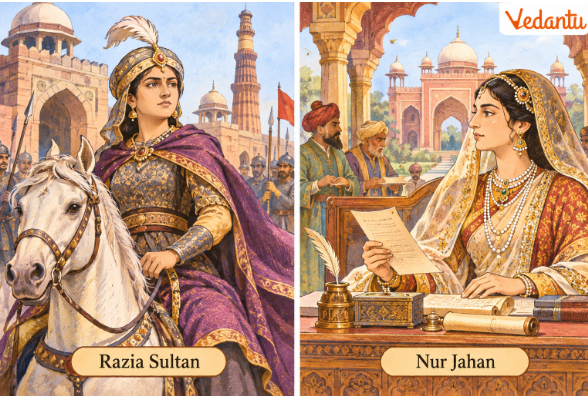
Answer: Razia Sultan was the first and only female ruler of the Delhi Sultanate. Nur Jahan, the wife of Emperor Jahangir, played an active role in Mughal governance and issued royal orders.
Q8. How did Urdu develop during this period?
Answer: Urdu developed from Hindi or Hindavi spoken in the Ganga-Yamuna plains. It adopted words from Arabic and Persian. In the Deccan, it developed into a regional form called Dakhini.
Q9. How did the introduction of zari and brocade influence Banarasi silk saris?
Answer: Zari (zardozi) and brocade became part of the distinctive style of Banarasi silk saris. They included rich patterns, often using gold or silver threads, along with floral and geometrical designs.
Class 8 Social Science Chapter 8 Short Answer Questions
Q10. How did education continue in India despite political instability and invasions between the 13th and 17th centuries?
Answer: Education continued through several local institutions despite political instability.
Gurukulas, mathas, temple schools, Buddhist viharas and Jain pallis continued to provide education.
Students studied subjects such as grammar, astronomy, law, medicine and sacred texts.
Village pathashalas provided learning opportunities, while madrasas taught Arabic, Persian, Hindavi and Islamic studies.
Skills related to arts, crafts and trades were passed down through apprenticeships within families and guilds.
These smaller, local systems helped preserve learning traditions even when larger educational centres were destroyed.
Q11. How did Indian music and miniature painting change under different cultural influences during this period?
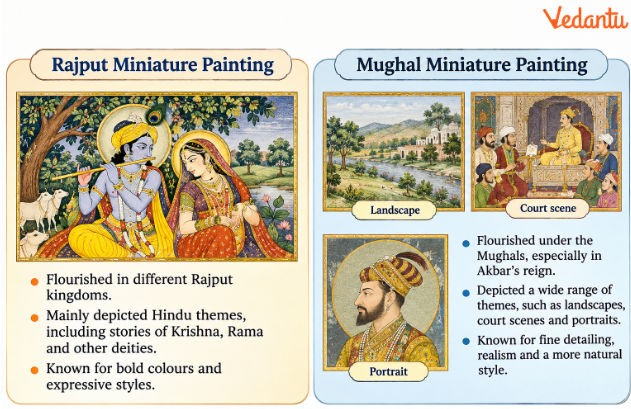
Answer: Indian music and miniature painting developed new styles while continuing older traditions.
Indian classical music developed in two related streams: Hindustani music in the North and Carnatic music in the South.
Sufi devotional songs called qawwalis combined Indian, Persian and Arabic singing traditions.
Rajput miniature paintings continued to depict Hindu themes, while Mughal miniature paintings included landscapes, court scenes and portraits.
Rajput and Mughal painters exchanged techniques, colours and artistic styles. Some Mughal painters moved to Bikaner, where the two painting styles influenced each other.
Q12. How did temple construction and reconstruction show the strength of Indian cultural traditions during this period?
Answer: Temple construction continued despite wars and political instability.
Kings, queens and other patrons supported the construction of temples and important buildings.
Under Krishnadevaraya, the Vijayanagara Empire witnessed major developments in temple architecture.
Hampi became an important centre of temple building, where skilled artisans used their knowledge of art and engineering.
Temples damaged during invasions were also rebuilt. The Sri Ranganathaswamy Temple at Srirangam was restored after being damaged in the early 14th century.
These efforts helped preserve religious practices, artistic skills and architectural traditions.
Class 8 Social Science Chapter 8 Long Answer Questions
Q13. Explain the role of the Bhakti and Sufi traditions in bringing people together between the 13th and 17th centuries.
Answer: The Bhakti and Sufi traditions played an important role in bringing people together during a period of political and religious changes. Both traditions emphasised devotion, love, and spiritual understanding.
Bhakti tradition
The bhakti marga was the path of devotion to God and one path to moksha.
It did not require rituals or priests.
Bhakti saints composed poems and songs in local languages.
People from different sections of society participated in devotional gatherings.
Teachings of bhakti saints
Kabir spoke of one God and criticised rituals followed in Hinduism and Islam.
Ravidas promoted equality and opposed rigid divisions based on varna and jati.
Guru Nanak travelled across regions and spread the message of one God and equality among all people.
Saints such as Mirabai, Chaitanya Mahaprabhu, Tukaram and Purandaradasa spread devotion through poetry and music.
Sufi tradition
Sufism encouraged devotion and a personal search for God.
Sufi saints such as Khwaja Moinuddin Chishti and Nizamuddin Auliya used music to express their love for God.
Qawwalis combined local musical styles with Sufi devotional traditions.
Some Sufis also adopted yogic and Vedantic practices, including inner silence and meditation.
Cultural unity
The Bhakti and Sufi traditions shared ideas of devotion, love and spiritual understanding. Their teachings encouraged people from different communities to come together.
These traditions helped preserve cultural continuity and promoted unity during times of political and religious change.
Q14. Describe the important developments in science, mathematics and medicine in India between the 13th and 17th centuries.
Answer: Indian scholars continued to make important contributions to science, mathematics and medicine during this period. Regional courts and educational institutions supported many of these developments.
Developments in mathematics
In the 14th century, Narayana Pandita wrote Ganitakaumudi, an important mathematical text.
Madhava made important contributions to the study of calculus.
He developed infinite series for trigonometric functions and represented the value of π through an infinite series.
Madhava and his followers formed what is now known as the Kerala School of Astronomy and Mathematics.
Developments in astronomy
Nilakantha Somayaji was an important scholar of the Kerala School.
In 1500, he developed a planetary model in which Mercury and Venus moved around the Sun in orbits that did not enclose the Earth.
He developed his model several decades before Copernicus published his heliocentric model in 1543.
Developments in chemistry
Indian craftsmen developed a special distillation process for producing pure zinc.
Saltpetre was used to make gunpowder and to cool water and beverages.
Applied chemistry was used in cooling techniques and perfume-making.
A rose-based perfume called Itr Jahangir was also developed.
Developments in medicine
Ayurveda, Siddha and Unani were widely practised.
Ayurveda remained an important system of medicine in India.
Siddha medicine was preferred in Tamil Nadu.
Unani medicine, introduced from West Asia, was followed in parts of northern India.
Medical knowledge was passed down through written texts and oral traditions.
These developments show that scientific learning continued in India despite political disturbances.
Q15. How did cultural exchanges influence food and clothing in India between the 13th and 17th centuries? Explain with examples.
Answer: Between the 13th and 17th centuries, Indian food and clothing were influenced by interactions with people from Persia, Central Asia and other regions. Indians adopted some new practices and changed others to suit local tastes and traditions.
Changes in food
Spices such as cardamom, clove, turmeric, coriander and black pepper were used in royal kitchens as well as in ordinary households.
The use of curd for marination and ghee became popular.
Khichri, a traditional dish made from rice and lentils, developed new flavours.
Naan cooked in a clay oven became part of North Indian cuisine through Persian influence.
Adaptation of foreign dishes
The Indian samosa developed from the Persian dish called sambuseh.
The original sambuseh contained ingredients such as meat, pistachios, almonds and walnuts. The Indian version commonly uses potatoes and peas.
Jalebi developed from the Persian zalabiyeh.
Indian jalebi has circular coils and uses sugar syrup, while the Persian version has a different coil pattern and uses honey and rose water syrup.
Changes in clothing
Cotton, muslin and silk production increased during this period.
The jama, a tunic-like garment, and pyjama became part of clothing worn in royal courts.
Fine muslin dupattas were also used.
The angrakha, a robe-like upper garment, is believed to have developed from Persian court fashion and was adapted to Indian fabrics and styles.
Continuation of Indian traditions
Traditional Indian clothing, especially the sari, continued to be worn in different regions.
Local weaving styles and fabrics remained important.
People combined older Indian traditions with new designs and materials.
Thus, cultural exchanges brought changes in food and clothing while older Indian traditions continued.
Class 8 Social Science Chapter 8 Important Questions: Key Topics on Cultural Currents: 13th to 17th Centuries
After practising the questions, check that you’ve covered these key topics. The Class 8 Social Science Chapter 8 important questions and answers explore religion, music, art, literature, science and daily life from the 13th to 17th centuries.
Focus on these topics:
Prepare Better Answers with Vedantu's Class 8 Social Science Chapter 8 Important Questions
Vedantu’s Class 8 Social Science Chapter 8 important questions and answers help students check their understanding and write complete, well-structured answers.
Remember key figures easily: Each answer links people to their contributions, such as Tansen with music, Dara Shikoh with translations and Madhava with mathematics.
Write answers backed by examples: Solved answers show how to use the chapter’s paintings, texts, monuments and traditions to support explanations.
Handle comparison questions with confidence: Answers explain each tradition separately before pointing out similarities and differences.
Write complete long answers: Point-wise answers cover every part of the question, so no important points are missed.
Recall scientific developments quickly: Each scholar is clearly matched with their work or idea from the textbook.
Students can attempt the questions independently and use the Class 8 Social Science Chapter 8 important questions and answers PDF to check missing points.
Class 8 Social Science Chapter 8 Part 2 Cultural Currents Important Study Materials
Students can use these study materials alongside the Class 8 Social Science Chapter 8 important questions and answers to understand cultural developments and practise textbook questions.
Class 8 Social Science Chapter-Wise Important Questions
Students can practise questions from other chapters of Exploring Society: India and Beyond. The current chapter is excluded from the list.
Important Study Materials for CBSE Class 8 Social Science
Use these resources to study other Class 8 Social Science topics.
FAQs on Important Questions and Answers 2026–27 for Class 8 Social Science Part 2 (Exploring Society: India and Beyond – Part 2) Chapter 8 Cultural Currents: 13th to 17th Centuries
1. How did Raja Mansingh Tomar contribute to the development of dhrupad music?
Raja Mansingh Tomar of Gwalior was a ruler and an accomplished musician. During the late 15th century, he supported the development of dhrupad, an old form of Indian classical music. His patronage helped this musical tradition reach new heights.
2. What occupations did women perform in the Vijayanagara Empire?
The Portuguese traveller Fernão Nunes described women working in different occupations in the Vijayanagara Empire. Some women were wrestlers, astrologers and musicians. Others maintained financial accounts and recorded matters related to the kingdom's administration.
3. Who translated Bhaskaracharya's Lilavati into Persian during the Mughal period?
Faizi, also known as Abu al-Faiz ibn Mubarak, translated Bhaskaracharya's Lilavati into Persian. The textbook mentions that three Persian translations of this mathematical work were made. Such translations helped scholars share knowledge across languages.
4. How did musical instruments like the sitar and tabla develop during this period?
Musicians and instrument makers experimented with different designs and playing techniques. The modern forms of the sitar and tabla evolved during these centuries. Their exact origins remain debated, but they drew upon older Indian musical traditions, including the pakhawaj.
5. What was Dhamali, and how was it connected with Chaitanya Mahaprabhu?
Dhamali was a style of Bengali folk song that developed during the 16th century. Chaitanya Mahaprabhu influenced this tradition through his devotion to Krishna. These songs described Krishna's life and became part of cultural performances, including kathak.
6. How can Vedantu help students prepare for Class 8 Social Science Chapter 8 important questions and answers?
Vedantu provides Class 8 Social Science Chapter 8 important questions and answers covering Bhakti and Sufi traditions, music, literature, science and cultural exchanges. Students can practise solved MCQs, very short answers, short answers, and long answers. They can also use Vedantu's chapter-wise PDF, NCERT Solutions and study notes to prepare for school examinations.