Class 8 Social Science Chapter 7 Important Questions and Answers on India's Urban Landscape
Before you revise the whole chapter again, try the Social Science Class 8 Chapter 7 question answer PDF. Answering these questions shows you where you’re confident and where you need a little more attention.
Class 8 Social Science Chapter 7 Important Questions – MCQs
Q1. What is population density?
(a) The total number of houses in a city
(b) The number of people living per unit of area
(c) The number of people moving to cities every year
(d) The total land area of a region
Answer: (b) The number of people living per unit of area
Q2. Which Indian city is famous for brass work?
(a) Tirupur
(b) Kanchipuram
(c) Moradabad
(d) Channapatna
Answer: (c) Moradabad
Q3. In which year was Kolkata's Durga Puja inscribed on UNESCO's list of Intangible Cultural Heritage of Humanity?
(a) 2018
(b) 2019
(c) 2020
(d) 2021
Answer: (d) 2021
Q4. Which of the following is a major reason for the growth of urban slums?
(a) Increase in the number of public parks
(b) Lack of affordable housing for people moving to cities
(c) Development of modern transport systems
(d) Expansion of educational institutions
Answer: (b) Lack of affordable housing for people moving to cities
Q5. A crowded city wants to reduce traffic congestion and improve public transport. Which of the following measures would be most suitable?
(a) Building more roads only for private vehicles
(b) Increasing the distance between residential areas and workplaces
(c) Connecting rail, bus services, cycling paths and walking routes
(d) Reducing the number of public transport services
Answer: (c) Connecting rail, bus services, cycling paths and walking routes.
Class 8 Social Science Chapter 7 Very Short Answer Questions
Q6. What is urbanisation?
Answer: Urbanisation is the shift of population from rural to urban areas, along with a decrease in the proportion of people living in rural areas.
Q7. How is population density calculated?
Answer: Population density is calculated by dividing a region's total population by its area in square kilometres.
Population density = Total population ÷ Area (in sq. km)
Q8. Why did Bengaluru develop into a major IT hub?
Answer: Bengaluru developed into a major IT hub because of the concentration of software companies, start-ups, and higher education institutions. The close link between industries and educational institutions also encouraged innovation.
Q9. Why does Bengaluru face water shortages even though it once had many lakes?
Answer: Rapid urbanisation, overuse of groundwater, lack of rainwater harvesting and encroachment of lake beds have caused water shortages. Many lakes have also become polluted by sewage and chemicals.
Class 8 Social Science Chapter 7 Short Answer Questions
Q10. How do geographical location and natural resources help cities become centres of economic activities?
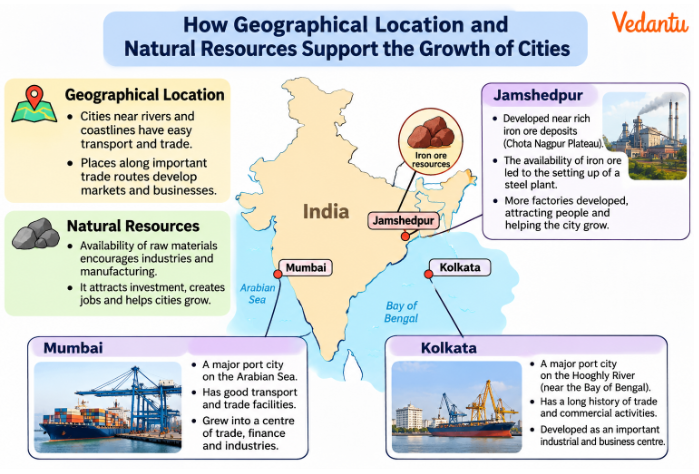
Answer: Geographical location and natural resources play an important role in the growth of cities.
Cities near rivers and coastlines benefit from easier transportation and trade.
Places along important trade routes develop markets and businesses.
Availability of raw materials encourages industries and manufacturing.
For example, Mumbai and Kolkata developed as important port cities, while Jamshedpur grew near rich iron ore deposits.
Q11. How do cities become centres of cultural activities? Explain with examples.
Answer: Cities attract people from different regions, bringing together their languages, food, festivals and traditions.
Cities have cultural centres, museums, libraries and sports stadiums where people meet and share ideas.
Kolkata is known for its Durga Puja celebrations, the Indian Museum and Victoria Memorial.
Varanasi and Amritsar attract pilgrims and visitors, supporting local traditions and businesses.
Cultural events and public spaces help people from different communities interact.
Q12. What major problems do people living in urban slums face?
Answer: Urban slums are overcrowded settlements where people often face several difficulties.
Houses are often poorly built, and living spaces are overcrowded.
People have limited access to clean water and sanitation facilities.
Healthcare and education facilities may be inadequate.
Poor waste management and unhygienic conditions affect the health of residents.
Many slum dwellers work as vegetable vendors, domestic workers, construction workers and plumbers. Improving their housing and basic facilities is an important urban challenge.
Q13. How are local communities helping to restore lakes in Bengaluru?
Answer: Non-profit organisations, Resident Welfare Associations (RWAs) and local communities are working together to restore Bengaluru's lakes.
They are taking several steps:
Removing silt from lakes to improve their condition.
Repairing bunds using natural materials.
Clearing drainage channels to improve water flow.
Planting native species and restocking fish to restore the lake environment.
These efforts help improve water availability and maintain ecological balance. The revival of Yelahanka Lake is one example discussed in the chapter.
Class 8 Social Science Chapter 7 Long Answer Questions
Q14. Explain how cities develop into centres of economic activities. Give examples from India.
Answer: Cities develop into centres of economic activities because of their geographical location, natural resources, industries, trade and transport facilities. These factors attract people, businesses and investments.
Availability of natural resources
Jamshedpur developed from the village of Sakchi in the Chota Nagpur Plateau. Its location near rich iron ore deposits made it suitable for establishing a steel plant. More factories developed in the region, attracting workers from different places.
Trade and transportation
Cities located near rivers, coastlines and important trade routes became major centres of trade. Mumbai and Kolkata developed as port cities because of their favourable locations.
Growth of industries and businesses
Mumbai became an important centre of trade and finance. The establishment of the Bombay Stock Exchange in 1875 contributed to its growth as a financial centre. The film industry also created new employment opportunities.
Technology and education
Bengaluru became an IT hub because of software companies, start-ups and higher education institutions. These institutions encourage innovation and provide employment to skilled workers.
Tourism and cultural importance
Cities such as Agra, Varanasi and Amritsar attract tourists and pilgrims. This creates employment in transportation, hotels, food vending, handicrafts and other services.
Thus, cities become important economic centres by bringing together people, resources, industries and services.
Q15. What are the major challenges faced by Indian cities? Suggest measures to address them.
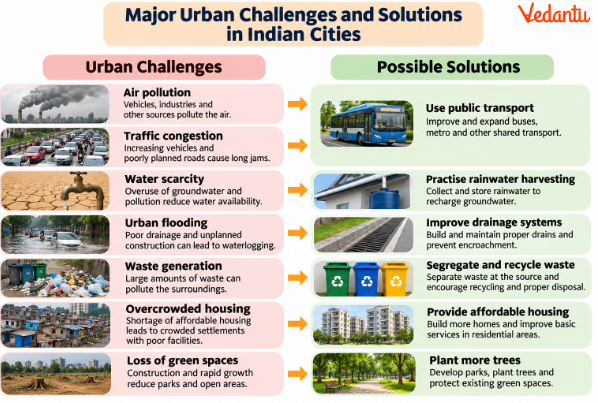
Answer: Rapid urbanisation increases the demand for housing, water, transport and other public facilities. When cities grow without proper planning, they face several problems.
Major challenges faced by cities:
Air pollution: A growing number of vehicles and other pollution sources reduce air quality and cause health problems.
Traffic congestion: Increasing traffic and poorly maintained roads make daily travel difficult.
Water scarcity: Overuse of groundwater, pollution and lack of rainwater harvesting reduce water availability.
Growth of slums: The shortage of affordable housing leads to overcrowded settlements with poor living conditions.
Waste management: Increasing population produces large amounts of waste, which can pollute the surroundings.
Loss of green spaces: Construction and unplanned development reduce parks and open spaces, contributing to higher temperatures.
Urban flooding: Poor drainage and unplanned construction can increase flooding during the monsoon season.
Measures to address these challenges:
Improve public transport and encourage walking, cycling and carpooling.
Promote rainwater harvesting and protect lakes and other water bodies.
Provide affordable housing and improve basic services in slum areas.
Encourage waste segregation, recycling and proper disposal.
Develop parks, plant trees and protect existing green spaces.
Improve drainage systems and plan new settlements carefully.
Proper urban planning and public participation can help make cities healthier, safer and more comfortable places to live.
Q16. Compare the urban planning of Jaipur and Singapore. How do these cities show the importance of good planning?
Answer: Jaipur and Singapore show how proper urban planning can improve people's lives. Both cities were designed with their residents' needs in mind.
Urban planning of Jaipur
Vidyadhar Bhattacharya planned Jaipur in 1727 under Maharaja Sawai Jai Singh II.
The city was designed using a grid pattern and divided into rectangular blocks called chowkris.
It had wide streets, open spaces, gardens and nine public squares.
A wall with seven gates surrounded the city for security.
Buildings along major streets were made using pink sandstone, giving Jaipur the name 'Pink City'.
Reservoirs and canals helped provide water in the region's dry climate.
Urban planning of Singapore
Singapore follows long-term planning to meet the changing needs of its population.
Its Concept Plan looks ahead up to 40 years, while the Master Plan is updated every five years.
The city has an interconnected transport network of trains, buses, cycling paths and walking routes.
Homes, offices, parks and public facilities are developed close to one another.
High-rise buildings with rooftop and vertical gardens help save space and reduce heat.
Healthcare, childcare and other facilities are planned to meet the needs of different age groups.
Importance of good urban planning
Both Jaipur and Singapore show that good planning helps cities use land and resources carefully. It improves transport, water supply, public safety and access to essential services.
Well-planned cities also protect green spaces, support economic activities and provide a better quality of life for their residents.
Vedantu’s Class 8 Social Science Part 2 Chapter 7 Questions for Exam Prep
Vedantu's Class 8 Social Science Chapter 7 important questions and answers cover the main topics of India's Urban Landscape through four types of questions.
Students can practise MCQs on population density and city development, short answers on economic and cultural activities, and long answers on urban challenges and planning.
Important Study Materials for Class 8 Social Science Part 2 Chapter 7 India's Urban Landscape
Students can use these resources alongside the Class 8 Social Science Chapter 7 important questions and answers to understand the textbook and practise additional questions.
Class 8 Social Science Chapter-Wise Important Questions and Answers
Students can practise important questions from other chapters of Exploring Society: India and Beyond. The current chapter is excluded to avoid self-linking.
Additional Study Materials for Class 8 Social Science
FAQs on Important Questions and Answers for Class 8 Social Science (Exploring Society: India and Beyond – Part 2) Chapter 7 India's Urban Landscape | 2026–27
1. What is Business Process Outsourcing (BPO), and how does it support urban development?
Business Process Outsourcing (BPO) means hiring another company to handle specific business activities or services. It helps businesses reduce costs and access skilled workers. The textbook explains how Gurugram developed into a major IT and BPO hub, attracting companies and creating employment opportunities.
2. What is the minimum population required for an area to be considered urban in India?
The textbook states that India uses a population threshold of 5,000 to identify urban areas. However, population alone does not determine whether a place is urban. Other factors, such as population density and the types of occupations, also help distinguish urban settlements from rural areas.
3. How does the Pradhan Mantri Awaas Yojana help people living in cities?
The Pradhan Mantri Awaas Yojana aims to provide affordable housing to economically weaker households. It helps address housing shortages faced by people living in urban areas. Such housing programmes can improve living conditions and access to basic facilities.
4. How can Information and Communication Technology (ICT) improve urban life?
Information and Communication Technology (ICT) helps cities manage services more efficiently. Intelligent traffic systems can improve road movement, while online complaint platforms help residents report civic problems. The textbook also mentions digital surveillance and solar-powered public spaces as examples of modern urban development.
5. What are blue zones, and why are they discussed in urban planning?
Blue zones are places where people tend to live longer and healthier lives. They often have low rates of serious long-term diseases. The textbook mentions Okinawa in Japan as an example. Green spaces, walking facilities and opportunities for social interaction can support healthier urban living.
6. Where can students find Class 8 Social Science Chapter 7 important questions and answers PDF for exam preparation?
Students can access Vedantu's Class 8 Social Science Chapter 7 important questions and answers PDF for India's Urban Landscape. It includes solved MCQs, very short answers, short answers and long answers. Students can also use Vedantu's NCERT Solutions and chapter notes to prepare for school examinations.