Class 4 Maths Chapter 4 Thousands Around Us Important Questions and Answers
The following Class 4 Maths Chapter 4 question answers cover important textbook concepts, including place value, regrouping, number sequences, comparing numbers and solving real-life problems.
Multiple Choice Questions (MCQs) for Class 4 Maths Chapter 4 Thousands Around Us
Q1. How many hundreds make one thousand?
A) 5 hundreds
B) 10 hundreds
C) 50 hundreds
D) 100 hundreds
Answer: B) 10 hundreds
Explanation: 10 × 100 = 1000. Therefore, ten hundreds make one thousand.
Q2. Which number comes immediately after 999?
A) 990
B) 998
C) 1000
D) 1001
Answer: C) 1000
Explanation: Adding 1 to 999 gives 1000, the smallest four-digit number.
Q3. Which is the correct expanded form of 4085?
A) 4000 + 800 + 5
B) 4000 + 80 + 5
C) 400 + 80 + 5
D) 4000 + 800 + 50
Answer: B) 4000 + 80 + 5
Explanation: The number has 4 thousands, 0 hundreds, 8 tens and 5 ones.
Q4. Which number lies between 2226 and 3226?
A) 3316
B) 3236
C) 3126
D) 2216
Answer: C) 3126
Explanation: 3126 is greater than 2226 and smaller than 3226.
Q5. Which number is the greatest?
A) 7087
B) 7807
C) 7078
D) 7780
Answer: B) 7807
Explanation: All four numbers have 7 in the thousands place. Comparing their hundreds digits, 8 is the greatest.
Q6. A number contains 12 hundreds, 18 tens and 2 ones. What is the number?
A) 1282
B) 1382
C) 12082
D) 1822
Answer: B) 1382
Explanation: 12 hundreds = 1200, 18 tens = 180 and 2 ones = 2. Their sum is 1382.
Q7. Which sign correctly compares 3012 and 3102?
A) 3012 > 3102
B) 3012 = 3102
C) 3012 < 3102
D) Both numbers are equal in value.
Answer: C) 3012 < 3102
Explanation: Both have 3 thousands. However, 3102 has 1 hundred, while 3012 has 0 hundreds.
Very Short Answer Questions for Class 4 Maths Chapter 4
Q8. Write the smallest and greatest four-digit numbers.
Answer:
Smallest four-digit number: 1000
Greatest four-digit number: 9999
Q9. Write 7000 + 200 + 40 + 6 in standard form.
Answer: 7246
Q10. What is the place value of 6 in 5638?
Answer: 600, because 6 is in the hundreds place.
Q11. Complete the number sequence: 2008, 2009, ____, ____, 2012.
Answer: 2010, 2011
Q12. How much more must be added to 850 to make 1000?
Answer: 150
850 + 150 = 1000.
Q13. Write the number represented by 3 thousands, 0 hundreds, 2 tens and 4 ones.
Answer: 3024
The zero in the hundreds place must be included.
Q14. How many whole numbers lie strictly between 7000 and 8000?
Answer: 999 numbers.
They start at 7001 and end at 7999.
Short Answer Questions for Class 4 Maths Chapter 4 Thousands Around Us
Q15. Use the place value table to write 5073 in expanded form and words.
Answer:
Expanded form: 5000 + 70 + 3
Number name: Five thousand seventy-three.
Q16. A community lunch serves 145 people in the first time slot, 325 in the second and 508 in the third. Which time slot has the most and least people?
Answer:
508 > 325 > 145
Most people: Third time slot, 508 people.
Least people: First time slot, 145 people.
Q17. Regroup 11 tens and 14 ones into hundreds, tens and ones.
Answer:
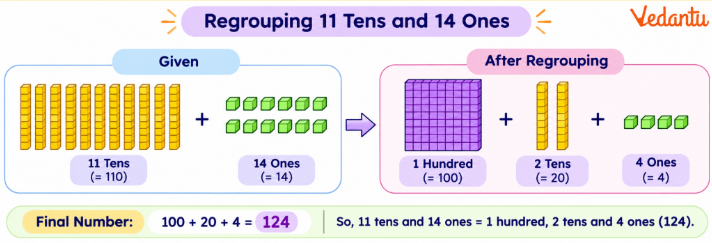
11 tens = 110
14 ones = 14
110 + 14 = 124
Therefore, the number has 1 hundred, 2 tens and 4 ones.
Q18. Arrange these prices in increasing order: ₹1986, ₹1099 and ₹1899.
Answer:
₹1099 < ₹1899 < ₹1986
Increasing order means arranging numbers from the smallest to the greatest.
Q19. What happens when 10 is added to 2785 and 20 is added to 6487?
Answer:
2785 + 10 = 2795
6487 + 20 = 6507
Adding tens can also change the hundreds digit when the total crosses a hundred.
Q20. Compare 2 thousands + 9 hundreds + 9 tens + 9 ones with 3000.
Answer:
2 thousands + 9 hundreds + 9 tens + 9 ones
= 2000 + 900 + 90 + 9
= 2999
Therefore, 2999 < 3000.
Q21. A student writes 5 thousands, 6 hundreds, 0 tens and 3 ones as 563. Is this correct? Explain.
Answer:
No. The correct number is 5603.
The digits must be placed in the thousands, hundreds, tens and ones columns. The zero shows that there are no tens.
Long Answer and Application-Based Questions for Class 4 Maths Chapter 4
Q22. Explain how Dienes blocks show the number 1000.
Answer:
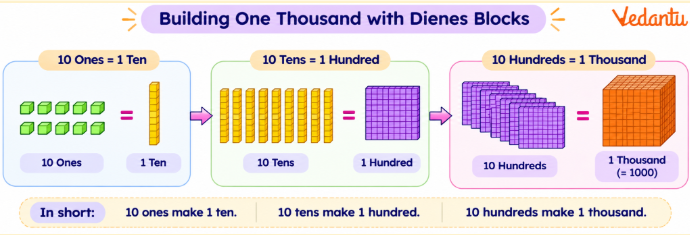
Dienes blocks help us understand how numbers are grouped.
10 ones make 1 ten.
10 tens make 1 hundred.
10 hundreds make 1 thousand.
Therefore, one thousand can be represented using 10 hundred blocks or one thousand block.
This grouping follows the base-10 number system.
Q23. Complete the following table by regrouping the given values.
Answer:
The important step is to regroup extra ones and tens into the next place value.
Q24. Arrange the following mountain heights in decreasing order.
Answer:
8611 > 8586 > 7816 > 7138 > 1930
The decreasing order is:
K2 – 8611 m
Kangchenjunga – 8586 m
Nanda Devi – 7816 m
Chaukhamba I – 7138 m
Mullayanagiri – 1930 m
Decreasing order means arranging values from the greatest to the smallest.
Q25. A student marks 1000, 1025, 1050, 1075 and 1100 on a number line. What is the difference between two neighbouring marks? Where will 1060 lie?
Answer:
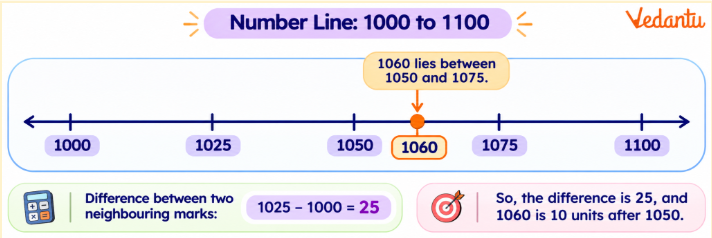
The difference between neighbouring marks is:
1025 − 1000 = 25
1060 lies between 1050 and 1075. It is 10 units after 1050.
Q26. Using the digits 2, 3, 4 and 7 only once, make the greatest and smallest possible four-digit numbers. Explain your answer.
Answer:
To make the greatest number, arrange the digits in descending order:
7, 4, 3, 2 = 7432
To make the smallest number, arrange them in ascending order:
2, 3, 4, 7 = 2347
The thousands digit has the greatest effect on the value of a four-digit number.
Q27. A number has 4 in the thousands place, 0 in the hundreds place and 8 in the tens place. The ones digit is 5. Write the number, its expanded form and number name.
Answer:
Number: 4085
Expanded form: 4000 + 80 + 5
Number name: Four thousand eighty-five.
The hundreds digit is zero, but it must remain in the number to preserve the correct place values.
Important Topics in Class 4 Maths Chapter 4 Thousands Around Us
How to Prepare for Class 4 Maths Chapter 4 Important Questions
Practise place value, regrouping and number formation.
Solve number-line, comparison and missing-digit problems.
Use real-life examples and the chapter PDF for practice.
Practise Class 4 Maths Chapter 4 with Vedantu
Vedantu's Class 4 Maths Chapter 4 important questions with answers include MCQs, number puzzles and word problems. Students can use the PDF to practise and check their answers.
Chapter 4 Thousands Around Us Study Materials
Students can use these chapter-specific resources to practise textbook activities and solve additional questions.
Class 4 Maths Chapter-wise Important Questions for 2026–27
Students can explore important questions from other Maths Mela chapters to practise different mathematical concepts.
Additional Study Materials for Class 4 Maths
Along with Class 4 Maths Chapter 4 important questions and answers, students can use the following learning resources to strengthen their understanding and practise different mathematical skills.
FAQs on Important Questions and Answers for Class 4 Maths Chapter 4 Thousands Around Us | 2026–27
1. How can I solve Class 4 Maths Chapter 4 Thousands Around Us question answers involving regrouping?
First, find the total value of the given hundreds, tens and ones. For example, 12 hundreds and 15 tens make 1200 + 150 = 1350. You can then write the answer using 1 thousand, 3 hundreds, 5 tens and 0 ones.
2. How do I represent 1000 using Dienes blocks?
You can represent 1000 using ten hundred blocks. Each hundred block contains 100 units, so 10 × 100 = 1000. A single thousand block represents the same value.
3. Why is 4085 different from 485 in place value questions?
In 4085, the digit 4 represents 4000, while in 485, it represents 400. The zero in 4085 holds the hundreds place and keeps the other digits in their correct positions.
4. How can I find a missing digit in a four-digit number comparison?
Compare the digits from left to right. For example, in 5_42 > 5342, the missing hundreds digit must be greater than 3. Therefore, 4, 5, 6, 7, 8 or 9 can complete the comparison correctly.
5. Where can I access Class 4 Maths Chapter 4 important questions PDF?
Students can access the Class 4 Maths Chapter 4 important questions PDF on Vedantu. It includes questions and answers based on Thousands Around Us, helping students practise the chapter at their own pace.
6. What kinds of questions appear in Class 4 Maths Chapter 4 important questions MCQ practice?
MCQs may ask students to identify place values, choose the correct expanded form, compare four-digit numbers or find missing numbers in a sequence. Some questions also involve regrouping hundreds, tens and ones.
7. What happens when adding 10 or 100 changes more than one digit?
When a place value reaches 10, regrouping takes place. For example, 3990 + 10 = 4000. The 9 tens become 1 hundred, and the 10 hundreds become 1 thousand.
8. Can the same four-digit number be represented using different groups of hundreds, tens and ones?
Yes. For example, 1240 can be represented as 12 hundreds and 4 tens or as 1 thousand, 2 hundreds and 4 tens. Both arrangements have the same value.
9. What should I practise before attempting Class 4 Maths Chapter 4 important questions CBSE assessments?
Focus on reading four-digit numbers, representing them using blocks, regrouping values, completing number patterns and solving comparison puzzles. Also practise questions involving real-life measurements and prices.