Class 4 Maths Chapter 3 Important Questions on Counting, Money and Number Patterns
The following questions cover the chapter's activities, including Let Us Count, Patterns with Money, Two Ways, Crayons Arrangement and odd-even number puzzles.
Class 4 Maths Chapter 3 Important Questions MCQ with Answers
Q1. Gundappa plucks 5 coconuts from each tree. How many coconuts will he collect from 8 trees?
(a) 35
(b) 40
(c) 45
(d) 50
Answer: (b) 40.
Explanation: 8 × 5 = 40 coconuts.
Q2. Which arrangement will help you count 24 cups quickly?
(a) 4 groups of 5 cups
(b) 4 groups of 6 cups
(c) 3 groups of 6 cups
(d) 5 groups of 6 cups
Answer: (b) 4 groups of 6 cups.
Explanation: 4 × 6 = 24 cups.
Q3. Which of the following numbers is odd?
(a) 36
(b) 52
(c) 69
(d) 38
Answer: (c) 69.
Explanation: 69 cannot be divided into two equal groups of whole objects without one being left over.
Q4. Shirley has ₹10, ₹10, ₹5 and ₹2. How much money does she have?
(a) ₹25
(b) ₹27
(c) ₹30
(d) ₹32
Answer: (b) ₹27.
Explanation: ₹10 + ₹10 + ₹5 + ₹2 = ₹27.
Q5. What happens when we arrange an even number of coins in pairs?
(a) One coin is always left
(b) Two coins are always left
(c) No coin is left unpaired
(d) The number of coins increases
Answer: (c) No coin is left unpaired.
Q6. Which number comes immediately after 47?
(a) 45
(b) 46
(c) 48
(d) 49
Answer: (c) 48.
Explanation: 48 comes after 47 and is an even number.
Class 4 Maths Chapter 3 Very Short Answer Questions
Q7. What is an even number?
Answer: An even number can be divided into pairs with no objects left unpaired. Examples are 2, 4, 6 and 8.
Q8. What is an odd number?
Answer: An odd number leaves one object unpaired when its objects are arranged in pairs. Examples are 1, 3, 5 and 7.
Q9. Write the next three numbers in the pattern: 2, 4, 6, 8, __, __, __.
Answer: 10, 12, 14.
Q10. Is 125 odd or even?
Answer: 125 is odd because its last digit is 5.
Q11. Make two 2-digit numbers using the digits 1 and 6 without repeating a digit.
Answer: 16 and 61.
Q12. How many even numbers are there from 1 to 20?
Answer: There are 10 even numbers.
Class 4 Maths Chapter 3 Short Answer and Picture-Based Questions
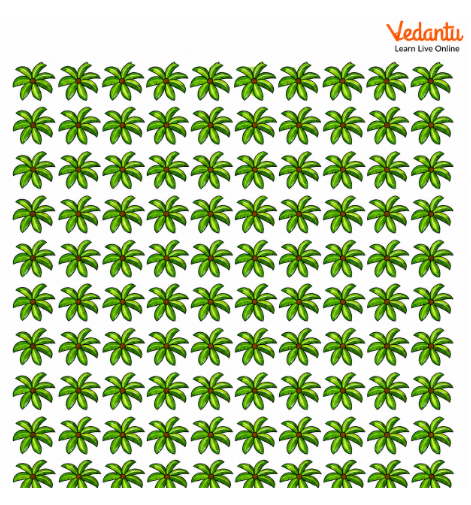
Q13. Picture-Based Question: Count Gundappa's Coconut Trees
Look at the top-view picture of Gundappa's coconut farm on page 34 of the textbook.
Count the trees by making groups.
Questions:
(a) How many trees are there in each row?
(b) How many rows are there?
(c) How many trees are there altogether?
(d) If Gundappa plucks 5 coconuts from each tree, how many coconuts will he collect?
Answer:
(a) There are 10 trees in each row.
(b) There are 10 rows.
(c) Total trees = 10 × 10 = 100 trees.
(d) Total coconuts = 100 × 5 = 500 coconuts.
Q14. Picture-Based Question: Count Muniamma's Sweets
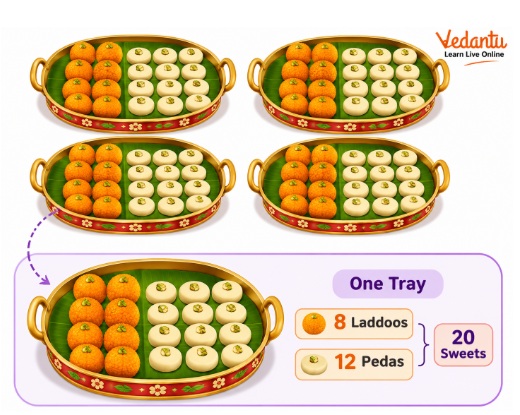
Muniamma places coconut laddoos and milk pedas on identical trays.
Suppose each tray has 8 coconut laddoos and 12 milk pedas. There are 4 trays placed one above another.
Find:
(a) Total coconut laddoos
(b) Total milk pedas
(c) Total sweets
Answer:
(a) Coconut laddoos = 8 × 4 = 32.
(b) Milk pedas = 12 × 4 = 48.
(c) Total sweets = 32 + 48 = 80.
We can count objects in repeated arrangements using multiplication.
Q15. Picture-Based Question: Find the Total Money in Two Arrangements
Shirley and Shiv arrange play money in two different patterns.
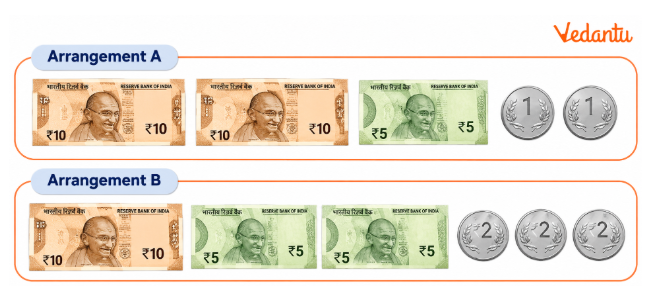
Arrangement A:
Four ₹10 coins
Five ₹5 coins
Arrangement B:
Four ₹10 notes
Two ₹20 notes
Eight ₹5 coins
Calculate the total money in each arrangement.
Answer:
Follow-up Question: Which arrangement has more money, and by how much?
Answer: Arrangement B has ₹55 more because ₹120 − ₹65 = ₹55.
Q16. How can you show ₹36 using ₹1, ₹2, ₹5 and ₹10 play money?
Answer:
One way is:
Three ₹10 notes = ₹30
One ₹5 coin = ₹5
One ₹1 coin = ₹1
Total = ₹30 + ₹5 + ₹1 = ₹36.
Another way is:
Two ₹10 notes = ₹20
Two ₹5 coins = ₹10
Three ₹2 coins = ₹6
Total = ₹20 + ₹10 + ₹6 = ₹36.
We can make the same amount using different combinations of notes and coins.
Q17. Picture-Based Question: Understand Shirley's and Shiv's Coin Arrangements
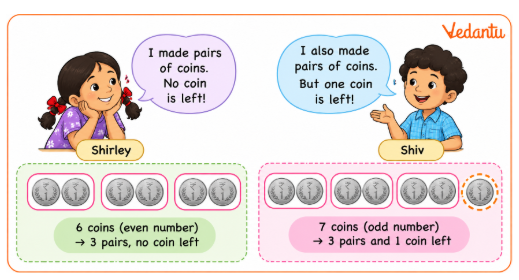
Shirley and Shiv arrange coins in two different ways.
Shirley makes groups with one coin left unpaired.
Shiv makes groups in which every coin has a partner.
Answer:
(a) Whose arrangement shows even numbers?
(b) Whose arrangement shows odd numbers?
(c) Is a group of 9 coins even or odd?
(d) Is a group of 12 coins even or odd?
Answer:
(a) Shiv's arrangement shows even numbers.
(b) Shirley's arrangement shows odd numbers.
(c) 9 is odd because one coin is left unpaired.
(d) 12 is even because all coins can be arranged in 6 pairs.
Q18. Picture-Based Question: Circle Odd Numbers and Put Squares Around Even Numbers
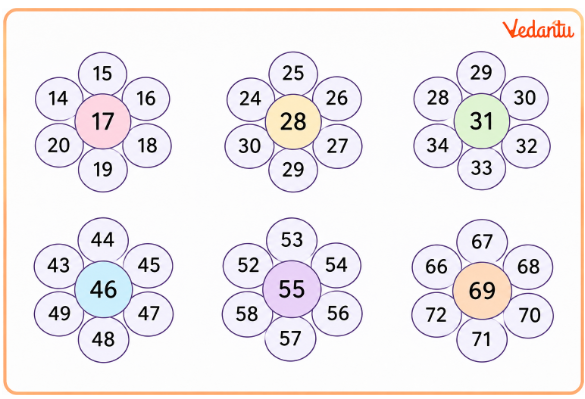
Look at the numbers from the Crayons Arrangement activity:
5, 8, 36, 69, 22, 51, 30, 38, 37, 52, 43
Questions:
(a) Which numbers should be circled?
(b) Which numbers should have squares around them?
(c) How can you identify odd and even numbers without drawing pairs?
Answer:
(a) Odd numbers: 5, 69, 51, 37, 43.
(b) Even numbers: 8, 36, 22, 30, 38, 52.
(c) Look at the last digit.
Numbers ending in 0, 2, 4, 6 or 8 are even.
Numbers ending in 1, 3, 5, 7 or 9 are odd.
Q19. What pattern does Shirley notice in the page numbers of her Maths book?
Answer:
Shirley notices that odd and even page numbers follow each other.
For example:
The pattern is odd, even, odd, even.
This happens because consecutive whole numbers alternate between odd and even.
Class 4 Maths Chapter 3 Long Answer and Application-Based Questions
Q20. Activity-Based Question: Explore the Pattern in the 2-Times Table
Write the first ten multiples of 2. Identify whether they are odd or even.
Answer:
Observation: Every number in the 2-times table is even.
Reason: Each answer is made by counting groups of 2. So the objects can always be arranged in pairs.
Q21. Picture-Based Question: Make Two-Digit Numbers and Identify Odd and Even
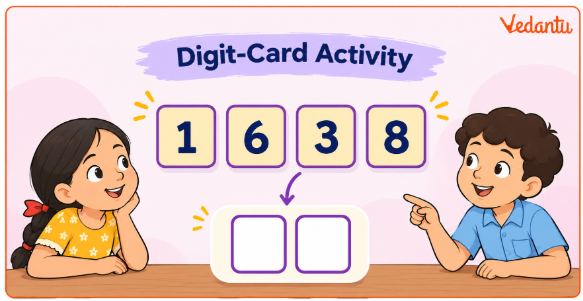
Use the digits 1 and 6 to make two different 2-digit numbers without repeating a digit.
Then answer:
(a) Write the two numbers.
(b) Which number is even?
(c) Which number is odd?
(d) Choose the digits 3 and 8. Make an even 2-digit number.
Answer:
(a) 16 and 61.
(b) 16 is even because it ends in 6.
(c) 61 is odd because it ends in 1.
(d) 38 is even because it ends in 8.
Q22. Challenge Question: Find the Odd-Even Pattern in Consecutive Numbers
Write 10 consecutive numbers starting from 20. Identify each as odd or even.
Answer:
Questions:
(a) What pattern do you notice?
(b) Are the numbers before and after an odd number always even?
(c) Are the numbers before and after an even number always odd?
Answer:
(a) Odd and even numbers appear alternately.
(b) Yes. For example, 24 and 26 are both even, and they come before and after 25.
(c) Yes. For example, 23 and 25 are both odd, and they come before and after 24.
Every consecutive whole number changes from odd to even or from even to odd.
Q23. Reasoning Question: Are There More Even or Odd Numbers from 1 to 100?
Shirley says there are more even numbers than odd numbers from 1 to 100. Shiv disagrees.
Who is correct? Explain your answer.
Answer:
Shiv is correct. There are equal numbers of odd and even numbers from 1 to 100.
We can make pairs:
(1, 2), (3, 4), (5, 6), ... (99, 100).
Each pair has:
One odd number
One even number
There are 50 such pairs.
Therefore:
Odd numbers = 50
Even numbers = 50
Conclusion: There are equal numbers of odd and even numbers from 1 to 100.
Important Topics and Practice Tips for Class 4 Maths Chapter 3 – Patterns Around Us
Revise these chapter activities before practising Class 4 Maths Chapter 3 important questions with answers.
How to Prepare Class 4 Maths Chapter 3 Important Questions
Count Gundappa's trees using rows instead of counting one by one.
Use play money to make ₹36 in two different ways.
Arrange coins in pairs to identify odd and even numbers.
Form 16, 61, 38 and 83 using digit cards and classify them.
Exam Tip: Check the last digit to identify odd and even numbers quickly.
Class 4 Maths Chapter 3 Important Questions PDF Download
Download Vedantu's PDF of solved MCQs, counting activities, money problems and number puzzles from Patterns Around Us. Use the Class 4 Maths Chapter 3 important questions worksheet for additional practice before school exams.
CBSE Class 4 Maths Chapter 3 Study Materials
Use these chapter-specific resources for additional practice.
CBSE Class 4 Maths Chapter-wise Important Questions
Explore important questions from the other chapters of Maths Mela.
Important Study Materials for CBSE Class 4 Maths
FAQs on Important Questions and Answers for Class 4 Maths (Maths Mela) Chapter 3 – Patterns Around Us | 2026–27
1. What topics are covered in Class 4 Maths Chapter 3 important questions with answers?
The questions cover counting objects in groups, money arrangements, odd and even numbers, coin pairing, the 2-times table and number patterns. Students also practise making two-digit numbers and identifying patterns in consecutive numbers.
2. How can students identify odd and even numbers quickly?
Look at the last digit of a number. Numbers ending in 0, 2, 4, 6 or 8 are even. Numbers ending in 1, 3, 5, 7 or 9 are odd.
3. Why are all the numbers in the 2-times table even?
Every answer in the 2-times table is a multiple of 2. This means the objects can be arranged in pairs without leaving any object unpaired.
4. How can play money help students learn number patterns?
Students can arrange coins and notes in groups and calculate their total value. They can also make the same amount using different combinations of ₹1, ₹2, ₹5 and ₹10.
5. Are there more odd or even numbers from 1 to 100?
There are 50 odd numbers and 50 even numbers from 1 to 100. Every pair of consecutive numbers, such as 1 and 2 or 3 and 4, contains one odd and one even number.
6. Where can I get the Class 4 Maths Chapter 3 important questions PDF?
Students can download Vedantu's Class 4 Maths Chapter 3 important questions PDF from the PDF download section on this page. It provides solved questions for offline practice and school exam preparation.
7. What can students practise in the Class 4 Maths Chapter 3 important questions MCQ section?
The MCQs cover counting equal groups, calculating money, identifying odd and even numbers, and finding missing numbers in patterns. Students can check their answers using the explanations.
8. How does the Class 4 Maths Chapter 3 important questions worksheet help with number puzzles?
The worksheet helps students practise forming two-digit numbers, identifying odd and even numbers, and completing consecutive-number patterns. It also includes counting and money-based activities from the chapter.