Class 12 History Chapter 10 Rebels and the Raj Important Questions with Answers PDF
This set of Chapter 10 History Class 12 Important Questions contains 24 solved questions: six MCQs, five very short answers, seven short answers and six long answers. The questions cover specific historical events, source interpretation, regional leaders, Awadh's land-revenue changes, communication among rebels, British repression, and contrasting representations of 1857.
Class 12 History Chapter 10 Important Questions MCQ Practice
Q1. On which date did the sepoys at Meerut begin their uprising against British rule?
(a) 29 March 1857
(b) 10 May 1857
(c) 11 May 1858
(d) 30 June 1857
Answer: (b) 10 May 1857.
Explanation: The sepoys revolted in Meerut on 10 May 1857. The uprising began among the infantry, spread to the cavalry and drew support from local people. Some rebels travelled to Delhi that night.
Q2. Why did the sepoys who arrived in Delhi on 11 May 1857 seek Bahadur Shah Zafar's support?
(a) To obtain modern weapons from his army
(b) To gain political legitimacy under the Mughal emperor
(c) To negotiate with the East India Company
(d) To make Delhi the Company's new headquarters
Answer: (b) To gain political legitimacy under the Mughal emperor.
Explanation: Bahadur Shah Zafar represented the older Mughal political order. His acceptance as the nominal leader gave the rebellion a recognised symbol of authority, even though he initially hesitated to support the sepoys.
Q3. Who became the leader of the uprising in Lucknow after the annexation of Awadh?
(a) Birjis Qadr
(b) Nana Sahib
(c) Kunwar Singh
(d) Shah Mal
Answer: (a) Birjis Qadr.
Explanation: Birjis Qadr was the young son of Nawab Wajid Ali Shah. Rebels in Lucknow recognised him as their leader after the British had deposed and exiled his father.
Q4. How did the Summary Settlement of 1856 affect the taluqdars of Awadh?
(a) It increased their control over all villages.
(b) It removed many of them from their landed estates.
(c) It abolished land revenue collection.
(d) It gave them permanent military commands.
Answer: (b) It removed many of them from their landed estates.
Explanation: The British treated many taluqdars as intermediaries without legitimate ownership claims. The proportion of villages under taluqdar control fell sharply after the Summary Settlement.
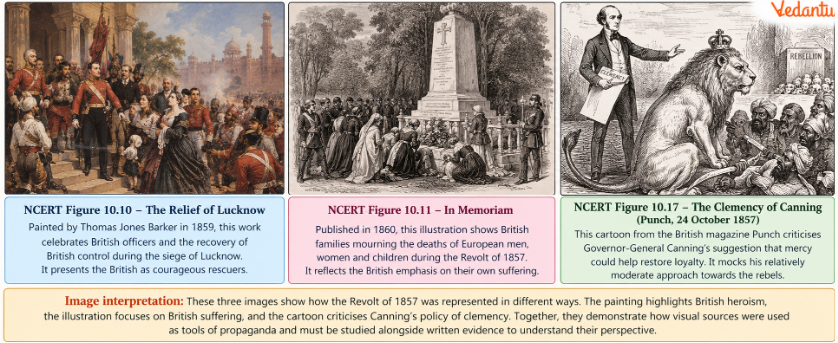
Q5. Which British artist painted The Relief of Lucknow in 1859?
(a) Joseph Noel Paton
(b) Thomas Jones Barker
(c) Felice Beato
(d) John Tenniel
Answer: (b) Thomas Jones Barker.
Explanation: Barker's painting celebrated British officers and the recovery of British control during the siege of Lucknow. It presented imperial soldiers as courageous rescuers.
Q6. Which British publication printed the cartoon The Clemency of Canning in October 1857?
(a) Delhi Urdu Akhbar
(b) Punch
(c) The Harijan
(d) Kesari
Answer: (b) Punch.
Explanation: The British satirical magazine Punch criticised Governor-General Canning's suggestion that mercy could help restore loyalty after the rebellion. The cartoon mocked his comparatively moderate approach.
Class 12 History Chapter 10 Very Short Answer Questions
Q7. What was the bell of arms in a British cantonment?
Answer: The bell of arms was a storeroom where weapons and ammunition were kept. Rebel sepoys often seized it at the beginning of an uprising to obtain arms.
Q8. What was meant by the term firangi in the rebel proclamations?
Answer: Firangi was a term of Persian origin commonly used in Hindi and Urdu for foreigners, often in a derogatory sense. During the rebellion, it referred mainly to the British.
Q9. Who was Shah Mal during the Revolt of 1857?
Answer: Shah Mal was a Jat cultivator and local rebel leader from the Barout region of present-day Uttar Pradesh. He organised villagers against British authority and was killed in battle in July 1857.
Q10. Why was Awadh called the nursery of the Bengal Army?
Answer: Awadh was called the nursery of the Bengal Army because many of the Company's sepoys came from villages in Awadh and eastern Uttar Pradesh. Their close connections with rural families helped grievances spread between villages and military cantonments.
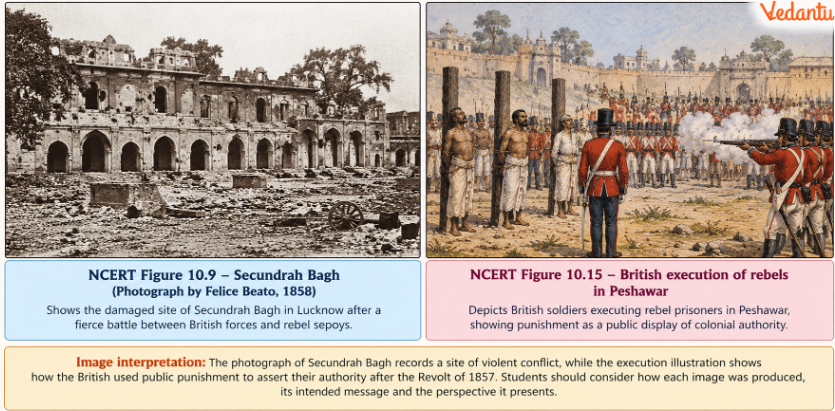
Q11. Who photographed the ruins of Secundrah Bagh in Lucknow after the rebellion?
Answer: Felice Beato photographed Secundrah Bagh in Lucknow in 1858. His image showed the aftermath of fierce fighting and became part of the visual record of British repression.
Class 12 History Chapter 10 Short Answer Questions
Q12. What sequence of events followed the sepoy uprising at Meerut on 10 May 1857?
Answer: The uprising at Meerut quickly developed into a wider rebellion.
Beginning in the Cantonment: Indian infantry sepoys revolted against their British officers on 10 May.
Spread to the Cavalry: The rebellion spread from the infantry to the cavalry and then into Meerut town.
Seizure of Weapons: The sepoys captured the bell of arms and obtained weapons and ammunition.
Attacks on Government Buildings: The rebels attacked the treasury, court, jail, record office and other buildings connected with British rule.
Public Participation: Ordinary townspeople and villagers joined the soldiers.
Communication Disruption: The telegraph line to Delhi was cut.
March Towards Delhi: Rebel sepoys travelled to Delhi overnight and entered the city on 11 May.
Conclusion: The uprising spread beyond the army and became a broader challenge to British political authority.
Q13. What evidence suggests that the Revolt of 1857 involved communication and coordination among different rebel groups?
Answer: The rebellion developed through communication between sepoys, local leaders and ordinary people.
Similar Patterns: Revolts in different cantonments often followed similar sequences, including seizing weapons and attacking British establishments.
Messages Between Cantonments: News of uprisings travelled from one military station to another.
Collective Decisions: Sepoy panchayats discussed matters and made decisions about the rebellion.
Cooperation Among Soldiers: Evidence shows communication between soldiers stationed in different places before the uprising.
Shared Leadership: Rebels sought the support of recognised rulers, including Bahadur Shah Zafar.
Rebel Proclamations: Notices in Hindi, Urdu and Persian called for unity against British rule.
Civilian Networks: Local leaders organised supplies, communication and resistance within villages.
Conclusion: The available evidence indicates planning and coordination in some places, although historians cannot establish a single central organisation controlling the entire uprising.
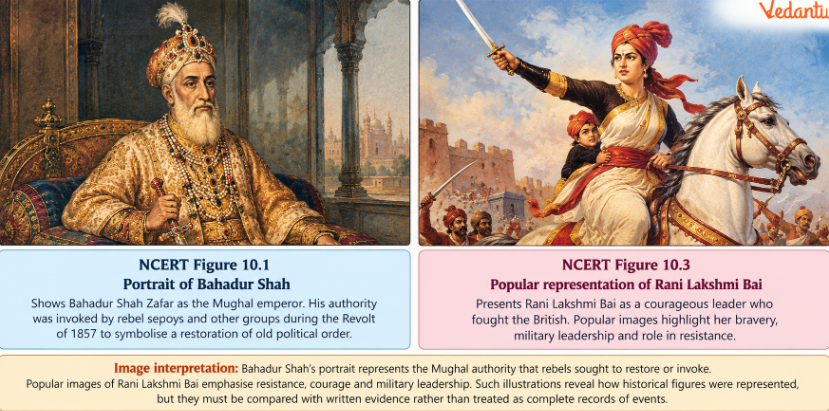
Q14. Why did the rebels seek leadership from rulers such as Bahadur Shah Zafar, Nana Sahib and Rani Lakshmi Bai?
Answer: Many rebels turned to established political figures because their names carried authority and local recognition.
Bahadur Shah Zafar: The sepoys who reached Delhi wanted the Mughal emperor to give legitimacy to their struggle.
Nana Sahib: Rebels in Kanpur encouraged Nana Sahib, the successor to Peshwa Baji Rao II, to lead them.
Rani Lakshmi Bai: The people and sepoys of Jhansi pressed the rani to assume leadership.
Kunwar Singh: In Arrah, Bihar, rebels rallied around this influential local zamindar.
Birjis Qadr: In Lucknow, people recognised the young son of the deposed Nawab Wajid Ali Shah.
Why their support mattered: The leaders represented older political arrangements that had been weakened or displaced by British expansion. Their authority could help bring different groups together.
Conclusion: The rebels did not always begin with a clear leadership structure. In many regions, recognised rulers and local chiefs became rallying points for resistance.
Q15. How did Shah Mal and Gonoo mobilise rural and tribal communities during the Revolt of 1857?
Answer: Shah Mal and Gonoo demonstrate that the uprising was not limited to famous rulers or sepoy leaders.
Shah Mal:
Shah Mal belonged to a Jat cultivating community in the Barout region.
He mobilised village headmen and cultivators across a network of eighty-four villages, known as chaurasee des.
His followers attacked symbols of British authority, including government buildings, roads and bridges.
They supplied provisions to rebels in Delhi and disrupted communication between British headquarters and Meerut.
Shah Mal used an English officer's bungalow as a local hall of justice and organised an intelligence network.
He was killed in battle in July 1857.
Gonoo:
Gonoo was a tribal cultivator from Singhbhum in Chotanagpur.
He emerged as a leader among the Kol tribal communities.
His participation shows that the rebellion involved rural and tribal groups as well as soldiers.
Conclusion: Both leaders show how local grievances and community networks shaped the wider uprising.
Q16. Why was the annexation of Awadh in 1856 strongly opposed by taluqdars, peasants and sepoys?
Answer: The annexation of Awadh affected several groups that were connected through land, employment and family relationships.
Removal of Wajid Ali Shah: The British deposed the popular Nawab and sent him into exile, creating widespread resentment.
Loss of Courtly Employment: Officials, soldiers, artisans and others associated with the royal court lost employment and patronage.
Dispossession of Taluqdars: The Summary Settlement removed many taluqdars from their estates.
Decline in Taluqdar Control: Historical records indicate that taluqdars controlled 67% of Awadh's villages before British annexation; the Summary Settlement reduced this proportion to 38%.
Higher Revenue Demands: Revenue assessments increased substantially in several areas, sometimes by 30–70%.
Peasant Difficulties: Cultivators faced high payments and inflexible revenue collection.
Sepoy Connections: Many Bengal Army sepoys came from Awadh, so grievances experienced by their families influenced their attitudes.
Conclusion: The revolt in Awadh was especially widespread because political dispossession, economic hardship and military grievances affected interconnected groups.
Q17. How did rumours about cartridges, flour and religious conversion influence the Revolt of 1857?
Answer: Rumours became powerful because they reflected existing fears about British interference in Indian religious and social practices.
Greased Cartridges: Sepoys believed the new rifle cartridges were coated with cow and pig fat.
Religious Objections: The cartridges were reportedly meant to be bitten open, offending Hindu and Muslim religious beliefs.
Distrust of Assurances: Many sepoys did not accept British attempts to dismiss their concerns.
Flour Rumours: People also feared that bone dust had been mixed with flour sold in markets.
Conversion Fears: Some believed that the British intended to destroy traditional religions and convert Indians to Christianity.
Effects of Earlier Policies: British social interventions, missionary activity and annexations made such rumours seem credible to many people.
Conclusion: Rumours were not the only causes of the revolt. They intensified distrust that had developed through colonial policies and everyday experiences.
Q18. What do the reports of the Delhi Urdu Akhbar reveal about ordinary life during the uprising of 1857?
Answer: The Delhi Urdu Akhbar provides evidence of how the rebellion disrupted everyday urban life.
Food Shortages: Reports described the difficulty of obtaining vegetables and other basic foods.
Poor-Quality Supplies: Some available vegetables were old or unsuitable for consumption.
Unequal Access: Limited supplies were more easily available to privileged groups than to poorer residents.
Disrupted Water Supply: Water carriers stopped performing their regular services in some areas.
Changes in Daily Work: Residents had to undertake tasks that were normally performed by service workers.
Social Effects: The breakdown of markets and services affected households across different sections of society.
Conclusion: These reports show that the revolt was not only a military or political event. It also changed the ordinary routines, markets and living conditions of city residents.
Class 12 History Chapter 10 Long Answer Questions
Q19. Why did the Revolt of 1857 spread beyond the sepoys and become a widespread popular rebellion? Explain with reference to Awadh and other regions.
Answer: The Revolt of 1857 began with military uprisings but quickly drew support from various groups with grievances against British rule.
1. Sepoy Discontent: Indian soldiers were dissatisfied with aspects of military service, including racial discrimination, treatment by British officers and religious concerns.
The controversy surrounding the new rifle cartridges intensified their anger.
2. Spread from Meerut: The uprising at Meerut on 10 May 1857 became a major turning point. Rebel sepoys marched to Delhi and obtained the nominal support of Bahadur Shah Zafar.
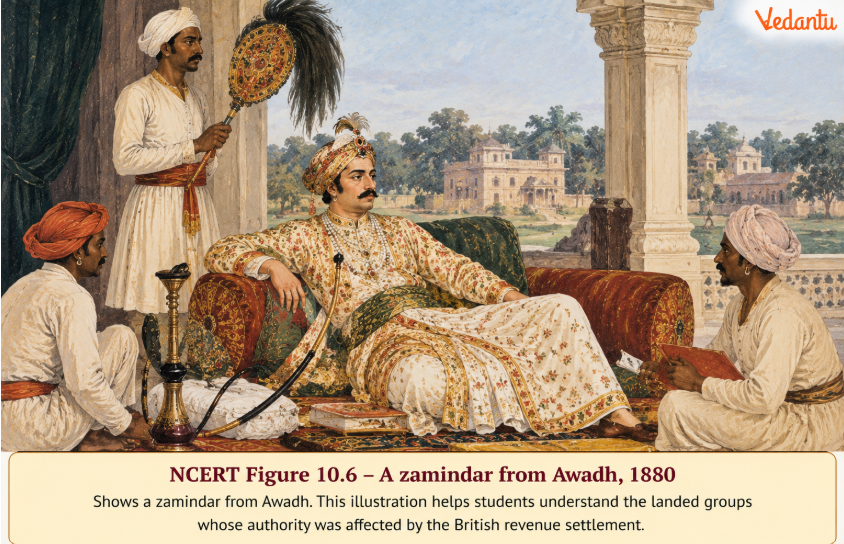
3. Political Dispossession: British expansion had weakened older rulers, princes and landed chiefs. Many believed they could restore their status and privileges only by ending British authority.
4. Annexation of Awadh: The removal of Wajid Ali Shah created resentment among soldiers, officials, artisans and the wider population connected with his court.
5. Loss of Taluqdari Estates: The Summary Settlement of 1856 dispossessed many taluqdars. They therefore had strong reasons to oppose the colonial administration.
6. Peasant Grievances: Peasants faced high revenue demands, rigid collection methods and growing economic difficulties. Some also resented moneylenders and wealthy groups seen as supporters of British rule.
7. Links Between Sepoys and Villages: Many Bengal Army sepoys came from Awadh and eastern Uttar Pradesh. They remained closely connected with their families and villages, allowing military and rural grievances to reinforce each other.
8. Participation of Local Leaders: Shah Mal organised cultivators in the Barout region, while Gonoo mobilised Kol communities in Chotanagpur.
9. Religious Concerns: Rumours about cartridges, conversion and interference with established practices strengthened opposition to British rule.
10. Calls for Unity: Rebel proclamations urged Hindus and Muslims to act together against foreign authority.
11. Popular Attacks on British Institutions:Government buildings, courts, record offices, treasuries and symbols of colonial control became targets.
12. Wider Opposition to Authority: In some places, people also attacked moneylenders and local elites whom they considered oppressive.
Conclusion: The Revolt of 1857 became a wider popular rebellion because military dissatisfaction combined with political, economic, social and religious grievances. The reasons for participation varied across regions and social groups.
Q20. How did the annexation of Awadh destroy an existing political and social order? Explain the impact on Wajid Ali Shah, taluqdars, peasants and sepoys.
Answer: The annexation of Awadh in 1856 created widespread dissatisfaction because British policies affected political authority, landownership, employment and village society.
Part A: Political Changes
1. Subsidiary Alliance of 1801:The British had already imposed a subsidiary alliance on Awadh in 1801. This limited the Nawab's military and diplomatic independence.
2. Annexation in 1856:Lord Dalhousie's administration annexed Awadh, claiming that it was being misgoverned.
3. Exile of Wajid Ali Shah: The Nawab was removed from power and sent into exile in Calcutta. His departure caused widespread sorrow and resentment.
4. Collapse of Courtly Patronage: The royal court had supported musicians, dancers, poets, artisans, administrators and soldiers. The removal of the Nawab disrupted these livelihoods.
Part B: Effects on Taluqdars
5. Summary Settlement: The British introduced the Summary Settlement in 1856. They treated many taluqdars as illegitimate intermediaries who had acquired land through force or manipulation.
6. Reduction in Landed Control
The proportion of villages held by taluqdars declined substantially.
7. Loss of Political Influence: Taluqdars lost estates, revenue privileges and influence over village communities.
Part C: Effects on Peasants
8. Rising Revenue Assessments: The British expected direct settlement with cultivators to reduce exploitation. Instead, revenue demands increased in several regions.
9. Disruption of Older Relationships: Taluqdars could be oppressive, but their relationships with peasants also involved patronage and assistance during difficulties.
Removing them disrupted these arrangements.
Part D: Effects on Sepoys
10. Military Recruitment: Awadh supplied many soldiers to the Bengal Army.
11. Family Connections: Changes in villages affected the families of sepoys, connecting military discontent with rural grievances.
12. Shared Participation in Rebellion: When the revolt began, many sepoys received support from peasants, taluqdars and ordinary residents of Awadh.
Conclusion: The annexation of Awadh affected much more than its ruler. It disrupted an entire network of political, economic and social relationships, making Awadh a major centre of rebellion in 1857.
Q21. What did the rebels of 1857 want to achieve? Explain the ideas of unity, political restoration and opposition to British policies reflected in their proclamations.
Answer: The rebels of 1857 did not all share an identical political programme. However, their proclamations expressed several important common demands and concerns.
1. End of British Rule: The central demand was to remove the firangis and end colonial domination.
2. Restoration of Earlier Authority:Many rebels wanted the return of rulers, chiefs and political arrangements displaced by British expansion.
3. Leadership of Bahadur Shah Zafar: The Mughal emperor became an important symbol around which different rebel groups could unite.
4. Hindu–Muslim Unity: Proclamations repeatedly called upon Hindus and Muslims to fight together.The struggle was presented as a common cause rather than belonging exclusively to one religious community.
5. Defence of Religious Practices: Rebel statements expressed fear that British rule threatened established religious traditions.
6. Opposition to British Laws and Policies: The rebels criticised revenue demands, administrative arrangements and changes associated with colonial authority.
7. Defence of Traditional Occupations: Some proclamations referred to the hardships experienced by artisans and other occupational groups under British economic policies.
8. Opposition to Commercial Exploitation:The rebels criticised the damaging effects of British economic control on Indian producers and traders.
9. Vision of Earlier Social Relationships:The proclamations often presented pre-British rule as a period in which different communities had coexisted.
10. A Shared Enemy: Despite differences among rulers, peasants, soldiers and religious leaders, opposition to the British created a common purpose.
11. Differences Among Groups: Dispossessed rulers wanted political authority, taluqdars wanted to recover estates, and peasants wanted relief from oppressive revenue and social conditions.
12. Limits of Historical Evidence: Relatively few rebels left written accounts of their own experiences. Historians therefore examine proclamations, notices, letters and accounts recorded by the British to reconstruct their aims.
Conclusion: The rebels shared a desire to remove British rule, but their expectations reflected the different political, economic and social positions they occupied.
Q22. How did the British suppress the Revolt of 1857? Explain their military operations, emergency laws and treatment of rebel communities.
Answer: The British used military force, special legal powers and political negotiations to regain control of territories held by the rebels.
1. Initial Loss of Control: During May and June 1857, British authority collapsed across several military stations and towns in North India.
2. Reinforcements: The British brought additional troops from Britain and redirected forces to fight the uprising.
3. Emergency Legislation: Special laws enacted in May and June 1857 gave officials and military officers extensive powers to try and punish suspected rebels.
4. Harsh Punishments: People accused of rebellion faced severe punishment, including execution.
5. Recovery of Delhi: British troops began efforts to retake Delhi in June and captured the city in September 1857 after prolonged fighting.
6. Village-by-Village Operations: In the Gangetic plain and Awadh, British forces faced strong local resistance. They often had to regain control of settlements one by one.
7. Recapture of Lucknow: The British eventually brought Awadh under control after extended military operations, with Lucknow retaken in March 1858.
8. Collective Punishment: Military repression affected suspected rebels and, in some places, the communities associated with them.
9. Destruction and Confiscation: Buildings were damaged, villages were attacked, and property belonging to some rebel supporters was confiscated.
10. Attempts to Divide Rebel Support: The British sought to weaken cooperation between taluqdars and peasants. Some landholders were offered the restoration of their estates if they abandoned the rebellion.
11. Rewards for Loyalty: Landholders who remained loyal to British rule could receive rewards or protection.
12. Public Display of Punishment: Executions were deliberately made visible to intimidate people and discourage further rebellion.
13. Long-Term Consequences: The East India Company's rule ended, and authority was transferred to the British Crown in 1858.
Conclusion: The British regained power through overwhelming military force and political measures designed to break rebel alliances. The violence of suppression also shaped how people remembered the rebellion.
Q23. How did British paintings and cartoons represent the Revolt of 1857? Explain with reference to The Relief of Lucknow, In Memoriam and The Clemency of Canning.
Answer: British paintings and cartoons played an important role in shaping public attitudes towards the rebellion. These images often celebrated British soldiers, emphasised the suffering of British civilians and encouraged support for repression.
Part A: The Relief of Lucknow
1. Artist and Date: Thomas Jones Barker painted The Relief of Lucknow in 1859.
2. Presentation of British Officers: The painting places Campbell, Outram and Havelock at the centre of the composition.
3. Use of Light: The central figures appear in a well-lit area, directing attention towards them.
4. Message of Victory: The painting presents British officers as heroic figures who restored safety and colonial control.
Part B: In Memoriam
5. Artist and Date: Joseph Noel Paton produced In Memoriam in 1859.
6. Representation of Women and Children: The painting shows British women and children gathered together in fear.
7. Emotional Appeal: It encourages viewers to sympathise with British civilians and fear the actions of the rebels.
8. Representation of Rebels: The rebels are not shown directly, but their supposed threat is central to the painting's emotional effect.
Part C: The Clemency of Canning
9. British Debate over Punishment: After the revolt, demands for revenge became widespread in Britain.
10. Canning's Position: Governor-General Canning suggested that restraint and mercy could help restore loyalty.
11. The Punch Cartoon: Punch mocked Canning by showing him protecting a threatening rebel.
12. Political Message: The cartoon portrayed leniency as dangerous and encouraged a harsher attitude towards the rebels.
Comparison Table
13. Historical Limitations: Paintings are not neutral records of events. Artists selected subjects and arranged figures to produce particular emotional responses.
14. Importance for Historians: By examining composition, symbols, captions and intended audiences, historians can understand how the British public was encouraged to interpret the rebellion.
Conclusion: British images often justified imperial authority and harsh punishment. They reveal not only the events of 1857 but also the fears and political attitudes of those who produced and circulated them.
Q24. How do colonial photographs, British cartoons and Indian nationalist images offer different interpretations of the Revolt of 1857? Explain why historians must analyse these representations carefully.
Answer: Visual representations are important sources for understanding how the Revolt of 1857 was remembered. However, they reflect the intentions and viewpoints of their creators rather than providing completely objective accounts.
Part A: Colonial Photographs
1. Recording Sites of Conflict: Photographers such as Felice Beato documented damaged buildings and locations associated with major battles.
2. Secundrah Bagh: The photograph of Secundrah Bagh in Lucknow showed a ruined site associated with the deaths of rebel soldiers.
3. Message of Destruction: Such images could communicate the severity of the conflict and the consequences of resistance.
Part B: British Paintings
4. Celebration of British Officers: Artists portrayed British commanders as courageous figures who defeated the rebels.
5. Depiction of British Civilians: Paintings of frightened women and children encouraged sympathy for the British.
6. Representation of Rebels: Rebels were frequently represented as threatening or brutal, helping justify severe punishment.
Part C: British Cartoons
7. Use of Allegory: Cartoons used symbolic figures to represent justice, revenge and imperial authority.
8. The British Lion's Vengeance: In the Punch cartoon, a British lion and a Bengal tiger symbolised the conflict between colonial power and the rebels.
9. Political Criticism: Cartoons such as The Clemency of Canning criticised calls for moderation.
Part D: Indian Nationalist Images
10. Remembering the Rebellion: During the twentieth-century national movement, the uprising was celebrated as the First War of Independence.
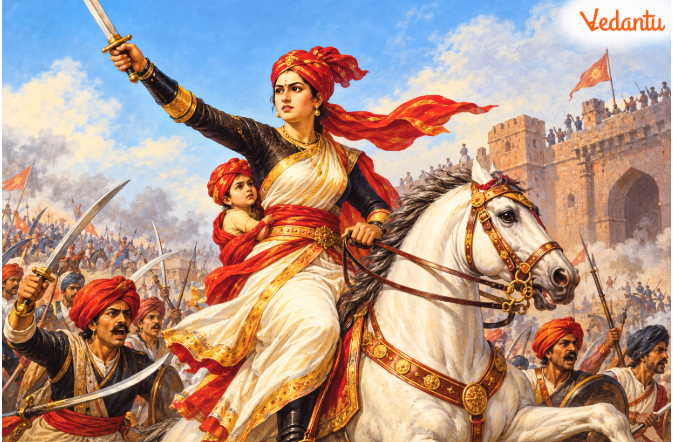
11. Rani Lakshmi Bai: Popular images portrayed the Rani of Jhansi as a courageous warrior carrying a sword and riding into battle.
12. Nationalist Inspiration: Paintings, poems, posters and films helped transform leaders of 1857 into symbols of anti-colonial resistance.
Part E: Comparing Different Representations
Part F: How Historians Examine Visual Sources
13. Identify the Creator: Who produced the image, and what were their political or social interests?
14. Examine the Date: Was the artwork made during the rebellion or many years later?
15. Study Visual Details: How are figures, colours, lighting, weapons, clothing and expressions used?
16. Identify the Intended Audience: Was the image meant for British newspaper readers, supporters of colonial rule or Indian nationalist audiences?
17. Compare Other Evidence: Images should be studied alongside proclamations, letters, newspapers and historical records.
Conclusion: Visual sources help historians understand both the events of 1857 and the ways those events were interpreted. Comparing colonial and nationalist images shows how the same uprising could be remembered as a threat to imperial order or as an inspiring struggle against foreign rule.
Why Practise Class 12 History Chapter 10 Important Questions with Vedantu?
Practising Class 12 History Chapter 10 Important Questions helps students understand why the Revolt of 1857 spread across North India, how different communities participated, and how historical sources represent the uprising. These chapter-based questions support factual revision, map interpretation and source-based answer writing.
How to Prepare Class 12 History Chapter 10 Important Questions with Vedantu?
Revise the timeline: Focus on 10–11 May 1857, the Awadh annexation of 1856 and major events of 1857–58.
Connect leaders with places: Match Bahadur Shah Zafar with Delhi, Nana Sahib with Kanpur, Birjis Qadr with Lucknow and Kunwar Singh with Arrah.
Understand regional causes: Explain why sepoys, taluqdars, peasants and tribal communities joined the uprising.
Practise source-based questions: Study rebel proclamations, contemporary newspapers and British reports.
Analyse historical images: Identify how paintings, photographs and cartoons present different interpretations of 1857.
Important Study Material Links for Class 12 History Chapter 10
Chapter-Wise Important Questions for Class 12 History
Important Study Materials for Class 12 History
FAQs on Important Questions and Answers for Class 12 History Chapter 10 Rebels and the Raj (Themes in Indian History-III) | 2026-27
1. Why did the Revolt of 1857 begin in Meerut and spread so quickly to Delhi?
The uprising began at Meerut on 10 May 1857 amid military grievances and fears surrounding rifle cartridges. Rebel sepoys seized weapons, attacked British establishments and marched to Delhi. By seeking Bahadur Shah Zafar's support, they gave the rebellion a recognised political symbol.
2. Why did Bahadur Shah Zafar initially hesitate to lead the Revolt of 1857?
Bahadur Shah Zafar was elderly and had limited political and military power. He initially reacted with alarm when the rebel sepoys entered Delhi. After soldiers entered the Red Fort and demanded his support, he accepted the nominal leadership of the rebellion.
3. How did the revolt change from a sepoy mutiny into a popular rebellion?
Peasants, townspeople, taluqdars, local chiefs and religious leaders joined the sepoys. Their participation stemmed from grievances over British annexations, land revenue, social interference, and local oppression. This widened the uprising beyond military stations.
4. Why did the annexation of Awadh in 1856 become an important cause of the revolt?
The annexation removed Nawab Wajid Ali Shah, disrupted court-related employment, and weakened the position of taluqdars. Peasants faced high revenue demands, while sepoys recruited from Awadh were affected by the difficulties their families faced.
5. What did the Summary Settlement of 1856 do to the taluqdars of Awadh?
It tried to remove taluqdars from their estates and collect land revenue directly from other landholders. According to the chapter, the proportion of villages controlled by taluqdars fell from 67% to 38%, creating widespread resentment.
6. What role did Rani Lakshmi Bai play in the Revolt of 1857?
Rani Lakshmi Bai emerged as a major rebel leader in Jhansi. She resisted British authority and became an enduring symbol of courage. Later nationalist paintings, poems and posters celebrated her military leadership.
7. Why is Shah Mal considered an important local leader of the 1857 uprising?
Shah Mal organised Jat cultivators and village headmen in the Barout region. His followers attacked British establishments, disrupted roads and communications, supplied rebels in Delhi and established a local system of authority.
8. How did the cartridge controversy influence Hindu and Muslim sepoys?
Sepoys believed rifle cartridges contained cow and pig fat and had to be bitten open. This raised religious objections among both Hindu and Muslim soldiers and intensified existing distrust of British military authorities.
9. What evidence shows that the rebels of 1857 appealed for Hindu–Muslim unity?
Rebel proclamations in Hindi, Urdu and Persian called on people of different religious communities to unite against British rule. They described the struggle as a common cause and referred to earlier traditions of coexistence.
10. What did the rebels of 1857 want to achieve by removing British rule?
Their goals varied. Dispossessed rulers wanted political authority restored, taluqdars sought control of their estates, and peasants wanted relief from oppressive economic conditions. Many proclamations expressed a shared desire to end foreign rule.
11. Why was the revolt especially widespread in Awadh compared with some other regions?
Awadh had experienced political annexation, the displacement of landed elites, high revenue assessments and the collapse of older patronage arrangements. Its villages also had close connections with Bengal Army sepoys, helping unite military and rural resistance.
12. How did the British regain control over Delhi and Lucknow during the Revolt of 1857?
The British used reinforcements, military campaigns, special legal powers and harsh punishments. Delhi was recaptured in September 1857, while Lucknow was retaken in March 1858 after prolonged resistance.
13. How did British paintings such as The Relief of Lucknow influence public opinion?
The painting portrayed British officers as heroic rescuers and emphasised the restoration of imperial authority. Such artworks encouraged British audiences to identify with colonial soldiers and interpret the rebellion from the viewpoint of British victory.
14. Which source-based and image-based questions are important for Class 12 History Chapter 10?
Students should focus on the causes and spread of the revolt, regional leaders, Awadh's annexation, rebel proclamations, military repression and image-based questions. Comparisons between British paintings and nationalist representations are especially useful for developing source-analysis skills.
15. Can students use Class 12 History Chapter 10 Important Questions in Hindi for revision?
Students who prefer Hindi can revise the chapter's historical terms and explanations in Hindi alongside the prescribed History textbook. However, this page provides answers in English; for full Class 12 History Chapter 10 Important Questions in Hindi practice, a separate Hindi-language question set is needed.