Class 12 History Chapter 9 Colonialism and the Countryside Important Questions with Answers PDF
This collection of Chapter 9 History Class 12 Important Questions includes 24 solved questions: six MCQs, five very short answers, seven short answers and six long answers. The practice questions focus on the Permanent Settlement, revenue defaults, benami purchases, jotedar influence, forest communities, Santhal settlement and resistance, peasant indebtedness, cotton prices, official reports and the limitations of colonial records.
Class 12 History Chapter 9 Important Questions MCQ Practice
Q1. In which year did the British East India Company introduce the Permanent Settlement in Bengal?
(a) 1765
(b) 1773
(c) 1793
(d) 1855
Answer: (c) 1793.
Explanation: Governor-General Lord Cornwallis introduced the Permanent Settlement in Bengal in 1793. It fixed the land revenue zamindars had to pay to the Company.
Q2. What happened at the Burdwan auction of 1797 that surprised the Collector?
(a) Santhal cultivators purchased all the estates.
(b) Most buyers were agents and servants of the Raja of Burdwan.
(c) The auction was cancelled because there were no purchasers.
(d) The estates were transferred directly to village panchayats.
Answer: (b) Most buyers were agents and servants of the Raja of Burdwan.
Explanation: People acting on the Raja's behalf purchased many auctioned estates because of unpaid revenue. Historical records indicate that more than 95% of the auction sales were fictitious, allowing the Raja to retain control.
Q3. Who were known as jotedars in the Bengal countryside?
(a) British military officers
(b) Wealthy peasants who controlled substantial agricultural resources
(c) Tribal chiefs appointed to command British regiments
(d) European cotton merchants
Answer: (b) Wealthy peasants who controlled substantial agricultural resources.
Explanation: Jotedars were rich peasants who acquired land, controlled trade and moneylending, and exercised considerable influence in villages.
Q4. What was Damin-i-Koh?
(a) A military camp established during the Deccan Riots
(b) A territory demarcated for Santhal settlement near the Rajmahal hills
(c) A revenue court established in Burdwan
(d) A cotton market in Bombay
Answer: (b) A territory demarcated for Santhal settlement near the Rajmahal hills.
Explanation: In 1832, the colonial authorities demarcated Damin-i-Koh for Santhals, encouraging them to clear forests, practise plough cultivation and establish permanent settlements.
Q5. Where did the Deccan Riots of 1875 begin?
(a) Burdwan
(b) Supa
(c) Rajmahal
(d) Calcutta
Answer: (b) Supa.
Explanation: The movement began on 12 May 1875 in Supa, a market village in Poona district. Peasants attacked moneylenders' establishments and destroyed debt documents.
Q6. Which revenue system involved direct settlement between the colonial government and the cultivator in the Bombay Deccan?
(a) Permanent Settlement
(b) Zamindari Settlement
(c) Ryotwari Settlement
(d) Mahalwari Settlement
Answer: (c) Ryotwari Settlement.
Explanation: Under the ryotwari system, the government assessed and settled land revenue directly with the ryot. Revenue rates were revised periodically rather than fixed permanently.
Class 12 History Chapter 9 Very Short Answer Questions
Q7. What was the Sunset Law under the Permanent Settlement?
Answer: The Sunset Law required zamindars to pay the prescribed revenue by sunset on the specified date. If they did not pay on time, the government could auction their estates.
Q8. What does the term benami purchase mean?
Answer: A benami purchase occurs when someone buys property in another person's name while exercising actual control over it. Some Bengal zamindars used this method to retain estates sold at revenue auctions.
Q9. Who were the Paharias of the Rajmahal hills?
Answer: The Paharias were hill communities living in the Rajmahal region. They depended on shifting cultivation, hunting, gathering forest produce and other forest-based activities.
Q10. What was the Santhal Hul?
Answer: The Santhal Hul was the Santhal rebellion of 1855-56 against oppressive zamindars, moneylenders and the British colonial administration.
Q11. What were bahi khatas?
Answer: Bahi khatas were account books moneylenders kept to record debts and financial transactions. During the Deccan Riots, peasants targeted these books because they represented the debts and obligations they opposed.
Class 12 History Chapter 9 Short Answer Questions
Q12. Why did zamindars fail to pay revenue even after the Permanent Settlement had fixed the demand?
Answer: Several economic and administrative problems prevented zamindars from paying revenue regularly.
1. High Initial Revenue: The Company fixed the demand at a high level because it expected agricultural prices and production to increase.
2. Falling Agricultural Prices: In the 1790s, prices of agricultural produce were low. This made it difficult for peasants to pay rent.
3. Fixed Payments: Revenue had to be paid even when crops failed, or agricultural income declined.
4. Sunset Law: Failure to pay by the prescribed deadline could result in the auction of the estate.
5. Limited Zamindari Authority: The colonial government restricted the zamindars' police, judicial and administrative powers.
6. Resistance by Jotedars: Wealthy peasants sometimes delayed payments and encouraged other cultivators to resist zamindari demands.
Conclusion: The Permanent Settlement fixed the assessment but did not guarantee zamindars enough rent to meet it.
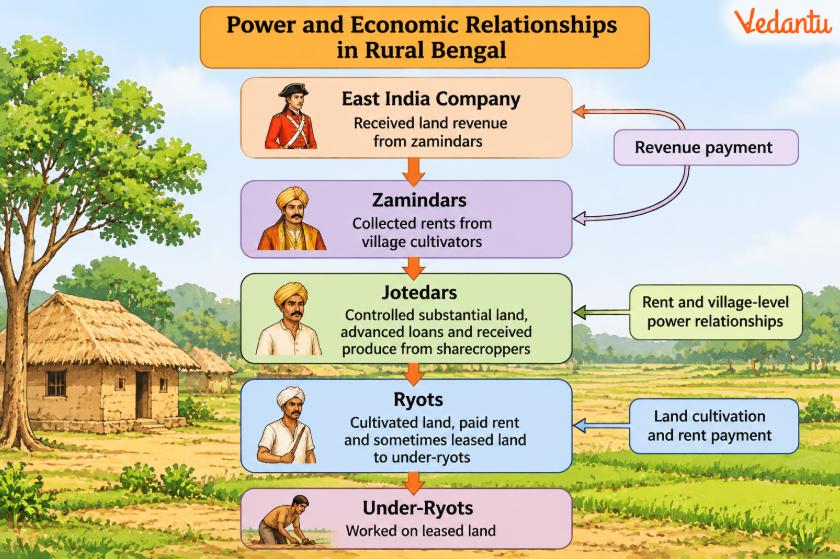
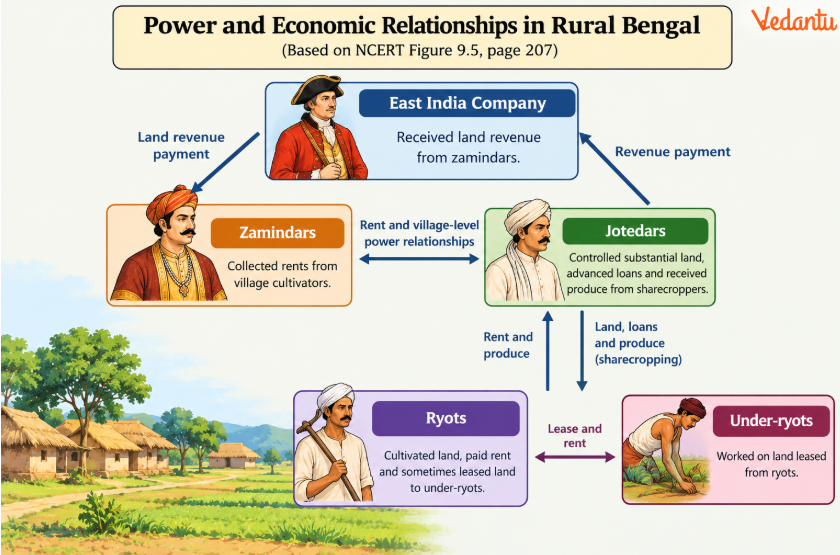
Q13. How did the jotedars of Dinajpur become powerful enough to challenge Bengal zamindars?
Answer: Jotedars were wealthy peasants who developed considerable influence in Bengal's village economy.
1. Extensive Landholdings: Some controlled several thousand acres of agricultural land.
2. Sharecropping: Much of their land was cultivated by sharecroppers called adhiyars or bargadars. These cultivators generally surrendered half the produce to the jotedars.
3. Moneylending: Jotedars advanced loans to poorer cultivators and increased their financial dependence.
4. Trade: They controlled aspects of the local trade in agricultural produce.
5. Village-Level Influence: Unlike many zamindars who lived in towns, jotedars lived in villages and interacted directly with cultivators.
6. Resistance to Zamindars: They delayed revenue payments, resisted zamindari officers and sometimes encouraged other peasants to withhold dues.
7. Purchase of Estates: Jotedars sometimes purchased lands auctioned after zamindari defaults.
Conclusion: Their control over land, credit, and village society allowed jotedars to weaken traditional zamindars' authority.
Q14. What methods did Bengal zamindars use to retain control of their estates despite revenue auctions?
Answer: Zamindars developed several methods to prevent the permanent loss of their estates.
1. Benami Purchases: Agents and servants purchased auctioned property on behalf of the original zamindars.
2. Transfer to Relatives: Some zamindars transferred property to female family members to protect it from confiscation under the rules then applied.
3. Manipulation of Auctions: Agents could influence sales to prevent genuine outside buyers from acquiring property.
4. Resistance to New Purchasers: Existing zamindars and their supporters sometimes obstructed buyers attempting to take possession of estates.
5. Local Influence: Personal relationships and support from local people helped some zamindars maintain control even after formal ownership changed.
Conclusion: Revenue auctions did not always fully transfer local power. Formal property records and actual control could differ.
Q15. How did the British attempts to pacify the Paharias affect the communities living in the Rajmahal hills?
Answer: The Paharias depended on forest resources and shifting cultivation. British expansion into their territories disrupted their livelihoods and political independence.
1. Forest-Based Life: Paharias practised hunting, food gathering, shifting cultivation and other activities connected with the hills.
2. Resistance to Outsiders: They opposed the expansion of settled cultivation and outside authority into their lands.
3. British Repression: During the 1770s, colonial authorities used violent campaigns against Paharia communities.
4. Cleveland's Policy: In the 1780s, Augustus Cleveland proposed giving annual allowances to Paharia chiefs in exchange for maintaining peace.
5. Loss of Independence: Chiefs who accepted allowances could lose authority within their communities because they were viewed as dependent on the colonial government.
6. Retreat into the Hills: Many Paharias withdrew into more inaccessible parts of the Rajmahal hills.
Conclusion: British policies reduced the autonomy of Paharia communities and placed increasing pressure on their traditional livelihoods.
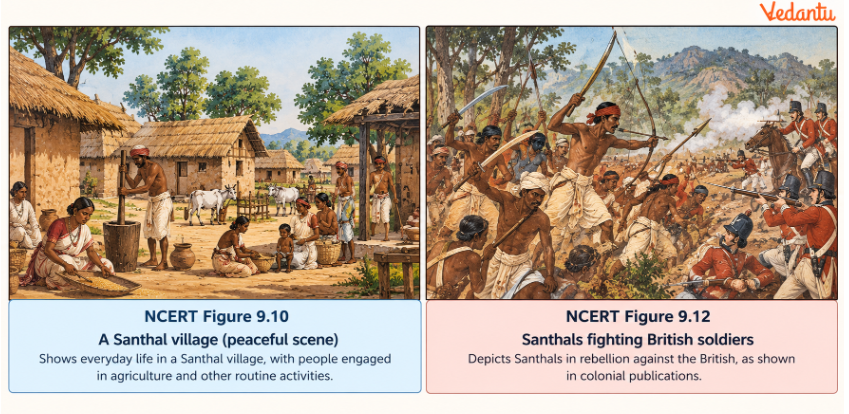
Q16. Compare the livelihoods and settlement patterns of the Paharias and Santhals in the Rajmahal hills.
Answer: The Paharias and Santhals had different relationships with the Rajmahal region's forests and agricultural land.
However, the spread of Santhal settlements restricted the lands available to the Paharias and later exposed the Santhals themselves to colonial revenue demands and exploitation.
Conclusion: The contrast between the hoe and the plough represents different ways of using land and the conflicts created by colonial agricultural expansion.
Q17. Why did the Santhals rebel in 1855–56 after being encouraged to settle in Damin-i-Koh?
Answer: The Santhals initially received opportunities to settle and cultivate land, but conditions changed as the colonial economy expanded.
1. Settlement in Damin-i-Koh: In 1832, the British demarcated a territory for Santhal settlement.
2. Expansion of Cultivation: Santhals cleared forests and established permanent agricultural villages.
3. High Revenue Demands: The colonial state imposed increasing land revenue on the areas it had brought under cultivation.
4. Moneylender Exploitation: Moneylenders charged high interest and could take possession of land when debts were not repaid.
5. Zamindari Claims: Zamindars increasingly asserted control over the land.
6. Loss of Economic Security: Many Santhals found that the land they had cultivated was passing out of their control.
7. Desire for Self-Rule: The rebellion expressed their desire to resist oppressive authority and establish a more just social and political order.
Conclusion: The Santhal rebellion responded to exploitation by moneylenders, zamindars, and the colonial state.
Q18. How did the ryotwari revenue system differ from the Permanent Settlement in Bengal?
Answer: The British introduced different revenue arrangements in Bengal and the Bombay Deccan.
Under the ryotwari system, officials assessed land and its productive potential. Revenue rates were revised through periodic resurveys, generally at intervals of around thirty years.
Conclusion: The Permanent Settlement fixed revenue obligations through zamindars, while the ryotwari system placed revenue responsibility directly on cultivators and allowed periodic revision.
Class 12 History Chapter 9 Long Answer Questions
Q19. Explain the objectives and consequences of the Permanent Settlement of 1793. Why did it create difficulties for Bengal zamindars?
Answer: Under Lord Cornwallis, the East India Company introduced the Permanent Settlement in Bengal in 1793. It aimed to reorganise land revenue collection and encourage investment in agriculture.
1. Need for a Reliable Revenue System
Company officials wanted a regular and predictable flow of land revenue.
They believed that a permanent revenue assessment would bring financial stability.
2. Encouraging Agricultural Improvement
The British expected that secure property rights and a fixed government demand would encourage investment in agricultural development.
3. Agreement with Zamindars
The Company settled with rajas and taluqdars, whom it classified as zamindars.
4. Fixed Revenue Assessment
The government fixed the amount zamindars had to pay permanently The demand did not automatically decrease during bad harvests or increase when agricultural production improved.
5. Zamindars as Revenue Collectors
Zamindars collected rent from the villages included in their estates. They paid the Company's demand and kept the remainder as income.
6. High Initial Demand
The Company set revenue at a high level to secure income before future agricultural expansion raised land values.
7. Falling Agricultural Prices
During the 1790s, agricultural prices were low.
Peasants often struggled to pay rent, making it difficult for zamindars to meet the Company's demands.
8. Sunset Law
Zamindars had to make payments by a fixed deadline.
If the government did not receive the money by sunset on the appointed date, the estate could be auctioned.
9. Restrictions on Zamindari Power
The Company reduced the zamindars' military, judicial and policing authority.
This restricted their ability to enforce payments from cultivators.
10. Increase in Estate Auctions
Many zamindars accumulated arrears, and the government put numerous estates up for public auction.
11. Growth of Jotedar Influence
Wealthy peasants became increasingly powerful, often controlling cultivation and lending money in villages.
12. Resistance and Manipulation
Some zamindars used benami purchases and other methods to retain effective control over auctioned estates.
Conclusion: The Permanent Settlement aimed to stabilise colonial revenue and improve agriculture, but high assessments, poor agricultural conditions, and unequal village power relations caused serious problems.
Q20. What does the 1797 Burdwan auction reveal about colonial land revenue policies and zamindars' resistance?
Answer: The Burdwan auction of 1797 is an important case study because it shows how powerful zamindars could manipulate colonial revenue laws.
1. Background
The Permanent Settlement came into operation in Bengal in 1793.
Zamindars had to pay a fixed revenue amount to the East India Company.
2. Revenue Arrears
The Raja of Burdwan failed to pay the required revenue and accumulated substantial arrears.
3. Auction of Estates
The Company put several of his estates, known as mahals, up for public auction to recover unpaid revenue.
4. Appearance of Genuine Sales
Numerous purchasers attended the auction, and estates were formally sold to the highest bidders.
5. Discovery by the Collector
The Collector later found that many supposed purchasers were servants or agents of the raja.
6. Fictitious Purchases
These agents bought property on the raja's behalf, not for themselves.
7. Extent of Manipulation
The chapter records that more than 95% of the sale was fictitious.
8. Continued Zamindari Control
Although the estates had been formally auctioned, the raja retained effective control over much of his property.
9. Other Protective Strategies
The raja also transferred some property to his mother, using provisions that protected women's property from takeover.
10. Limits of Colonial Authority
The example demonstrates that colonial property regulations could not always remove the influence of powerful local families.
11. Importance for Historians
The auction reveals the gap between formal ownership records and how power was actually exercised.
12. Wider Historical Significance
The case helps explain why zamindari authority did not disappear entirely even when estates were sold to recover revenue.
Conclusion: The Burdwan case shows how zamindars adapted to colonial laws and sometimes retained authority by manipulating auctions and local relationships.
Q21. How did colonial expansion change the lives of the Paharias and Santhals in the Rajmahal hills? Explain the causes and consequences of the Santhal rebellion.
Answer: The Rajmahal hills became a key conflict zone as the British sought to expand settled agriculture into lands used by forest communities.
Part A: The Paharias and Their Traditional Livelihoods
1. Forest-Based Economy
Paharia communities depended on shifting cultivation, hunting, gathering, charcoal production and other forest activities.
2. Importance of Forest Land
Forests and hills were central to their livelihoods, identity, and community life.
3. Resistance to Agricultural Expansion
The Paharias resisted outsiders' intrusion and the expansion of settled farming into their territory.
Part B: British Expansion and the Santhals
4. Colonial Objectives
The British encouraged forest clearance to increase cultivated land, agricultural production and revenue.
5. Encouraging Santhal Settlement
The British considered Santhals suitable settlers because they were willing to clear forests and use plough agriculture.
6. Damin-i-Koh
In 1832, the British demarcated a territory for the Santhals.
They were expected to establish villages and clear part of the land for cultivation.
7. Rapid Settlement Growth
Historical records show that Santhal villages increased from about 40 in 1838 to 1,473 in 1851.
Over the same period, the recorded population increased from around 3,000 to more than 82,000.
Part C: Consequences for the Paharias
8. Loss of Access to Land
As settled cultivation expanded, Paharias were pushed into the more difficult, rocky interior hills.
9. Decline in Traditional Livelihoods
Movement restrictions made shifting cultivation and access to forest resources increasingly difficult.
Part D: Santhal Resistance
10. Rising Revenue Demands
Santhals faced increasing demands on land that they had cleared and cultivated.
11. Moneylender Exploitation
Moneylenders charged high interest and could take land when debts remained unpaid.
12. Zamindari Pressure
Zamindars asserted control over lands within the Santhal settlement area.
13. Santhal Rebellion
In 1855–56, Santhals rebelled against zamindars, moneylenders and colonial officials.
14. British Response
The British suppressed the rebellion militarily.
The colonial administration later created Santhal Pargana as a separate territory with special arrangements.
Conclusion: Colonial expansion disrupted Paharia livelihoods and eventually produced serious economic and political grievances among the Santhals themselves, resulting in rebellion.
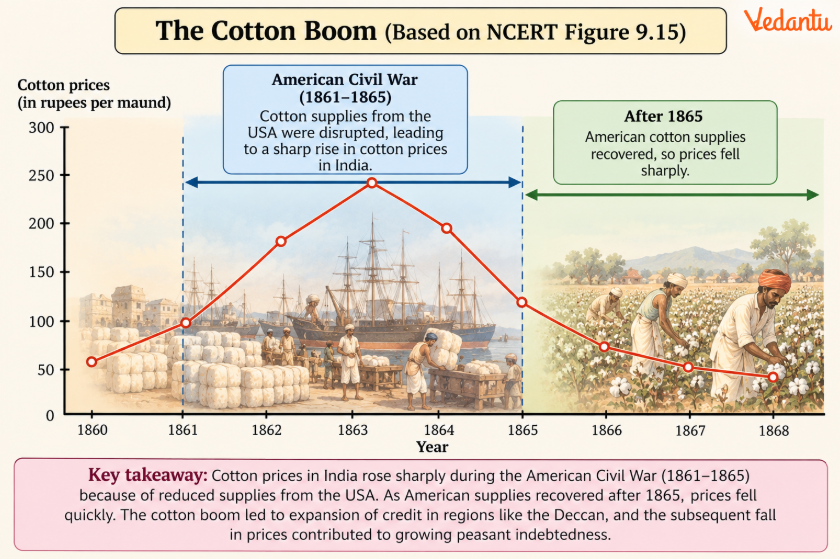
Q22. Explain how the American Civil War created a cotton boom in the Bombay Deccan and why this prosperity did not last.
Answer: The cotton boom of the 1860s shows how international developments influenced Indian agriculture and peasant indebtedness.
1. British Dependence on American Cotton: Before the 1860s, a large share of raw cotton imported into Britain came from America. British manufacturers wanted alternative sources of supply.
2. Efforts to Expand Cotton Production: The Cotton Supply Association was formed in 1857, followed by the Manchester Cotton Company in 1859. Both encouraged cotton production in regions suitable for the crop.
3. American Civil War: When the American Civil War began in 1861, cotton supplies from America were severely disrupted.
4. Growing Demand for Indian Cotton: British merchants increased their purchases of Indian cotton. Cotton prices rose sharply.
5. Expansion of Cultivation: Peasants in the Bombay Deccan expanded the area under cotton. According to the chapter, cotton acreage doubled between 1860 and 1864.
6. Increased Availability of Credit: Moneylenders offered advances to cultivators because high cotton prices made repayment seem likely.
7. Commercial Networks: Export merchants advanced money to urban traders, who provided credit to rural moneylenders and cotton producers.
8. Unequal Benefits: Some wealthy cultivators gained from high cotton prices.
However, many peasants became more deeply indebted because they borrowed money to expand cultivation.
9. End of the American Civil War: When the war ended in 1865, American cotton production recovered.
10. Falling Demand and Prices: British purchases of Indian cotton declined, and cotton prices fell.
11. Reduction in Credit: Moneylenders became reluctant to offer fresh loans and began demanding repayment of existing debts.
12. Rising Revenue Burden: At the same time, revised revenue assessments increased demands on cultivators.
13. Peasant Distress: Farmers faced falling earnings, high debts and declining access to credit.
Conclusion: The cotton boom brought temporary commercial opportunities but left many Deccan cultivators vulnerable when global demand declined.
Q23. Why did Deccan peasants revolt against moneylenders in 1875? Explain the causes, events and significance of the uprising.
Answer: The Deccan Riots of 1875 resulted from mounting peasant debt, rising revenue demands, and resentment against moneylending practices.
1. High Revenue Assessments: The ryotwari system made cultivators directly responsible for paying land revenue. Early settlements imposed demands that were difficult to meet.
2. Agricultural Problems: Poor rainfall, famine and falling agricultural prices reduced the income available to peasants.
3. Increasing Dependence on Loans: Many cultivators borrowed money to pay revenue and meet everyday expenses.
4. Cotton Boom and Borrowing: The cotton boom of the early 1860s encouraged farmers to increase cultivation using borrowed money.
5. Collapse of Cotton Prices: After the American Civil War ended, cotton demand and prices declined.
6. Reduction in Credit: Moneylenders became unwilling to extend further loans and pressed for repayment.
7. Exploitative Lending Practices: Peasants complained about excessive interest, manipulated accounts, unfair bonds and the loss of property.
8. Beginning at Supa: On 12 May 1875, cultivators gathered at Supa in Poona district and attacked moneylenders' establishments.
9. Destruction of Debt Records: Peasants demanded account books and debt bonds.
They burned these documents because they represented the legal basis of their debts.
10. Spread of Revolt: The movement spread from Poona to Ahmednagar and surrounding villages.
11. British Suppression: Officials established police posts, deployed troops and arrested suspected participants.
12. Importance of the Uprising: The revolt exposed the distress of rural cultivators and their anger towards moneylenders and the colonial legal system.
Conclusion: The Deccan Riots were not simply attacks on wealthy creditors. They expressed deep resentment against debt, exploitation, and the economic hardships of colonial rule.
Q24. How do the Fifth Report, Buchanan's journals and the Deccan Riots Report help historians reconstruct colonial rural history? Discuss their limitations.
Answer: Historians use official records to understand colonial policies, rural society and peasant resistance. However, these records reflect their authors' interests and viewpoints.
Part A: The Fifth Report
1. Background
The Fifth Report was submitted to the British Parliament in 1813.
It examined aspects of East India Company administration in India.
2. Information about Bengal
The report described revenue defaults, estate auctions and problems with Company administration.
3. Historical Importance
It provides figures and descriptions that help historians study changes in zamindari.
4. Limitations
The report emerged from parliamentary criticism of Company rule.
It sometimes exaggerated the collapse of traditional zamindari power and the scale of estate transfers.
Part B: Buchanan's Journals
5. Nature of the Records
Francis Buchanan travelled through different regions and recorded information about landscapes, people, agriculture and natural resources.
6. Rajmahal Observations
His journals provide information about Paharia and Santhal communities.
7. Economic Perspective
He examined resources such as minerals, forests, soils and crops that could be commercially useful.
8. Limitations
His writings often reflected the colonial desire to make landscapes more productive and profitable.
They did not always present local communities' views on their own terms.
Part C: The Deccan Riots Report
9. Commission of Enquiry
After the Deccan Riots, an official commission investigated the causes of the uprising.
It presented its report to Parliament in 1878.
10. Evidence Collected
The commission recorded statements from peasants, moneylenders and witnesses.
It also collected statistics about revenue assessments, prices and interest rates.
11. Peasant Petitions
The report preserves complaints about debt, unfair lending practices, and account manipulation.
12. Colonial Bias
The commission placed much of the blame on moneylenders while rejecting government revenue demands as the main cause of the uprising.
This shows colonial officials' reluctance to accept responsibility for peasant suffering.
Comparison of Historical Sources
Conclusion: Official records are valuable historical evidence, but they must be compared with local documents, newspapers, petitions and other sources to develop a balanced understanding of colonial rural society.
Why Practise Class 12 History Chapter 9 Important Questions with Vedantu?
Practising Class 12 History Chapter 9 Important Questions helps students understand how colonial revenue policies affected zamindars, peasants and tribal communities. The solved questions cover important historical events, economic changes, rural resistance and the interpretation of official records.
How to Prepare Class 12 History Chapter 9 Important Questions with Vedantu?
Revise key dates: Learn 1793, 1832, 1855–56, 1861 and 1875.
Compare revenue systems: Understand the Permanent Settlement and ryotwari arrangements.
Study rural communities: Focus on zamindars, jotedars, Paharias and Santhals.
Practise source-based questions: Revise the Fifth Report, Buchanan's observations and the Deccan Riots Report.
Study chapter illustrations and graphs: Interpret historical illustrations, rural power relationships and the cotton-price graph.
Important Study Material Links for Class 12 History Chapter 9
Chapter-Wise Important Questions for Class 12 History
Important Study Materials for Class 12 History
FAQs on Important Questions and Answers for Class 12 History Chapter 9 - Colonialism and the Countryside (Themes in Indian History-III) | 2026-27
1. Why did the Permanent Settlement fail to provide financial security to many Bengal zamindars?
The Permanent Settlement fixed a high revenue demand that zamindars had to pay regardless of agricultural conditions. Falling crop prices, difficulty collecting rent and strict payment deadlines caused many zamindars to accumulate arrears. The state could auction estates when they failed to pay.
2. What made the Burdwan auction of 1797 unusual?
Most of the auction purchases were not genuine transfers of control. Many buyers were servants or agents purchasing property on behalf of the Raja of Burdwan. According to the chapter, more than 95% of the sale was fictitious.
3. Why were jotedars sometimes more influential than zamindars within Bengal villages?
Jotedars lived in villages, controlled land, advanced loans and maintained direct relationships with cultivators. They could delay revenue payments and organise resistance to zamindari officials, making their influence particularly strong at the village level.
4. How did the Sunset Law affect revenue collection in Bengal?
The Sunset Law made timely payment compulsory. Zamindars who failed to pay revenue by sunset on the specified date risked having their estates auctioned, even when agricultural conditions were unfavourable.
5. Why did the Paharias resist British expansion into the Rajmahal hills?
The Paharias depended on forests and shifting cultivation for their livelihoods. British efforts to expand settled agriculture threatened their access to land, forest resources and traditional ways of life.
6. Why did the British encourage Santhals to settle in Damin-i-Koh?
Colonial officials wanted the Santhals to clear forests and establish permanent farms. This would expand cultivation, increase land revenue and bring the region more firmly under colonial administration.
7. What were the main causes of the Santhal rebellion of 1855–56?
The Santhals faced rising land revenue demands, high-interest loans, land loss, and pressure from zamindars. These grievances led them to rebel against moneylenders, zamindars and the colonial state.
8. How were the Paharias and Santhals different in their agricultural practices?
The Paharias mainly practised shifting cultivation and used forest resources, while the Santhals increasingly adopted settled plough agriculture. These differences became important as the colonial government expanded permanent cultivation.
9. Why did the British introduce the ryotwari system instead of extending the Permanent Settlement everywhere?
Colonial officials wanted a revenue system that could be revised as agricultural production and prices increased. Under the ryotwari settlement, officials assessed revenue directly with cultivators and revised it periodically.
10. How did the American Civil War influence cotton cultivation in the Bombay Deccan?
The war interrupted cotton supplies from America to Britain. British merchants increased purchases from India, raising cotton prices and cultivation in the Deccan. The temporary boom encouraged borrowing and agricultural expansion.
11. Why did Deccan peasants become more indebted after the cotton boom ended?
Cotton prices fell after American supplies recovered, while revenue demands and existing debts remained high. Moneylenders reduced fresh lending and demanded repayment, making it increasingly difficult for peasants to meet their expenses.
12. Why did peasants destroy account books and debt bonds during the Deccan Riots?
The documents recorded loans, interest and repayment obligations. Peasants believed that moneylenders used them to enforce unfair debts and seize property. Burning them challenged the system of indebtedness.
13. What information does the Fifth Report provide about colonial Bengal?
The Fifth Report contains information about land revenue collection, zamindari defaults, estate auctions and East India Company administration. Historians use it to study the effects of the Permanent Settlement, while recognising its political context.
14. Why should historians be cautious when using the Deccan Riots Report?
A colonial commission prepared the report, and it reflected official priorities. Although it recorded valuable evidence from peasants and moneylenders, it largely blamed creditors rather than government revenue policies for the uprising.
15. How can students use Class 12 History Chapter 9 Important Questions and Answers PDF for exam preparation?
Students can use the Class 12 History Chapter 9 Important Questions and Answers PDF to revise key dates, compare revenue systems, practise source-based answers, and understand events such as the Santhal rebellion and Deccan Riots. They should also practise interpreting chapter illustrations and historical records.