Class 12 Geography Chapter 6 Tertiary and Quaternary Activities: Important Questions for Exams
Students can use the Class 12 Geography Chapter 6 Important Questions and Answers PDF to practise questions based on service activities, knowledge-based industries, outsourcing, tourism, and the digital divide. The questions are organised into multiple-choice, very short answer, short answer, and long answer categories to make exam preparation more structured.
Class 12 Geography Chapter 6 (MCQ) Multiple Choice Questions
Q1. Which of the following is a tertiary economic activity?
(a) Hunting
(b) Trading
(c) Iron smelting
(d) Weaving
Answer: (b) Trading. Trade involves buying and selling goods.
Q2. Which activity primarily involves selling directly to consumers?
(a) Wholesale trading
(b) Retail trading
(c) Mining
(d) Manufacturing
Answer: (b) Retail trading.
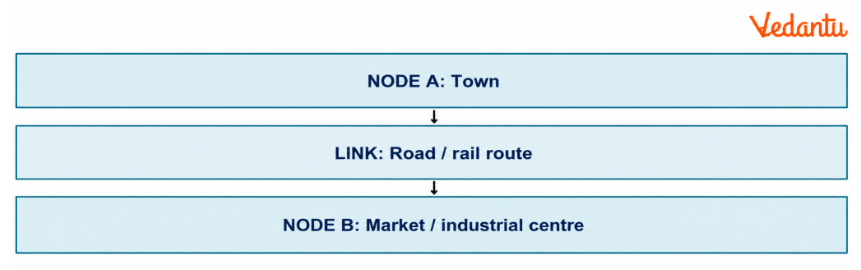
Q3. In a transport network, a road joining two nodes is known as a:
(a) Link
(b) Sector
(c) Market
(d) Service
Answer: (a) Link.
Q4. Lines joining places reached in equal travel time are called:
(a) Contours
(b) Isochrones
(c) Latitudes
(d) Boundaries
Answer: (b) Isochrones.
Q5. Which of the following is an example of mass media?
(a) Television
(b) A local delivery van
(c) A personal taxi
(d) A retail shop
Answer: (a) Television. Radio and television can reach large audiences.
Q6. Which of the following is closely associated with quaternary activities?
(a) Catching fish
(b) University teaching
(c) Making garments
(d) Iron smelting
Answer: (b) University teaching, a knowledge-based service.
Q7. The highest-level policy and decision makers are associated mainly with:
(a) Primary
(b) Secondary
(c) Quinary
(d) Retail
Answer: (c) Quinary activities.
Q8. Which term refers to contracting work to an outside agency to improve efficiency and reduce cost?
(a) Barter
(b) Outsourcing
(c) Wholesale trade
(d) Tourism
Answer: (b) Outsourcing.
Q9. Knowledge Process Outsourcing (KPO) particularly relies on:
(a) Highly skilled knowledge workers
(b) Only unskilled manual labour
(c) Raw material extraction
(d) Only local markets
Answer: (a) Highly skilled knowledge workers.
Q10. The unequal access to information and communication technology is called:
(a) Digital divide
(b) Time distance
(c) Agglomeration
(d) Wholesale exchange
Answer: (a) Digital divide.
Class 12 Geography Chapter 6 Very Short Answer Questions
Q11. Define tertiary activities.
Answer:
Tertiary activities provide commercial services rather than tangible goods. They include trade, transport, communication and professional services.
Q12. What is a rural marketing centre?
Answer: A local trading and distribution centre serving nearby rural settlements, often with a mandi and retail market.
Q13. What is wholesale trading?
Answer: Wholesale trading involves buying and selling goods in bulk, usually through intermediary merchants who supply retailers.
Q14. Define transport.
Answer: Transport is the service of physically moving people, raw materials and finished goods from one place to another.
Q15. What are isochrone lines?
Answer: Isochrone lines connect places that take the same amount of time to reach.
Q16. What is medical tourism?
Answer: Medical tourism combines travel with receiving medical treatment, often in another country.
Q17. What is meant by offshoring?
Answer: Offshoring is transferring work to an overseas location; it may occur as part of outsourcing.
Class 12 Geography Chapter 6 Short Answer Questions
Q18. Differentiate between retail and wholesale trading.
Retail: Sale of goods directly to consumers, through shops, peddlers, or online channels.
Wholesale: Bulk trade through intermediaries who normally supply retailers; wholesalers may also provide credit.
Q19. How do rural and urban marketing centres differ?
Rural centres: Serve nearby settlements, handle frequently demanded goods and usually have fewer specialised services.
Urban centres: Provide a wider range of manufactured goods, specialist markets and professional services such as health, law and education.
Q20. Explain three ways of measuring transport distance.
Kilometre distance: Actual route length.
Time distance: Time required to travel along a route.
Cost distance: Expense of travel on that route.
Q21. State four factors affecting transport routes.
Locations of settlements, industrial centres and raw materials.
Patterns of trade and size of population.
Landscape and climate along the route.
Funds available to overcome obstacles.
Q22. How have telecommunications changed communication?
Modern telecommunications let messages travel rapidly over long distances.
Mobile telephony enables direct, near-instant contact.
Radio and television reach mass audiences; satellites and the internet connect distant regions.
Q23. Explain the main attractions that promote tourism.
Climate: Warm sunshine or snow suitable for winter sports.
Landscape: Mountains, lakes, coasts and scenery.
History and art: Heritage sites, old towns, palaces and monuments.
Culture and economy: Local customs and affordable accommodation or travel.
Q24. Distinguish between quaternary and quinary activities.
Quaternary: Knowledge-oriented services involving information collection, production, research and dissemination.
Quinary: Highest-level decisions, policy-making, and specialised evaluation of ideas or technologies by senior experts.
Q25. Why do firms outsource work to other countries?
They seek efficiency and lower costs, especially where trained workers are available at comparatively lower wages.
Outsourcing can create employment in receiving countries, while it may also face resistance from job seekers in countries sending work overseas.
Class 12 Geography Chapter 6 Long Answer Questions
Q26. Explain the significance and growth of the service sector in modern economies.
Meaning: Tertiary activities provide services; output is usually measured in wages or salaries rather than tangible goods.
Production and exchange: Services include professional work, trade, transport and communication that help overcome distance.
Employment change: At early stages of development, the primary sector employs more workers. In developed economies, a much larger share of workers work in services.
Importance: Education, health, finance, retail and communication support households and other sectors.
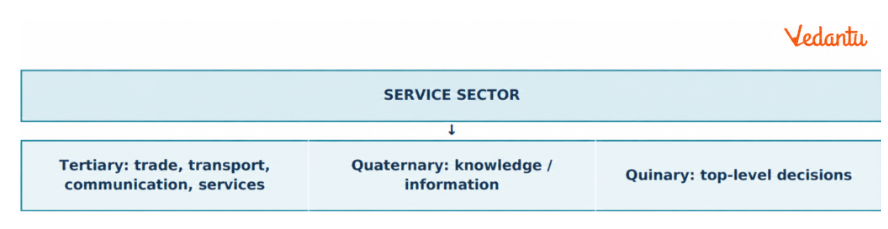
Growing specialisation: Quaternary knowledge services and quinary decision-making become increasingly important in advanced economies.
Q27. Discuss the significance of transport and communication services.
Transport: Moves people, raw materials and finished goods. It supports production, distribution and consumption, adding value by making products accessible.
Route selection: Transport demand depends on population; settlements, industries, terrain, climate, trade patterns, and available funds shape routes.
Measures of distance: Kilometre distance, time distance and cost distance; isochrones represent equal travel times.
Communication: Transmits messages, facts and ideas. Modern telecommunications, mobile services, satellites and the internet reduce time barriers.
Combined effect: Efficient transport networks and fast communications strengthen economic integration and service delivery.
Q28. Explain the role of tourism and the factors that attract tourists.
Tourism: Recreational travel that employs accommodation, food, transport, entertainment, shops and related services.
Economic role: Stimulates transport infrastructure, retail trade and handicraft or souvenir industries.
Climate: Sun, warmth and favourable seasonal conditions attract beach tourists; snow draws winter-sports visitors.
Landscape: Mountain scenery, lakes and attractive coasts create demand.
History and culture: Monuments, heritage towns, customs and local traditions attract travellers.
Cost: Affordable travel, stays and services also influence destination choice. Tourism may be seasonal or year-round.
Q29. Describe quaternary and quinary activities and compare them with examples.
Quaternary activities: Advanced services centred on collecting, creating, processing and sharing information. They rely on technical skills and specialised knowledge.
Examples: Research and development, software work, statistical analysis, consultancy and university-based work.
Quinary activities: Work of top-level decision makers who develop policy and evaluate ideas, data and emerging technologies.
Examples: Senior business executives, high government officials, research leaders and expert financial or legal consultants.
Main difference: Quaternary emphasises producing and using knowledge; quinary emphasises strategic decisions and policy at the highest level.
Q30. What is outsourcing?
Explain KPO and the digital divide in the context of global services.
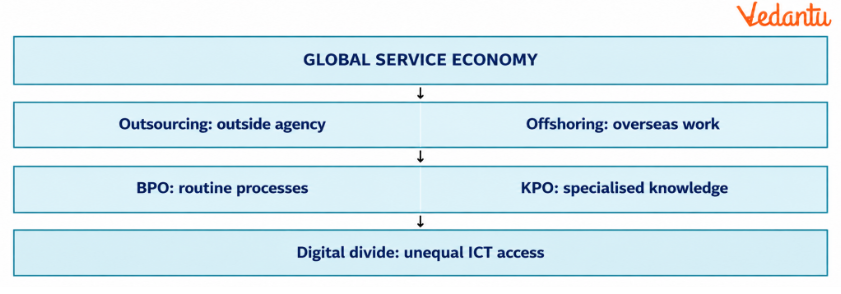
Outsourcing: Contracting work to outside agencies to improve efficiency and reduce costs. When work moves overseas, it is called offshoring.
Areas: IT, customer support, call centres, human resources and sometimes engineering or manufacturing.
KPO: Knowledge Process Outsourcing needs highly skilled employees; examples include R&D, legal research, e-learning and business research. It differs from BPO because it is more knowledge-intensive.
Outcomes: Outsourcing can create jobs in receiving countries and reduce costs, but it may cause dissatisfaction in countries sending work abroad.
Digital divide: Unequal access to ICT services across countries and within a country, such as better connectivity in metropolitan areas than in remote rural areas.
Key Topics to Focus on for Class 12 Geography Chapter 6: Tertiary and Quaternary Activities Important Questions
Before attempting important questions from Chapter 6, students should understand how tertiary, quaternary, and quinary activities differ and why they matter to modern economies.
Pay special attention to the classification of services, knowledge-based activities, outsourcing, and the digital divide. These concepts help students prepare for definition-based, comparison-based, and detailed explanation questions.
How Vedantu's Class 12 Geography Chapter 6 Important Questions Help Students Prepare for Exams
Vedantu's Class 12 Geography Chapter 6 Important Questions and Answers help students understand Tertiary and quaternary activities through focused practice.
The chapter explains how services, technology, and knowledge-based activities support economic growth. Practising questions from these topics helps students connect textbook concepts with real-world examples and improve their exam preparation.
Students can benefit from this chapter-wise practice material in the following ways:
Strengthen Conceptual Understanding: Learn the differences between tertiary, quaternary, and quinary activities with clear examples.
Practise Different Question Types: Prepare for MCQs, very short answer, short answer, and long answer questions from Chapter 6.
Improve Answer-Writing Skills: Practise explaining topics such as outsourcing, tourism, service activities, and the digital divide using well-structured points.
Identify Important Concepts: Focus on the meaning, classification, and importance of service-based and knowledge-based activities.
Build Exam Confidence: Attempt questions independently, compare answers, and identify topics that need more attention.
Prepare at Your Own Pace: Use the Class 12 Geography Chapter 6 Important Questions PDF for convenient chapter-wise question practice before exams.
Students should first read Chapter 6 in their NCERT textbook, then attempt the important questions without checking the answers.
Comparing responses with the provided solutions helps students identify mistakes, understand concepts more clearly, and improve answer presentation for their Geography examinations.
Important Study Material Links for Class 12 Geography Chapter 6 (Fundamentals of Human Geography)
CBSE Class 12 Geography other books Important Questions and Study Resources
Chapter-Wise Important Questions for Class 12 Geography – Fundamentals of Human Geography
Important Study Materials for Class 12 Geography
FAQs on Important Questions and Answers for Class 12 Geography (Fundamentals of Human Geography) Chapter 6 Tertiary and Quaternary Activities | 2026-27
1. What are the most important questions from Class 12 Geography Chapter 6 Tertiary and Quaternary Activities?
Chapter 6 covers tertiary, quaternary, and quinary activities; types of services; outsourcing; tourism; and the digital divide. Students should practise questions on the differences between these activities, the importance of the service sector, and the role of technology in economic development.
2. Which topics should students focus on for Class 12 Geography Chapter 6 board exams?
Students should focus on the classification of tertiary activities, retail and wholesale trading, tourism, outsourcing, quaternary and quinary services, and the digital divide. Understanding the meaning, characteristics, and examples of these topics helps students answer both short- and long-answer questions.
3. What is the difference between tertiary and quaternary activities in Class 12 Geography?
Tertiary activities provide services such as trade, transport, tourism, and communication. Quaternary activities involve knowledge-based services such as information processing, research, and information technology. The main difference is that tertiary activities cover a broad range of services, while quaternary activities focus mainly on information and specialised knowledge.
4. Why are tertiary and quaternary activities important for economic development?
Tertiary and quaternary activities create employment opportunities, support businesses, and improve access to services and information. Tertiary activities connect producers and consumers through services such as transport and trade, while quaternary activities support research, technology, and innovation.
5. What types of questions are included in Class 12 Geography Chapter 6 Tertiary and Quaternary Activities Questions and Answers?
Students can practise multiple-choice questions (MCQs), very short-answer, short-answer, and long-answer questions. These cover definitions, differences between economic activities, examples of services, outsourcing, tourism, and the digital divide. Practising different question formats helps students improve their understanding and answer-writing skills.
6. Where can students get Class 12 Geography Chapter 6 Important Questions and Answers PDF?
Students can access Class 12 Geography Chapter 6 Tertiary and Quaternary Activities Important Questions and Answers on Vedantu. The page provides chapter-specific question practice with answers to help students understand key concepts and prepare for exams. Students can also use the PDF download option, when available, for offline practice.
7. How should students use Vedantu's Class 12 Geography Chapter 6 Important Questions for exam preparation?
Students should first understand the chapter from their NCERT textbook and then attempt Vedantu's important questions independently. After completing the questions, they can compare their answers with the provided solutions, identify mistakes, and practise difficult concepts again. This helps improve conceptual clarity, answer-writing skills, and confidence in exams.