Class 12 Computer Science Chapter 7 Understanding Data Questions and Answers PDF
Class 12 Computer Science Chapter 7 Important MCQs
1. Which of the following is an example of structured data?
(a) Newspaper article
(b) Audio recording
(c) Inventory table containing product names and prices
(d) Social media video
Answer:
(c) Inventory table containing product names and prices.
Explanation: Structured data is organised in a well-defined format, usually rows and columns.
2. Which of the following is an example of metadata associated with an image?
(a) Name of a shopkeeper
(b) Image resolution
(c) Customer's bank balance
(d) Number of students in a class
Answer:
(b) Image resolution.
3. Which statistical technique identifies the value that occurs most frequently in a dataset?
(a) Mean
(b) Median
(c) Mode
(d) Range
Answer:
(c) Mode.
Explanation: The mode is the value that occurs most frequently in a dataset.
4. Which of the following measures of central tendency is generally less sensitive to outliers?
(a) Mean
(b) Median
(c) Both are equally sensitive
(d) Neither can be calculated
Answer:
(b) Median.
Explanation: The mean can be strongly affected by exceptionally large or small values. The median is the middle value of sorted data.
5. Which statistical technique measures the spread of data by considering all its values?
(a) Mode
(b) Median
(c) Range
(d) Standard deviation
Answer:
(d) Standard deviation.
Explanation: Unlike range, which considers only the maximum and minimum values, standard deviation uses all values to measure their spread around the mean.
Class 12 Computer Science Chapter 7 Very Short Answer Questions
6. What is data? Give any four examples.
Answer
Data is a collection of characters, numbers, and other symbols that represent values of situations or variables.
Four examples are:
1. Name, age, gender and contact details of a person.
2. Banking and shopping transactions.
3. Images, graphics, audio and video.
4. Data generated by sensors and satellites.
7. Why is data important in decision-making? Give two examples.
Answer:
Data helps people and organisations make decisions by providing facts that can be processed and analysed.
Examples:
1. Banks maintain account and transaction data to update balances after ATM withdrawals.
2. Meteorological offices monitor satellite data to identify approaching cyclones or heavy rainfall.
8. What is structured data? Explain attributes and observations.
Answer:
Structured data are organised in a well-defined format, generally in rows and columns.
Attributes: Each column represents a parameter or characteristic, such as Product Name, Unit Price, or Discount.
Observations: Each row represents the values of different attributes for one item.
9. What is unstructured data? Give three examples.
Answer:
Unstructured data does not follow the traditional row-and-column structure.
Three examples mentioned in the chapter are:
1. Newspaper articles.
2. Email content.
3. Audio and video files.
10. What is metadata? Give examples related to an email and an image.
Answer:
Metadata is data about data. It describes other data.
Email metadata: Subject, recipient and attachment information.
Image metadata: Image size, file type such as JPEG or PNG, and image resolution.
11. What is data collection? Mention any situations.
Answer:
Data collection means identifying or gathering data from appropriate sources for processing.
1. Sales data are available in a diary or register and must be entered into a digital format.
2. Sales data are already available digitally, such as in a CSV file.
3. No sales data have been recorded, so software can be developed to store and retrieve future records using a CSV file or a database such as MySQL.
12. What is data storage? Name any five storage devices.
Answer:
Data storage is the process of saving data on storage devices so that it can be retrieved later.
Five storage devices mentioned in the chapter are:
1. Hard Disk Drive (HDD).
2. Solid State Drive (SSD).
3. CD/DVD.
4. Pen Drive.
5. Memory Card.
13. Define mean, median and mode.
Answer:
Mean: The average of numerical values of an attribute.
Median: The middle value of data arranged in ascending or descending order. When the number of values is even, it is the average of the two middle values.
Mode: The value that appears most frequently in a dataset. A dataset can have multiple modes or no mode.
14. Define range and standard deviation.
Answer:
Range is the difference between the maximum and minimum values in numerical data.
Range = Maximum - Minimum
Standard deviation measures how spread out the values are around the mean. A smaller standard deviation indicates less spread, while a larger standard deviation indicates greater spread.
Class 12 Computer Science Chapter 7 Short Answer Questions
15. Differentiate between structured and unstructured data with examples.
Answer:
16: Explain how data is used in different fields for decision-making.
Answer:
The chapter explains the importance of data in different fields.
Banking: Banks maintain customer account details and transactions to record withdrawals and update balances.
Weather forecasting: Meteorological offices analyse satellite data to identify upcoming cyclones and heavy rainfall.
Business: Companies analyse customer demand and feedback to improve products and services.
Healthcare: Pharmaceutical companies record data while testing new medicines to study their effectiveness.
Libraries: Libraries maintain information about books and memberships.
Conclusion: Data is collected and analysed to support decisions across different activities.
17. Explain the main steps of data processing with a flowchart.
Answer:
Data processing converts raw data into meaningful information.
There are three main stages in the data processing cycle:
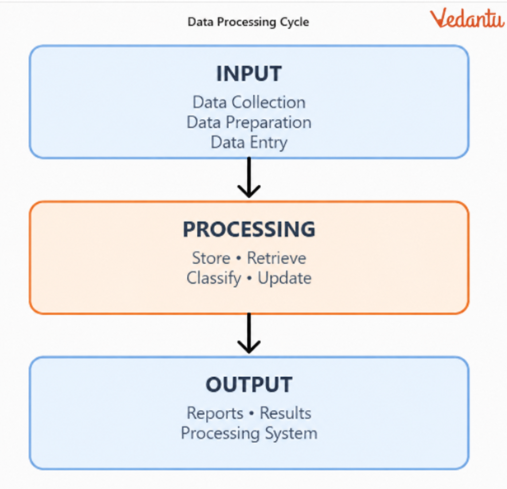
Data processing converts raw data into meaningful information.
Step 1 – Input: Data is collected, prepared and entered into the system.
Step 2 – Processing: The system stores, retrieves, classifies, and updates data.
Step 3 – Output: The system presents the processed information as reports or results.
18. Explain the difference between mean, median and mode using the height data given below.
90, 102, 110, 115, 85, 90, 100, 110, 110 cm.
Answer:
The given heights of nine students:
90, 102, 110, 115, 85, 90, 100, 110, 110 cm.
Mean:
$\text{Mean} = \frac{912}{9} = 101.33\,\text{cm}$
Median:
Arrange the data in ascending order:
85, 90, 90, 100, 102, 110, 110, 110, 115
The middle value is 102 cm.
Mode:
110 occurs three times, more than any other value.
Mode = 110cm
Class 12 Computer Science Chapter 7 Long Answer Questions
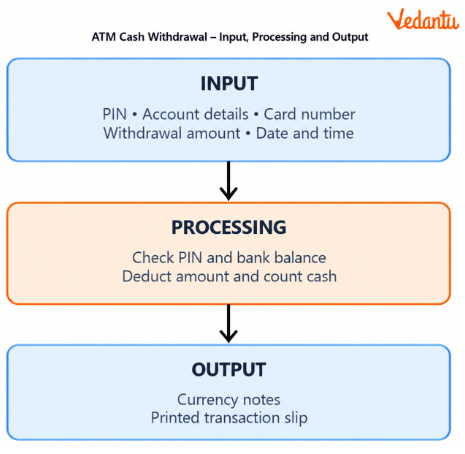
19. Explain the process of cash withdrawal through an ATM in terms of input, processing and output.
Answer:
1. Input
The ATM system receives details such as:
ATM PIN.
Account type and account number.
Card number.
Withdrawal amount.
ATM location, date and time.
2. Processing
The system checks whether the PIN is valid and whether the account has sufficient balance. If these conditions are met, the system deducts the withdrawal amount from the account and counts the cash.
3. Output
The system provides currency notes and a printed transaction slip.
20. Explain how an online examination registration system processes data to generate an admit card.
Answer:
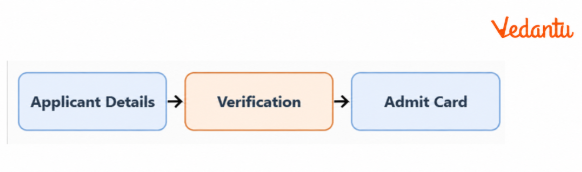
An online examination registration system is an example of data processing.
1. Input: The applicant enters their name, address, qualifications, marks, mobile number, photograph, signature, examination centre choice and payment details.
2. Processing: The system checks whether the submitted information is correct, verifies eligibility and payment, confirms that the required photograph and signature have been uploaded, and generates a roll number.
3. Output: An examination admit card containing the roll number, examination centre address, date and time.
21. Explain the process of issuing train tickets through data processing.
Answer:
Input:
Starting and destination stations.
Journey date and number of tickets.
Travel class and berth preference.
Passenger names and ages.
Mobile number, email ID and payment details.
Processing:
The system verifies login details, checks berth availability, processes payment and updates the remaining ticket availability. It allocates a PNR number and assigns berths or a waiting-list number.
Output:
A train ticket containing the allocated coach and berth numbers, or a waiting-list number.
How to Prepare Class 12 Computer Science Chapter 7 Understanding Data for Exams
Understanding Data becomes easier when students learn which statistical technique to apply to a particular problem, rather than memorising definitions and formulas alone.
The NCERT exercises include real-world questions about scholarship selection, temperature records, school results, bank accounts and sales data.
The following table helps students identify the correct technique based on what a question asks.
Why Practise Class 12 Computer Science Chapter 7 Important Questions with Vedantu?
Vedantu's Chapter 7 Important Questions and Answers help students understand textbook concepts and practise questions in different formats.
Revise important topics through simple questions and explanations.
Practice MCQs, very short, short, and long-answer questions.
Understand numerical problems with step-by-step solutions.
Strengthen your knowledge through NCERT-based examples.
Check your preparation and identify topics that need more attention.
Important Study Material Links for Class 12 Computer Science Chapter 7: Understanding Data
Students can strengthen their understanding of Understanding Data using these chapter-specific learning resources.
Class 12 Computer Science Chapter-Wise Important Class 12 Computer Science Chapter-Wise Important Questions
Additional Study Materials for Class 12 Computer Science
FAQs on Important Questions and Answers for Class 12 Computer Science Chapter 7 Understanding Data | 2026-27
1. Why are Vedantu's Important Questions for Class 12 Computer Science Chapter 7 useful for exam preparation?
Vedantu's Chapter 7 Important Questions and Answers help students understand key textbook concepts such as data types, data collection, data processing and statistical techniques. The questions cover different formats, including short answers, long answers, and numerical problems, helping students practise writing accurate exam answers.
2. What are the most important topics in Class 12 Computer Science Chapter 7: Understanding Data?
Key topics include structured and unstructured data, metadata, data collection, data storage, the data processing cycle, and statistical techniques such as mean, median, mode, range, and standard deviation. Students should also understand the real-life applications explained in the NCERT chapter.
3. What is the difference between structured and unstructured data in Chapter 7 Understanding Data?
Structured data are organised in a fixed format, usually rows and columns, such as student records and inventory tables. Unstructured data do not follow a fixed tabular format and include emails, images, videos and social media content. The chapter explains both types with examples.
4. How can students solve numerical questions from Class 12 Computer Science Chapter 7?
Students should understand the formulas for mean, median, mode, range and standard deviation. While solving numerical questions, they should write the formula, substitute the given values and show each calculation step. Vedantu's Chapter 7 Important Questions and Answers provide worked examples to help students practise these calculations.
5. Does Class 12 Computer Science Chapter 7 include questions on the data processing cycle and flowcharts?
Yes. Chapter 7 explains the data processing cycle through three stages: input, processing and output. It also includes examples of ATM withdrawals, online examination registration and train ticket booking. Students should understand the input data, processing steps and final output for each application.
6. Where can students access Class 12 Computer Science Chapter 7 Important Questions and Answers online?
Students can access Class 12 Computer Science Chapter 7 Important Questions and Answers on Vedantu. The page offers chapter-based questions with answers covering definitions, statistical calculations, data processing concepts and NCERT-based applications.
7. Are NCERT exercise questions enough to prepare for Class 12 Computer Science Chapter 7 Understanding Data?
NCERT exercise questions are important, but students should also understand the definitions, examples, diagrams and statistical calculations explained throughout the chapter.
Practising Vedantu's Chapter 7 Important Questions alongside NCERT exercises helps students strengthen conceptual understanding and prepare for different exam question formats.