When Is Maharishi Valmiki Jayanti 2026 and Why Is It Celebrated?
Maharishi Valmiki Jayanti 2026 will be celebrated on Monday, 26 October 2026, in India. The festival falls on Ashwin Purnima, the full moon day of the Hindu month of Ashwin, and honours Maharishi Valmiki, the revered sage traditionally credited with composing the Sanskrit Ramayana. He is also known as Adi Kavi, meaning the first poet.
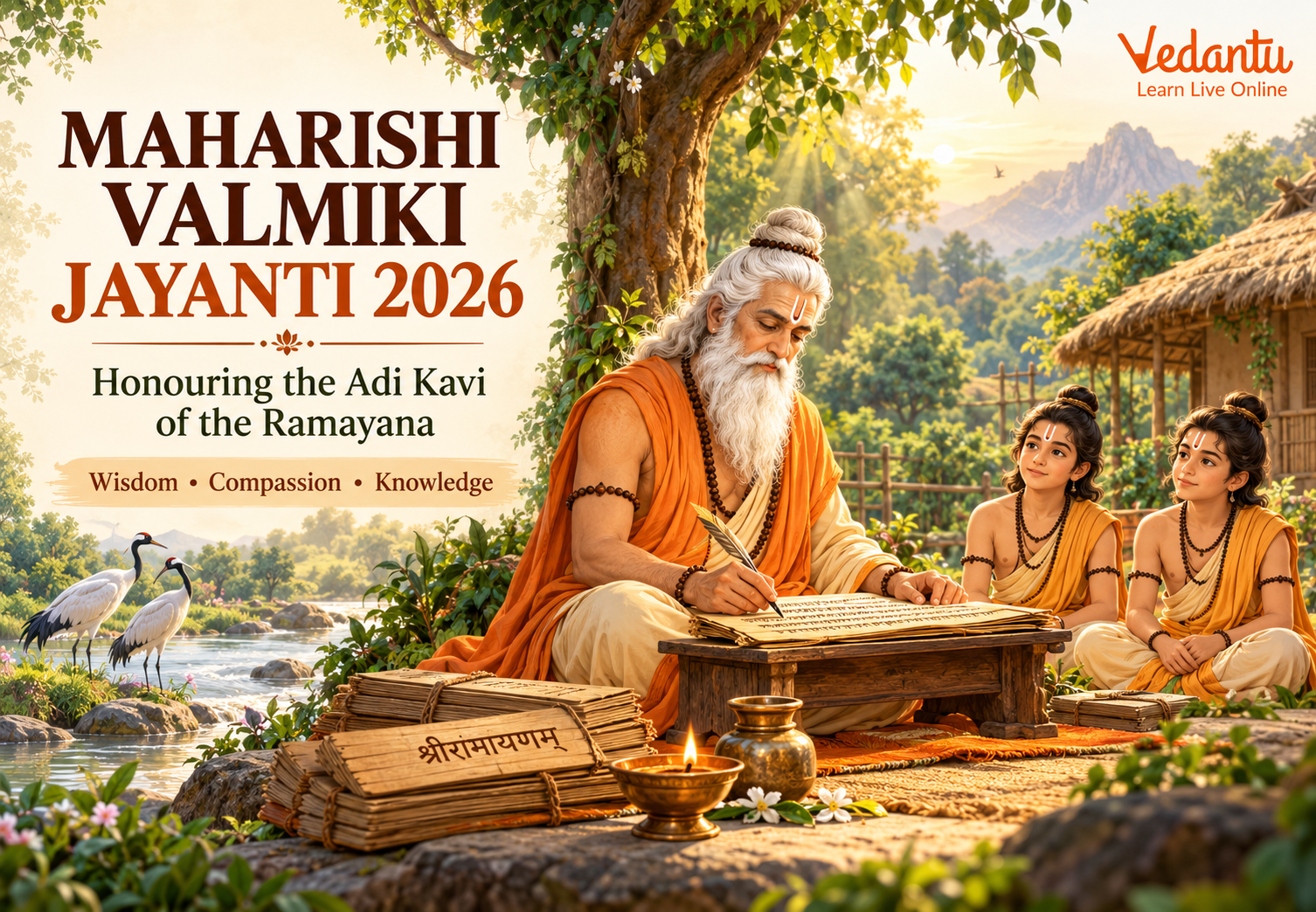
Valmiki Jayanti celebrates the sage's contribution to Sanskrit literature, spiritual teachings and Indian cultural heritage. Devotees observe the occasion through prayers, Ramayana recitations, Shobha Yatras (religious processions) and charitable activities. The festival is also known as Pargat Diwas or Pragat Diwas in several communities.
According to Drik Panchang, Valmiki Jayanti 2026 falls on 26 October, while Sharad Purnima is observed on 25 October. Although both are connected with Ashwin Purnima, their observance dates may differ because of lunar calendar rules.
For students, Maharishi Valmiki's life and literary legacy offer meaningful lessons about compassion, responsibility, poetry and the importance of learning from one's actions.
Valmiki Jayanti 2026 Date, Purnima Tithi and Important Details
The following table provides the key information about Valmiki Jayanti 2026.
Calendar reference: Drik Panchang, India, 2026. Purnima timings are shown in Indian Standard Time. Readers should consult their city-specific Panchang when planning religious observances.
Is Valmiki Jayanti on 25 or 26 October 2026?
Valmiki Jayanti is observed on 26 October 2026 in India, according to Drik Panchang.
The confusion arises because Purnima Tithi begins on 25 October and continues into the morning of 26 October.
Sharad Purnima is observed on 25 October in the checked Indian festival calendar, while Maharishi Valmiki Jayanti is listed on 26 October.
The festival dates can differ between countries because lunar dates and their observance depend on local sunrise and traditional calendar rules.
Who Was Maharishi Valmiki?
Maharishi Valmiki is a revered sage and poet in Hindu tradition, best known as the composer of the Valmiki Ramayana, one of India's most influential Sanskrit epics.
The Ramayana narrates the life of Lord Rama, his marriage to Sita, his exile, the abduction of Sita by Ravana and the events that follow.
Through its characters and stories, the epic explores duty, courage, loyalty, justice, compassion and the consequences of human decisions.
Valmiki's contribution extends beyond religious literature. His work has influenced Indian languages, poetry, theatre, dance, music and storytelling traditions for generations.
Although Maharishi Valmiki's life is surrounded by traditional accounts, his exact birth year and other biographical details cannot be established with certainty through historical evidence.
Important Facts About Maharishi Valmiki
Why Is Maharishi Valmiki Called Adi Kavi?
Maharishi Valmiki is traditionally called Adi Kavi, or the first poet, because of his association with the emergence of Sanskrit poetic verse.
One well-known account connects the origin of his poetry with an incident involving two Krauncha birds.
According to the traditional story, Valmiki saw a hunter kill one bird from a pair. The grief of the surviving bird deeply moved him, and he expressed his sorrow in a rhythmic verse.
The verse is traditionally regarded as the first Shloka of Sanskrit poetry.
The Krauncha Bird Story and the First Sanskrit Shloka
The well-known verse associated with this incident is:
मा निषाद प्रतिष्ठां त्वमगमः शाश्वतीः समाः।
यत्क्रौञ्चमिथुनादेकमवधीः काममोहितम्॥
The verse condemns the killing of one of the birds in a loving pair.
In the Ramayana tradition, this moment represents how compassion and grief inspired poetic expression.
It helps explain why Maharishi Valmiki is remembered not only as a religious sage but also as an important figure in the history of Sanskrit literature.
For students studying poetry, the story illustrates how human emotions, observation and language can come together to create meaningful literature.
What Is the Story of Ratnakar Becoming Maharishi Valmiki?
One of the most popular stories associated with Maharishi Valmiki describes his transformation from Ratnakar into a respected sage.
This is a traditional devotional narrative, not a historically verified biography.
According to the story, Ratnakar lived by robbing travellers to support his family.
One day, he encountered Sage Narada, who asked whether his family members would share responsibility for the wrong actions Ratnakar committed on their behalf.
When Ratnakar questioned his family, he realised that the responsibility for his actions belonged to him.
The experience caused him to reflect on his behaviour and seek a different path.
With Narada's guidance, Ratnakar turned towards meditation and spiritual practice.
Some versions of the story describe him chanting a sacred name for so long that an anthill formed around him.
The Sanskrit word Valmika means anthill, and the traditional narrative connects this word with the name Valmiki.
What Does the Ratnakar Story Teach Us?
The traditional story highlights several meaningful ideas:
Personal Responsibility: Every person is responsible for their decisions and actions.
Self-Reflection: Recognising mistakes is an important part of learning.
Positive Change: People can improve their behaviour through sincere effort.
Patience: Meaningful transformation often requires dedication and time.
Guidance: Advice from teachers and mentors can help people make better choices.
The story is remembered because it presents transformation as a process of learning, accountability and self-improvement.
What Was Maharishi Valmiki's Contribution to the Ramayana?
Maharishi Valmiki is traditionally credited with composing the Valmiki Ramayana, a major Sanskrit epic that narrates Lord Rama's life and explores the meaning of dharma, or righteous conduct.
The epic is traditionally described as containing approximately 24,000 Shlokas divided into seven Kandas, or books.
Each Kanda describes an important stage in the narrative.
Seven Kandas of the Valmiki Ramayana
The Ramayana has been adapted and retold in many Indian languages, making it an important part of India's literary and cultural heritage.
It has also influenced traditional theatre, dance and storytelling across several parts of Asia.
What Was Maharishi Valmiki's Role in the Lives of Lava and Kusha?
According to the Uttara Kanda tradition, Sita found refuge in Maharishi Valmiki's hermitage during a difficult period of her life.
Her twin sons, Lava and Kusha, grew up under the sage's guidance.
Valmiki is traditionally described as their teacher, instructing them in knowledge, values and the recitation of the Ramayana.
The story highlights the importance of education, oral storytelling and passing knowledge from one generation to another.
Why Is Maharishi Valmiki Jayanti Celebrated?
Maharishi Valmiki Jayanti honours the sage's contribution to literature, religious thought and cultural traditions.
The celebration also encourages people to reflect on the teachings associated with his life and the Ramayana.
Honouring Sanskrit Literature
Maharishi Valmiki's contribution to Sanskrit poetry holds an important place in Indian literary tradition.
Valmiki Jayanti provides an opportunity to introduce younger generations to classical literature and storytelling.
Remembering the Values of the Ramayana
The Ramayana explores ideas such as duty, loyalty, truthfulness, justice and compassion.
These themes continue to be discussed in literature, education and cultural activities.
Recognising the Importance of Personal Growth
The traditional Ratnakar story reminds people that reflection and responsible choices can lead to meaningful change.
Preserving Cultural Heritage
Valmiki Jayanti celebrations help preserve Ramayana recitation, devotional singing, storytelling and community traditions.
Encouraging Service and Compassion
Many communities mark the occasion through charitable work, food distribution and other activities that support people in need.
How Is Valmiki Jayanti Celebrated Across India?
Valmiki Jayanti 2026 is observed through religious gatherings, cultural programmes and community activities.
Celebrations may differ across states, cities and local communities.
Temple Visits and Special Prayers
Devotees visit temples dedicated to Maharishi Valmiki and offer flowers, prayers and lamps.
Some temples organise special ceremonies and devotional programmes to honour the sage.
Shobha Yatras and Community Processions
Shobha Yatras are an important part of Valmiki Jayanti celebrations in several communities.
These processions may include decorated vehicles, devotional music, cultural performances and representations of Maharishi Valmiki.
Ramayana Recitation and Storytelling
Families and religious organisations read or listen to passages from the Ramayana.
Storytelling sessions help children understand the epic's characters, events and literary importance.
Community Service and Charity
Some communities distribute food, clothing and other useful items to people in need.
These activities reflect the importance of kindness and social responsibility.
School and Cultural Programmes
Educational institutions may organise speeches, poetry readings, quizzes and discussions about Maharishi Valmiki's contribution to Indian literature.
Such events encourage students to learn about the cultural significance of Valmiki Jayanti.
How Can Valmiki Jayanti Be Celebrated at Home?
Families who observe Valmiki Jayanti at home may follow a simple devotional routine according to their traditions.
Clean the prayer area and prepare a suitable place for worship.
Place a picture of Maharishi Valmiki in the prayer space.
Offer flowers and light a diya safely.
Read or listen to a passage from the Valmiki Ramayana.
Discuss the values and teachings associated with the sage.
Conclude with prayers or an act of kindness.
Note: Valmiki Jayanti does not have one compulsory puja procedure followed by all communities. Families may observe the occasion according to their own customs.
Is Valmiki Jayanti 2026 a Public Holiday in India?
Valmiki Jayanti 2026 falls on Monday, 26 October, but its holiday status varies between states and institutions.
Some state governments and organisations recognise the occasion through official or restricted holiday arrangements.
The holiday calendar applicable to an individual depends on the state, government department, employer or school.
Students and parents should check the relevant school calendar or government notification before assuming that educational institutions will be closed.
Valmiki Jayanti should not be described as a compulsory nationwide holiday.
What Can Students Learn From Maharishi Valmiki's Life?
Maharishi Valmiki's literary legacy and traditional stories offer several lessons that students can connect with everyday learning.
Students can use these ideas while studying literature, preparing speeches or participating in classroom discussions.
Interesting Facts About Maharishi Valmiki
Here are some important facts that students may find useful:
Maharishi Valmiki is traditionally known as Adi Kavi, meaning the first poet.
He is traditionally credited with composing the Sanskrit Ramayana.
The Valmiki Ramayana is commonly described as having approximately 24,000 Shlokas.
The epic is traditionally divided into seven Kandas.
The Krauncha bird incident is associated with the origin of Sanskrit poetic verse.
According to the Uttara Kanda tradition, Valmiki guided Lava and Kusha.
The Ratnakar transformation story is a popular devotional narrative associated with the sage.
Valmiki Jayanti is celebrated on Ashwin Purnima and is also called Pargat Diwas in some communities.
Valmiki's literary influence extends to storytelling, music, dance and theatre.
Maharishi Valmiki Jayanti 2026 Wishes and Greetings
Share these original wishes with friends, teachers and family members.
"Happy Valmiki Jayanti 2026! May Maharishi Valmiki's teachings inspire wisdom, kindness and responsibility."
"Wishing you a peaceful Valmiki Jayanti filled with learning, compassion and positive thoughts."
"May the literary legacy of Adi Kavi encourage us to value knowledge and truth."
"On Maharishi Valmiki Jayanti, let us celebrate the power of learning and meaningful change."
"May this special occasion inspire us to respect literature, culture and the wisdom of our teachers."
Valmiki Jayanti Wishes in Hindi
"महर्षि वाल्मीकि जयंती की हार्दिक शुभकामनाएं! उनके विचार हमें सत्य, ज्ञान और करुणा के मार्ग पर चलने की प्रेरणा दें।"
"आदिकवि महर्षि वाल्मीकि की जयंती पर सभी को शुभकामनाएं। आइए, साहित्य और शिक्षा का सम्मान करें।"
"महर्षि वाल्मीकि जयंती के अवसर पर आपके जीवन में सकारात्मकता, शांति और खुशियां बनी रहें।"
Inspiring Valmiki Jayanti Quotes and Slogans
The following are original educational slogans suitable for school events, posters and awareness programmes.
"Celebrate the wisdom of Adi Kavi, the poet of the Ramayana."
"Knowledge inspires growth, and compassion gives it meaning."
"Let literature guide us towards understanding and kindness."
"Valmiki Jayanti celebrates poetry, learning and cultural heritage."
"A better tomorrow begins with responsible choices today."
These are suggested slogans, not historical quotations from Maharishi Valmiki.
Sample 10-Line Speech on Maharishi Valmiki Jayanti 2026
Good morning, everyone! Today, I am going to speak about Maharishi Valmiki Jayanti 2026.
Valmiki Jayanti will be celebrated on Monday, 26 October 2026.
The festival honours Maharishi Valmiki, one of India's most revered sages.
He is traditionally known as Adi Kavi, meaning the first poet.
Maharishi Valmiki is credited with composing the Sanskrit Ramayana.
The Ramayana is an important epic that explores duty, courage and compassion.
Valmiki Jayanti is celebrated through prayers, processions and Ramayana recitations.
His traditional stories teach us about responsibility and positive change.
As students, we can honour his legacy by respecting literature and practising kindness.
Thank you, and Happy Maharishi Valmiki Jayanti 2026!
School Activities for Maharishi Valmiki Jayanti 2026
Schools can use Valmiki Jayanti to introduce students to Sanskrit literature, Indian epics and cultural traditions.
Useful activities include:
Speech Competition: Explain Maharishi Valmiki's contribution to the Ramayana.
Storytelling: Present the Krauncha bird story or the traditional Ratnakar narrative.
Literature Quiz: Ask questions about the seven Kandas, main characters and Adi Kavi.
Poster Making: Create artwork highlighting knowledge, compassion and classical poetry.
Reading Activity: Read a suitable translated passage from the Ramayana and discuss its meaning.
Creative Writing: Write a short poem inspired by nature, kindness or personal responsibility.
These activities can help students appreciate literary traditions while practising communication and creative thinking.
Remembering Maharishi Valmiki's Legacy in 2026
Maharishi Valmiki Jayanti 2026, observed on 26 October, is an occasion to honour a sage whose literary contribution continues to influence Indian culture.
Remembered as Adi Kavi and the traditional composer of the Ramayana, Maharishi Valmiki holds an important place in Sanskrit literature and religious tradition.
His association with poetry, compassion and personal transformation offers meaningful lessons for students and families.
By learning about the Ramayana, participating in cultural activities and practising kindness, we can celebrate Valmiki Jayanti while appreciating India's rich literary heritage.
FAQs on Maharishi Valmiki Jayanti 2026: Date, Life Story, Ramayana and Significance
1. When is Maharishi Valmiki Jayanti in 2026?
Maharishi Valmiki Jayanti 2026 falls on Monday, 26 October, according to Drik Panchang for India. It is observed on Ashwin Purnima and honours the sage traditionally credited with composing the Ramayana.
2. Is Valmiki Jayanti on 25 or 26 October 2026?
Valmiki Jayanti is listed on 26 October in the checked Indian Panchang. The Purnima Tithi begins on 25 October and ends on 26 October, which explains why readers may encounter both dates in festival calendars.
3. What is the Purnima Tithi timing for Valmiki Jayanti 2026?
According to Drik Panchang, Purnima Tithi begins at approximately 11:55 AM on 25 October and ends at 9:41 AM on 26 October 2026 in the checked Indian calendar.
4. Why is Maharishi Valmiki Jayanti celebrated?
Valmiki Jayanti celebrates Maharishi Valmiki's literary legacy, traditional teachings and contribution to the Ramayana. It also highlights the importance of knowledge, compassion and righteous conduct.
5. Who was Maharishi Valmiki?
Maharishi Valmiki was a revered sage in Hindu tradition, best known as the traditional author of the Sanskrit Ramayana. He is widely called Adi Kavi, meaning the first poet.
6. Why is Maharishi Valmiki called Adi Kavi?
Maharishi Valmiki is called Adi Kavi because he is traditionally associated with the origin of Sanskrit poetic verse. The Krauncha bird story describes how compassion inspired his first Shloka.
7. What is the story of Ratnakar and Maharishi Valmiki?
According to a popular devotional narrative, Ratnakar was a robber who changed his life after meeting Sage Narada. He devoted himself to meditation and became known as Maharishi Valmiki. This is a traditional story rather than a verified historical biography.
8. How many Shlokas and Kandas are there in the Valmiki Ramayana?
The Valmiki Ramayana is traditionally described as containing approximately 24,000 Shlokas divided into seven Kandas.
9. What was Maharishi Valmiki's role in the lives of Lava and Kusha?
According to the Uttara Kanda tradition, Sita lived in Valmiki's hermitage, where her sons Lava and Kusha grew up under his guidance. Valmiki taught them the Ramayana.
10. Is Valmiki Jayanti the same as Sharad Purnima?
Both are associated with Ashwin Purnima, but they may be observed on different civil dates. In 2026, Drik Panchang lists Sharad Purnima on 25 October and Valmiki Jayanti on 26 October in its checked Indian calendar.
11. What is another name for Valmiki Jayanti?
Valmiki Jayanti is also known as Pargat Diwas or Pragat Diwas in several communities.
12. How is Valmiki Jayanti celebrated in India?
People observe Valmiki Jayanti through temple visits, prayers, Shobha Yatras, Ramayana recitations, devotional singing, community gatherings and charitable activities.
13. Is Valmiki Jayanti 2026 a government holiday?
Holiday status depends on the state and the relevant institution. Valmiki Jayanti is recognised in some official holiday calendars, but it is not a compulsory nationwide holiday for every school, office or organisation.
14. What are the main teachings associated with Maharishi Valmiki?
His traditional stories and literary legacy encourage compassion, personal responsibility, perseverance, self-reflection and respect for knowledge.
15. What can students do on Valmiki Jayanti 2026?
Students can prepare speeches, participate in storytelling activities, create posters, read selected Ramayana passages and learn about Maharishi Valmiki's contribution to Sanskrit literature.