




What is Encystation Definition Stages and Importance
Encystation is the formation of a layered hard crust or a cyst around to protect itself from unfavourable conditions. Organisms go through encystation for protection and reproduction. However, the morphology of cyst walls depends on the genus and species. The cysts are immotile and metabolically idle yet are innately fit for vegetation by shedding their cyst coating.
Encystation is just a defensive feature taken by the cell to survive the pressure forced by an adverse climate. We can observe encystations in many organisms like Amoeba, Entamoeba, etc. but it is studied deeply in Amoeba only.
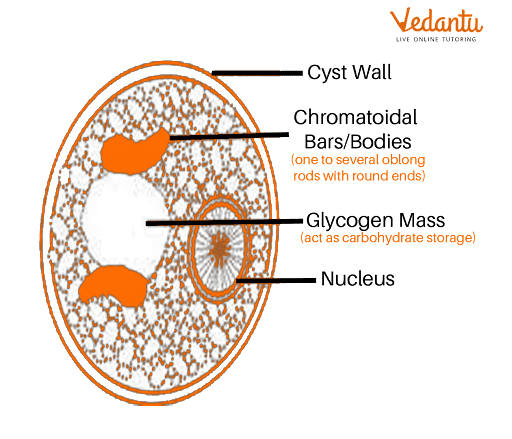
Cyst Structure
Encystation in Amoeba
Amoeba is a protozoan which possesses pseudopodia for mobility and traps its food for nutrition. It reproduces by binary or multiple fission. It shows endocytosis and exocytosis for taking in food and secreting out waste, respectively.
Encystation: During the adverse environmental conditions, it withdraws its pseudopodia and forms a shell-like structure having hard layers around itself called a cyst. It shows no movement or nutrition but is vegetatively active inside the cyst.
Morphologically, cyst in amoeba has two layers of walls. The ectocyst is the external layer, and the endocyst, which is formed after the ectocyst, is the internal fibrillar layer. These layers are composed of acid-insoluble proteins and cellulose but the exact composition is not well known.
Some scientists suggested that cellulose was the only compound present in both layers of the cyst wall but later this was disapproved and recently it has been shown that the endocyst is thinner and fibrillar than the ectocyst which resembles the cellulose structure found in plant cell walls.
When this cyst matures and conditions are favourable, the cyst bursts open and releases many cells which divide multiple fission. These daughter cells of amoeba possess pseudopodia and are fit for survival and reproduction.
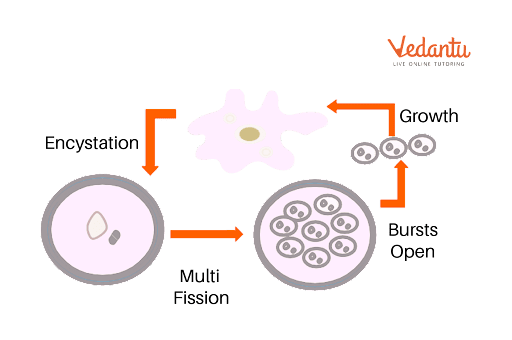
Cyst Formation in Amoeba
Encystation in Entamoeba Histolytica
Entamoeba histolytica is a parasitic protozoan which can cause amoebic dysentery affecting approximately 90 million people each year worldwide. It is transmitted through ingestion of food and water contaminated with the cyst form, which undergoes excystation in the small intestine to the trophozoite form that colonises the large intestine. They show encystation outside the host body and when they enter they start to reproduce after rupturing out from the cyst.
From this article, we can conclude that the sole purpose of encystation is reproduction and spreading the disease. Morphologically entamoeba has one layered cyst composed of chitin and encystation-specific chitin-binding lectins that cross-link chitin, degrade chitin, or self-aggregate that makes cyst walls impenetrable to small molecules, acids or other substances.
Encystment and Excystment
The formation of cyst is known as encystment. It occurs during unfavourable conditions. When the environment is favourable after encystment, the wall of the cyst ruptures this is called as excystation. This happens under favourable conditions and to prevent diseases caused by this protozoan (e.g., Amoeba), the process excystment should be blocked. It can be done by taking steps to interrupt their life cycles.
Important Questions
What does excystation mean?
Ans: When favourable conditions arrive, the protozoans tend to reproduce. They rupture their cyst wall and burst open with many cells divided by multiple fission. This is called an excystation.
Which organisms undergo encystation?
Ans: Protozoans like euglena, amoeba, and entamoeba histolytica undergo the process of encystation. They tend to become dormant during adverse conditions like high temperature, acidic environment, or high pressure and survive this by forming hard shell-like cyst around them.
Practice Questions
1. Histolytica does not show ________________.
Budding
Excystation
2. Sporulation in Amoeba mainly occurs during ___________.
Favourable conditions
Unfavourable conditions
The time of germination
Answers: 1(b) 2(a)
Key Features
The formation of cyst is an integral part of the life cycle of many protozoans. This allows these organisms to become dormant and survive adverse environmental conditions.
When the favourable conditions arrive, they may reproduce or spread the diseases in the host body.
Encystation can be studied and observed deeply in amoeba only and to our knowledge, no research and investigations have yet been performed to determine the survival capacities in other protozoan cysts.


FAQs on Encystation in Protozoa and Microorganisms
1. What is encystation in biology?
Encystation is the process by which a protozoan or microorganism forms a protective cyst around itself to survive unfavorable conditions. It involves the transformation of an active trophozoite into a dormant, resistant stage.
- Triggered by stress such as lack of nutrients or dehydration
- Formation of a thick cyst wall
- Metabolic activity becomes greatly reduced
- Common in protozoa like Entamoeba and Giardia
2. Why do protozoa undergo encystation?
Protozoa undergo encystation to protect themselves from unfavorable environmental conditions. The formation of a cyst allows them to survive stress and aid in transmission.
- Protection against drying, extreme temperature, or chemicals
- Resistance to digestive enzymes in host organisms
- Helps in dispersal from one host to another
- Ensures survival during nutrient deficiency
3. What are the stages of encystation?
The stages of encystation include transformation from trophozoite to a mature cyst through structural and biochemical changes. The main stages are:
- Initiation phase triggered by environmental stress
- Secretion of a protective cyst wall
- Nuclear division in some species (e.g., Entamoeba histolytica)
- Formation of a mature, dormant cyst
4. What is the difference between encystation and excystation?
Encystation is the formation of a protective cyst, while excystation is the emergence of the active form from the cyst.
- Encystation: Active trophozoite → dormant cyst
- Excystation: Cyst → active trophozoite
- Encystation occurs during unfavorable conditions
- Excystation occurs when conditions become favorable, such as inside a host
5. How does encystation help in disease transmission?
Encystation helps in disease transmission by producing resistant cysts that can survive outside the host. These infective cysts can contaminate food and water.
- Resistant to environmental stress
- Survive stomach acidity
- Ingested by a new host
- Undergo excystation to release trophozoites
6. What triggers encystation in protozoa?
Encystation is triggered by environmental stress such as nutrient depletion or changes in temperature and pH. Specific triggers include:
- Lack of food supply
- Dehydration
- High population density
- Changes in osmotic pressure
7. What is the structure of a cyst formed during encystation?
A cyst formed during encystation has a thick protective wall surrounding a dormant cell with reduced metabolism. The structure typically includes:
- Outer cyst wall made of chitin-like or proteinaceous material
- Condensed cytoplasm
- One or more nuclei (species-specific)
- Stored food reserves
8. Can you give examples of organisms that undergo encystation?
Examples of organisms that undergo encystation include several parasitic and free-living protozoa. Common examples are:
- Entamoeba histolytica
- Giardia lamblia
- Balantidium coli
- Some free-living amoebae
9. Is encystation a form of reproduction?
Encystation is not a form of reproduction but a survival mechanism. Although nuclear division may occur inside the cyst in some species, the primary purpose is protection rather than producing new individuals.
- Reduces metabolic activity
- Forms a protective wall
- Ensures survival during stress
10. What is the importance of encystation in the life cycle of parasites?
Encystation is important in the life cycle of parasites because it creates a resistant infective stage essential for transmission. The cyst stage allows the parasite to move from one host to another.
- Survives outside the host body
- Resists harsh environmental conditions
- Facilitates oral-fecal transmission
- Ensures continuation of the life cycle



