




What Are Basophils Their Structure Function and Role in Allergy
Basophil is a type of immune cell that contains granules with enzymes that are released during allergic reactions or asthma attacks. Basophil is a type of white blood cell and falls under the category of granulocytes along with neutrophils and eosinophils.
They are made up of a variety of substances, including histamine and heparin. As part of the body's immune defense, basophils will split open (degranulate) to release these substances when needed during an allergic reaction. These cells perform various functions to protect our bodies and there are several tests that we can do to find out the damage or any kind of disease we are suffering from.
What are Basophils?
White blood cells, also known as leukocytes, are of two types: Granulocytes and Agranulocytes, based on the presence and absence of granules.
Granulocytes are those which contain granules, like neutrophils, eosinophils, and basophils.
Granulocytes work together to cure illnesses or allergies in our bodies. The granules of each type of granulocyte contain a unique mix of chemicals and enzymes.
Basophils are the smallest granulocytes, measuring 10-14 µm in diameter.
These polymorphonuclear cells have a bilobed nucleus and cytoplasmic granules that are strongly metachromatic.
They have a short life span of 1-2 days.
These are the only leukocytes that circulate in the body containing histamine.

Image: Structure of Basophil
Function of Basophils
Basophils are one of five types of white blood cells that protect the body against infections and respond to invaders such as parasites, fungus, and cancer cells.
They are a part of the innate immune system, the immunity that is present by birth.
The human body's reactivity to allergens is controlled by basophils.
Whenever we come into contact with an allergen, they're the reason we sneeze, cough, or have a runny nose.
They can detect and eliminate some cancer cells in their early stages.
During an allergic reaction or an asthma attack, basophils also release histamine from their granules, which plays a crucial role.
They also help in protecting our bodies against microbial pathogens, viruses, helminths, etc.
They are essentially the frontline cells that attack any foreign agent that makes its way into the body.
Action of Basophils
Basophils aid in the induction of inflammatory responses.
The body's natural response to anything that could harm it is known as inflammation.
It is the body's way of telling the immune system to heal and restore damaged tissues while also protecting itself from external invaders.
Histamine and heparin are among the substances found in the granules of basophils.
Role of Histamine: It acts as a vasodilator, which means it widens blood vessels. This attracts extra immune cells to the damage or site of infection.
Role of Heparin: It acts as an anti-coagulant (blood thinner). The body makes it to prevent the formation of blood clots at the site of an injury or infection.
Basophils also target foreign agents indirectly by binding to B-cell lymphocytes.
B-cells release antibodies termed immunoglobulin E (IgE) into the bloodstream as a result of the binding.
IgE has a high anti-parasite and anti-venom effect.
Basophils Role in Allergies
An allergy is when the immune system reacts abnormally to a substance or event that is otherwise safe.
Basophils release histamine, which is one of the main causes of allergic symptoms.
Basophils and related cells called mast cells break open when the body is exposed to an allergen (allergy-causing chemical).
Histamine causes blood vessels to dilate, allowing fluid to flow into the surrounding tissues.
As those tissues grow and become inflammatory, they can cause redness and swelling of the skin in the form of rashes and itching.
Levels of Basophils
A test called a white blood cell (WBC) count is used to determine the concentration of white blood cells, of which basophils make up between 0.5 and 1 percent.
The absolute basophil count (ABC) is a test that measures the actual number of basophils in cubic millimetres (mm3).
A basophil's normal range is 0.5% to 1% of your total white blood cell count. In healthy humans, this equates to zero to 300 basophils per microliter of blood.
If your basophil level is higher than this, you may have allergic reactions, chickenpox, collagen vascular disease, hyperthyroidism, or bone marrow disease.
The lower level of basophils indicates cancer, acute infection, and thyrotoxicosis.
Basophils in blood tests might be high or low in response to specific conditions or treatments.
Basophilia refers to an excessively high basophil count, while basopenia refers to an abnormally low basophil count.
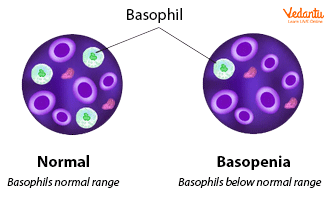
Image: Basopenia
Conclusion
Basophils are granulocytes, a type of white blood cell. Basophils are one of the first lines of defense against illnesses, including parasites, as part of the innate immune system. Infections, hyperthyroidism, and chickenpox can all produce high basophilia, while acute infections and cancer treatments can all cause low basophilia. Basophils also play an important part in causing allergies by releasing histamine into the bloodstream, which is an allergy-causing substance.


FAQs on Basophils in Blood Structure and Immune Function
1. What are basophils?
Basophils are a type of white blood cell (leukocyte) that play a key role in allergic reactions and immune defense. They are the least abundant granulocytes in the blood and contain large cytoplasmic granules filled with inflammatory chemicals.
- Produced in the bone marrow
- Circulate in the bloodstream
- Release substances like histamine during immune responses
2. What is the function of basophils in the immune system?
The main function of basophils is to mediate inflammatory and allergic responses by releasing chemical mediators. They help coordinate the body’s reaction to allergens and infections.
- Release histamine to increase blood vessel permeability
- Secrete heparin to prevent clotting
- Participate in defense against parasites
3. What do basophils release?
Basophils release inflammatory mediators such as histamine, heparin, and cytokines during immune reactions. These chemicals contribute to allergy symptoms and inflammation.
- Histamine: causes vasodilation and swelling
- Heparin: acts as an anticoagulant
- Cytokines: regulate immune cell communication
4. How do basophils cause allergic reactions?
Basophils cause allergic reactions by releasing histamine after their surface-bound IgE antibodies bind to an allergen. This process is called degranulation.
- Allergen binds to IgE on basophil surface
- Basophil undergoes degranulation
- Histamine release leads to redness, swelling, and itching
5. What is the normal range of basophils in blood?
The normal range of basophils is about 0.5% to 1% of total white blood cells in peripheral blood. They are the least common type of granulocyte.
- Measured in a complete blood count (CBC)
- Elevated levels are called basophilia
- Decreased levels are called basopenia
6. What is the structure of a basophil?
Basophils are characterized by a bilobed nucleus and large, dark-staining cytoplasmic granules. The granules often obscure the nucleus under a microscope.
- Belong to the group of granulocytes
- Granules contain histamine and heparin
- Stain dark blue or purple with basic dyes
7. What is the difference between basophils and eosinophils?
The main difference between basophils and eosinophils is their function and the substances in their granules. Both are granulocytes but act in different immune responses.
- Basophils: involved mainly in allergic reactions; contain histamine
- Eosinophils: fight parasitic infections; contain toxic proteins
- Basophils stain dark blue; eosinophils stain red-orange
8. What causes high basophil levels (basophilia)?
High basophil levels, known as basophilia, can be caused by allergies, chronic inflammation, or certain blood disorders. It is usually detected through a blood test.
- Chronic allergic reactions
- Myeloproliferative disorders such as chronic myeloid leukemia
- Hypothyroidism or inflammatory diseases
9. Where are basophils produced?
Basophils are produced in the bone marrow through a process called hematopoiesis. They develop from myeloid stem cells.
- Originate from hematopoietic stem cells
- Differentiate into myeloid progenitor cells
- Mature and enter the bloodstream
10. Are basophils involved in parasitic infections?
Yes, basophils help defend against parasitic infections, especially helminths, by promoting inflammatory and immune responses. They work alongside other immune cells.
- Release cytokines that activate Th2 immune responses
- Support IgE-mediated defense mechanisms
- Enhance recruitment of other white blood cells



