






Where Do Tiger Snakes Live, What Do They Eat, and How Dangerous Are They?
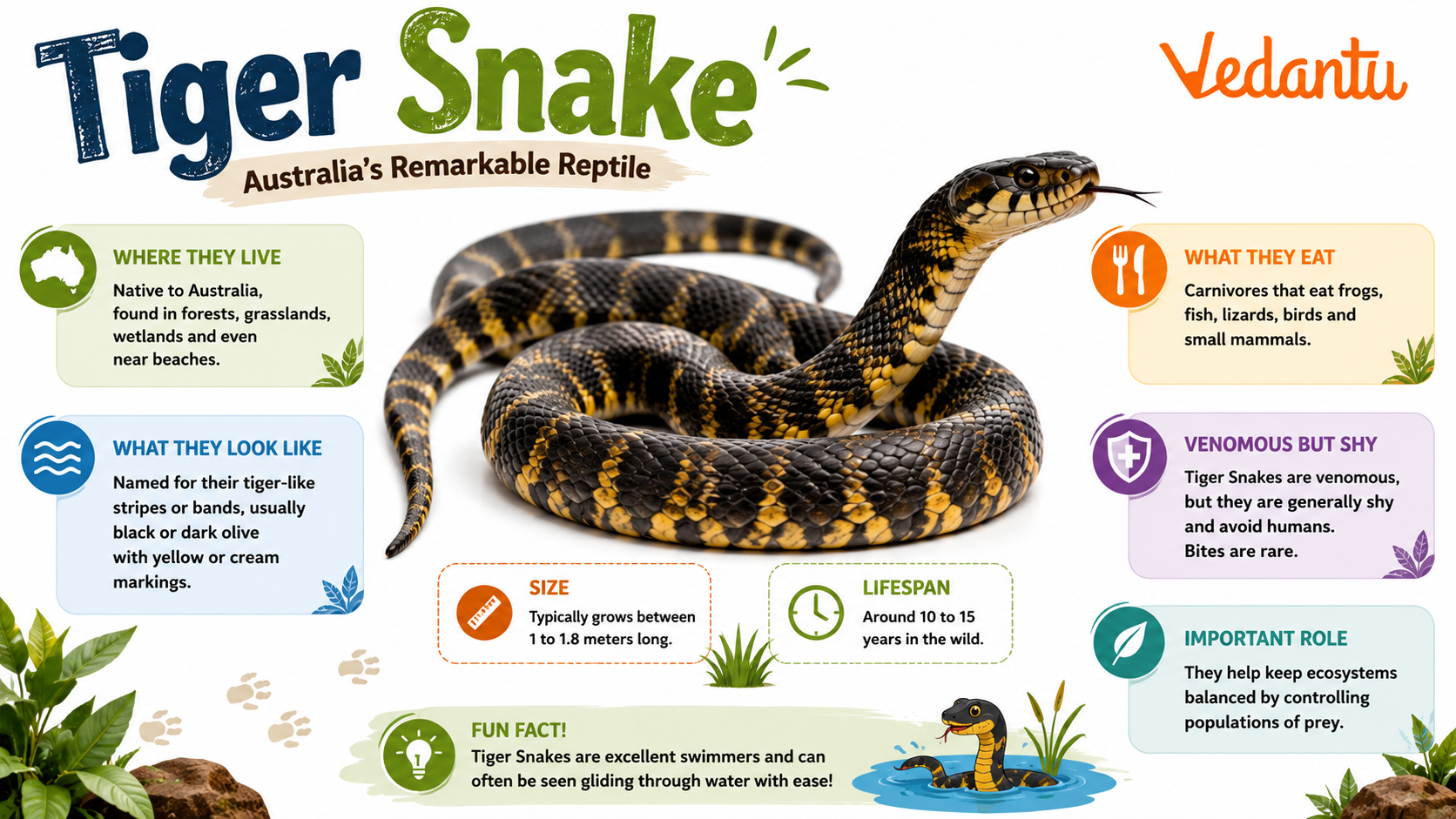
Quick Facts About Tiger Snake
| Feature | Details |
|---|---|
| Common Name | Tiger Snake |
| Scientific Name | Notechis scutatus |
| Animal Group | Reptile |
| Type | Venomous Snake |
| Length | 1 – 1.5 metres (can grow longer) |
| Habitat | Wetlands, grasslands, coastal regions |
| Diet | Frogs, birds, fish, small mammals |
| Movement | Slithers; excellent swimmer |
| Lifespan | 10–15 years (in the wild) |
| Found In | Southern Australia & Tasmania |
Appearance and Physical Characteristics
- Long, muscular body with smooth scales.
- Colour varies from olive, brown, black to yellow.
- Distinct dark cross-bands like tiger stripes.
- Broad head and strong jaws.
- Cold-blooded reptile that depends on sunlight for warmth.
Tiger Snake Habitat and Distribution
- Common near swamps, rivers, lakes, and marshes.
- Found in coastal regions and grassy fields.
- Lives in southern Australia and Tasmania.
- Often hides under rocks, logs, or thick vegetation.
Diet and Feeding Habits
- Carnivorous reptile.
- Eats frogs, small mammals, birds, fish, and lizards.
- Uses venom to paralyse prey.
- Swallows prey whole.
Behaviour and Lifestyle
- Usually solitary.
- Active during the day in cooler weather.
- May become more active at night during hot days.
- Excellent swimmer.
- Defensive if disturbed.
Tiger Snake Life Cycle
- Mating: Occurs in spring.
- Birth: Female gives birth to live young (not eggs).
- Young Snakes: Baby snakes are independent from birth.
- Growth: They shed skin regularly as they grow.
- Adult Stage: Reach maturity in a few years.
What Makes the Tiger Snake Special?
Importance and Role in Nature
Amazing Tiger Snake Facts
- The Tiger Snake is among the most dangerous snakes in Australia.
- It can swim across rivers and coastal waters.
- Its venom can affect muscles and breathing.
- Some island populations grow larger than mainland ones.
- It adapts well to different climates.
- It uses smell to track prey.
Fun Facts for Kids
FAQs on Tiger Snake: Fascinating Facts About Australia’s Venomous Snake
1. What is a Tiger Snake?
A Tiger Snake is a highly venomous snake found mainly in Australia.
- It belongs to the elapid family, which includes cobras and taipans.
- It gets its name from the tiger-like stripes on its body.
- It is known for its strong venom and defensive behavior.
- It is commonly found in coastal regions, wetlands, and grasslands.
2. Where do Tiger Snakes live?
Tiger Snakes mainly live in southern parts of Australia, especially near water.
- Common in Victoria, Tasmania, South Australia, and Western Australia.
- Prefer wetlands, marshes, rivers, and coastal areas.
- Can also be found in grasslands and suburban areas.
- They like places with plenty of prey and hiding spots.
3. Why is it called a Tiger Snake?
The Tiger Snake is named for its striped pattern that looks like a tiger’s stripes.
- Many have bold yellow and black bands.
- Some may be plain brown or olive without clear stripes.
- The pattern helps with camouflage in grass and wetlands.
4. How dangerous is a Tiger Snake?
A Tiger Snake is very dangerous because its venom is highly toxic.
- Its venom can affect nerves and blood clotting.
- Symptoms include pain, numbness, and difficulty breathing.
- Antivenom is available and effective if given quickly.
- Snake bites are rare when people keep a safe distance.
5. What do Tiger Snakes eat?
Tiger Snakes are carnivores that eat small animals.
- Common prey includes frogs, fish, birds, and small mammals.
- They may also eat lizards and rodents.
- They use their venom to paralyze prey before swallowing it whole.
6. How big does a Tiger Snake grow?
A fully grown Tiger Snake usually measures about 1 to 1.5 meters long.
- Some can grow up to 2 meters in rare cases.
- They have thick bodies and strong muscles.
- Size may vary depending on habitat and food supply.
7. How does a Tiger Snake protect itself?
A Tiger Snake defends itself by showing warning behaviors before striking.
- It flattens its neck like a cobra.
- It hisses loudly to scare predators.
- If threatened, it may bite and inject venom.
- It usually prefers to escape rather than fight.
8. Are Tiger Snakes active during the day or night?
Tiger Snakes are mostly active during the day, especially in warm weather.
- They are diurnal, meaning active in daylight.
- In very hot conditions, they may become active at dawn or dusk.
- They bask in the sun to warm their bodies.
9. How do Tiger Snakes reproduce?
Tiger Snakes give birth to live young instead of laying eggs.
- They are viviparous snakes.
- A female can give birth to 10 to 30 baby snakes at once.
- Baby Tiger Snakes are born fully independent and venomous.
10. What should you do if you see a Tiger Snake?
If you see a Tiger Snake, stay calm and keep a safe distance.
- Do not try to touch or disturb the snake.
- Slowly move away without sudden movements.
- Call local wildlife authorities if needed.
- Remember that snakes usually avoid humans unless threatened.
