






What Are Teleost Fish? Key Traits, Types, and Real-World Examples
Teleosts are the largest and most advanced group of bony fish found in oceans, rivers, and lakes across the world. From tiny aquarium fish to large food fishes, teleosts show amazing diversity in shape, size, colour, and behaviour. When learning about teleost facts, habitat, diet, characteristics, and life cycle, students discover how these fish have adapted perfectly to life in water and why they are so important to humans and aquatic ecosystems.
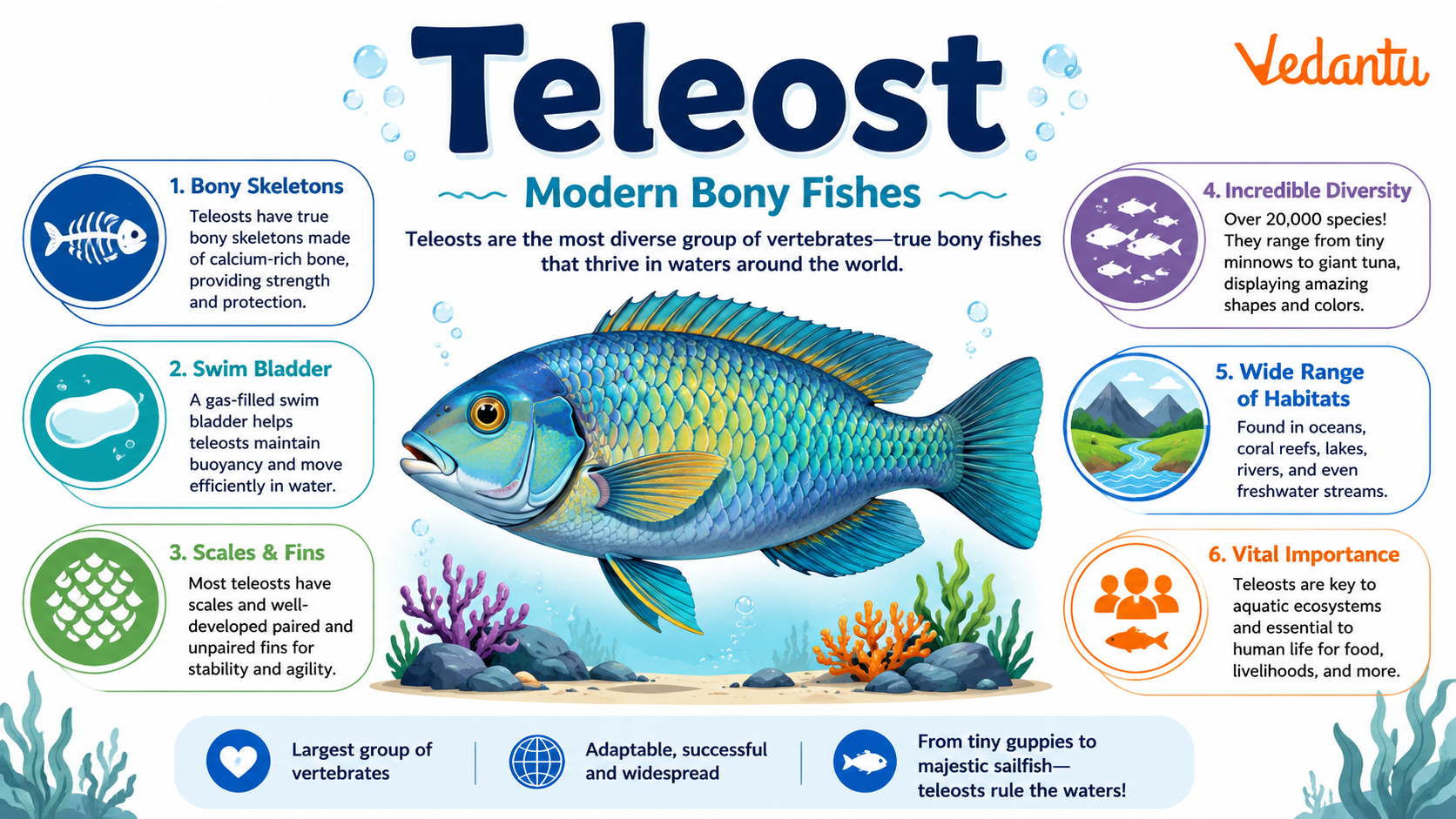
Quick Facts About Teleost
| Feature | Details |
|---|---|
| Common Name | Teleost (Advanced Bony Fish) |
| Scientific Group | Infraclass Teleostei |
| Animal Group | Vertebrates (Animals with backbone) |
| Habitat | Oceans, seas, rivers, lakes, ponds |
| Skeleton Type | Made of true bone (not cartilage) |
| Number of Species | Over 30,000 species |
| Diet | Herbivore, carnivore, or omnivore (varies by species) |
| Importance | Major source of food for humans |
Teleost Characteristics and Body Structure
- Streamlined body shape for smooth swimming.
- Skeleton made of hard bone.
- Movable jaw for better feeding.
- Gills covered by a bony flap called the operculum.
- Scales covering the body for protection.
- Usually have a swim bladder to control buoyancy.
Teleost Habitat and Distribution
- Found in freshwater: rivers, lakes, and ponds.
- Found in saltwater: oceans and seas.
- Some species live in deep sea areas.
- Others live near coral reefs or coastal regions.
- A few species can survive in both fresh and salt water.
From icy polar waters to warm tropical seas, teleosts have adapted to many different climates.
Teleost Diet and Feeding Habits
Some teleosts feed on algae and aquatic plants.
Many species eat insects, smaller fish, and crustaceans.
Some eat both plant and animal matter.
A few species filter tiny organisms from water.
Their movable jaws and different types of teeth help them catch and eat a variety of food.
Behaviour and Lifestyle
- Some teleosts live alone, while others form large schools.
- Many are active during the day; some are nocturnal.
- They communicate using body movements and colour changes.
- Schooling helps protect them from predators.
- Some species migrate long distances for breeding.
Teleost Life Cycle
- Egg Stage: Most teleosts lay eggs in water.
- Larval Stage: Tiny larvae hatch and feed on plankton.
- Juvenile Stage: Body shape becomes similar to adults.
- Adult Stage: Fully grown fish capable of reproduction.
Some species show parental care, but many leave the eggs after laying them.
Types and Diversity of Teleost
Known for long migration journeys.
Fast-swimming ocean fish.
Popular aquarium teleost.
Lives among sea anemones.
These examples show how teleost species vary in size, colour, habitat, and behaviour.
Importance of Teleost in Nature and for Humans
Teleosts are one of the main sources of protein for humans.
They act as both predators and prey in aquatic ecosystems.
Fishing industries depend heavily on teleost species.
Some species are used in biological studies.
Amazing Teleost Facts
- Teleosts evolved over 200 million years ago.
- They have flexible fins supported by bony rays.
- Many species can change colour for camouflage.
- Some teleosts can produce electric signals.
- They have excellent vision underwater.
- Some species glow in the dark (bioluminescence).
Interesting Facts About Teleost
- They have a swim bladder that helps them float without constant swimming.
- Some teleosts can survive in very low oxygen levels.
- Coral reef ecosystems are full of colourful teleost species.
- Teleost jaws are more advanced than those of many ancient fish.
Fun Facts for Kids
FAQs on Teleost Fish Explained: Characteristics, Evolution, and Importance
1. What is a Teleost?
A Teleost is a type of advanced bony fish that makes up most fish species in the world.
- Teleosts belong to a large group of bony fish (Osteichthyes)
- They have a flexible tail and movable upper jaw
- About 96% of all fish species are teleosts
- Examples include salmon, goldfish, tuna, and clownfish
2. What are examples of Teleost fish?
Common teleost fish include many freshwater and saltwater species found around the world.
- Goldfish
- Salmon
- Tuna
- Cod
- Clownfish
- Tilapia
3. Where do Teleosts live?
Teleosts live in almost every water habitat on Earth.
- Oceans and seas (saltwater)
- Rivers and lakes (freshwater)
- Coral reefs
- Deep sea environments
4. How are Teleosts different from other fish?
Teleosts are different because they have more advanced body features than other fish groups.
- A movable upper jaw for better feeding
- A symmetrical tail fin (homocercal tail)
- Lightweight bony skeleton
- Better swimming control with flexible fins
5. What do Teleost fish eat?
Teleost fish eat many different foods depending on their species.
- Plants and algae (herbivores)
- Small fish and insects (carnivores)
- Both plants and animals (omnivores)
6. When did Teleosts first appear?
Teleosts first appeared about 200 million years ago during the late Triassic period.
- They evolved from early bony fish ancestors
- They became very diverse during the Age of Dinosaurs
- Today they are the most common group of fish
7. Why are Teleosts important to humans?
Teleosts are important because they provide food, jobs, and scientific knowledge.
- They are a major source of seafood like tuna and cod
- Support fishing and aquaculture industries
- Used in research, such as the zebrafish in science labs
- Popular in aquariums as pet fish
8. Do Teleosts lay eggs?
Most teleosts lay eggs, but some give birth to live young.
- Many species release eggs in water
- Fertilization usually happens outside the body
- Some species, like certain guppies, give live birth
9. What body features do Teleosts have?
Teleosts have special body parts that help them swim and survive.
- Gills for breathing underwater
- Scales for protection
- Fins for movement and balance
- Swim bladder to control floating
10. Are Teleosts the same as bony fish?
Teleosts are a large subgroup of bony fish, but not all bony fish are teleosts.
- All teleosts are bony fish
- Some primitive bony fish, like lungfish, are not teleosts
- Teleosts are the most modern and diverse group
