




How to Use Possessive Nouns in Sentences (with Examples)
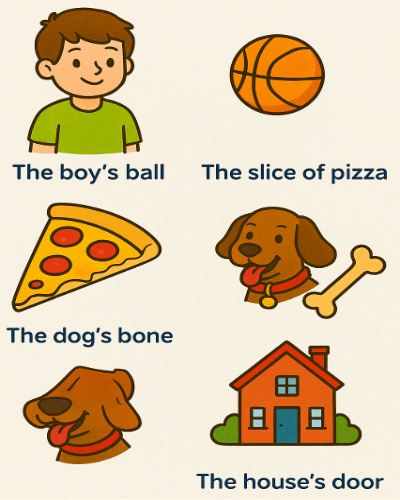
Section A: Rewrite the Phrase
Instructions: Rewrite each phrase below using a possessive noun. The first one is done for you.
Example: the cap of the boy → the boy’s cap
1. the tail of the monkey
________________________________________________
2. the toys of the children
________________________________________________
3. the nest of the birds
________________________________________________
4. the phone of my mother
________________________________________________
5. the house of Mr. Das
________________________________________________
6. the tools of the mechanic
________________________________________________
Section B: Fill in the Blanks
Instructions: Complete each sentence by writing the correct possessive form of the noun given in the brackets.
1. The __________ roar could be heard from far away. (lion)
2. My __________ new dress is blue and white. (sister)
3. The __________ classroom is on the ground floor. (students)
4. We cleaned the __________ cage yesterday. (rabbit)
5. The __________ feathers were white and soft. (geese)
Section C: Multiple Choice Questions
Instructions: Choose the correct word to complete each sentence.
1. That is my __________ bicycle. 🚲
(a) friends (b) friend's (c) friends'
2. The __________ laughter filled the playground.
(a) children's (b) childrens' (c) childrens
3. All the __________ bags were kept in a line.
(a) guest's (b) guests (c) guests'
4. The __________ meow woke me up this morning.
(a) cats (b) cat's (c) cats'
5. The __________ uniforms are blue.
(a) player's (b) players' (c) players
Section D: Sentence Correction
Instructions: The apostrophe is missing or used incorrectly in these sentences. Rewrite each sentence correctly.
1. The dogs tail was wagging happily.

________________________________________________
2. I read my mothers new book.
________________________________________________
3. Where are the womens purses?
________________________________________________
4. The horses hooves were loud on the street.
________________________________________________
Section E: True or False
Instructions: Read each statement carefully and write 'True' or 'False'.
1. We add 's to show that something belongs to one person. __________
2. "The babies' toys" is the correct way to write "the toys of the babies". __________
3. The word "teachers" always means something belongs to a teacher. __________
4. "The mices cheese" is a grammatically correct phrase. __________
5. An apostrophe (') can show that something belongs to someone or something. __________
Answer Key
Section A: Rewrite the Phrase
1. the monkey’s tail
2. the children’s toys
3. the birds’ nest
4. my mother’s phone
5. Mr. Das’s house
6. the mechanic's tools
Section B: Fill in the Blanks
1. lion's
2. sister's
3. students'
4. rabbit's
5. geese's
Section C: Multiple Choice Questions
1. (b) friend's
2. (a) children's
3. (c) guests'
4. (b) cat's
5. (b) players'
Section D: Sentence Correction
1. The dog's tail was wagging happily.
2. I read my mother's new book.
3. Where are the women's purses?
4. The horses' hooves were loud on the street.
Section E: True or False
1. True
2. True
3. False (It can also be the plural of 'teacher'.)
4. False (It should be 'mice's'.)
5. True
Printable Possessive Nouns Worksheet for Class 3 – Grammar Practice and Answers
With this Class 3 worksheet on English Grammar Possessive Nouns, learners practice showing ownership in sentences, such as “Ria’s book” or “the dog’s bone.” The activities build skills needed for daily communication and story writing. Students and parents see clear progress in English Grammar. The worksheet uses familiar examples, so children find learning about possessive nouns and punctuation both enjoyable and useful. This Topic covers a key part of third grade English.
Build Confidence in English Grammar Rules
This Class 3 English worksheet on Possessive Nouns helps students master how to use apostrophes and possessive forms correctly. Children learn to spot possessive nouns in sentences and use them in their own writing. Parents notice improved writing clarity and stronger grammar skills. Practicing this topic at home or school prepares learners for harder English Grammar activities.
FAQs on Possessive Nouns Practice Worksheet for Grade 3
1. What is a possessive noun for Class 3?
A possessive noun for Class 3 is a noun that shows who owns something. For example, in "Riya’s doll", Riya owns the doll. Possessive nouns usually use an apostrophe ‘s’ (‘s) to show belonging. Common examples include Tom’s bag and dog’s bone.
2. What are 10 examples of possessive nouns?
Here are 10 examples of possessive nouns suitable for Grade 3:
- Tom’s bag
- Riya’s doll
- Dog’s bone
- Cat’s tail
- Papa’s chair
- Teacher’s desk
- Sunita’s book
- Child’s toy
- Bird’s nest
- Sister’s dress
3. How to explain possessive nouns?
Possessive nouns are explained by showing that they tell us who owns something. Add an apostrophe and s (’s) to the noun: for example, "the girl’s ball" means the ball belongs to the girl. This helps students understand ownership in English grammar.
4. What is the rule for possessive nouns for kids?
The rule for possessive nouns for kids is simple: Add ’s to a singular noun to show ownership (cat’s hat). For plural nouns ending in s, just add an apostrophe (dogs’ bowls). Always use the apostrophe to show that something belongs to someone or something.
5. How to teach possessive nouns to Class 3 students?
Teach possessive nouns to Class 3 students by:
- Explaining with examples (e.g., Ravi’s pencil)
- Using pictures and objects
- Practicing with worksheets and fill-in-the-blanks
- Emphasizing adding ‘s
6. Why do we use possessive nouns?
We use possessive nouns to show that something belongs to a person, animal, or thing. For example, in "Mother’s bag", the bag belongs to Mother. Understanding possessive nouns helps students use correct ownership words in English sentences.
7. Does this possessive nouns worksheet include an answer key?
Yes, this possessive nouns worksheet for Class 3 includes an answer key for all activities. This helps parents and students check if the solutions are correct and supports self-study and revision.
8. Is the worksheet printable and suitable for homework?
Yes, this possessive nouns worksheet PDF is designed for easy printing. Parents and teachers can use it for homework, exam practice, or holiday revision to help students improve their English grammar skills.
9. What age group or grade level is the worksheet best for?
The possessive nouns worksheet is specially designed for Class 3 (Grade 3) students, typically suitable for children aged 7 to 9 years old. The activities match the syllabus and learning level for this age group.
10. Can I use this worksheet on a tablet or mobile device?
Yes, the possessive nouns worksheet is mobile-friendly and can be viewed on tablets or smartphones. You can preview and complete it digitally before printing, which helps students learn anywhere, anytime.
11. How does practicing possessive nouns help improve English grammar?
Practicing possessive nouns helps students:
- Understand ownership and belonging
- Use apostrophes correctly
- Build stronger grammar and sentence skills
- Prepare for exams with confidence
12. Can this worksheet be modified or used with other grammar topics?
Yes, you can combine this possessive nouns worksheet with other grammar practice sheets such as action verbs, nouns, and pronouns for comprehensive English learning. Teachers and parents can customize activities to suit different class levels or objectives.
