




What is myopia and hypermetropia? How are they corrected, explain using a diagram.
Answer
 Verified
543.3k+ views
Hint :We will need to start the solution first by defining what is myopia and hypermetropia. While defining them you have to also mention the causes of these eye defects. After this list the methods which are available to treat these defects are followed by the diagram of an eye with the defect and a diagram in which correction is made.
Complete Step By Step Answer:
First we will try to define what is myopia and hypermetropia.
Myopia: It is the defect of the eye where the person can see nearby objects clearly but the distant object appears indistinct. It is also known as nearsightedness. In this defect, sharp images of the distant object are not produced by the lens on the retina, instead they are formed in front of the retina.
Following are the two reasons for Myopia:
The curvature of the cornea and eye lens increases. The muscles near the lens cannot relax so that the converging power of the lens remains large.
This result is usually linked with an elongated eyeball.
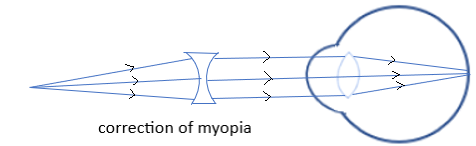
Correction of myopia : Spectacles with concave lenses of proper length are used as this lens diverges the incident rays and the diverged ray are converged by the lens in the eye leading to the formation of image on the retina.
Following diagram describes Myopia and how it is corrected.
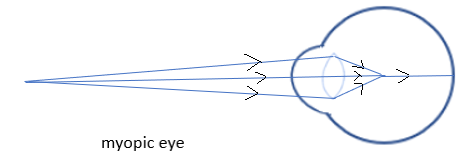
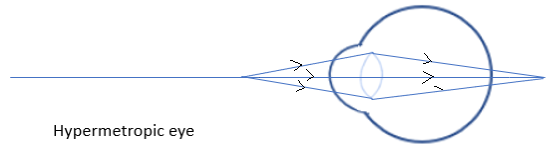
Hypermetropia: It is a defect where the person can see the distant object clearly but cannot see nearby objects distinctly. The images are produced behind the retina in this defect. It is also known as farsightedness.
Following are two measure reasons for hypermetropia:
The curvature of the cornea and eye lens decreases and hence the converging power of the lens becomes less.
It may also be caused due to flattening of the eyeball.
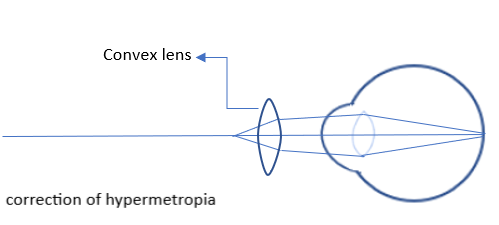
Correction of Hypermetropia: This can be treated by using a convex lens which helps in the formation of image on the retina.
Following diagram describes Hypermetropia and how it is corrected.
Note :
Since the focal length of the concave length is negative, a lens with negative power is required for correcting myopia or nearsightedness. Similarly a lens with positive power is required for correcting hypermetropia or far sightedness. The power of the lens depends on the magnitude of the near sightedness or far sightedness.
Complete Step By Step Answer:
First we will try to define what is myopia and hypermetropia.
Myopia: It is the defect of the eye where the person can see nearby objects clearly but the distant object appears indistinct. It is also known as nearsightedness. In this defect, sharp images of the distant object are not produced by the lens on the retina, instead they are formed in front of the retina.
Following are the two reasons for Myopia:
The curvature of the cornea and eye lens increases. The muscles near the lens cannot relax so that the converging power of the lens remains large.
This result is usually linked with an elongated eyeball.
Correction of myopia : Spectacles with concave lenses of proper length are used as this lens diverges the incident rays and the diverged ray are converged by the lens in the eye leading to the formation of image on the retina.
Following diagram describes Myopia and how it is corrected.
Hypermetropia: It is a defect where the person can see the distant object clearly but cannot see nearby objects distinctly. The images are produced behind the retina in this defect. It is also known as farsightedness.
Following are two measure reasons for hypermetropia:
The curvature of the cornea and eye lens decreases and hence the converging power of the lens becomes less.
It may also be caused due to flattening of the eyeball.
Correction of Hypermetropia: This can be treated by using a convex lens which helps in the formation of image on the retina.
Following diagram describes Hypermetropia and how it is corrected.
Note :
Since the focal length of the concave length is negative, a lens with negative power is required for correcting myopia or nearsightedness. Similarly a lens with positive power is required for correcting hypermetropia or far sightedness. The power of the lens depends on the magnitude of the near sightedness or far sightedness.
Recently Updated Pages
Master Class 12 Economics: Engaging Questions & Answers for Success

Master Class 12 Physics: Engaging Questions & Answers for Success
Master Class 12 English: Engaging Questions & Answers for Success
Master Class 12 Social Science: Engaging Questions & Answers for Success
Master Class 12 Maths: Engaging Questions & Answers for Success
Master Class 12 Business Studies: Engaging Questions & Answers for Success
Trending doubts
Which are the Top 10 Largest Countries of the World?
What are the major means of transport Explain each class 12 social science CBSE
Draw a labelled sketch of the human eye class 12 physics CBSE
Why cannot DNA pass through cell membranes class 12 biology CBSE
Differentiate between insitu conservation and exsitu class 12 biology CBSE
Draw a neat and well labeled diagram of TS of ovary class 12 biology CBSE