




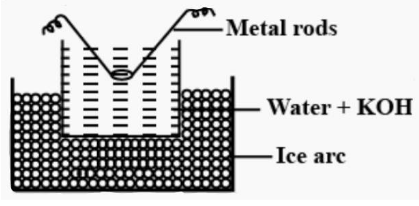
In Bredig’s arc method, an electric arc is stuck between the metal electrodes under the surface of water containing some stabilizing agent. The process involves:
(a) Mechanical dispersion
(b) Condensation
(c) Both dispersion and condensation
(d) Ultrasonic dispersion
Answer
 Verified
546.6k+ views
Hint :Bredig’s arc method is a method which is used for the preparation of the colloidal solutions of metals. The metals such as Gold, silver and Platinum are suitable for the preparation of the colloidal solution with the help of Bredig’s arc method.
Complete Step By Step Answer:
First of all, we will discuss what is Bredig’s arc method:
Bredig’s arc method: Bredig’s arc method is a method which is used for the preparation of the colloidal solutions of metals. The metals such as Gold, silver and Platinum are suitable for the preparation of the colloidal solution with the help of Bredig’s arc method.
Now, we will discuss how we prepare sols from Bredig’s arc method:
Bredig’s arc method consists of two processes. They are dispersion and condensation, in which an electric arc is struck between the electrodes under the surface of water which contains some stabilizing agents. When intense heat is applied in them, the arc vaporises the metal which condensed under the cold water and then colloidal particles are prepared in the stabilised by adding some amount of potassium hydroxide.
So, from the above discussions we can conclude that in the Bredig’s arc method, an electric arc is stuck between the metal electrodes under the surface of water containing some stabilizing agent, in these the process there are of both dispersion and condensation.
Hence, the correct option is (c) Both dispersion and condensation.
Note :
Although Bredig’s arc method is a method which is used for the preparation of the colloidal solutions of metals, it is not suitable to prepare a colloidal solution of copper and sodium and also when the dispersion medium is an organic liquid as considerable stirring occurs.
Complete Step By Step Answer:
First of all, we will discuss what is Bredig’s arc method:
Bredig’s arc method: Bredig’s arc method is a method which is used for the preparation of the colloidal solutions of metals. The metals such as Gold, silver and Platinum are suitable for the preparation of the colloidal solution with the help of Bredig’s arc method.
Now, we will discuss how we prepare sols from Bredig’s arc method:
Bredig’s arc method consists of two processes. They are dispersion and condensation, in which an electric arc is struck between the electrodes under the surface of water which contains some stabilizing agents. When intense heat is applied in them, the arc vaporises the metal which condensed under the cold water and then colloidal particles are prepared in the stabilised by adding some amount of potassium hydroxide.
So, from the above discussions we can conclude that in the Bredig’s arc method, an electric arc is stuck between the metal electrodes under the surface of water containing some stabilizing agent, in these the process there are of both dispersion and condensation.
Hence, the correct option is (c) Both dispersion and condensation.
Note :
Although Bredig’s arc method is a method which is used for the preparation of the colloidal solutions of metals, it is not suitable to prepare a colloidal solution of copper and sodium and also when the dispersion medium is an organic liquid as considerable stirring occurs.
Recently Updated Pages
Master Class 12 Economics: Engaging Questions & Answers for Success

Master Class 12 Physics: Engaging Questions & Answers for Success
Master Class 12 English: Engaging Questions & Answers for Success
Master Class 12 Social Science: Engaging Questions & Answers for Success
Master Class 12 Maths: Engaging Questions & Answers for Success
Master Class 12 Business Studies: Engaging Questions & Answers for Success
Trending doubts
Which are the Top 10 Largest Countries of the World?
What are the major means of transport Explain each class 12 social science CBSE
Draw a labelled sketch of the human eye class 12 physics CBSE
Why cannot DNA pass through cell membranes class 12 biology CBSE
Differentiate between insitu conservation and exsitu class 12 biology CBSE
Draw a neat and well labeled diagram of TS of ovary class 12 biology CBSE