




Fraunhofer lines in solar spectrum can be cited as an example of –
A) Stefan’s law
B) Kirchhoff’s law
C) William’s law
D) Planck's law
Answer
 Verified
643.5k+ views
Hint: We need to understand the reasons for the Fraunhofer’s lines in the spectral lines from solar radiation. Then, we can relate the given laws to the phenomenon and thereby find the most suitable explanation for the Fraunhofer lines.
Complete step-by-step solution:
We know that the Fraunhofer lines in a spectrum of radiation are the dark lines within the spectrum. These dark lines or the Fraunhofer lines are the result of selective absorption of the colour of a particular wavelength by the particles present in the path of the radiation.
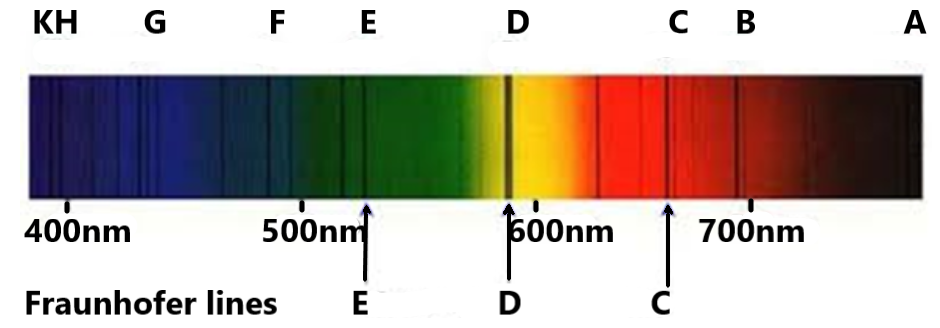
Now, let us discuss the different laws given to us and identify the one which describes the Fraunhofer lines.
Stefan’s law: It states that the rate of energy radiated from a body is directly proportional to its emissivity, surface area and the fourth power of the temperature difference with the surrounding.
Kirchhoff’s law: It states that a hot matter, whether solid, liquid or gas will give a continuous spectrum under high pressures. At low pressures the matter gives an emission line spectrum.
William’s law: It states that in a spectrum of a radiation, one can see dark lines or some missing colours due to the selective absorption of the wavelength by particles in the path of the radiation.
Planck's law: It gives the mathematical relationship on the spectral-energy distribution of a radiation emitted by a body.
Comparing the four laws, we understand the Fraunhofer lines are best described by William's law.
The correct answer is option C.
Note: The Kirchhoff’s law has an extension which says that hot matter can give a continuous spectrum with dark lines when the radiation is passed through a low-pressure gas. But the law doesn’t give an explanation for these dark lines in the spectrum.
Complete step-by-step solution:
We know that the Fraunhofer lines in a spectrum of radiation are the dark lines within the spectrum. These dark lines or the Fraunhofer lines are the result of selective absorption of the colour of a particular wavelength by the particles present in the path of the radiation.
Now, let us discuss the different laws given to us and identify the one which describes the Fraunhofer lines.
Stefan’s law: It states that the rate of energy radiated from a body is directly proportional to its emissivity, surface area and the fourth power of the temperature difference with the surrounding.
Kirchhoff’s law: It states that a hot matter, whether solid, liquid or gas will give a continuous spectrum under high pressures. At low pressures the matter gives an emission line spectrum.
William’s law: It states that in a spectrum of a radiation, one can see dark lines or some missing colours due to the selective absorption of the wavelength by particles in the path of the radiation.
Planck's law: It gives the mathematical relationship on the spectral-energy distribution of a radiation emitted by a body.
Comparing the four laws, we understand the Fraunhofer lines are best described by William's law.
The correct answer is option C.
Note: The Kirchhoff’s law has an extension which says that hot matter can give a continuous spectrum with dark lines when the radiation is passed through a low-pressure gas. But the law doesn’t give an explanation for these dark lines in the spectrum.
Recently Updated Pages
Explain the structure of megasporangium class 12 biology CBSE

Why is chloroform kept in dark coloured bottles class 12 chemistry CBSE
Derive the balancing condition of a Wheatstone bri class 12 physics CBSE
Draw VI characteristics of a pn junction diode Explain class 12 physics CBSE
Is it possible to carry pride in ones language too class 12 english CBSE
In a population at Hardy Weinberg equilibrium the allele class 12 biology CBSE
Trending doubts
Draw a labelled sketch of the human eye class 12 physics CBSE
Which are the Top 10 Largest Countries of the World?
Draw ray diagrams each showing i myopic eye and ii class 12 physics CBSE
One megawatt is equal to how many units of electri class 12 physics CBSE
Which is the correct genotypic ratio of mendel dihybrid class 12 biology CBSE
Give 10 examples of unisexual and bisexual flowers