




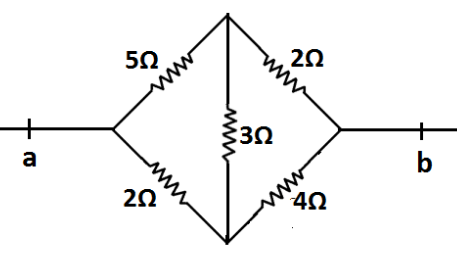
Calculate the equivalent resistance between a and b of the following network of conductors.
A. $4\Omega $
B. $5\Omega $
C. $3\Omega $
D. $2\Omega $
Answer
 Verified
622.8k+ views
Hint:We can clearly see that the given circuit is the Wheatstone bridge circuit. We will first determine whether this circuit is balanced or unbalanced. After then, we will calculate the equivalent resistance based on the type of the bridge, balanced or unbalanced.
Complete step by step answer:
Let us first determine whether the given circuit is balanced or unbalanced.The ratio of the resistances on the left hand arms is $\dfrac{5}{2}$ and the ratio of the resistances on the right arms is $\dfrac{2}{4} = \dfrac{1}{2}$. As these both are not equal, the given Wheatstone bridge is unbalanced.
Now, we will find the equivalent resistance of this network step by step.Our first step is to convert the delta network to star network.As shown in figure, three resistances of $5\Omega $, $2\Omega $ and $3\Omega $ forms delta connection. So, we will convert this delta connection into a star connection of three resistances $P\Omega $, $Q\Omega $ and $R\Omega $ as shown in the figure.
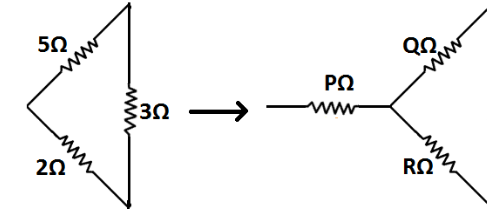
Now, we will find the resistances $P\Omega $, $Q\Omega $ and $R\Omega $ by using the rules of conversion from delta to star conversion.
$ \Rightarrow P = \dfrac{{5 \times 2}}{{5 + 2 + 3}} = \dfrac{{10}}{{10}} = 1\Omega $
$ \Rightarrow Q = \dfrac{{5 \times 3}}{{5 + 2 + 3}} = \dfrac{{15}}{{10}} = 1.5\Omega $
$ \Rightarrow R = \dfrac{{2 \times 3}}{{5 + 2 + 3}} = \dfrac{6}{{10}} = 0.6\Omega $
Thus, our main circuit will become as shown in the following figure.
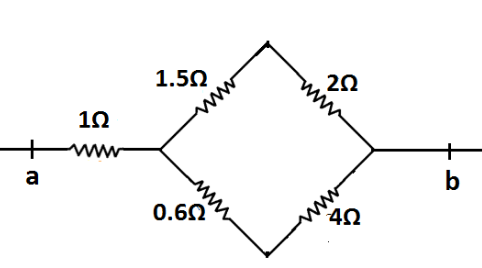
From the figure it is clear that resistances $1.5\Omega $ and $2\Omega $ are in series connection.We know that the equivalent resistance of two resistances connected in series is given by ${R_{eq}} = {R_1} + {R_2}$
Therefore, the equivalent resistance of $1.5\Omega $ and $2\Omega $ is $1.5 + 2 = 3.5\Omega $
Similarly, the equivalent resistance of $0.6\Omega $ and $4\Omega $ is $0.6 + 4 = 4.6\Omega $
Thus, our main circuit will become as shown in the following figure.
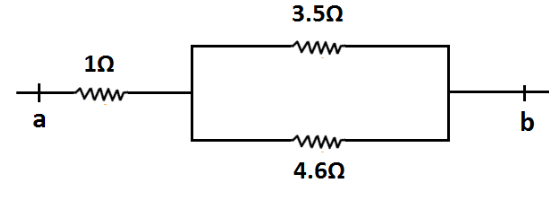
From the figure it is clear that resistances $3.5\Omega $ and $4.6\Omega $ are in parallel connection.We know that the equivalent resistance of two resistances connected in parallel is given by \[{R_{eq}} = \dfrac{{{R_1}{R_2}}}{{{R_1} + {R_2}}}\]
Therefore, the equivalent resistance of $3.5\Omega $ and $4.6\Omega $ is $\dfrac{{3.5 \times 4.6}}{{3.5 + 4.6}} = 1.99\Omega $
Now, our main circuit will become as shown in the following figure.Here, resistances $1\Omega $ and $1.99\Omega $ are in series connection.Therefore, the equivalent resistance of $1\Omega $ and $1.99\Omega $ is $1 + 1.99 = 2.99 \approx 3\Omega $
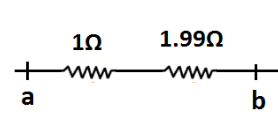
Here, resistances $1\Omega $ and $1.99\Omega $ are in series connection.Therefore, the equivalent resistance of $1\Omega $ and $1.99\Omega $ is $1 + 1.99 = 2.99 \approx 3\Omega $.
Finally, our circuit will be as shown in the following figure.
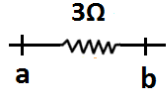
Thus, the equivalent resistance between a and b of the given network of conductors is $3\Omega $ .
Hence, option C is the right answer.
Note:In this type of question where the Wheatstone circuit is given, it is important to know if it is balanced or unbalanced. Here, the given circuit is unbalanced, therefore we have first converted the delta connection to star connection. And then, we have applied the laws of equivalent resistance for series and parallel connections to get our final answer.
Complete step by step answer:
Let us first determine whether the given circuit is balanced or unbalanced.The ratio of the resistances on the left hand arms is $\dfrac{5}{2}$ and the ratio of the resistances on the right arms is $\dfrac{2}{4} = \dfrac{1}{2}$. As these both are not equal, the given Wheatstone bridge is unbalanced.
Now, we will find the equivalent resistance of this network step by step.Our first step is to convert the delta network to star network.As shown in figure, three resistances of $5\Omega $, $2\Omega $ and $3\Omega $ forms delta connection. So, we will convert this delta connection into a star connection of three resistances $P\Omega $, $Q\Omega $ and $R\Omega $ as shown in the figure.
Now, we will find the resistances $P\Omega $, $Q\Omega $ and $R\Omega $ by using the rules of conversion from delta to star conversion.
$ \Rightarrow P = \dfrac{{5 \times 2}}{{5 + 2 + 3}} = \dfrac{{10}}{{10}} = 1\Omega $
$ \Rightarrow Q = \dfrac{{5 \times 3}}{{5 + 2 + 3}} = \dfrac{{15}}{{10}} = 1.5\Omega $
$ \Rightarrow R = \dfrac{{2 \times 3}}{{5 + 2 + 3}} = \dfrac{6}{{10}} = 0.6\Omega $
Thus, our main circuit will become as shown in the following figure.
From the figure it is clear that resistances $1.5\Omega $ and $2\Omega $ are in series connection.We know that the equivalent resistance of two resistances connected in series is given by ${R_{eq}} = {R_1} + {R_2}$
Therefore, the equivalent resistance of $1.5\Omega $ and $2\Omega $ is $1.5 + 2 = 3.5\Omega $
Similarly, the equivalent resistance of $0.6\Omega $ and $4\Omega $ is $0.6 + 4 = 4.6\Omega $
Thus, our main circuit will become as shown in the following figure.
From the figure it is clear that resistances $3.5\Omega $ and $4.6\Omega $ are in parallel connection.We know that the equivalent resistance of two resistances connected in parallel is given by \[{R_{eq}} = \dfrac{{{R_1}{R_2}}}{{{R_1} + {R_2}}}\]
Therefore, the equivalent resistance of $3.5\Omega $ and $4.6\Omega $ is $\dfrac{{3.5 \times 4.6}}{{3.5 + 4.6}} = 1.99\Omega $
Now, our main circuit will become as shown in the following figure.Here, resistances $1\Omega $ and $1.99\Omega $ are in series connection.Therefore, the equivalent resistance of $1\Omega $ and $1.99\Omega $ is $1 + 1.99 = 2.99 \approx 3\Omega $
Here, resistances $1\Omega $ and $1.99\Omega $ are in series connection.Therefore, the equivalent resistance of $1\Omega $ and $1.99\Omega $ is $1 + 1.99 = 2.99 \approx 3\Omega $.
Finally, our circuit will be as shown in the following figure.
Thus, the equivalent resistance between a and b of the given network of conductors is $3\Omega $ .
Hence, option C is the right answer.
Note:In this type of question where the Wheatstone circuit is given, it is important to know if it is balanced or unbalanced. Here, the given circuit is unbalanced, therefore we have first converted the delta connection to star connection. And then, we have applied the laws of equivalent resistance for series and parallel connections to get our final answer.
Recently Updated Pages
Basicity of sulphurous acid and sulphuric acid are

Onehalf of a convex lens is covered with a black paper class 12 physics CBSE
Differentiate between lanthanoids and actinoids class 12 chemistry CBSE
An object 5 cm in length is held 25 cm away from a class 12 physics CBSE
Name the following halides according to the IUPAC system class 12 chemistry CBSE
What is the Full Form of PVC, PET, HDPE, LDPE, PP and PS ?
Trending doubts
Draw a labelled sketch of the human eye class 12 physics CBSE
Which are the Top 10 Largest Countries of the World?
Draw ray diagrams each showing i myopic eye and ii class 12 physics CBSE
Which is the correct genotypic ratio of mendel dihybrid class 12 biology CBSE
Differentiate between homogeneous and heterogeneous class 12 chemistry CBSE
Give 10 examples of unisexual and bisexual flowers