




An object 5 cm in length is held 25 cm away from a converging lens of focal length 10 cm. Draw the ray diagram and find the position, size and the nature of the image formed.
Answer
 Verified
629.1k+ views
Hint: We need to understand the image formation by the lenses when the object is placed at a point away from the lens. The position of the object determines the image position, the size of the image and the nature of the image formed due to the object.
Complete step-by-step answer:
We know that a converging lens forms the image of an object placed in front of it by converging the light rays falling on it. We can find the image distance very easily using the lens’ formula when the focal length and the object distance of the system is given.
According to the lens’ formula –
\[\dfrac{1}{f}=\dfrac{1}{v}-\dfrac{1}{u}\]
Where, f is the focal length of the lens,
v is the image distance,
u is the object distance.
It is given that the object is 25 cm away from the lens and the focal length of the lens is 10 cm. We can find the image distance by substituting the values as –
\[\begin{align}
& \dfrac{1}{f}=\dfrac{1}{v}-\dfrac{1}{u} \\
& \Rightarrow \dfrac{1}{v}=\dfrac{1}{f}+\dfrac{1}{u} \\
& \Rightarrow v=\dfrac{uf}{u+f} \\
& \Rightarrow v=\dfrac{(-25cm)(+10cm)}{-25+10} \\
& \therefore v=+\dfrac{50}{3}cm=+16.67cm \\
\end{align}\]
We can find the magnification of the image formed by finding the ratio between the image distance to the object distance. This is given by –
\[\begin{align}
& m=\dfrac{v}{u} \\
& \Rightarrow m=\dfrac{\dfrac{50}{3}}{-25} \\
& \therefore m=-\dfrac{2}{3} \\
\end{align}\]
From this we can conclude that the image is two-third of the object size. The image size can be given as –
\[\begin{align}
& h'=mh \\
& \Rightarrow h'=-\dfrac{2}{3}(5) \\
& \therefore h'=-\dfrac{10}{3}cm=3.33cm \\
\end{align}\]
The image size has a negative sign, this implies that the image formed is real and inverted.
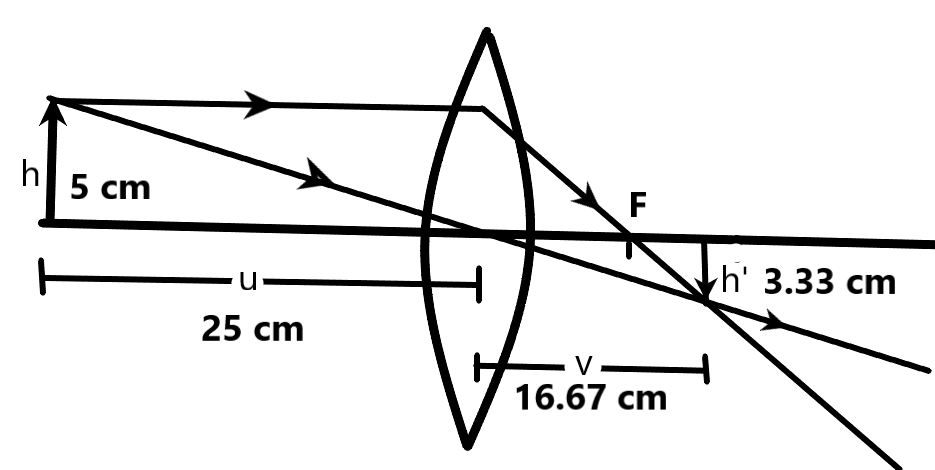
The image is formed 16.67 cm away from the lens. The image size is 3.33 cm. The image is real and inverted.
This is the required solution.
Note: The converging lenses need not to convex lenses. A concave lens when submerged in a medium with greater refractive index means that the material of the lens can also act as a converging lens. We should not be confused by this while solving problems.
Complete step-by-step answer:
We know that a converging lens forms the image of an object placed in front of it by converging the light rays falling on it. We can find the image distance very easily using the lens’ formula when the focal length and the object distance of the system is given.
According to the lens’ formula –
\[\dfrac{1}{f}=\dfrac{1}{v}-\dfrac{1}{u}\]
Where, f is the focal length of the lens,
v is the image distance,
u is the object distance.
It is given that the object is 25 cm away from the lens and the focal length of the lens is 10 cm. We can find the image distance by substituting the values as –
\[\begin{align}
& \dfrac{1}{f}=\dfrac{1}{v}-\dfrac{1}{u} \\
& \Rightarrow \dfrac{1}{v}=\dfrac{1}{f}+\dfrac{1}{u} \\
& \Rightarrow v=\dfrac{uf}{u+f} \\
& \Rightarrow v=\dfrac{(-25cm)(+10cm)}{-25+10} \\
& \therefore v=+\dfrac{50}{3}cm=+16.67cm \\
\end{align}\]
We can find the magnification of the image formed by finding the ratio between the image distance to the object distance. This is given by –
\[\begin{align}
& m=\dfrac{v}{u} \\
& \Rightarrow m=\dfrac{\dfrac{50}{3}}{-25} \\
& \therefore m=-\dfrac{2}{3} \\
\end{align}\]
From this we can conclude that the image is two-third of the object size. The image size can be given as –
\[\begin{align}
& h'=mh \\
& \Rightarrow h'=-\dfrac{2}{3}(5) \\
& \therefore h'=-\dfrac{10}{3}cm=3.33cm \\
\end{align}\]
The image size has a negative sign, this implies that the image formed is real and inverted.
The image is formed 16.67 cm away from the lens. The image size is 3.33 cm. The image is real and inverted.
This is the required solution.
Note: The converging lenses need not to convex lenses. A concave lens when submerged in a medium with greater refractive index means that the material of the lens can also act as a converging lens. We should not be confused by this while solving problems.
Recently Updated Pages
Onehalf of a convex lens is covered with a black paper class 12 physics CBSE

Differentiate between lanthanoids and actinoids class 12 chemistry CBSE
An object 5 cm in length is held 25 cm away from a class 12 physics CBSE
Name the following halides according to the IUPAC system class 12 chemistry CBSE
What is the Full Form of PVC, PET, HDPE, LDPE, PP and PS ?
An infinite ladder network of resistances is constructed class 12 physics CBSE
Trending doubts
Draw a labelled sketch of the human eye class 12 physics CBSE
Which are the Top 10 Largest Countries of the World?
Draw ray diagrams each showing i myopic eye and ii class 12 physics CBSE
Which is the correct genotypic ratio of mendel dihybrid class 12 biology CBSE
Differentiate between homogeneous and heterogeneous class 12 chemistry CBSE
Give 10 examples of unisexual and bisexual flowers