



Bond order of${{\text{O}}_{\text{2}}}$, $\text{O}_{\text{2}}^{\text{+}}$, $O_{2}^{-}$ and \[\text{O}_{\text{2}}^{\text{2-}}\] is in order.
(A) $\text{O}_{\text{2}}^{\text{- }}\langle \text{ O}_{2}^{2-}\text{ }\langle \text{ }{{\text{O}}_{\text{2}}}\text{ }\langle \text{ O}_{2}^{+}$
(B) $\text{O}_{\text{2}}^{\text{2- }}\langle \text{ O}_{2}^{-}\text{ }\langle \text{ }{{\text{O}}_{\text{2}}}\text{ }\langle \text{ O}_{2}^{+}$
(C) $\text{O}_{\text{2}}^{\text{+ }}\langle \text{ O}_{2}^{{}}\text{ }\langle \text{ O}_{2}^{-}\text{ }\langle \text{ O}_{2}^{2-}$
(D) $\text{O}_{\text{2}}^{\text{ }}\langle \text{ O}_{2}^{+}\text{ }\langle \text{ O}_{2}^{-}\text{ }\langle \text{ O}_{2}^{2-}$
Answer
 Verified
596.7k+ views
Hint: First draw a molecular orbital diagram (MOT) where the atomic orbitals combine to form molecular orbitals. The total electrons associated with the molecules are filled in the MOT diagram.
To solve this question, we need to write the molecular orbital configuration. To find out the bond order from the molecular orbital configuration is:
$\text{Bond order =}\dfrac{\text{1}}{\text{2}}\left[ \text{Bonding - antibonding} \right]$
Complete step by step answer:
Let’s first draw the MOT of the oxygen molecule. The oxygen molecule ${{\text{O}}_{\text{2}}}$ contains the 16 electrons. The MOT is as shown below:
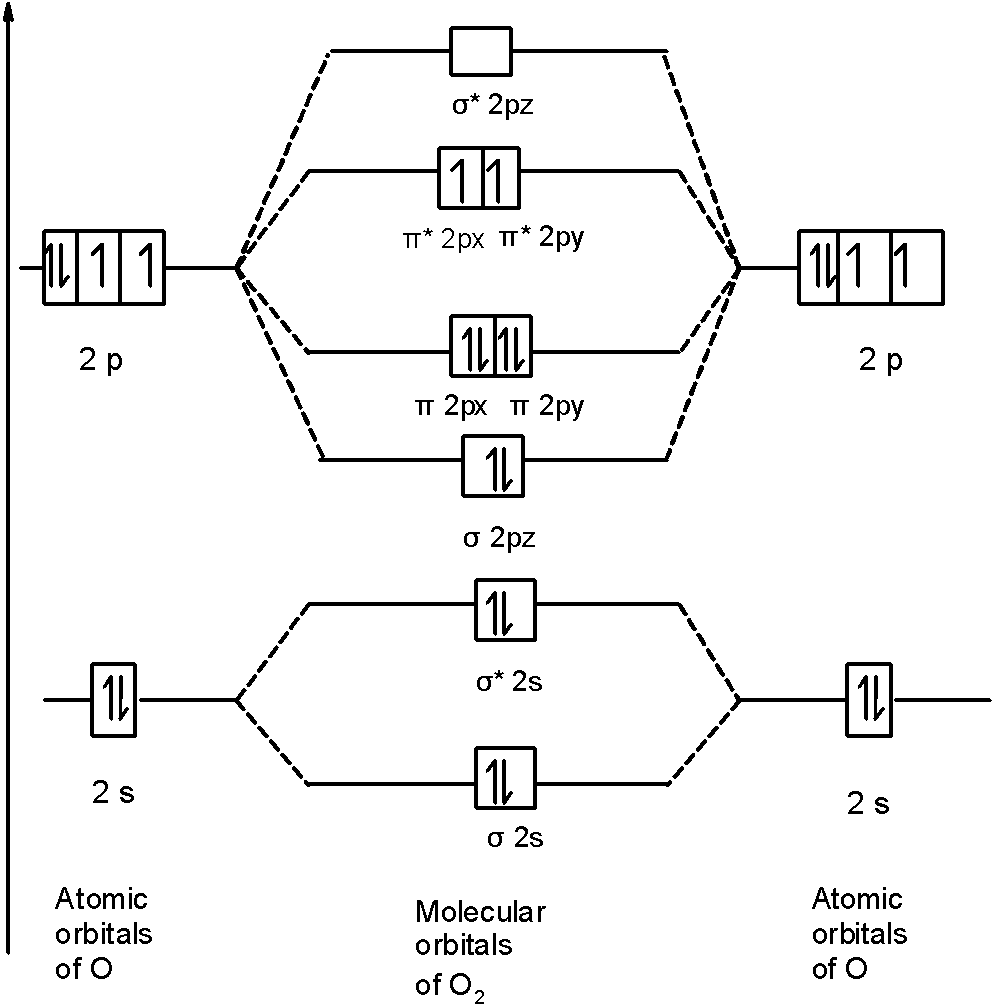
First of all, we can write the molecular orbital configuration of ${{\text{O}}_{\text{2}}}$ the molecule. In a ${{\text{O}}_{\text{2}}}$ molecule, there are a total of 16 electrons. The molecular orbital configuration of ${{\text{O}}_{\text{2}}}$ the molecule is as follows:
\[\]\[\text{ }\!\!\sigma\!\!\text{ 1}{{\text{s}}^{\text{2}}}\text{,}{{\text{ }\!\!\sigma\!\!\text{ }}^{\text{*}}}\text{1}{{\text{s}}^{\text{2}}}\text{, }\!\!\sigma\!\!\text{ 2}{{\text{s}}^{\text{2}}}\text{, }{{\text{ }\!\!\sigma\!\!\text{ }}^{\text{*}}}\text{2}{{\text{s}}^{\text{2}}}\text{, }\!\!\sigma\!\!\text{ 2}{{\text{p}}^{\text{2}}}_{z}\text{, 2p}_{\text{x}}^{\text{2}}\text{ }\!\!\pi\!\!\text{ = 2p}_{\text{y}}^{\text{2}}\text{ }\!\!\pi\!\!\text{ , 2p}_{\text{x}}^{1}{{\text{ }\!\!\pi\!\!\text{ }}^{\text{*}}}\text{=2p}_{\text{y}}^{1}{{\text{ }\!\!\pi\!\!\text{ }}^{\text{*}}}\]
There are 10 bonding and 6 nonbonding electrons in the orbitals according to the molecular orbital configuration.
Therefore, $\text{Bond order =}\dfrac{\text{1}}{\text{2}}\left[ \text{Bonding-antibonding} \right]$
= $\frac{1}{2}\left[ 10-6 \right]=\dfrac{1}{2}\left( 4 \right)=2$
Thus, the bond order ${{\text{O}}_{\text{2}}}$ is 2.
Similarly, in $\text{O}_{\text{2}}^{\text{+}}$ a molecule, there are 15 electrons. Therefore, the MOT diagram $\text{O}_{\text{2}}^{\text{+}}$ contains the 15 electrons. We will write down the MOT diagram for the $\text{2p}$ orbital as the bonding between the $\text{1s}$ and $\text{2s}$ is the same as that of the ${{\text{O}}_{\text{2}}}$ . The MOT diagram is,
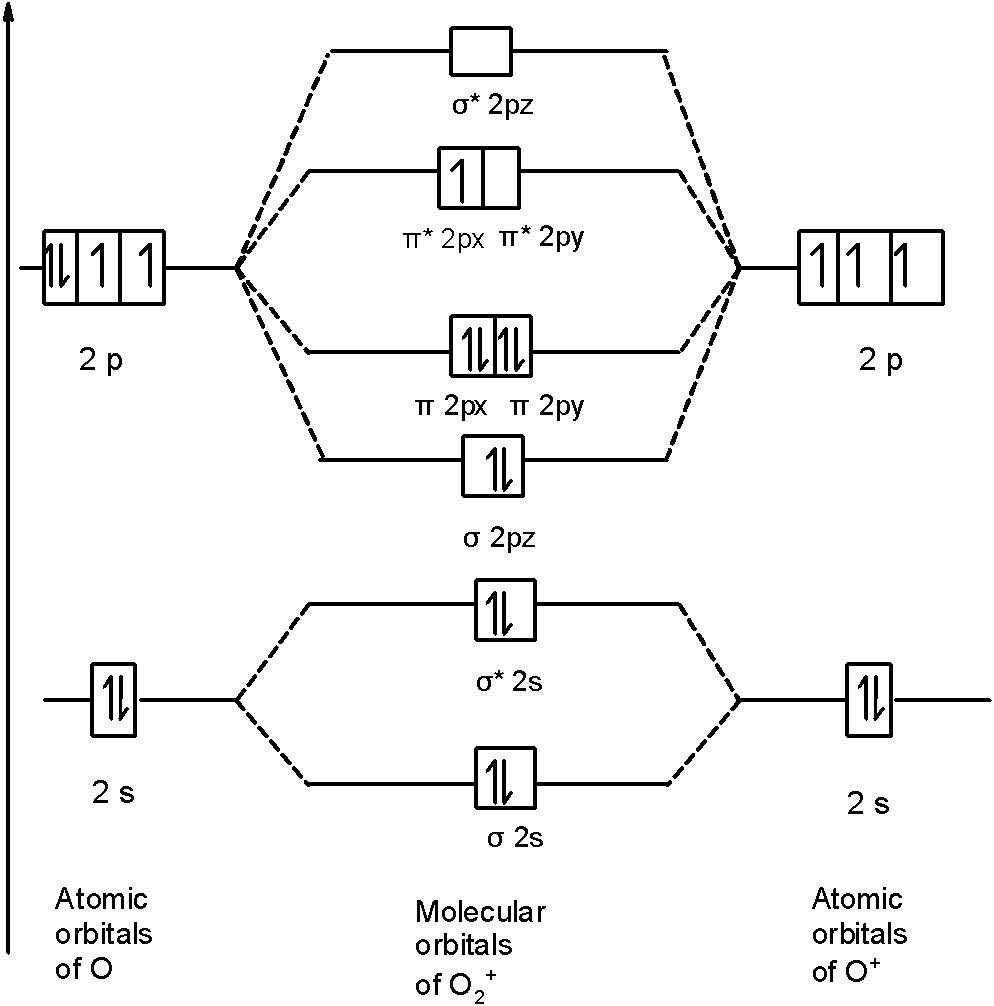
Therefore, the molecular orbital configuration of $\text{O}_{\text{2}}^{\text{+}}$ is as follows:$\text{O}_{\text{2}}^{\text{+}}$
\[\text{ }\!\!\sigma\!\!\text{ 1}{{\text{s}}^{\text{2}}}\text{,}{{\text{ }\!\!\sigma\!\!\text{ }}^{\text{*}}}\text{1}{{\text{s}}^{\text{2}}}\text{, }\!\!\sigma\!\!\text{ 2}{{\text{s}}^{\text{2}}}\text{, }{{\text{ }\!\!\sigma\!\!\text{ }}^{\text{*}}}\text{2}{{\text{s}}^{\text{2}}}\text{, }\!\!\sigma\!\!\text{ 2}{{\text{p}}^{\text{2}}}_{z}\text{, 2p}_{\text{x}}^{\text{2}}\text{ }\!\!\pi\!\!\text{ = 2p}_{\text{y}}^{\text{2}}\text{ }\!\!\pi\!\!\text{ , 2p}_{\text{x}}^{\text{2}}{{\text{ }\!\!\pi\!\!\text{ }}^{\text{*}}}\text{=2p}_{\text{y}}^{0}{{\text{ }\!\!\pi\!\!\text{ }}^{\text{*}}}\]
There are 10 bonding (including molecular orbitals formed by the $\text{1s}$ orbitals) and 5 nonbonding electrons in the orbitals according to the molecular orbital configuration.
Therefore, $\text{Bond order =}\dfrac{\text{1}}{\text{2}}\left[ \text{Bonding-antibonding} \right]$
$=\frac{1}{2}\left[ 10-5 \right]=2.5$
Therefore, the bond order of $\text{O}_{\text{2}}^{\text{+}}$ is $2.5$.
In $O_{2}^{-}$ a molecule, there are 17 electrons. The MOT diagram holds a total of 17 electrons. The MOT diagram is as shown below,
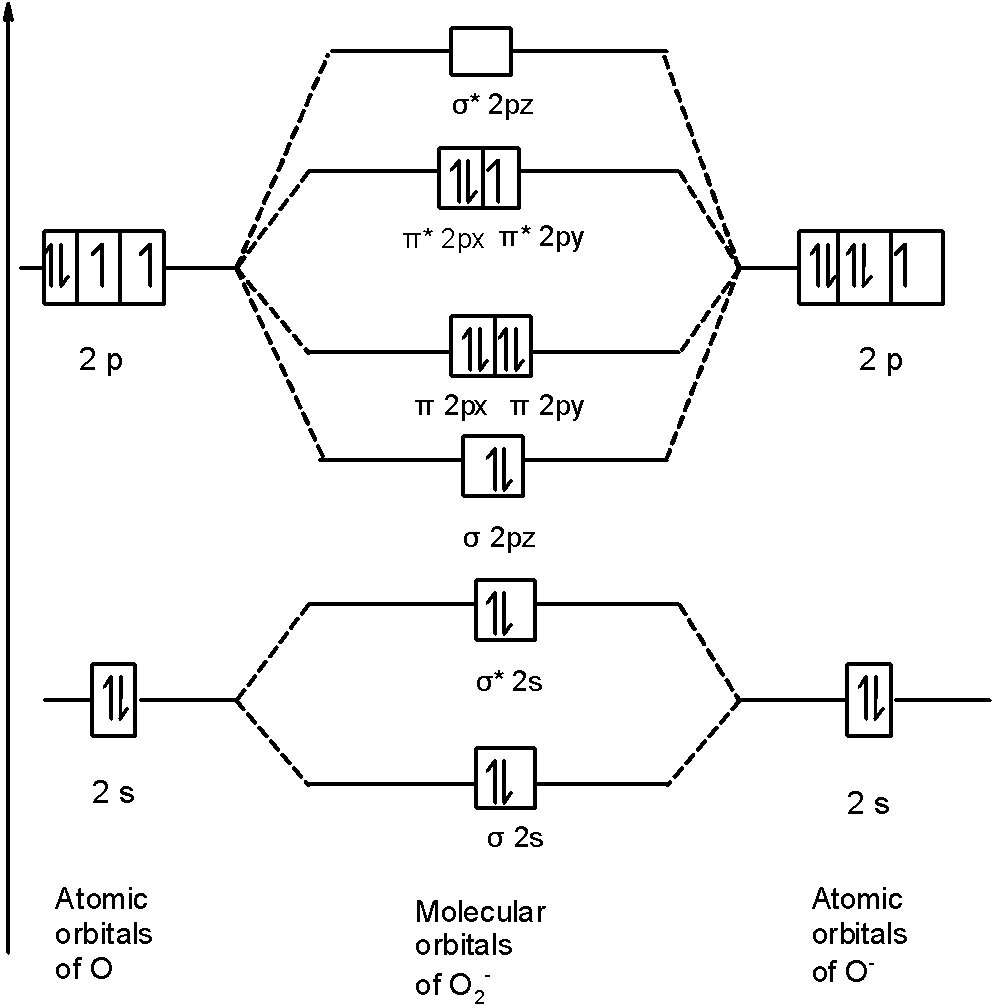
So, the molecular orbital configuration is as follows:
\[\text{ }\!\!\sigma\!\!\text{ 1}{{\text{s}}^{\text{2}}}\text{,}{{\text{ }\!\!\sigma\!\!\text{ }}^{\text{*}}}\text{1}{{\text{s}}^{\text{2}}}\text{, }\!\!\sigma\!\!\text{ 2}{{\text{s}}^{\text{2}}}\text{, }{{\text{ }\!\!\sigma\!\!\text{ }}^{\text{*}}}\text{2}{{\text{s}}^{\text{2}}}\text{, }\!\!\sigma\!\!\text{ 2}{{\text{p}}^{\text{2}}}_{z}\text{, 2p}_{\text{x}}^{\text{2}}\text{ }\!\!\pi\!\!\text{ = 2p}_{\text{y}}^{\text{2}}\text{ }\!\!\pi\!\!\text{ , 2p}_{\text{x}}^{\text{2}}{{\text{ }\!\!\pi\!\!\text{ }}^{\text{*}}}\text{=2p}_{\text{y}}^{1}{{\text{ }\!\!\pi\!\!\text{ }}^{\text{*}}}\]
There are 10 bonding electrons (including molecular orbitals formed by the $\text{1s}$ orbitals.) and 7 nonbonding electrons.
Therefore, $\text{Bond order =}\dfrac{\text{1}}{\text{2}}\left[ \text{Bonding-antibonding} \right]$
$=\dfrac{1}{2}\left[ 10-7 \right]=1.5$
Therefore, the bond order $O_{2}^{-}$ is $1.5$.
In \[\text{O}_{\text{2}}^{\text{2-}}\] a molecule, there are 18 electrons. The MOT diagram is as shown below,
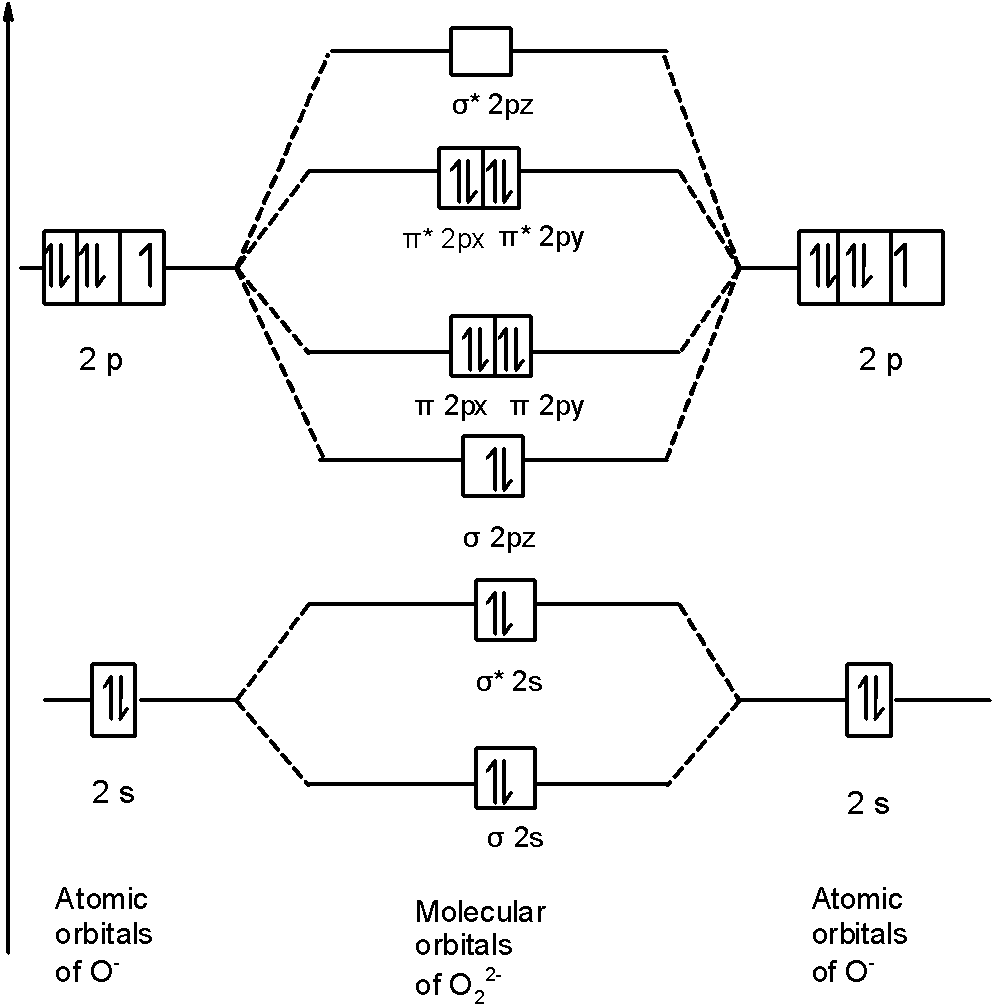
So, the molecular orbital configuration is as follows:
\[\text{ }\!\!\sigma\!\!\text{ 1}{{\text{s}}^{\text{2}}}\text{,}{{\text{ }\!\!\sigma\!\!\text{ }}^{\text{*}}}\text{1}{{\text{s}}^{\text{2}}}\text{, }\!\!\sigma\!\!\text{ 2}{{\text{s}}^{\text{2}}}\text{, }{{\text{ }\!\!\sigma\!\!\text{ }}^{\text{*}}}\text{2}{{\text{s}}^{\text{2}}}\text{, }\!\!\sigma\!\!\text{ 2}{{\text{p}}^{\text{2}}}_{z}\text{, 2p}_{\text{x}}^{\text{2}}\text{ }\!\!\pi\!\!\text{ = 2p}_{\text{y}}^{\text{2}}\text{ }\!\!\pi\!\!\text{ , 2p}_{\text{x}}^{\text{2}}{{\text{ }\!\!\pi\!\!\text{ }}^{\text{*}}}\text{=2p}_{\text{y}}^{\text{2}}{{\text{ }\!\!\pi\!\!\text{ }}^{\text{*}}}\]
There are 10 bonding electrons and 8 nonbonding electrons.
Therefore, $\text{bond order =}\dfrac{\text{1}}{\text{2}}\left[ \text{Bonding-antibonding} \right]$
$=\dfrac{1}{2}\left[ 10-8 \right]=1$
Therefore, the bond order \[\text{O}_{\text{2}}^{\text{2-}}\] is 1.
So, the correct order of bond order is $\text{O}_{\text{2}}^{\text{2- }}\langle \text{ O}_{2}^{-}\text{ }\langle \text{ }{{\text{O}}_{\text{2}}}\text{ }\langle \text{ O}_{2}^{+}$
So, the correct answer is “Option B”.
Note: You should notice that bond order is indirectly proportional to the length of the bond. The higher the bond order, the shorter and stronger will be the bond. The addition of each electron in the antibonding molecular orbital will decrease the bond order.
To solve this question, we need to write the molecular orbital configuration. To find out the bond order from the molecular orbital configuration is:
$\text{Bond order =}\dfrac{\text{1}}{\text{2}}\left[ \text{Bonding - antibonding} \right]$
Complete step by step answer:
Let’s first draw the MOT of the oxygen molecule. The oxygen molecule ${{\text{O}}_{\text{2}}}$ contains the 16 electrons. The MOT is as shown below:
First of all, we can write the molecular orbital configuration of ${{\text{O}}_{\text{2}}}$ the molecule. In a ${{\text{O}}_{\text{2}}}$ molecule, there are a total of 16 electrons. The molecular orbital configuration of ${{\text{O}}_{\text{2}}}$ the molecule is as follows:
\[\]\[\text{ }\!\!\sigma\!\!\text{ 1}{{\text{s}}^{\text{2}}}\text{,}{{\text{ }\!\!\sigma\!\!\text{ }}^{\text{*}}}\text{1}{{\text{s}}^{\text{2}}}\text{, }\!\!\sigma\!\!\text{ 2}{{\text{s}}^{\text{2}}}\text{, }{{\text{ }\!\!\sigma\!\!\text{ }}^{\text{*}}}\text{2}{{\text{s}}^{\text{2}}}\text{, }\!\!\sigma\!\!\text{ 2}{{\text{p}}^{\text{2}}}_{z}\text{, 2p}_{\text{x}}^{\text{2}}\text{ }\!\!\pi\!\!\text{ = 2p}_{\text{y}}^{\text{2}}\text{ }\!\!\pi\!\!\text{ , 2p}_{\text{x}}^{1}{{\text{ }\!\!\pi\!\!\text{ }}^{\text{*}}}\text{=2p}_{\text{y}}^{1}{{\text{ }\!\!\pi\!\!\text{ }}^{\text{*}}}\]
There are 10 bonding and 6 nonbonding electrons in the orbitals according to the molecular orbital configuration.
Therefore, $\text{Bond order =}\dfrac{\text{1}}{\text{2}}\left[ \text{Bonding-antibonding} \right]$
= $\frac{1}{2}\left[ 10-6 \right]=\dfrac{1}{2}\left( 4 \right)=2$
Thus, the bond order ${{\text{O}}_{\text{2}}}$ is 2.
Similarly, in $\text{O}_{\text{2}}^{\text{+}}$ a molecule, there are 15 electrons. Therefore, the MOT diagram $\text{O}_{\text{2}}^{\text{+}}$ contains the 15 electrons. We will write down the MOT diagram for the $\text{2p}$ orbital as the bonding between the $\text{1s}$ and $\text{2s}$ is the same as that of the ${{\text{O}}_{\text{2}}}$ . The MOT diagram is,
Therefore, the molecular orbital configuration of $\text{O}_{\text{2}}^{\text{+}}$ is as follows:$\text{O}_{\text{2}}^{\text{+}}$
\[\text{ }\!\!\sigma\!\!\text{ 1}{{\text{s}}^{\text{2}}}\text{,}{{\text{ }\!\!\sigma\!\!\text{ }}^{\text{*}}}\text{1}{{\text{s}}^{\text{2}}}\text{, }\!\!\sigma\!\!\text{ 2}{{\text{s}}^{\text{2}}}\text{, }{{\text{ }\!\!\sigma\!\!\text{ }}^{\text{*}}}\text{2}{{\text{s}}^{\text{2}}}\text{, }\!\!\sigma\!\!\text{ 2}{{\text{p}}^{\text{2}}}_{z}\text{, 2p}_{\text{x}}^{\text{2}}\text{ }\!\!\pi\!\!\text{ = 2p}_{\text{y}}^{\text{2}}\text{ }\!\!\pi\!\!\text{ , 2p}_{\text{x}}^{\text{2}}{{\text{ }\!\!\pi\!\!\text{ }}^{\text{*}}}\text{=2p}_{\text{y}}^{0}{{\text{ }\!\!\pi\!\!\text{ }}^{\text{*}}}\]
There are 10 bonding (including molecular orbitals formed by the $\text{1s}$ orbitals) and 5 nonbonding electrons in the orbitals according to the molecular orbital configuration.
Therefore, $\text{Bond order =}\dfrac{\text{1}}{\text{2}}\left[ \text{Bonding-antibonding} \right]$
$=\frac{1}{2}\left[ 10-5 \right]=2.5$
Therefore, the bond order of $\text{O}_{\text{2}}^{\text{+}}$ is $2.5$.
In $O_{2}^{-}$ a molecule, there are 17 electrons. The MOT diagram holds a total of 17 electrons. The MOT diagram is as shown below,
So, the molecular orbital configuration is as follows:
\[\text{ }\!\!\sigma\!\!\text{ 1}{{\text{s}}^{\text{2}}}\text{,}{{\text{ }\!\!\sigma\!\!\text{ }}^{\text{*}}}\text{1}{{\text{s}}^{\text{2}}}\text{, }\!\!\sigma\!\!\text{ 2}{{\text{s}}^{\text{2}}}\text{, }{{\text{ }\!\!\sigma\!\!\text{ }}^{\text{*}}}\text{2}{{\text{s}}^{\text{2}}}\text{, }\!\!\sigma\!\!\text{ 2}{{\text{p}}^{\text{2}}}_{z}\text{, 2p}_{\text{x}}^{\text{2}}\text{ }\!\!\pi\!\!\text{ = 2p}_{\text{y}}^{\text{2}}\text{ }\!\!\pi\!\!\text{ , 2p}_{\text{x}}^{\text{2}}{{\text{ }\!\!\pi\!\!\text{ }}^{\text{*}}}\text{=2p}_{\text{y}}^{1}{{\text{ }\!\!\pi\!\!\text{ }}^{\text{*}}}\]
There are 10 bonding electrons (including molecular orbitals formed by the $\text{1s}$ orbitals.) and 7 nonbonding electrons.
Therefore, $\text{Bond order =}\dfrac{\text{1}}{\text{2}}\left[ \text{Bonding-antibonding} \right]$
$=\dfrac{1}{2}\left[ 10-7 \right]=1.5$
Therefore, the bond order $O_{2}^{-}$ is $1.5$.
In \[\text{O}_{\text{2}}^{\text{2-}}\] a molecule, there are 18 electrons. The MOT diagram is as shown below,
So, the molecular orbital configuration is as follows:
\[\text{ }\!\!\sigma\!\!\text{ 1}{{\text{s}}^{\text{2}}}\text{,}{{\text{ }\!\!\sigma\!\!\text{ }}^{\text{*}}}\text{1}{{\text{s}}^{\text{2}}}\text{, }\!\!\sigma\!\!\text{ 2}{{\text{s}}^{\text{2}}}\text{, }{{\text{ }\!\!\sigma\!\!\text{ }}^{\text{*}}}\text{2}{{\text{s}}^{\text{2}}}\text{, }\!\!\sigma\!\!\text{ 2}{{\text{p}}^{\text{2}}}_{z}\text{, 2p}_{\text{x}}^{\text{2}}\text{ }\!\!\pi\!\!\text{ = 2p}_{\text{y}}^{\text{2}}\text{ }\!\!\pi\!\!\text{ , 2p}_{\text{x}}^{\text{2}}{{\text{ }\!\!\pi\!\!\text{ }}^{\text{*}}}\text{=2p}_{\text{y}}^{\text{2}}{{\text{ }\!\!\pi\!\!\text{ }}^{\text{*}}}\]
There are 10 bonding electrons and 8 nonbonding electrons.
Therefore, $\text{bond order =}\dfrac{\text{1}}{\text{2}}\left[ \text{Bonding-antibonding} \right]$
$=\dfrac{1}{2}\left[ 10-8 \right]=1$
Therefore, the bond order \[\text{O}_{\text{2}}^{\text{2-}}\] is 1.
So, the correct order of bond order is $\text{O}_{\text{2}}^{\text{2- }}\langle \text{ O}_{2}^{-}\text{ }\langle \text{ }{{\text{O}}_{\text{2}}}\text{ }\langle \text{ O}_{2}^{+}$
So, the correct answer is “Option B”.
Note: You should notice that bond order is indirectly proportional to the length of the bond. The higher the bond order, the shorter and stronger will be the bond. The addition of each electron in the antibonding molecular orbital will decrease the bond order.
Recently Updated Pages
If x a + bt + ct2 where x is in meters and t is in class 11 physics CBSE

A car covers the first half distance between two places class 11 physics CBSE
The resultant of two vectors overrightarrow P and overrightarrow class 11 physics CBSE
Find the value of cos 135 class 11 maths CBSE
A mass M is held in place by an applied force F and class 11 physics CBSE
A solution of glucose in water is labelled as 10 dfracwv class 11 chemistry CBSE
Trending doubts
One Metric ton is equal to kg A 10000 B 1000 C 100 class 11 physics CBSE
Find the value of the expression given below sin 30circ class 11 maths CBSE
Draw a diagram of nephron and explain its structur class 11 biology CBSE
10 examples of friction in our daily life
Proton was discovered by A Thomson B Rutherford C Chadwick class 11 chemistry CBSE
Bond order ofO2 O2+ O2 and O22 is in order A O2 langle class 11 chemistry CBSE