




A window in a building is at a height of 10m from the ground. The angle of depression at the point P on the ground from the window is \[{30^o}\]. The angle of elevation at the top of the building from the point P is \[{60^o}\]. Find the height of the building.
Answer
 Verified
594k+ views
Hint: In this problem we have to find the height of the building. First we construct this problem as a diagram to easily understand for us. The given angles are angle of depression and angle of elevation and we solve this problem by using tangent formula.
Draw a diagram and mark two angles- angle of depression and angle of elevation.
Formula Used:
$\tan (\theta ) = \dfrac{{{\text{perpendicular}}}}{{{\text{Base}}}}$
$\tan ({30^ \circ }) = \dfrac{1}{{\sqrt 3 }}$
Complete step by step solution:
Let the height of the building be AC. Suppose at any point B be the window of the building, which is at a height of 10 m above the ground.
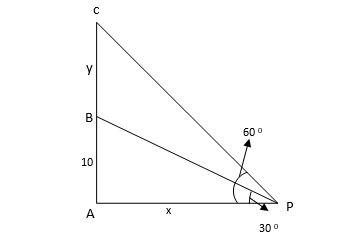
Let the height of the building be AC. Suppose at any point B be the window of the building, which is at a height of 10 m above the ground.
$\angle APB = {30^ \circ }$be the angle of depression from the window at point P.
Let $\angle APC = {60^ \circ }$ be the angle of elevation from point P to the top of the building.
In $\Delta APC$ we have to find out the height of the building AC,
We already have a height of window in a building is \[10m\] from the ground and assuming the height above the window in a building as $BC = y$
Therefore, $AB = 10$
\[AC = BC + AB\]
$\Rightarrow$\[AC = y + 10\].....(1)
For calculating the height of the building we have to calculate the value of AP first:
So, it is given:
$\angle APB = {30^ \circ }$
In \[\Delta ABP,{\text{ }}AB = 10m,{\text{ }}AP = x\]
Putting the values in the formula $\tan \theta = \dfrac{{{\text{perpendicular}}}}{{{\text{Base}}}}$
Here, perpendicular = $AB$
Base = $x$
$\Rightarrow$$\tan {30^ \circ } = \dfrac{{10}}{x}$ ......(2)
AS we know $\tan {30^ \circ }$=$\dfrac{1}{{\sqrt 3 }}$
Using the value of $\tan {30^ \circ }$ in above equation …..(2)
$\Rightarrow$$\dfrac{1}{{\sqrt 3 }} = \dfrac{{10}}{x}$
On substituting, we will get
$\Rightarrow$$x = 10\sqrt 3 $
Now we have the value of $x{\text{ or AP = }}10\sqrt 3 $, we will calculate the height of the building AC.
So, in triangle AC, we have
$\Rightarrow$\[AC = y + 10\] and $\angle APC = {60^ \circ }$
Now using the above formula again:
$\tan \theta = \dfrac{{{\text{perpendicular}}}}{{{\text{Base}}}}$
Now, in triangle AC, perpendicular = AC
Base $ = AP = 10\sqrt 3 $
After putting the above values in the formula, we will have
$\Rightarrow$$\tan {60^ \circ } = \dfrac{{AC}}{x}$ .......(3)
As we know the value of $\tan {60^ \circ } = \sqrt 3 $, we will put it in the above equation ....(3)
$\Rightarrow$$\sqrt 3 = \dfrac{{10 + y}}{{10\sqrt 3 }}$
On substituting, we will get
$\Rightarrow$$\sqrt 3 \times 10\sqrt 3 = 10 + y$
$\Rightarrow$$30 = 10 + y$
On simplifying the above equation, we get
$\Rightarrow$$y = 30 - 10 = 20$
$\Rightarrow$$y = 20$
From y we can get the value of AC in equation (1).
$AC = $ Height of the building
$\Rightarrow$ $10 + y = 10 + 20 = 30m$
$\therefore$ The height of the building is 30m
Note: During construction of the diagram of the question, you must keep in mind that the angle of elevation is relevant for the objects, which are above the horizontal line. The angle of depression is relevant for the objects, which are below the horizontal line. If we will draw these angles wrong our question will get incorrect automatically.
Draw a diagram and mark two angles- angle of depression and angle of elevation.
Formula Used:
$\tan (\theta ) = \dfrac{{{\text{perpendicular}}}}{{{\text{Base}}}}$
$\tan ({30^ \circ }) = \dfrac{1}{{\sqrt 3 }}$
Complete step by step solution:
Let the height of the building be AC. Suppose at any point B be the window of the building, which is at a height of 10 m above the ground.
Let the height of the building be AC. Suppose at any point B be the window of the building, which is at a height of 10 m above the ground.
$\angle APB = {30^ \circ }$be the angle of depression from the window at point P.
Let $\angle APC = {60^ \circ }$ be the angle of elevation from point P to the top of the building.
In $\Delta APC$ we have to find out the height of the building AC,
We already have a height of window in a building is \[10m\] from the ground and assuming the height above the window in a building as $BC = y$
Therefore, $AB = 10$
\[AC = BC + AB\]
$\Rightarrow$\[AC = y + 10\].....(1)
For calculating the height of the building we have to calculate the value of AP first:
So, it is given:
$\angle APB = {30^ \circ }$
In \[\Delta ABP,{\text{ }}AB = 10m,{\text{ }}AP = x\]
Putting the values in the formula $\tan \theta = \dfrac{{{\text{perpendicular}}}}{{{\text{Base}}}}$
Here, perpendicular = $AB$
Base = $x$
$\Rightarrow$$\tan {30^ \circ } = \dfrac{{10}}{x}$ ......(2)
AS we know $\tan {30^ \circ }$=$\dfrac{1}{{\sqrt 3 }}$
Using the value of $\tan {30^ \circ }$ in above equation …..(2)
$\Rightarrow$$\dfrac{1}{{\sqrt 3 }} = \dfrac{{10}}{x}$
On substituting, we will get
$\Rightarrow$$x = 10\sqrt 3 $
Now we have the value of $x{\text{ or AP = }}10\sqrt 3 $, we will calculate the height of the building AC.
So, in triangle AC, we have
$\Rightarrow$\[AC = y + 10\] and $\angle APC = {60^ \circ }$
Now using the above formula again:
$\tan \theta = \dfrac{{{\text{perpendicular}}}}{{{\text{Base}}}}$
Now, in triangle AC, perpendicular = AC
Base $ = AP = 10\sqrt 3 $
After putting the above values in the formula, we will have
$\Rightarrow$$\tan {60^ \circ } = \dfrac{{AC}}{x}$ .......(3)
As we know the value of $\tan {60^ \circ } = \sqrt 3 $, we will put it in the above equation ....(3)
$\Rightarrow$$\sqrt 3 = \dfrac{{10 + y}}{{10\sqrt 3 }}$
On substituting, we will get
$\Rightarrow$$\sqrt 3 \times 10\sqrt 3 = 10 + y$
$\Rightarrow$$30 = 10 + y$
On simplifying the above equation, we get
$\Rightarrow$$y = 30 - 10 = 20$
$\Rightarrow$$y = 20$
From y we can get the value of AC in equation (1).
$AC = $ Height of the building
$\Rightarrow$ $10 + y = 10 + 20 = 30m$
$\therefore$ The height of the building is 30m
Note: During construction of the diagram of the question, you must keep in mind that the angle of elevation is relevant for the objects, which are above the horizontal line. The angle of depression is relevant for the objects, which are below the horizontal line. If we will draw these angles wrong our question will get incorrect automatically.
Recently Updated Pages
Master Class 10 Computer Science: Engaging Questions & Answers for Success

Master Class 10 General Knowledge: Engaging Questions & Answers for Success
Master Class 10 English: Engaging Questions & Answers for Success
Master Class 10 Social Science: Engaging Questions & Answers for Success
Master Class 10 Maths: Engaging Questions & Answers for Success
Master Class 10 Science: Engaging Questions & Answers for Success
Trending doubts
What is the median of the first 10 natural numbers class 10 maths CBSE
Which women's tennis player has 24 Grand Slam singles titles?
Who is the Brand Ambassador of Incredible India?
Why is there a time difference of about 5 hours between class 10 social science CBSE
Write a letter to the principal requesting him to grant class 10 english CBSE
A moving boat is observed from the top of a 150 m high class 10 maths CBSE