




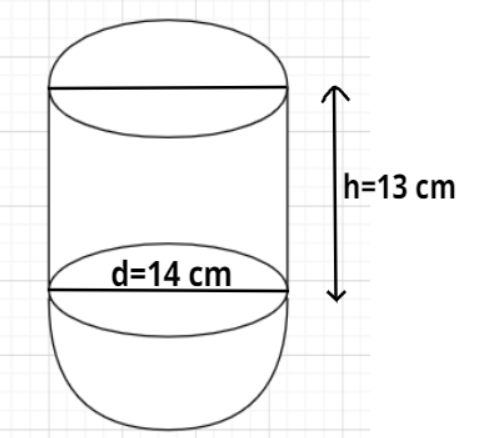
A vessel in the form of a hollow hemisphere mounted by a hollow cylinder. The diameter of the hemisphere is 14 cm and the height of the cylindrical part is 13 cm. Find the inner surface area of the vessel.
Answer
 Verified
622.8k+ views
Hint- Here, we will be using the formulas for the curved surface area of the cylinder and hemisphere with the help of which we can determine the total inner surface area of the vessel.
Given, diameter of the hemispherical part of the vessel $d = 14{\text{ cm}}$
Height of the cylindrical part of the vessel $h = 13{\text{ cm}}$
Since, radius$ = \dfrac{{{\text{diameter}}}}{2}$
So, radius of the hemispherical part of the vessel $r = \dfrac{d}{2} = \dfrac{{14}}{2} = 7{\text{ cm}}$
Since, the cylinder is mounted on the hemisphere so the diameters of both will be equal which means the radius of the cylindrical part will be equal to the radius of hemispherical part of the vessel.
i.e., Radius of the cylindrical part of the vessel $r = 7{\text{ cm}}$
Clearly, the inner surface of the vessel consists of the curved surface of the hollow hemispherical part and the curved surface of the cylindrical part of the vessel.
As we know that the curved surface area of the hemisphere having radius $r$ is $2\pi {r^2}$ and the curved surface area of the cylinder having radius $r$ and height $h$ is $2\pi rh$.
So, Inner surface area of the vessel$ = $Curved surface area of the hemispherical part$ + $Curved surface area of the cylindrical part
$ \Rightarrow {\text{Inner surface area of the vessel}} = 2\pi {r^2} + 2\pi rh = 2\pi r\left( {r + h} \right) = 2 \times \dfrac{{22}}{7} \times 7 \times \left( {7 + 13} \right) = 44 \times 20 = 880{\text{ c}}{{\text{m}}^2}$
Hence, the inner surface area of the vessel is 880 cm2.
Note- In these types of problems, the figure is analysed carefully so that it follows the problem statement. In this particular problem, the cylinder is mounted on the hemispherical part of vessel so the base of the cylinder will merge with the open surface of the hemispherical part of the vessel and hence the radius of the cylindrical part and that of the hemispherical part will be equal to each other.
Given, diameter of the hemispherical part of the vessel $d = 14{\text{ cm}}$
Height of the cylindrical part of the vessel $h = 13{\text{ cm}}$
Since, radius$ = \dfrac{{{\text{diameter}}}}{2}$
So, radius of the hemispherical part of the vessel $r = \dfrac{d}{2} = \dfrac{{14}}{2} = 7{\text{ cm}}$
Since, the cylinder is mounted on the hemisphere so the diameters of both will be equal which means the radius of the cylindrical part will be equal to the radius of hemispherical part of the vessel.
i.e., Radius of the cylindrical part of the vessel $r = 7{\text{ cm}}$
Clearly, the inner surface of the vessel consists of the curved surface of the hollow hemispherical part and the curved surface of the cylindrical part of the vessel.
As we know that the curved surface area of the hemisphere having radius $r$ is $2\pi {r^2}$ and the curved surface area of the cylinder having radius $r$ and height $h$ is $2\pi rh$.
So, Inner surface area of the vessel$ = $Curved surface area of the hemispherical part$ + $Curved surface area of the cylindrical part
$ \Rightarrow {\text{Inner surface area of the vessel}} = 2\pi {r^2} + 2\pi rh = 2\pi r\left( {r + h} \right) = 2 \times \dfrac{{22}}{7} \times 7 \times \left( {7 + 13} \right) = 44 \times 20 = 880{\text{ c}}{{\text{m}}^2}$
Hence, the inner surface area of the vessel is 880 cm2.
Note- In these types of problems, the figure is analysed carefully so that it follows the problem statement. In this particular problem, the cylinder is mounted on the hemispherical part of vessel so the base of the cylinder will merge with the open surface of the hemispherical part of the vessel and hence the radius of the cylindrical part and that of the hemispherical part will be equal to each other.
Recently Updated Pages
Master Class 10 Computer Science: Engaging Questions & Answers for Success

Master Class 10 General Knowledge: Engaging Questions & Answers for Success
Master Class 10 English: Engaging Questions & Answers for Success
Master Class 10 Social Science: Engaging Questions & Answers for Success
Master Class 10 Maths: Engaging Questions & Answers for Success
Master Class 10 Science: Engaging Questions & Answers for Success
Trending doubts
What is the median of the first 10 natural numbers class 10 maths CBSE
Which women's tennis player has 24 Grand Slam singles titles?
Who is the Brand Ambassador of Incredible India?
Why is there a time difference of about 5 hours between class 10 social science CBSE
Write a letter to the principal requesting him to grant class 10 english CBSE
State and prove converse of BPT Basic Proportionality class 10 maths CBSE