









What is the Category-Wise NEET Reservation Criteria 2026 for SC ST OBC EWS and PwD? Check the Complete Details
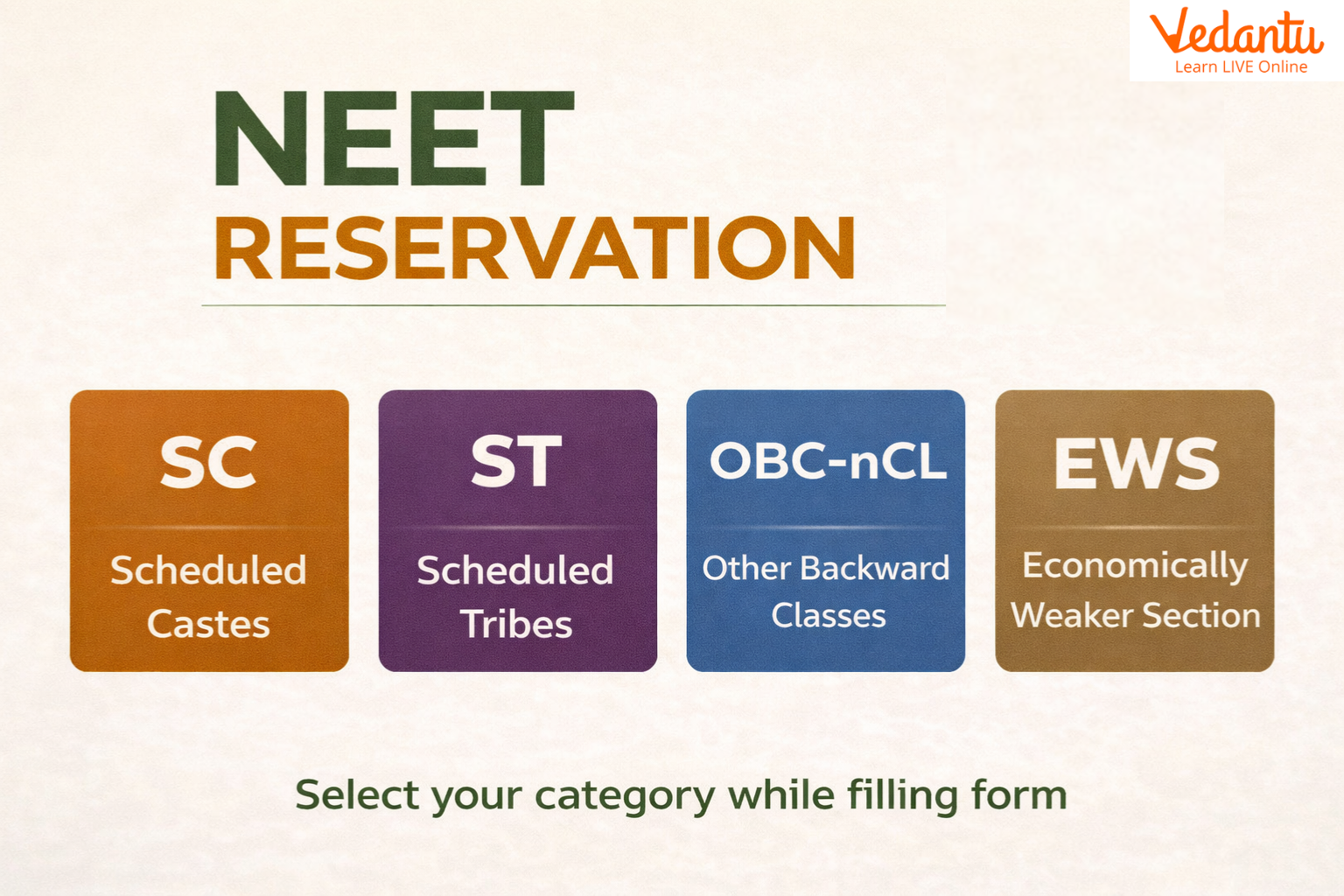
The NEET reservation policy provides category-based benefits to support students from different backgrounds in medical admissions. Currently, 27% reservation is allotted to OBC candidates and 10% to EWS candidates within the 15% All India Quota (AIQ) seats during counselling. To avail these benefits, candidates must correctly select their category while filling out the NEET application form.
Earlier, the 15% AIQ seats mainly applied to central institutes and national universities, but reservation policies have expanded over time. For example, Tamil Nadu offers a 7.5% reservation for NEET-qualified students from government schools, giving them better access to medical seats.
There are also special provisions under the central pool quota for victims of terrorist attacks and their families for MBBS and BDS admissions. Candidates from Union Territories may need to submit a self-declaration during the application process to claim reservation benefits. Understanding these rules helps students use NEET reservation advantages during counselling.
Also Visit: NEET 2026 NEET 2026 Registration
NEET Reservation for 85% State Quota Seats
Under the NEET reservation system, 85% of medical seats are filled through the State Quota, managed by individual State or Union Territory counselling authorities.
Each State/UT conducts its own counselling process to allocate seats under the 85% state quota.
A state-wise merit list is prepared based on NEET scores to determine eligibility for admissions.
Candidates should check the official website of their respective state counselling authority to know the counselling schedule, registration process, and admission guidelines.
Admission through the state quota depends on meeting the eligibility requirements and reservation rules applicable in that particular State or Union Territory.
NEET Reservation for 15% All India Quota (AIQ) Seats
Under the NEET reservation system, 15% of medical seats are filled through the All India Quota (AIQ) for admissions across India.
Indian Nationals, NRIs, OCI, PIO, and Foreign Nationals are eligible to apply for seats under the AIQ.
To secure admission through the 15% AIQ seats, candidates must participate in online counselling conducted by the Medical Counselling Committee (MCC).
If any seats remain vacant after completing the AIQ counselling rounds, those seats are transferred to the respective State Quota.
The AIQ merit list is prepared according to the number of available seats, ensuring that candidates are ranked based on their NEET scores.
Andhra Pradesh and Telangana are now included in the 15% All India Quota counselling, and candidates from these states are no longer required to submit a self-declaration form.
Also Visit: NEET Eligibility CriteriaNEET Exam CentresNEET Dress Code
NEET Reservation for Candidates from Jammu & Kashmir and Ladakh
Candidates from Jammu & Kashmir and Ladakh are generally not included in the 15% All India Quota (AIQ) scheme.
As a result, they are usually not eligible for admission under the 15% AIQ seats.
However, if candidates from these Union Territories wish to participate in AIQ counselling, they must submit an online self-declaration form during the application process.
NEET Reservation for Other Backward Classes (OBC)
NTA and the Medical Counselling Committee (MCC) have updated the reservation rules for OBC candidates in NEET counselling.
Under the current policy, OBC candidates belonging to the Non-Creamy Layer (OBC-NCL) are eligible for reservation benefits in medical admissions.
27% reservation is allotted to OBC-NCL candidates under the 15% All India Quota (AIQ) seats during NEET counselling.
Recent changes in the reservation policy are expected to benefit around 2,700 OBC candidates and about 550 EWS candidates in medical admissions.
Candidates who wish to claim OBC-NCL reservation must correctly select their category in the NEET application form.
During the counselling process, candidates must submit all required documents related to the OBC-NCL category; otherwise, they will not be eligible to claim reservation benefits.
Eligible OBC-NCL candidates can avail the 27% reservation quota for MBBS and BDS admissions through NEET counselling.
Reservation for Persons with Disabilities (PwD)
Candidates belonging to the PwD category are eligible for a 5% reservation in medical admissions through NEET.
To claim this reservation, applicants must meet the rules and eligibility criteria set by the concerned authorities.
The candidate must have a minimum disability of 40% or more to qualify for the PwD reservation.
The disability must be assessed according to the guidelines prescribed by the government.
Candidates must possess a valid Disability Certificate to avail the reservation benefit.
This certificate should be issued by one of the 14 designated centres approved by the National Testing Agency (NTA).
Reservation for Economically Weaker Sections (EWS)
The EWS reservation in NEET was introduced by the Ministry of Health and Family Welfare in 2019 for NEET-UG admissions.
Under this policy, 10% of seats are reserved in government medical colleges for candidates belonging to the Economically Weaker Sections.
The reservation is intended to support students from financially weaker backgrounds who do not fall under other reserved categories.
Eligibility for the EWS reservation is based on specific criteria set by the government.
The total annual family income of the candidate should not exceed ₹8,00,000.
Families owning 5 acres or more of agricultural land are not eligible for EWS reservation.
Ownership of a residential flat measuring 1000 sq. ft. or more makes the candidate ineligible for this quota.
Candidates whose families own a residential plot of 100 square yards or more in notified municipalities are not eligible.
Candidates whose families own a residential plot of 200 square yards or more in areas outside notified municipalities are also not eligible.
If a candidate’s family meets any of the above property conditions, they cannot claim the EWS reservation benefit.
Authorized Authorities to Issue Income and Asset Certificate for NEET EWS Reservation
District Magistrate / Additional District Magistrate / Collector / Deputy Commissioner / Additional Deputy Commissioner / First Class Stipendiary Magistrate / Sub-Divisional Magistrate / Taluka Magistrate / Executive Magistrate / Extra Assistant Commissioner
Chief Presidency Magistrate / Additional Chief Presidency Magistrate / Presidency Magistrate
Revenue Officer not below the rank of Tehsildar
Sub-Divisional Officer of the area where the candidate or their family normally resides
Reservation Criteria for Deemed Universities
The Directorate General of Health Sciences (DGHS) conducts the All India Quota (AIQ) counselling for NEET admissions, including seats in Deemed and Central universities.
The counselling process also covers admissions to institutions such as ESIC colleges and AFMS institutes.
Admission rules and guidelines for the Armed Forces Medical College (AFMC), Pune are determined by the Directorate General of Armed Forces Medical Services under the Ministry of Defence, Government of India.
Tamil Nadu Government School NEET Reservation: 7.5% Quota
The Tamil Nadu government has introduced a 7.5% reservation for students from government schools who qualify in the NEET exam.
This reservation is included within the existing reservation structure and creates a special category for eligible government school students.
The initiative was announced by the Tamil Nadu government to support students from government schools in securing medical admissions.
The reservation mainly benefits students who have completed their education from Class 6 to Class 12 in government schools in Tamil Nadu.
The decision was taken after observing a decline in MBBS admissions among government school students in recent years.
To improve student preparedness, the state has also introduced free NEET coaching programmes and is working to align the state board syllabus more closely with the CBSE curriculum.
Reservation for Victims of Terror Attacks
According to the NEET reservation guidelines issued by the Ministry of Health and Family Welfare, special provisions are available for victims of terror attacks.
The Ministry has issued instructions to all states and Union Territories regarding reservation under the central pool for medical admissions.
Spouses and children of victims of terror attacks can receive reservation benefits for MBBS and BDS admissions after qualifying the NEET exam.
These reserved seats are provided through the central pool of medical seats.
Eligibility Criteria
Candidates eligible under this category may include:
Children who have been threatened or targeted by terrorist groups.
Children from families of Kashmir migrants who have lost their livelihood due to terrorism.
Children whose parent or close family member has lost their life in a terrorist attack.
Children whose parents or family members became an innocent victim of firing by armed forces during anti-terror operations in the Union Territories of Jammu and Kashmir or Ladakh.
Key Guidelines for NEET Reservation 2026
The All India Quota (AIQ) does not provide reservation under the Defence quota. However, some states may offer Defence quota reservations through their state counselling process. Candidates should check with their respective state counselling authorities for accurate details.
Deemed Universities usually conduct their own counselling process for NEET admissions based on their institutional policies.
The All India Quota does not include seats under the Management quota. However, certain private universities may allocate seats under this category. Candidates should contact the respective institutions for detailed information.
Students should carefully check their eligibility for reservation under both the All India Quota and State Quota before applying for NEET counselling.
FAQs on NEET Reservation Criteria 2026 Quota for SC, ST, OBC, EWS and PwD
1. Who can claim reservation in NEET 2026?
Candidates belonging to SC, ST, OBC-NCL, EWS, and PwD categories with a valid certificate can claim reservation.
2. How much is the NEET AIQ reservation for OBC candidates?
OBC-NCL candidates get 27% reservation in AIQ seats in central universities and government colleges.
3. Can I claim State Quota if I am from a different state?
No, State Quota seats are only for domicile candidates of that particular state.
4. How do I prove my OBC/EWS category?
You need to submit a valid OBC-NCL or EWS certificate issued by a competent authority.
5. Is there a separate reservation for female candidates?
Some states have reservation for female candidates, but AIQ does not have a specific female quota.
6. What happens if I don’t submit my category certificate on time?
You will be considered as a General category candidate during counselling.
7. Can I apply under PwD quota if my disability is less than 40%?
No, only candidates with 40% or more disability (as per the RPwD Act) can apply under the PwD quota.
8. What is the NEET reservation for EWS candidates?
EWS candidates get 10% reservation in AIQ seats in central institutions and government colleges.
9. Is there a reservation for NRI students in NEET?
Yes, NRI seats are available in Deemed Universities under the Management Quota.
10. Where can I check my state’s reservation policy?
Check your state’s medical counselling website for specific reservation rules.
11. What is the OBC reservation in NEET?
OBC (Other Backward Classes) candidates get 27% reservation in All India Quota (AIQ) seats in government medical colleges. However, only OBC-NCL (Non-Creamy Layer) candidates are eligible. If your family income is above ₹8 lakh per year, you will not be eligible for OBC reservation.
12. Where can I find the NEET reservation list?
The NEET reservation list includes the category-wise seat distribution for AIQ and State Quota. You can check this list on:
AIQ reservation is available on the MCC website (mcc.nic.in).
State quota reservations can be checked on your state’s medical counselling website.
13. Is there a separate reservation for General category in NEET?
General category students do not have a specific reservation. However, they can apply for EWS (Economically Weaker Section) reservation, which offers 10% reserved seats for General category candidates with family income below ₹8 lakh per year.
14. What is the NEET reservation percentage for each category?
Here’s the NEET 2026 reservation percentage for AIQ seats:
All India Quota (AIQ) – 15% of government college seats
SC – 15%
ST – 7.5%
OBC-NCL – 27%
EWS – 10%
PwD – 5% (horizontal reservation across all categories)
State Quota (85% of government seats)
Each state has its own reservation rules for SC, ST, OBC, EWS, and PwD.
15. What is the total reservation in NEET?
In All India Quota (AIQ) seats, a total of 59.5% of seats are reserved for various categories (SC, ST, OBC, EWS, and PwD). The remaining 40.5% of seats are for General category students.
16. How many SC seats are in NEET?
Seats are allocated based on the NEET reservation policy. Under the 15% All India Quota (AIQ), 15% of seats are reserved for SC candidates. Additional seats are also available through state quota counselling, depending on each state’s reservation rules. This system is part of the broader SC ST reservation in NEET designed to support students from reserved categories.
17. What is the 15 all India quota in NEET?
The 15% All India Quota (AIQ) refers to seats in government medical and dental colleges that are open to candidates from any state or union territory. These seats are filled through national-level counselling conducted by MCC and follow the NEET reservation rules, which include OBC reservation in NEET, EWS reservation in NEET, SC, ST, and PwD categories.
18. Is 10,000 medical seats increased?
Yes. The Union Cabinet approved a major expansion plan to add over 10,000 new medical seats in existing government medical colleges and hospitals. This initiative, supported by significant government funding, aims to increase opportunities for students appearing in NEET and strengthen medical education infrastructure in India.
19. Will NEET seats increase in 2026?
Yes. The number of medical seats in India continues to grow each year. Reports suggest that MBBS seats may reach around 1.28 lakh in NEET 2026, with additional postgraduate medical seats also increasing. This expansion is expected to create more opportunities for students applying through NEET counselling.
20. Which caste has more reservations in NEET?
Under the NEET reservation system for the 15% AIQ seats. OBC (Non-Creamy Layer): 27% – the largest share under OBC reservation in NEET.
