





Understanding the Concepts in Class 9 Maths Chapter 5 Exercise 5.2


Exercise Set 5.2
Question 1.
Show that the triangle formed by a chord and the centre of the circle is isosceles.
Solution:
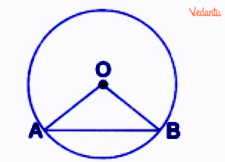
Given: AB is a chord of a circle with centre O.
To prove: ∆OAB is an isosceles triangle.
Proof:
Points A and B lie on the circle's circumference. Therefore, OA and OB are radii of the same circle.
OA = OB
Thus, ∆OAB has two equal sides. Hence, ∆OAB is isosceles.
Therefore, the triangle formed by a chord and the centre of a circle is isosceles.
Question 2.
Show that if two such isosceles triangles (occurring in the previous question) have equal base length, they are congruent to each other.
Solution:
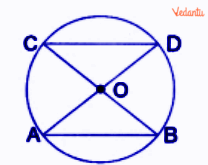
Given: ∆OAB and ∆OCD are formed by chords AB and CD of the same circle with centre O, and:
AB = CD
To prove:
∆OAB ≅ ∆OCD
Proof:
In ∆OAB and ∆OCD:
OA = OC, as they are radii of the same circle.
OB = OD, as they are radii of the same circle.
AB = CD, as given.
Therefore, all three corresponding sides are equal.
Hence, by the SSS congruence criterion:
∆OAB ≅ ∆OCD
Therefore, two such isosceles triangles with equal bases are congruent.
Key Points to Remember from Class 9 Maths: I’m Up and Down, and Round and Round Exercise 5.2
Equal radii: The radii drawn from the centre to points on the same circle are equal.
Isosceles triangle: A chord joined to the centre forms an isosceles triangle with two equal sides.
Equal chords: Equal chords in the same circle can be used to show that the corresponding triangles formed with the centre are equal.
SSS criterion: When all three corresponding sides of two triangles are equal, SSS can prove their congruence.
Proof writing: Clearly identify the given information, what needs to be proved, and the geometric reason supporting each step.
Diagram reading: Labelling the centre, chord, and radii correctly makes the relationships between the sides much easier to spot.
Access Exercise Wise NCERT Solutions for Chapter 5 Maths Class 9
CBSE Class 9 Maths Chapter 5 Other Study Materials
Chapter-Specific NCERT Solutions for Class 9 Maths
Additional Study Materials for Class 9 Maths


FAQs on NCERT Solutions for Class 9 Maths Chapter 5 Exercise 5.2 | 2026-27
1. What is Exercise 5.2 of Class 9 Maths Chapter 5 about?
Exercise 5.2 deals with circles, chords, radii, isosceles triangles, and congruence using geometric reasoning.
2. What is the relationship between a chord and the centre of a circle?
When you join the endpoints of a chord to the centre, the two segments are radii. Since the radii are equal, they form an isosceles triangle.
3. How do you prove that a triangle formed by a chord and the centre is isosceles?
Let AB be a chord, and O be the centre. Since OA and OB are radii of the same circle, OA = OB. Therefore, triangle OAB is isosceles.
4. Which theorem is used to prove the triangles in Exercise 5.2 are congruent?
The SSS congruence criterion is used when the three corresponding sides of the two triangles are equal.
5. Are all radii of a circle equal?
Yes. Every radius extends from the centre to the circumference, so all radii in the same circle have the same length.
6. What happens when two chords of the same circle have equal lengths?
When the corresponding triangles are formed by joining the chord endpoints to the centre, their corresponding sides can be shown to be equal, allowing SSS congruence to be applied.
7. How do you solve Class 9 Maths Chapter 5 Exercise 5.2 Question 1?
Identify the chord and centre, join the chord's endpoints to the centre, and use the fact that the two resulting segments are equal radii.
8. What is the main idea behind Question 2 in Exercise 5.2?
The question extends the result from Question 1. Equal radii provide two pairs of equal sides, while equal chord lengths provide the third pair, proving congruence by SSS.
9. Why is SSS suitable for Question 2?
The two triangles have three pairs of corresponding equal sides: two pairs are equal because they are radii, and the third pair is equal because the chords have equal lengths.
10. How should students write a proof in Class 9 Maths Chapter 5 Exercise 5.2?
Write the given information first, state the required result, show the relevant equal sides with reasons, and then mention the congruence criterion or conclusion.
11. What should I know before studying Chapter 5 Maths Class 9 Exercise 5.2?
You should be familiar with basic circle terms such as radius and chord, along with the concept of an isosceles triangle and the SSS congruence criterion.
12. Can a chord be used to form an isosceles triangle?
Yes. Joining a chord's endpoints to the centre creates two equal radii, so the resulting triangle is isosceles.
13. Why are diagrams important in Exercise 5.2?
The diagrams help you identify which segments are radii and which one is the chord, making the equal-side relationships easier to understand.
14. Where can I find NCERT solutions for Class 9 Maths Chapter 5 Exercise 5.2?
The step-by-step solutions on this Vedantu page cover the questions in Exercise 5.2 and explain the geometric reasoning used in each proof.
15. How can I revise Class 9 maths chapter 5 exercise 5.2 solutions effectively?
Focus on the logic behind each proof: identify equal radii, recognise the role of equal chords, and understand why SSS proves the required triangles congruent.