



How to Solve Symmetrical Designs Questions in Class 5 Maths
NCERT Textbook Page 136
Alphabet Cutout
Which of the following alphabet cutouts can be made by just drawing half ($$\frac{1}{2}$$) or quarter ($$\frac{1}{4}$$) of the letter? You can do it by drawing lines of symmetry on the letters.

Solution:
Letters with ($$\frac{1}{4}$$) symmetry.

Letters with ($$\frac{1}{2}$$) symmetry.

Which of the letters have a horizontal line of symmetry? _________________
Solution:

Which of the letters have a vertical line of symmetry? ____________________
Solution:

Which letters have both vertical and horizontal lines of symmetry?________
Solution:

Let Us Do
Use lines of symmetry to make paper cutouts of diya, boat, and other designs. Look along the border of the page to fine the pictures.
Solution:
Students should do it by themselves
NCERT Textbook Pages 137-138
Let Us Make a Windmill Firki
Observe the dot in the firki. Does the firki look the same after $$\frac{1}{4}, \frac{1}{2}, \frac{3}{4}$$ and a full turn?
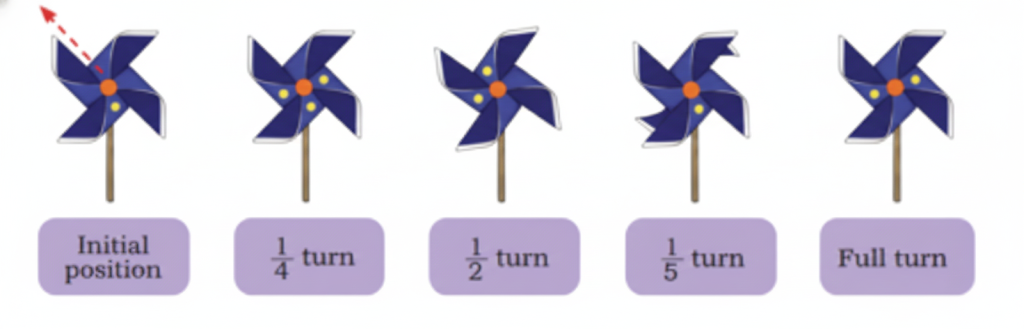
Solution:
Yes
Observe the letters below. Do they look the same when turned? Dots have been marked on the letters to keep track of the orientation of letters. You may also cut out the letters and fix the centre point of the letter by a nail or use tracing paper to check if the letter looks the same when turned.
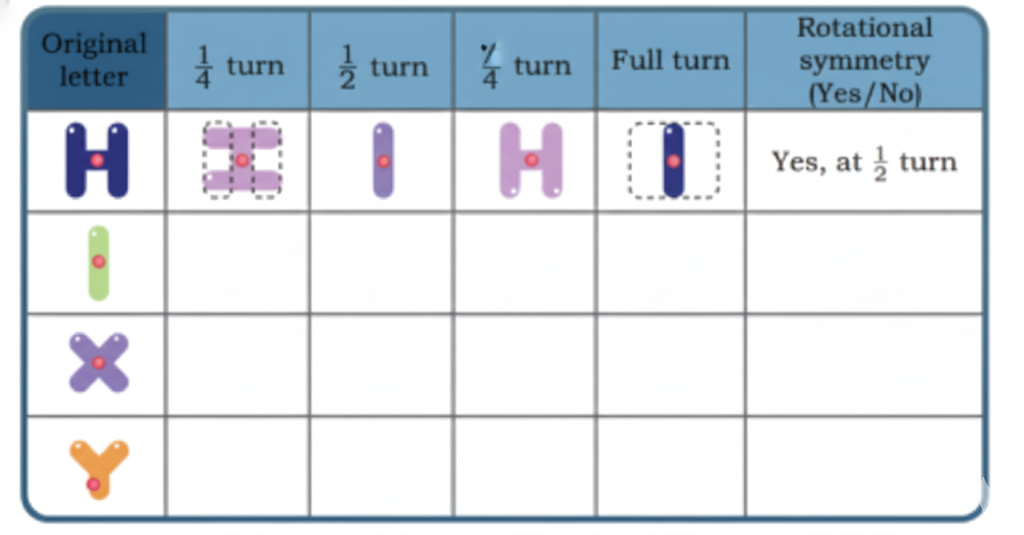
Solution:
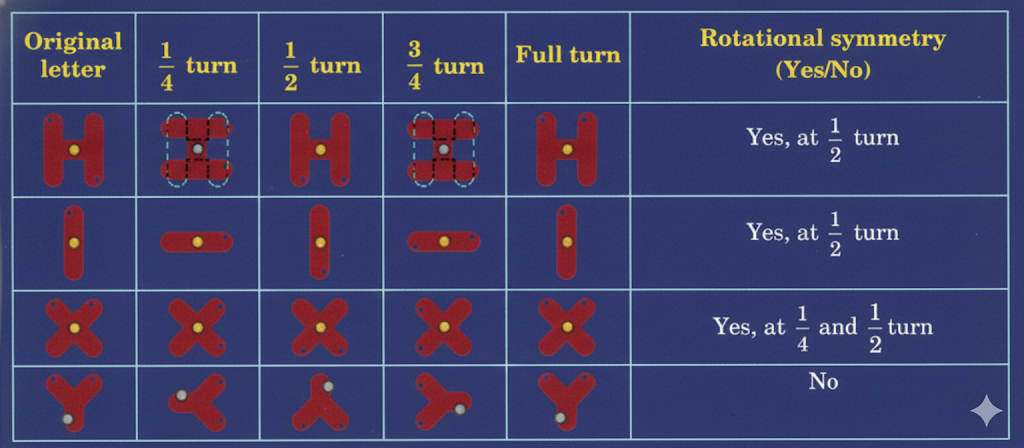
NCERT Textbook Page 138
Let Us Do
Find symmetry in the digits.

Solution:
Horizontal line of symmetry.

Both horizontal and vertical line of symmetry

Which digit(s) have reflection symmetry?
Solution:

Which digit(s) have rotational symmetry?
Solution:

Which digit(s) have both rotational and reflection symmetries?
Solution:

Now, let us look at the following numbers: ||, |00|
Do these have
(a) rotational symmetry,
(b) reflection symmetry or
(c) both symmetries?
Solution:
Both || and |00| exhibit rotational symmetry as well as reflection symmetry.
Give examples of 2-, 3-, and 4-digit numbers which have rotational symmetry, reflection symmetry, or both.
Solution:
A 2-digit number that has both rotational and reflection symmetry is ||.
The 3-digit numbers that show both rotational and reflection symmetry are ||| and |0|.
The 4-digit numbers that have both rotational and reflection symmetry are |||| and |00|.
NCERT Textbook Page 139
Making Designs
(a) Does the design have rotational symmetry?
Yes/No.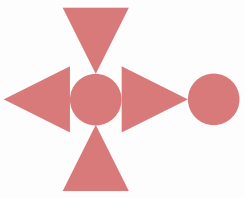
Solution:
No, it does not look the same after any rotation
i.e., $$\frac{1}{2}$$ or $$\frac{1}{4}$$ turn .
(b) Try to change the design by adding some shape(s) so that the new design looks the same after a $$\frac{1}{2}$$ turn. Draw the new design 2 in your notebook.
Solution:
Students should do it by themselves.
(c) Now try to modify or add more shapes so that the new design looks the same after ~ turn.
Draw the new design in your notebook.
Solution:
Students should do it by themselves.
(d) Do the new designs have reflection symmetry? If yes, draw the lines of symmetry.
Solution:
Students should do it by themselves.
Let Us Think
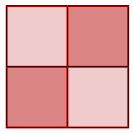
Does this design look the same after $$\frac{1}{2}$$ turn?
Solution:
Yes, the design looks the same after $$\frac{1}{2}$$ turn.
Does this design looks the same after $$\frac{1}{4}$$ turn?

Solution:
No, the design does not look the same after $$\frac{1}{4}$$ turn.
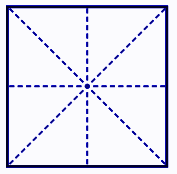
Colour the square given in the adjoining figure using two colours so that the design looks the same after every $$\frac{1}{4}$$ turn.
How many times does this shape look the. same during a full turn?
Do these designs have reflection symmetry also? Draw the line(s) of symmetry.
Solution:
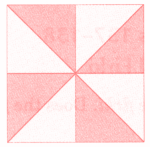
The image looks the same after every $$\frac{1}{4}$$ turn.
During one complete rotation, the figure appears the same four times. The shaded design does not exhibit reflection symmetry.
NCERT Textbook Pages 139-140
Let Us Do
Cut out squares and equilateral triangles with the same side length. These are provided at the end of the book.
Make different symmetrical designs by using these two shapes.

Solution:
Students should do it by themselves.
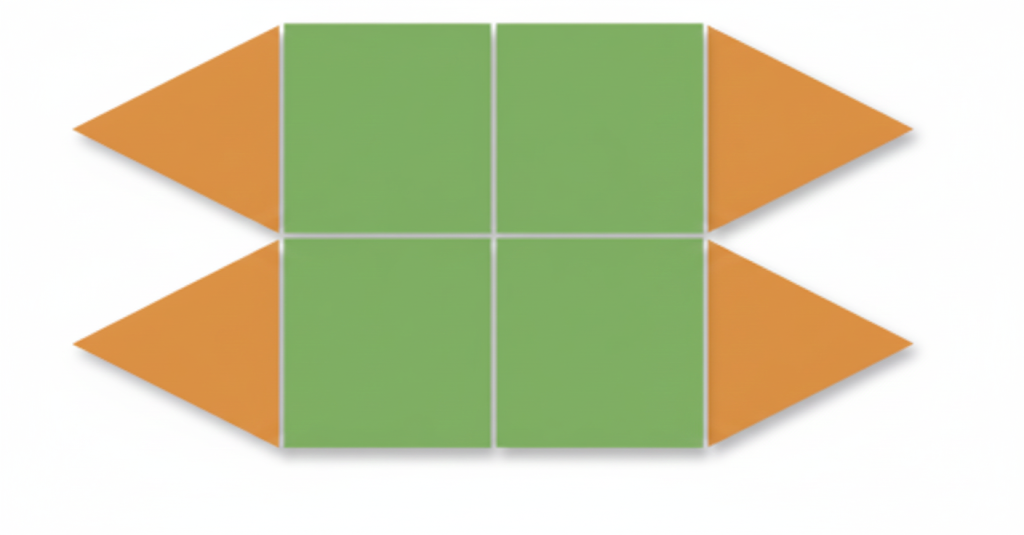
Does this shape have reflection symmetry? If yes, draw its line(s) of symmetry.
Solution:
Yes, the shape does have reflection symmetry. The lines of symmetry are shown in the picture below.
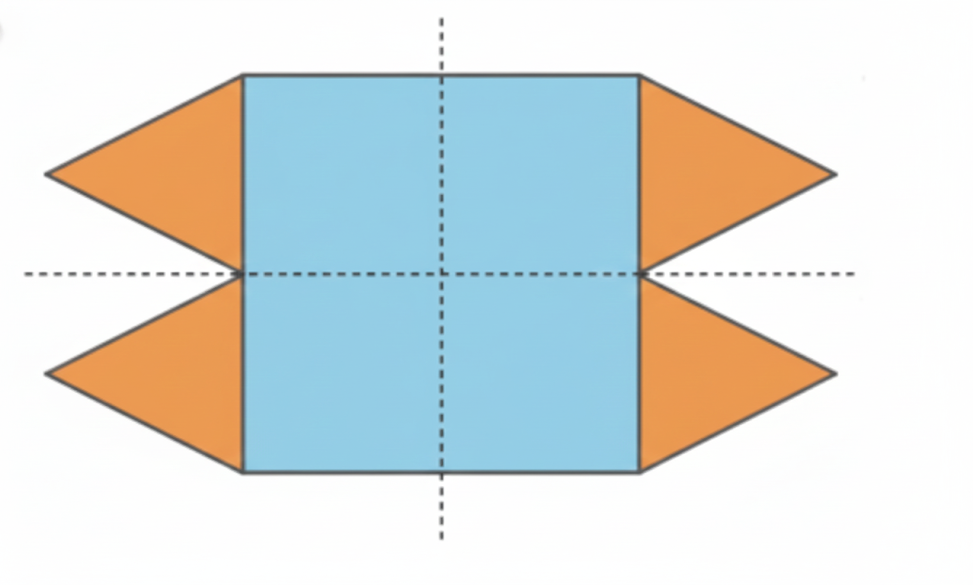
Does it have rotational symmetry? If yes, at which turn?
Solution:
The shape has rotational symmetry of $$\frac{1}{2}$$ turn also.
Does it have both symmetries?
Solution:
Yes.
NCERT Textbook Page 140
Let Us Explore
Below are images of wooden blocks and a part of their prints. Match each block to its correct print by drawing a line. One is done for you.
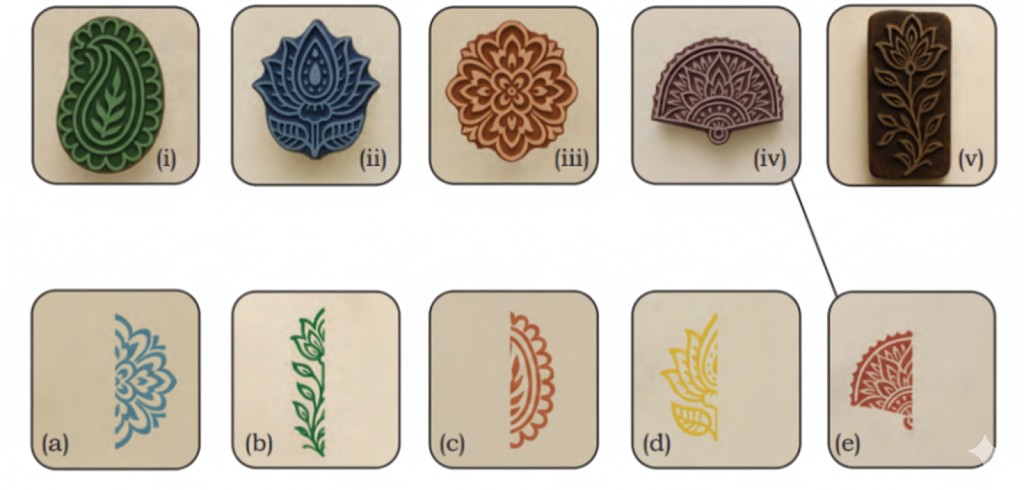
Solution:
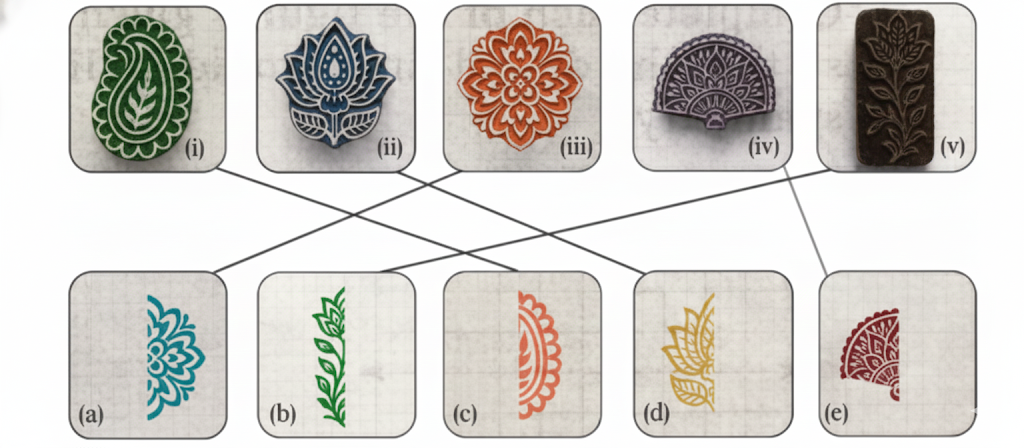
NCERT Textbook Page 141
Let Us Do
Observe the shapes given on the border. Which of the shapes have reflection symmetry? Put a mark on them. Put a on the shapes that have rotational symmetry.
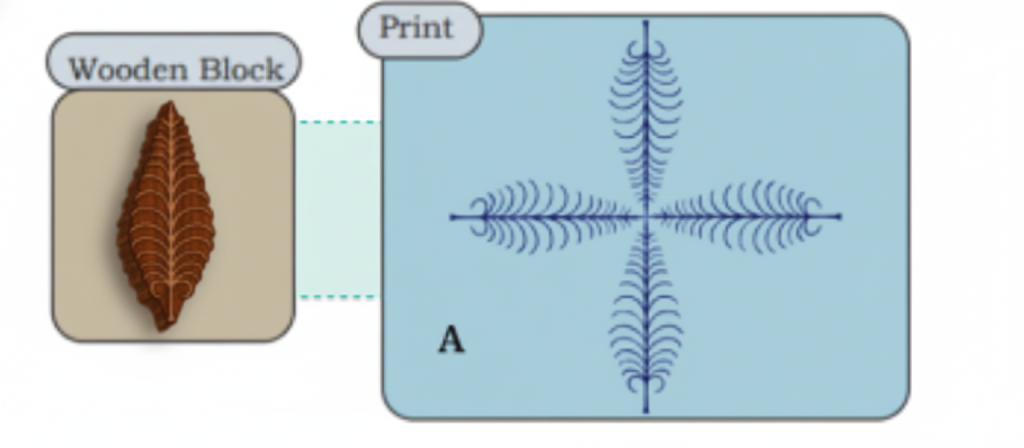
The design A looks the same after every $$\frac{1}{4}$$ turn.
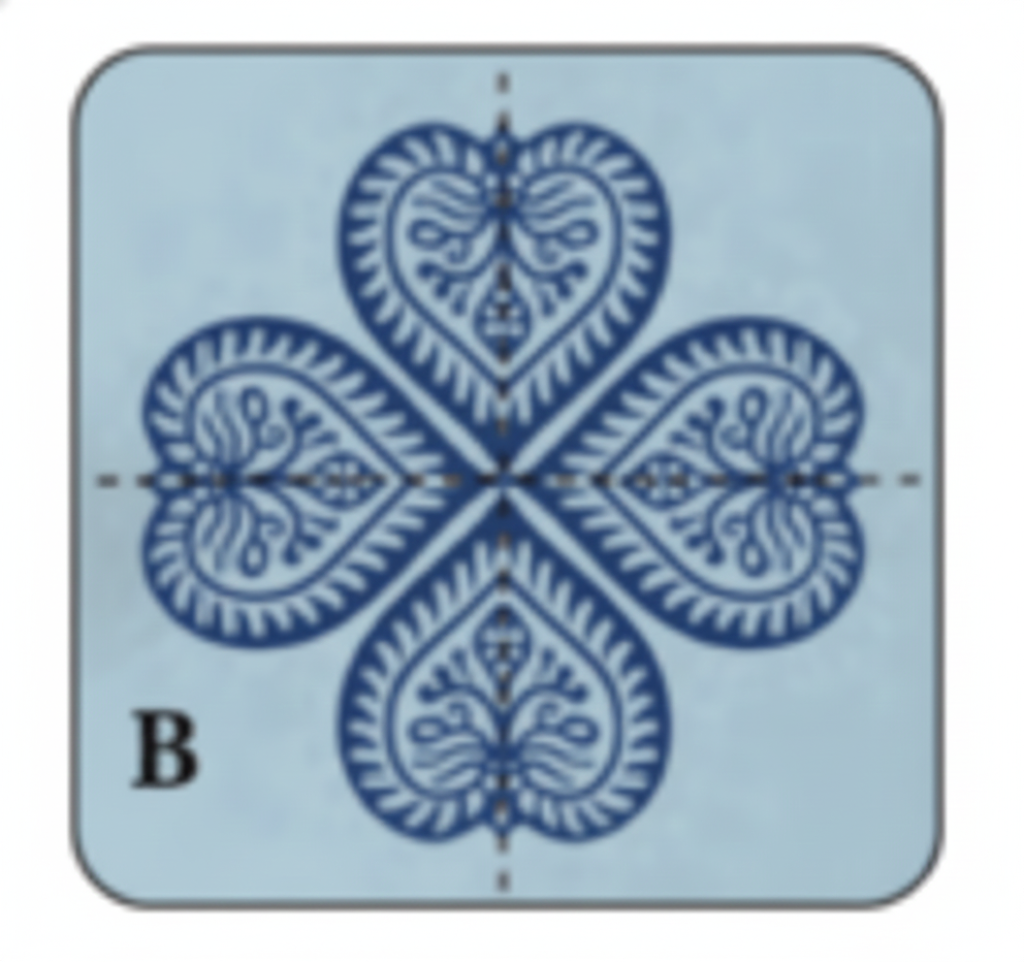
The design B looks the same after every ____________ turn. This design has _________________symmetry.
Solution:
Students should do it by themselves.
Project Work
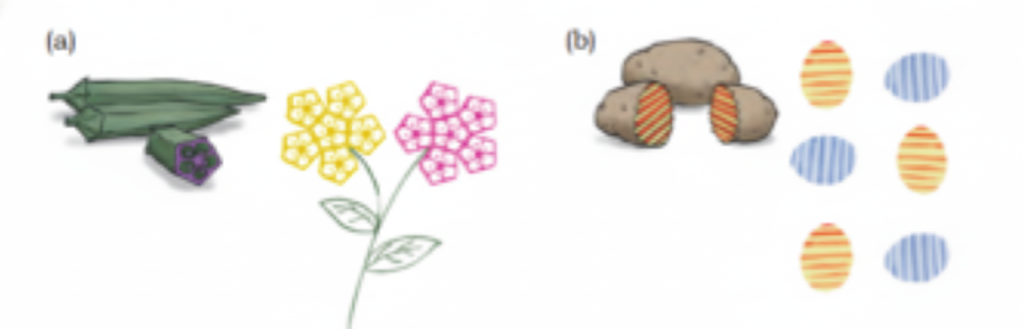
Create symmetrical patterns and designs using vegetable blocks. Some are shown below.
Solution:
Students should do it by themselves.
Understanding Symmetry in Mathematics
Learning about symmetry and designs helps Class 5 students recognize patterns in their daily life. The chapter makes it fun to identify reflection symmetry and rotational symmetry in letters, numbers, and beautiful traditional art.
Exploring the NCERT solutions Class 5 Maths Mela Chapter 10 Symmetrical Designs (2025-26) boosts problem-solving and creative skills. By practicing different questions, students understand how symmetry appears in crafts, block printing, and even in English alphabets.
Tip: Always look for lines of symmetry while drawing or making paper designs. This easy habit can improve exam performance and make working with shapes and patterns fun and rewarding!
FAQs on NCERT Solutions For Class 5 Maths Chapter 10 Symmetrical Designs (2025-26)
1. What is symmetry in Class 5 Maths?
Symmetry in Class 5 Maths means a shape or design that looks exactly the same on both sides if you fold it along a line (the line of symmetry).
Key points:
- A figure is symmetrical if one half is the mirror image of the other.
- The imaginary line dividing the shape into two equal parts is called the line of symmetry.
- Examples include figures like squares, rectangles, and some letters like A, H, and M.
2. How do you solve symmetrical designs questions?
To solve symmetrical designs questions in NCERT Class 5 Maths, follow these steps:
- Identify the line of symmetry in the figure.
- Fold or imagine folding the shape along this line.
- Check if both halves match exactly to decide if the shape is symmetrical.
- Draw the missing half if required, by mirroring the given part using the line of symmetry as reference.
3. Are diagrams or definitions mandatory in answers for Class 5 Maths Chapter 10?
Yes, diagrams and definitions are often mandatory in answers for Class 5 Maths Chapter 10.
- Drawing symmetrical shapes and lines of symmetry earns easy marks.
- Definitions like symmetry and line of symmetry should be clear and precise.
- Make diagrams neat and label the line of symmetry clearly.
4. How to write stepwise NCERT answers to score full marks in Chapter 10 Symmetrical Designs?
To score full marks in NCERT Chapter 10 Symmetrical Designs, always:
- Start with a relevant definition or brief introduction.
- Write each step clearly (numbered or in order), matching the method used in the textbook.
- Draw and label diagrams wherever asked.
- Highlight final answers, use keywords like 'symmetrical', 'mirror image', 'line of symmetry'.
5. Which questions are most important from NCERT Solutions Class 5 Maths Chapter 10 for exams?
The most important questions from NCERT Solutions Class 5 Maths Chapter 10 typically include:
- Finding and drawing lines of symmetry in given figures or alphabets.
- Drawing the other symmetrical half of a figure.
- Identifying symmetrical and non-symmetrical shapes.
- Definitions of symmetry and line of symmetry.
6. Where can I find and download the free PDF of NCERT Solutions Class 5 Maths Chapter 10 Symmetrical Designs?
You can download the free PDF of NCERT Solutions Class 5 Maths Chapter 10 Symmetrical Designs from trusted educational websites such as Vedantu or by searching "Class 5 Maths Chapter 10 NCERT Solutions PDF".
- PDFs are useful for offline study and quick revision.
- Always check the academic year (2025–26) for correct solutions.
7. How does mastering symmetrical designs help in CBSE Class 5 Maths exams?
Mastering symmetrical designs helps in CBSE Class 5 Maths exams by:
- Increasing marks in diagram and definition questions.
- Improving visual reasoning skills and accuracy.
- Making geometry and pattern-based problems easier in higher classes.
8. How should long answers be structured for better marks in Class 5 Maths Chapter 10?
For long answers in Class 5 Maths Chapter 10:
- Start with a short definition or introduction of the concept.
- Explain the steps one by one, using bullet points or numbering.
- Include neat diagrams whenever required, and label each part (especially the line of symmetry).
- End with the main conclusion or answer, using key terms from the chapter.
9. What are common mistakes students make in the Symmetrical Designs chapter, and how can they avoid them?
Common mistakes in the Symmetrical Designs chapter include:
- Not drawing or labelling the line of symmetry correctly.
- Missing to check if both halves are exact mirror images.
- Incomplete or untidy diagrams losing step marks.
- Always use a ruler for lines of symmetry.
- Double-check if the halves match perfectly.
- Keep diagrams neat and concise, and follow textbook conventions.
10. Are NCERT Solutions enough for Class 5 Maths exams?
NCERT Solutions for Class 5 Maths, Chapter 10, are usually sufficient for exam preparation because:
- They cover all important questions stepwise as per CBSE syllabus (2025–26).
- Provide clear explanations, diagrams, and definitions matching school exams.
- For additional practice, students can solve exemplar questions and sample papers.
11. Do examiners award partial marks for correct steps even if the final answer is wrong?
Yes, in CBSE and school exams, partial marks are often awarded if your steps and logic are correct, even if the final answer is incorrect.
- Show each calculation or construction step clearly.
- You may still earn marks for correct method, even with a small mistake at the end.
12. How to learn diagrams and maps for Class 5 Maths Symmetrical Designs?
To learn diagrams for Class 5 Maths Symmetrical Designs:
- Practice drawing different shapes with lines of symmetry (use a pencil and ruler).
- Label the line of symmetry on each figure clearly.
- Use colour or shading to differentiate halves when revising.
- Refer to NCERT textbook and solved examples for reference diagrams.
