








Easy Definition of Division with Examples and Steps for Kids
An Introduction to Division Methods
When you divide, you begin to create equal portions of a group of items. Counting objects into equal groups is one method that is commonly applied when learning to divide. For instance, if you had three dolls and needed to place 12 bracelets on each of them, you may distribute the bracelets evenly among the dolls until there are none remaining. Here, each doll would receive 4 bracelets since $\dfrac{12}{3}$ equals 4. The dividend in this instance is 12, the divisor is 3, and the quotient is 4. We must first know the components of a division problem in order to understand how to divide. The significant figure you are dividing is the dividend. The divisor is the quantity into which you are dividing the dividend. When you divide, the result is the quotient. Let's discuss how to divide in the further section.
What is Division?
In mathematics, the division is the process of dividing a number into equal parts and estimating the maximum number of equal parts that may be formed. For example, in this case, dividing 15 by 3 resulted in the division of 15 into 3 groups of 5 each.
The character "$\div$" or often "/" stands for division.
Components of Division
A long division equation is made up of many unique components. Let's understand these components in detail which makes sure your kids recognise what they represent and how to identify them.
1. The number under the line on the right side of the calculation is the dividend. It stands in for the dividing amount.
2. The number on the left, which is doing the dividing, is the divisor.
3. The number at the top is the quotient. When the equation is finished, it indicates the solution or the number of units in each place value.
4. The figure at the bottom is the remaining amount. It stands for the units that remain after being divided into the quotient unevenly.
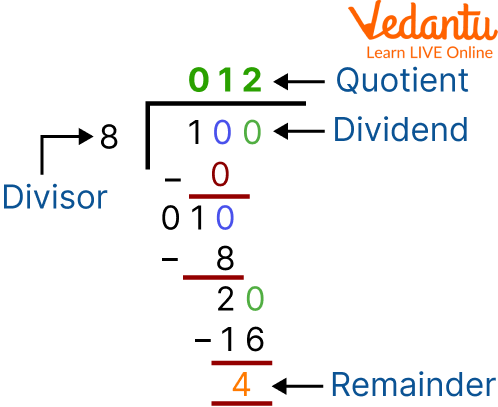
Components of Division
The following statement shows the relation between these four components:
Dividend = Divisor x Quotient + Remainder
To determine whether or not the solution is right, use this formula, often known as the division formula.
Short Division
A large number can be divided by a one-digit number using the short division, while a two-digit or more number can be divided by a large number using the long division.
Here is an illustration to help us better comprehend this concept.
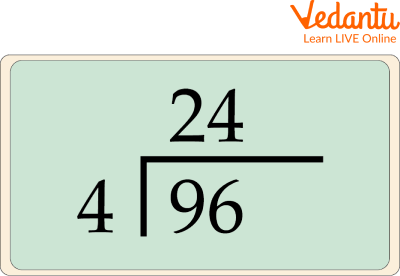
Short Division
In this image, four is multiplied by nine twice, leaving a remainder of one. The remainder is then added to the following number (six), making a total of 16. Four enters 16 four times, resulting in a total answer of 24.
Long Division
Long division is a mathematical technique used to divide big numbers into smaller groups or parts. Dividing a problem into small, straightforward steps can be helpful. There are dividends, divisors, quotients, and remainders in long divisions. Decimal numbers can also be divided into equal groups using long division. It follows the same processes as long division, which are to divide, multiply, subtract, bring down, and repeat or get the remainder.
Let’s see an example of Long division by 10. Here, 621300 is divided by 10.
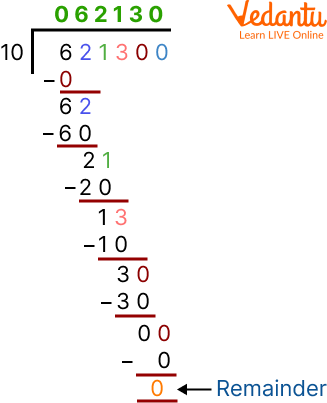
Long division by 10
And this is how teachers will know how to do division for kids. Let’s see some solved example:
Solved Examples
Example 1: Divide 726 by 4
Solution: Firstly, Put the divisor, or the number you're dividing by another number, outside the long division bar to properly format the problem. The number you will be dividing by the divisor, the dividend should be put inside the long division bar. Your result, or the quotient, will come above the division bar.
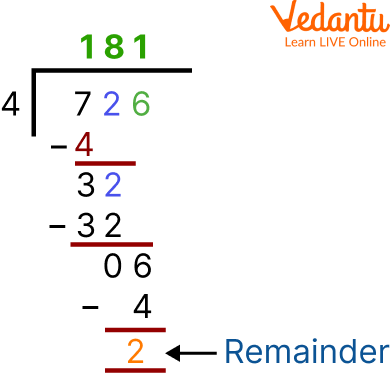
Division
As a result, the problem's quotient is 181, and the remainder is 2.
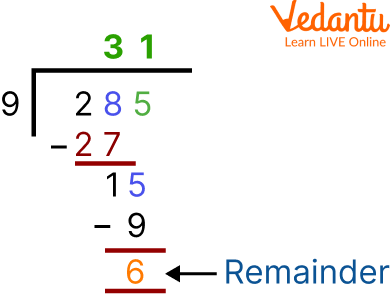
Example 2: Laila's mother gathered every family photo and planned to put them all in an album. How many pages will she need if there are 285 photos if each page of an album can hold 9 pictures?
Solution: Given 285 photos if 9 photos are there on one page the 285 photos require 285 $\div$ 9
Division
Here the quotient is 31, and the remaining number is 6. She, therefore, requires 32 pages, or 31 + 1 (for the left six photos).
Practice Problems
Q1. If the remainder is 4, the quotient is 71, and the divisor is 8, find the dividend.
Ans: 572
Q2. Five garlands are to be constructed from the 75 flowers. What number of flowers will be in each garland?
Ans: 15
Summary
We have already discussed that we can split up huge numbers into numerous smaller groups or portions with the long division method. The number of groups that can be formed when a dividend is divided by a divisor is given by the quotient, and the number of elements or integers that will remain ungrouped is given by the remainder. Larger numbers can be divided by one-digit numbers using the short division, while larger numbers can be divided by two-digit or more numbers using the long division. Some solved examples and practice questions are also provided in this article. Grab your pen and pencil and start solving these questions.
FAQs on What Is Division in Math for Kids
1. What is division for kids?
Division is the process of sharing or splitting a number into equal parts. It tells us how many equal groups we can make or how many items are in each group.
- It is one of the four basic operations in Maths.
- It is the opposite of multiplication.
- Example: 12 ÷ 3 = 4 means 12 items shared into 3 equal groups gives 4 in each group.
2. What is the division symbol?
The division symbol is ÷, and division can also be written using / or a fraction bar. These symbols all mean “to divide.”
- Example: 15 ÷ 5 = 3
- It can also be written as 15 / 5 = 3
- Or as a fraction: 15/5 = 3
3. How do you explain division to a child?
You can explain division to a child as sharing equally between groups. Use real objects to make it simple.
- Take 8 candies and 2 children.
- Share them equally.
- Each child gets 4 candies, so 8 ÷ 2 = 4.
4. What is an example of division?
An example of division is 20 ÷ 4 = 5. This means 20 items are split into 4 equal groups with 5 in each group.
- Total items: 20
- Number of groups: 4
- Items in each group: 5
5. What are the parts of a division problem?
The parts of a division problem are called the dividend, divisor, quotient, and sometimes remainder. Each part has a specific meaning.
- Dividend: The number being divided.
- Divisor: The number you divide by.
- Quotient: The answer.
- Remainder: The amount left over (if any).
6. How do you do division step by step?
To do basic division, you divide, multiply, subtract, and bring down when using long division. Follow these steps:
- Divide the first digit by the divisor.
- Multiply the divisor by the answer.
- Subtract the result.
- Bring down the next digit and repeat.
7. What is the relationship between division and multiplication?
Division and multiplication are inverse operations, meaning they undo each other. If you know one fact, you can find the other.
- If 4 × 5 = 20, then
- 20 ÷ 5 = 4 and
- 20 ÷ 4 = 5.
8. What is a remainder in division?
A remainder is the number left over after division when the dividend cannot be divided evenly. It is smaller than the divisor.
- Example: 10 ÷ 3 = 3 R1
- 3 groups of 3 make 9.
- 1 is left over, so the remainder is 1.
9. Why is division important in Maths?
Division is important because it helps us share equally, solve problems, and understand fractions. It is used in everyday life and advanced Maths.
- Sharing food or money equally.
- Finding averages.
- Understanding fractions like 1/2 or 3/4.
10. What is the difference between division and subtraction?
Division splits a number into equal groups, while subtraction takes one number away from another. They solve different types of problems.
- 12 ÷ 3 = 4 (splitting into equal groups)
- 12 − 3 = 9 (taking away 3 once)
