








What is Triangle Congruence Theorem SSS SAS ASA AAS and RHS Criteria
Triangle Congruence Theorem is a fundamental tool of Geometry and two figures in geometry are said to be congruent if they are of exactly the same size and shape. We use Triangle Congruence Theorems to prove if the triangles are congruent or not. In this article, we will discuss the methods to prove triangles congruent in detail.
Statement of Triangle Congruence Theorem
Triangle Congruence Theorem is as follows:
Angle Side Angle Congruence Theorem: Two triangles are congruent if the two corresponding angles equal to each other include a corresponding side that is equal to each other in two triangles.
Side Angle Side Congruence Theorem: Two triangles are congruent if two sides of two triangles are equal including the corresponding angles formed by these sides also equal.
Side Side Side Congruence Theorem: According to SSS congruence theorem, the two triangles are said to be congruent, if three sides of a triangle are equal to the corresponding sides of the other triangle.
Proof of Triangle Congruence Theorem
Angle Side Angle Congruence Theorem
Two triangles are congruent if the two corresponding angles equal to each other include a corresponding side that is equal to each other in two triangles.
Proof:
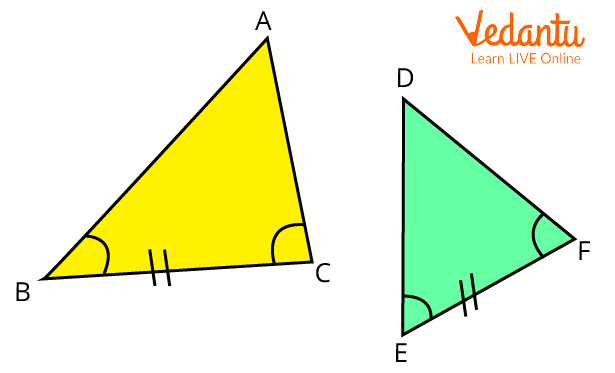
Triangles ABC and DEF for ASA Theorem
Given:
$B C=E F$
$\angle B=\angle E$
$\angle C=\angle F$
Superimposing both the triangles and aligning them according to the angles and sides.
Align side $E F$ with side $B C$.
Also, $\angle B=\angle E$.
So, the direction of side $E D$ will be the same as the direction of side $B A$.
Also, $\angle C=\angle F$
So, the direction of side $F D$ will be the same as the direction of side $C A$.
So, we can say that the point of intersection of sides $E D$ and $F D$ (that is $D$ ) will coincide exactly with the point of intersection of sides $B A$ and $C A$ (that is $A$ ).
Hence, we can say that both triangles are same in shape and size,
So,
$\triangle A B C \cong \triangle D E F$
Side Angle Side Congruence Theorem
Two triangles are congruent if two sides of two triangles are equal including the corresponding angles formed by these sides also equal.
Proof:
Given: $A B=P Q, B C=Q R, \angle B=\angle Q$.
To prove: $\triangle A B C \cong \triangle P Q R$
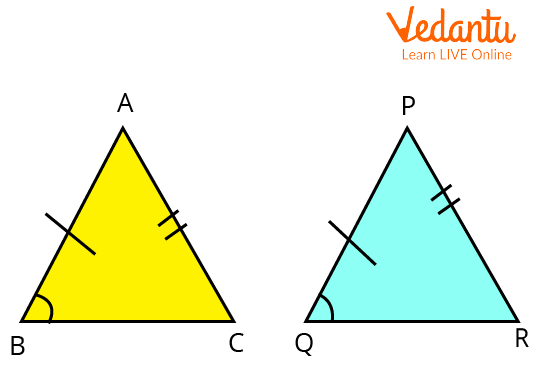
Triangles ABC and PQR for SAS Theorem
As done in $A S A$, again superimpose triangles here.
Place the triangle $\triangle A B C$ over the triangle $\triangle P Q R$ in a way that angle $B$ falls on angle $Q$ and side $A B$ falls on the side $P Q$. It is given that $A B=P Q$, so point $A$ falls on point $P$, and $\angle B=\angle Q$, so the side $B C$ will fall on the side $Q R$, and $B C=Q R$, so point $C$ will fall on point $R$.
Therefore, side $B C$ coincides with side $Q R$ and side $A C$ coincides with side $P R$.
So, we have $\triangle A B C \cong \triangle P Q R$.
Hence Proved.
Side Side Side Congruence Theorem
According to the $SSS$ congruence theorem, the two triangles are said to be congruent, if three sides of a triangle are equal to the corresponding sides of the other triangle. Proof:
Given: All sides are equal, i.e., $A B=D E, A C=D F, B C=E F$.
To prove: $\triangle A B C \cong \triangle D E F$.
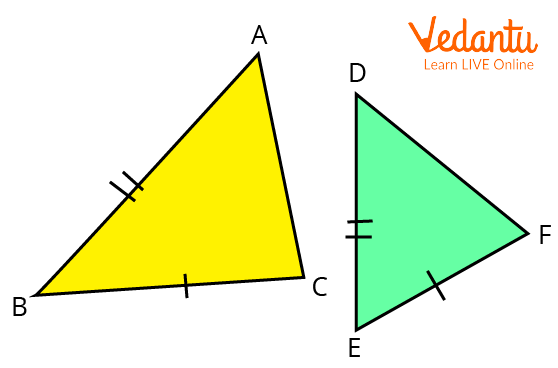
Triangles ABC and DEF for SSS Theorem
All three sides of both triangles are of the same size and length.
On superimposing both the triangles,
Side $D E$ will be on the side $A B$,
Side $E F$ will be on the side $B C$, and
side $D F$ will be on the side $A C$.
Therefore, $\triangle A B C \cong \triangle D E F$.
Hence proved.
Limitations of Triangle Congruence Theorem
Triangle Congruence theorems are applicable only if triangles are the same in both shape and size.
Applications of Triangle Congruence Theorem
Triangle Congruence Theorem has a wide range of applications in our day-to-day life.
A Truss bridge is made using equilateral triangles applying the triangle congruence theorem.
The theorem is used in understanding the structure of the environment.
Solved Examples
1. Describe the type of congruence in two triangles given by
$\triangle A B C, A B=7 \mathrm{~cm}, B C=5 \mathrm{~cm}, \angle B=50^{\circ}$ and $\triangle D E F, D E=5 \mathrm{~cm}, E F=7 \mathrm{~cm}, \angle E$ $=50^{\circ}$.
Ans:
$A B=E F=7 \mathrm{~cm},$
$B C=D E=5 \mathrm{~cm}$ and
$\angle B=\angle E=50^{\circ}$
So from above, we can say that both triangles are congruent using the SAS congruence criteria.
Therefore, $\triangle A B C \cong \triangle F E D$ (SAS).
2. In a $\triangle A B C$, if $A B=A C$ and $\angle B=70^{\circ}$, find $\angle A$.
Ans:
In a $\triangle A B C, A B=A C$ and $\angle B=70^{\circ}$
$\angle B=\angle C$ (as angles opposite to equal sides of a triangle are also equal)
Therefore, $\angle B=\angle C=70^{\circ}$
Sum of angles in a triangle $=180^{\circ}$
$\angle A+\angle B+\angle C=180^{\circ} $
$\angle A+70^{\circ}+70^{\circ}=180^{\circ} $
$\angle A=180^{\circ}-140^{\circ} $
$\angle A=40^{\circ}$
3. In the given congruent triangles under $A S A$, find the value of $x$ and $y$ where $QR=TU$.
Ans:
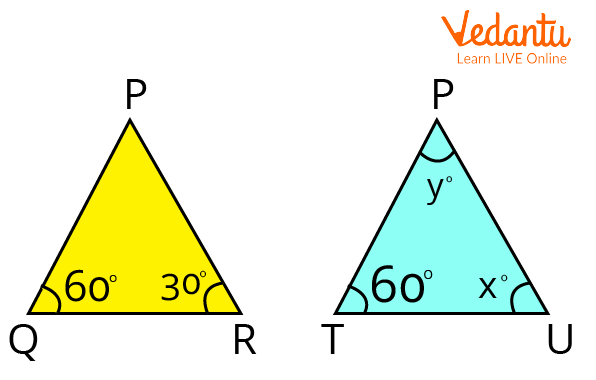
Triangles PQR and PTU given in the question
Given: $\triangle P Q R=\triangle P T U$ (By ASA rule)
$\angle Q=\angle T=60^{\circ}$ (given)
$QR=TU$
$\angle x=30^{\circ}$ (for ASA rule)
Now in $\triangle \mathrm{PTU}$,
$\angle P+\angle T+\angle U=180^{\circ}$ (Angle sum property)
$\angle y+60^{\circ}+\angle x=180^{\circ}$
$\angle y+60^{\circ}+30^{\circ}=180^{\circ}$
$\angle y+90^{\circ}=180^{\circ}$
$\angle y=180^{\circ}-90^{\circ}=90^{\circ}$
Hence, $x=30^{\circ}$ and $y=90^{\circ}$.
Conclusion
In the article, we have discussed the detailed proof of Triangle Congruence Theorems. All the different ways to prove that the triangles are congruent are discussed above. Real-life examples of the theorem are also discussed. The Triangle Congruence theorem forms an important tool of geometry and is an essential element of geometry to study objects of the same size and shape.
FAQs on Triangle Congruence Theorem Explained with Rules and Proof
1. What is the Triangle Congruence Theorem?
The Triangle Congruence Theorem states that two triangles are congruent if certain corresponding sides and angles are equal according to specific rules like SSS, SAS, ASA, AAS, or RHS (HL). When triangles are congruent, all corresponding sides and angles are exactly equal in measure. This means the triangles are the same size and shape, even if they are oriented differently. These theorems are fundamental in geometry proofs and problem-solving.
2. What are the five triangle congruence criteria?
The five main triangle congruence criteria are SSS, SAS, ASA, AAS, and RHS (HL).
- SSS (Side-Side-Side): All three corresponding sides are equal.
- SAS (Side-Angle-Side): Two sides and the included angle are equal.
- ASA (Angle-Side-Angle): Two angles and the included side are equal.
- AAS (Angle-Angle-Side): Two angles and a non-included side are equal.
- RHS/HL (Right angle-Hypotenuse-Side): In right triangles, the hypotenuse and one side are equal.
3. How do you prove triangles are congruent using SSS?
To prove triangles congruent using SSS, you must show that all three pairs of corresponding sides are equal.
- Step 1: Identify the three sides of the first triangle.
- Step 2: Show the three corresponding sides of the second triangle are equal.
- Step 3: Conclude the triangles are congruent by SSS Congruence Theorem.
4. What is the difference between SAS and ASA congruence?
The difference between SAS and ASA congruence lies in the position of the known side relative to the angles.
- SAS: Two sides and the included angle between them are equal.
- ASA: Two angles and the included side between them are equal.
5. Why is AAA not a triangle congruence theorem?
The AAA (Angle-Angle-Angle) condition does not prove congruence because it only guarantees similarity, not equal size. If all three angles of two triangles are equal, the triangles have the same shape but may have different side lengths. For example, two triangles with angles 60°, 60°, and 60° can have different side lengths, so they are similar but not congruent.
6. What is the RHS (HL) triangle congruence rule?
The RHS (Right angle–Hypotenuse–Side) rule states that two right triangles are congruent if their hypotenuse and one corresponding side are equal. This rule applies only to right-angled triangles.
- Both triangles must have a 90° angle.
- The hypotenuse lengths must be equal.
- One pair of corresponding legs must be equal.
7. Can you give an example of triangle congruence using SAS?
An example of SAS congruence is when two sides and their included angle are equal in two triangles. Suppose in △ABC and △DEF:
- AB = DE = 4 cm
- AC = DF = 6 cm
- ∠A = ∠D = 50°
8. How do you write a triangle congruence statement correctly?
A correct triangle congruence statement lists corresponding vertices in the same order. If triangle ABC corresponds to triangle DEF, you write △ABC ≅ △DEF. The order shows that:
- A corresponds to D
- B corresponds to E
- C corresponds to F
9. How are triangle congruence theorems used in geometry proofs?
Triangle congruence theorems are used in geometry proofs to show that corresponding sides and angles are equal. Once triangles are proven congruent using SSS, SAS, ASA, AAS, or RHS, you can apply CPCTC (Corresponding Parts of Congruent Triangles are Congruent) to justify equality of other sides or angles. This method is common in proving parallel lines, isosceles triangle properties, and midpoint theorems.
10. What is the difference between triangle congruence and triangle similarity?
The key difference is that congruent triangles have equal shape and size, while similar triangles have equal shape but not necessarily equal size.
- Congruence: All corresponding sides and angles are equal (SSS, SAS, ASA, AAS, RHS).
- Similarity: Corresponding angles are equal and sides are proportional (AAA, SAS similarity, SSS similarity).
