



How to Learn and Use the 14 Times Table with Examples
It is very essential to memorise the 14 times table for primary schoolers. To perform the quick mathematical operation, one has to learn the multiplication table of 14.
We know that Multiplication is one of the most basic mathematical concepts that students are taught from the beginning. A multiplication chart is a table that shows the outcome of multiplying two integers.
In this article, you will learn about the table of 14 with numbers from 1 to 10 along with some tricks to easily memorise these multiplication tables.
FAQs on Table of 14 Multiplication Table with Patterns
1. What is the table of 14?
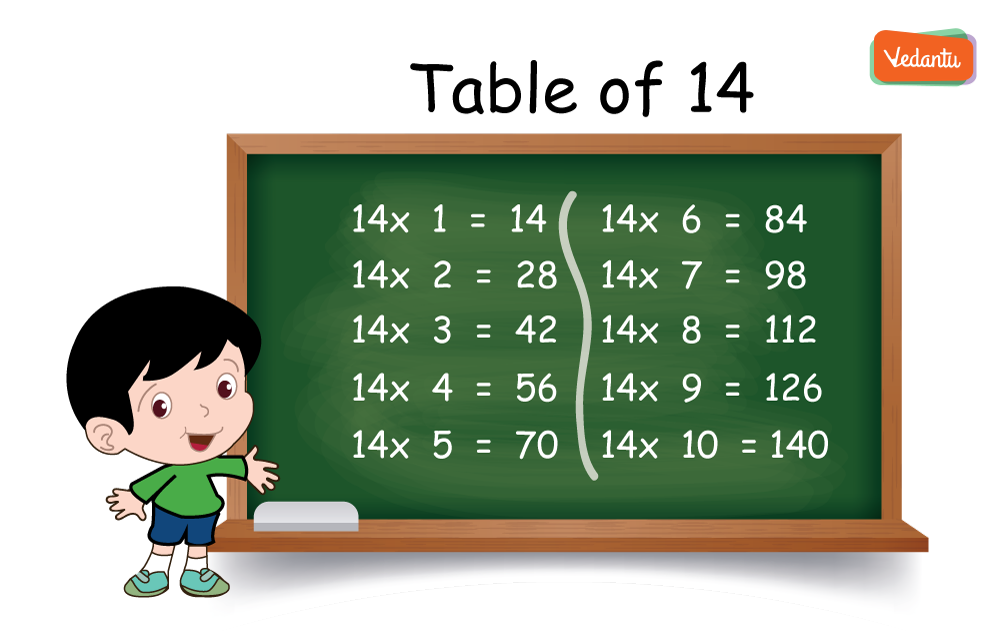
The table of 14 is the list of multiples of 14 obtained by multiplying 14 by whole numbers. It helps in quick calculations and mental maths.
- 14 × 1 = 14
- 14 × 2 = 28
- 14 × 3 = 42
- 14 × 4 = 56
- 14 × 5 = 70
- 14 × 6 = 84
- 14 × 7 = 98
- 14 × 8 = 112
- 14 × 9 = 126
- 14 × 10 = 140
2. How do you calculate the table of 14?
You can calculate the 14 times table by multiplying 14 with natural numbers like 1, 2, 3, and so on. Follow these steps:
- Step 1: Start with 14 × 1 = 14
- Step 2: Add 14 repeatedly (14 + 14 = 28, then 28 + 14 = 42)
- Step 3: Continue this repeated addition method to get further multiples
3. What are the first 20 multiples in the table of 14?
The first 20 multiples of 14 are obtained by multiplying 14 by numbers from 1 to 20.
- 14 × 1 to 10 = 14, 28, 42, 56, 70, 84, 98, 112, 126, 140
- 14 × 11 to 20 = 154, 168, 182, 196, 210, 224, 238, 252, 266, 280
4. Is 14 a prime number in the multiplication table?
No, 14 is not a prime number because it has more than two factors. Its factors are 1, 2, 7, and 14. Since it is divisible by 2 and 7, it is a composite number and forms multiples in the 14 times table.
5. How can I learn the table of 14 easily?
You can learn the table of 14 easily by using patterns and repeated addition. Try these tips:
- Break 14 into 10 + 4 and multiply separately
- Use skip counting: 14, 28, 42, 56...
- Practice writing and reciting daily
- Notice that each product increases by 14
6. What is 14 multiplied by 12?
The value of 14 multiplied by 12 is 168. This is calculated as:
- 14 × 12 = 14 × (10 + 2)
- = (14 × 10) + (14 × 2)
- = 140 + 28 = 168
7. What pattern can you see in the table of 14?
The main pattern in the 14 times table is that each number increases by 14. Additional patterns include:
- All products are even numbers
- The unit digits follow a repeating cycle: 4, 8, 2, 6, 0
- Every second multiple is divisible by 28
8. How is the table of 14 related to the tables of 7 and 2?
The table of 14 is directly related to the tables of 7 and 2 because 14 = 7 × 2. This means:
- 14 × n = (7 × 2) × n
- = 7 × (2n)
9. What is the formula for finding any multiple in the table of 14?
The formula to find any multiple in the table of 14 is 14 × n, where n is a natural number. For example:
- If n = 15, then 14 × 15 = 210
- If n = 25, then 14 × 25 = 350
10. Why is the table of 14 important in maths?
The table of 14 is important because it helps in faster multiplication, division, and problem-solving. It is useful in:
- Solving word problems involving groups of 14
- Finding factors and multiples
- Simplifying fractions like 28/14 = 2
- Algebra and higher arithmetic calculations
