






How to Learn and Use the Table of 13 with Solved Examples
Learning a table of 13 is necessary for kids and students as it is helpful in long and complex calculations. We should learn this table and memorise it for quick calculation in school exams and competitive exams.
In this article, you will learn tricks and tips to memorise table 13. Learning and memorising the multiplication table of 13 at a young age will help students to quickly and accurately solve the problems of division, multiplication of large numbers, fractions, Algebraic equations, etc.
FAQs on Table of 13 Multiplication Chart and Practice Guide
1. What is the table of 13?
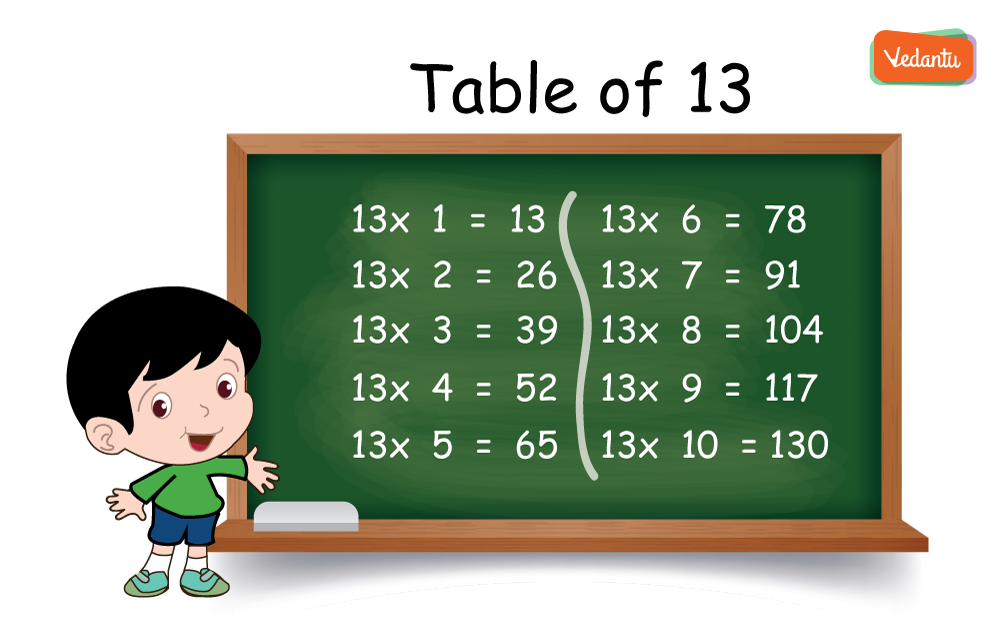
The table of 13 is the list of multiples of 13 obtained by multiplying 13 by whole numbers like 1, 2, 3, and so on. It helps in quick multiplication and division calculations.
- 13 × 1 = 13
- 13 × 2 = 26
- 13 × 3 = 39
- 13 × 4 = 52
- 13 × 5 = 65
- 13 × 6 = 78
- 13 × 7 = 91
- 13 × 8 = 104
- 13 × 9 = 117
- 13 × 10 = 130
2. How do you calculate the table of 13?
You can calculate the table of 13 by multiplying 13 with consecutive whole numbers. Follow these steps:
- Start with 13 × 1 = 13
- Add 13 repeatedly: 13 + 13 = 26, 26 + 13 = 39, and so on
- Or directly multiply: 13 × 4 = (10 × 4) + (3 × 4) = 40 + 12 = 52
3. What are the first 20 multiples of 13?
The first 20 multiples of 13 are the results of 13 × 1 to 13 × 20.
- 13, 26, 39, 52, 65
- 78, 91, 104, 117, 130
- 143, 156, 169, 182, 195
- 208, 221, 234, 247, 260
4. Is 13 a prime number?
Yes, 13 is a prime number because it has exactly two factors: 1 and 13. A prime number is defined as a number greater than 1 with only two distinct positive divisors.
- Factors of 13: 1, 13
- It is not divisible by 2, 3, 4, 5, or any other number except 1 and itself
5. How can I memorize the table of 13 easily?
You can memorize the 13 times table easily by using patterns and repeated addition practice. Try these tips:
- Break it into parts: (10 × n) + (3 × n)
- Practice in chunks: 13 × 1 to 13 × 5 first
- Notice the pattern of adding 13 each time
- Recite daily for quick recall
6. What is 13 multiplied by 12?
The value of 13 × 12 is 156. You can calculate it as:
- 13 × 12 = 13 × (10 + 2)
- = (13 × 10) + (13 × 2)
- = 130 + 26 = 156
7. What is the pattern in the table of 13?
The main pattern in the table of 13 is that each term increases by 13, forming an arithmetic sequence. Key observations include:
- Common difference = 13
- Units digits cycle irregularly (3, 6, 9, 2, 5, 8, 1, 4, 7, 0)
- Each multiple equals 13 × n
8. How do you use the table of 13 in division?
You use the table of 13 in division by finding which multiple of 13 equals the given number. For example:
- To solve 91 ÷ 13
- Check the table: 13 × 7 = 91
- So, 91 ÷ 13 = 7
9. What is the formula for the nth multiple of 13?
The formula for the nth multiple of 13 is 13n, where n is a natural number. This means:
- 1st multiple: 13 × 1 = 13
- 5th multiple: 13 × 5 = 65
- nth multiple: 13 × n
10. What are some real-life uses of the table of 13?
The table of 13 is used in everyday multiplication, grouping, and repeated addition problems. Common applications include:
- Calculating total cost (e.g., 13 items × price)
- Finding total objects in equal groups
- Solving word problems in Maths exams
- Quick mental arithmetic in competitive tests
