
Courses
Courses for Kids
Free study material
Offline Centres
More
Store Icon
Store

Table of 10 Multiplication Table with Values up to 100

ffImage
banner

How to Learn and Use the Table of 10 with Solved Examples

The 10 times table is one of the simplest tables to remember. To memorise the table of ten, simply add a zero after each number you are multiplying with, and you will get the answer.


Example: 10 times 2 gives the result 20, and in the case of adding the numbers, it is 10+10 = 20.
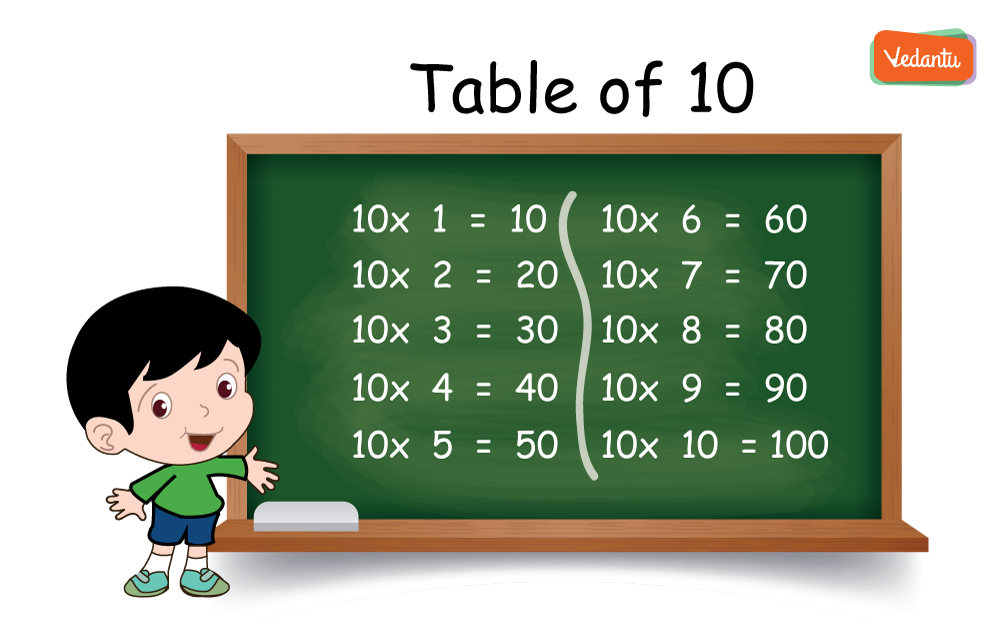

Table of 10

Table Chart of 10 from 1 to 10

10 × 1 = 10

10 × 6 = 60

10 × 2 = 20

10 × 7 = 70

10 × 3 = 30

10 × 8 = 80

10 × 4 = 40

10 × 9 = 90

10 × 5 = 50

10 × 10 = 100


Easy Tips and Tricks for Memorising the Table of 10

Learning the multiplication table of ten will help you solve Maths problems and understand number patterns. Look at some tips below to understand in a better way.

  • The table of ten is the easiest to remember. In multiples of 10, the digit at the unit's position is always 0.

  • To obtain the 10 times table, simply write the natural numbers followed by a 0.


Solved Questions Based on Table of 10

The following are some questions based on the table of 10 that can come in the form of word problems, numericals, or multiple-choice questions.


Word Problems on Table of 10 with Practice Questions

1. What is the pattern of the table of 10?

Ans: The pattern of tables of 10 is very easy and simple to remember. The order goes like this: 10, 20, 30, 40, 50, 60, 70, 80, 90, 100, and so on.


2. There are 5 apples in a basket. How many apples are there in 10 such baskets?

Ans: By using 10 tables we get,

5 apples × 10 baskets = 50 apples.

Therefore, the answer is 50.


Practice Questions

1. Using the table of 10, evaluate 10 times 17.

Answer: 170


2. Shiwani buys 9 packets of 10 pens each. Find how many pens has she bought in total by using the 10 times table?

Answer: 90


MCQs Based on the Multiplication Table of 10 with Practice Questions

Question: 10 x __ = 150?

  1. 11

  2. 14

  3. 15

  4. 19

Ans: (c), 10 x 15 = 150.


Practice Question

Question: What is 10 x 13?

  1. 160

  2. 190

  3. 120

  4. 130

Answer: d


Table Chart of 10 from 11 to 20

Multiplication table of 10 till 20 has been provided below. You can refer to and download the image below to easily memorise the multiples of 10 from 11 to 20. 


10 × 11 = 110

10 × 16 = 160

10 × 12 = 120

10 × 17 = 170

10 × 13 = 130

10 × 18 = 180

10 × 14 = 140

10 × 19 = 190

10 × 15 = 150

10 × 20 = 200


For Parents/Teachers: How to Read the Table to Your Kid?

Kids can easily learn this table of tens without having to memorise or practise too much. One of the easiest tables is the multiplication table of 10. Children enjoy learning this table of ten since it is a simple maths table. Read the table as mentioned below to your kids. These simple methods for learning the 10 times tables allow kids to have fun while learning multiplication tables. 


  • Ten ones are ten

  • Ten twos are twenty

  • Ten threes are thirty

  • Ten fours are forty

  • Ten fives are fifty

  • Ten sixes are sixty 

  • Ten sevens are seventy

  • Ten eights are eighty

  • Ten nines are ninety

  • Ten tens are hundred


Conclusion

There is no difficult method to remember the table of 10; all you need to know is that each one's digit is "0" and ten's digit is the multiplier itself. Learning the multiplication table of ten is essential for quickly solving mathematics problems and understanding the number system.

FAQs on Table of 10 Multiplication Table with Values up to 100

1. What is the table of 10?

The table of 10 is the multiplication table that shows the results of multiplying numbers by 10. It lists products like 10 × 1, 10 × 2, 10 × 3, and so on.

  • 10 × 1 = 10
  • 10 × 2 = 20
  • 10 × 3 = 30
  • 10 × 4 = 40
  • 10 × 5 = 50
  • 10 × 6 = 60
  • 10 × 7 = 70
  • 10 × 8 = 80
  • 10 × 9 = 90
  • 10 × 10 = 100
This multiplication table helps students quickly calculate multiples of 10.

2. How do you write the table of 10 up to 20?

The table of 10 up to 20 is written by multiplying 10 with numbers from 1 to 20. The pattern continues by adding 10 each time.

  • 10 × 11 = 110
  • 10 × 12 = 120
  • 10 × 13 = 130
  • 10 × 14 = 140
  • 10 × 15 = 150
  • 10 × 16 = 160
  • 10 × 17 = 170
  • 10 × 18 = 180
  • 10 × 19 = 190
  • 10 × 20 = 200
Each product increases by 10, making the pattern simple and easy to memorize.

3. What is the easiest way to learn the table of 10?

The easiest way to learn the table of 10 is to remember that multiplying any number by 10 adds a zero at the end. For example:

  • 5 × 10 = 50
  • 8 × 10 = 80
  • 12 × 10 = 120
This happens because multiplying by 10 shifts the number one place to the left in the place value system. This simple rule makes the multiplication table of 10 one of the easiest tables to memorize.

4. What is the pattern in the table of 10?

The pattern in the table of 10 is that each product ends with 0 and increases by 10 each time. Key observations include:

  • Ones digit is always 0
  • Tens digit increases by 1 each step (10, 20, 30...)
  • Products are multiples of 10
This consistent pattern makes the 10 times table simple and predictable.

5. Why does multiplying by 10 add a zero?

Multiplying by 10 adds a zero because of the base-10 place value system. When a number is multiplied by 10, its digits shift one place to the left.

  • 6 becomes 60
  • 23 becomes 230
  • 45 becomes 450
This shift increases the value ten times, which is why a zero appears at the end in whole numbers.

6. How do you solve 10 multiplied by a number?

To solve 10 multiplied by a number, multiply the number by 10 or simply attach a zero to the number if it is a whole number. Steps:

  • Step 1: Take the number (e.g., 7)
  • Step 2: Multiply by 10
  • Step 3: Add a zero → 7 × 10 = 70
This shortcut works for all whole numbers in the table of 10.

7. What are the first 10 multiples of 10?

The first 10 multiples of 10 are 10, 20, 30, 40, 50, 60, 70, 80, 90, and 100. These are found by multiplying 10 by numbers from 1 to 10:

  • 10 × 1 = 10
  • 10 × 2 = 20
  • ...
  • 10 × 10 = 100
All these numbers are divisible by 10 and end with zero.

8. What is 10 times 25?

10 times 25 equals 250. Using the multiplication rule of 10:

  • 25 × 10
  • Add one zero to 25
  • Result = 250
This follows the place value rule where multiplying by 10 shifts digits one place to the left.

9. How is the table of 10 used in real life?

The table of 10 is used in real life for quick calculations involving money, measurements, and counting in tens. Examples include:

  • Counting currency (10, 20, 30 rupees/dollars)
  • Converting units (e.g., multiplying by 10)
  • Calculating total cost (10 items × $5 = $50)
Because multiples of 10 are common in daily math, this table is widely applied.

10. What is the difference between the table of 5 and the table of 10?

The main difference is that the table of 10 increases by 10 each step, while the table of 5 increases by 5 each step. Comparison:

  • 5 × 4 = 20
  • 10 × 4 = 40
Every product in the table of 10 is double the corresponding product in the table of 5, since 10 is twice 5.
