








Squeeze Theorem definition proof and solved limit examples
Squeeze Theorem, also known as Sandwich Theorem, is a theorem used to find the limits of a function that is squeezed between two functions. The modern Squeeze form was given by Carl Friedrich Gauss. In this article, we will discuss the Squeeze theorem and the steps to apply and prove the Squeeze theorem in questions. Squeeze theorem proof and examples will be elaborated in this article in simpler form for better clarity of the topic and how to do Squeeze theorem in function will be discussed here.
History of Carl Friedrich Gauss

Carl Friedrich Gauss
Name: Carl Friedrich Gauss
Born: 30 April 1777
Died: 23 February 1855
Field: Mathematics
Nationality: German
Statement of Squeeze Theorem
According to Squeeze Theorem, if g(x), f(x), h(x) are three functions such that \[g(x) \leq f(x) \leq h(x)\] and at any point a \[\mathop {{\rm{\;}}\lim }\limits_{x \to a} g(x) = \mathop {{\rm{\;}}\lim }\limits_{x \to a} h(x) = L \], then \[\mathop {{\rm{\;}}\lim }\limits_{x \to a} f(x) = L\].
Squeeze Theorem Proof
Assume that $g(x) \leq f(x) \leq h(x)$ and $\mathop {{\rm{\;}}\lim }\limits_{x \to a} g(x)=\mathop {{\rm{\;}}\lim }\limits_{x \to a} h(x)=L$.
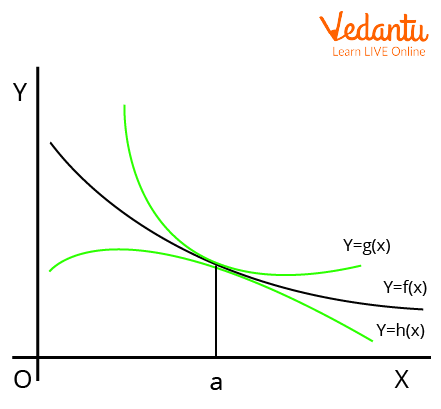
Squeeze Theorem
Using the definition of limits,
$\Rightarrow \mathop {{\rm{\;}}\lim }\limits_{x \to a} g(x)=L \text { means that } \forall \in>0, exists \delta_{1}>0$ such that
$\Rightarrow|x-a|<\delta_{1}$
$\Rightarrow |x-a| < \delta_{1}$
$\Rightarrow|g(x)-L|< \epsilon$
$\Rightarrow - \epsilon < g(x)-L< \epsilon \ldots \text { (1) } $(expanding using property of modulus)
$\Rightarrow \lim _{x \rightarrow a} h(x)=L \text { using definition of limits again } \forall \in>0, \exists \delta_{2}>0 \text { such that }$
$\Rightarrow |x-a| < \delta_{2} $
$\Rightarrow |x-a| < \delta_{2} $
$\Rightarrow |h(x)-L| < \epsilon$
$\Rightarrow - \epsilon < h(x)-L < \epsilon \ldots \text { (2) }$ (expanding using property of modulus)
Now, it is given that $g(x) \leq f(x) \leq h(x)$.
Subtracting $L$ from each side of the above expression, we get
$\Rightarrow g(x)-L \leq f(x)-L \leq h(x)-L$
Let us choose $\delta=minimum \left\{\delta_{1}, \delta_{2}\right\}$,
we have, whenever $|x-a| < \delta$,
$\Rightarrow - \epsilon < g(x)-L \leq f(x)-L \leq h(x)-L <\epsilon \text { (using (1) and (2)) }$
So, from the above expression, we have
$\Rightarrow - \epsilon < f(x)-L < \epsilon$
$\Rightarrow \mathop {{\rm{\;}}\lim }\limits_{x \to a} f(x) = L$
Hence, the squeeze theorem is proved.
Limitations of Squeeze Theorem
The squeeze theorem is not applicable if left and right function limits are not equal.
The squeeze Theorem does not apply if we know the limits of any of two functions other than both extreme functions.
Applications of Squeeze Theorem
The squeeze Theorem is used to reduce the tedious calculation of the limits of some functions.
The squeeze Theorem can be related to the converging power of the lense.
Squeeze Theorem Examples
1. Evaluate the limit $\mathop {{\rm{\;}}\lim }\limits_{x \to 0}\left(x \cdot \cos \left(\dfrac{1}{x}\right)\right)$, if it exists.
Ans: We know that $-1 \leq \cos \left(\frac{1}{x}\right) \leq 1$ for all $x \neq 0$.
Then, $-x \leq x \cdot \cos \left(\frac{1}{x}\right) \leq x$, so
$\Rightarrow \mathop {{\rm{\;}}\lim }\limits_{x \to 0}(-x) \leq \mathop {{\rm{\;}}\lim }\limits_{x \to 0} \left(x \cdot \cos \left(\frac{1}{x}\right)\right) \leq \mathop {{\rm{\;}}\lim }\limits_{x \to 0} x$
Since $\mathop {{\rm{\;}}\lim }\limits_{x \to 0}(-x)=0=\mathop {{\rm{\;}}\lim }\limits_{x \to 0} x$,
we see that
$\Rightarrow \mathop {{\rm{\;}}\lim }\limits_{x \to 0}\left(x \cdot \cos \left(\frac{1}{x}\right)\right)=0$.
2. Evaluate the limit using the Squeeze Theorem:
$\mathop {{\rm{\;}}\lim }\limits_{x \to 0} x^{2} \cos \frac{5}{x}$
Ans: We know that $-1 \leq \cos \frac{1}{x} \leq 1$.
Next, multiplying the inequality by $x^{2}$, we have
$\Rightarrow-x^{2} \leq x^{2} \cos \frac{5}{x} \leq x^{2}$
Take the limit of each part of the inequality.
$\Rightarrow \mathop {{\rm{\;}}\lim }\limits_{x \to 0}\left(-x^{2}\right) \leq \mathop {{\rm{\;}}\lim }\limits_{x \to 0} x^{2} \cos \frac{5}{x} \leq \mathop {{\rm{\;}}\lim }\limits_{x \to 0} x^{2}$
Next, we know that
$\Rightarrow \mathop {{\rm{\;}}\lim }\limits_{x \to 0}\left(-x^{2}\right)=0 \text { and } \mathop {{\rm{\;}}\lim }\limits_{x \to 0}\left(x^{2}\right)=0$.
Thus, we have
$\Rightarrow 0 \leq \mathop {{\rm{\;}}\lim }\limits_{x \to 0} x^{2} \cos \frac{5}{x} \leq 0$
So, $\mathop {{\rm{\;}}\lim }\limits_{x \to 0} x^{2} \cos \frac{5}{x}=0$
3. Evaluate the limit using the Squeeze Theorem:
$\mathop {{\rm{\;}}\lim }\limits_{x \to 0} x^{2} \cos (10 x)$
Ans: We know that $-1 \leq \cos (10 x) \leq 1$.
Next, multiplying the inequality by $x^{2}$, we have
$\Rightarrow-x^{2} \leq x^{2} \cos (10 x) \leq x^{2}$
Take the limit of each part of the inequality.
$\Rightarrow \mathop {{\rm{\;}}\lim }\limits_{x \to 0}\left(-x^{2}\right) \leq \mathop {{\rm{\;}}\lim }\limits_{x \to 0} x^{2} \cos (10 x) \leq \mathop {{\rm{\;}}\lim }\limits_{x \to 0} x^{2}$
Next, we know that
$\Rightarrow \mathop {{\rm{\;}}\lim }\limits_{x \to 0}\left(-x^{2}\right)=0 \text { and } \mathop {{\rm{\;}}\lim }\limits_{x \to 0}\left(x^{2}\right)=0$.
Thus, we have
$\Rightarrow 0 \leq \mathop {{\rm{\;}}\lim }\limits_{x \to 0} x^{2} \cos (10 x) \leq 0$
So, $\mathop {{\rm{\;}}\lim }\limits_{x \to 0} x^{2} \cos (10 x)=0$
Conclusion
In the article, we have discussed the detailed proof of the Squeeze Theorem and its proof. Squeeze Theorem in simple terms says that if you are stuck between two things, then you will go the same way the two things are going. In all, we can say that Squeeze Theorem is a fantastic theorem in calculus and we can say that calculus needs limits and limits needs Squeeze Theorem.
Important Formulas to Remember
If $g(x), f(x), h(x)$ are such that $g(x) \leq f(x) \leq h(x)$, and $\mathop {{\rm{\;}}\lim }\limits_{x \to a} g(x)=\mathop {{\rm{\;}}\lim }\limits_{x \to a} h(x)=L$ then $\mathop {{\rm{\;}}\lim }\limits_{x \to a} f(x)=L$
Important Points to Remember
Squeeze Theorem is also known as Sandwich Theorem.
The limit of the Squeeze function has the same value as the limits of the other two functions.


FAQs on Squeeze Theorem in Calculus Explained Clearly
1. What is the Squeeze Theorem in calculus?
The Squeeze Theorem states that if a function is trapped between two other functions that have the same limit at a point, then the trapped function has that same limit. Formally, if g(x) ≤ f(x) ≤ h(x) near x = a and lim x→a g(x) = lim x→a h(x) = L, then lim x→a f(x) = L. This theorem is also called the Sandwich Theorem and is mainly used to evaluate limits that are difficult to compute directly.
2. When can you use the Squeeze Theorem?
You can use the Squeeze Theorem when a function is bounded between two simpler functions with known and equal limits. It applies when:
- g(x) ≤ f(x) ≤ h(x) for all x near a
- lim x→a g(x) and lim x→a h(x) both exist
- Both limits are equal to the same value L
3. How do you apply the Squeeze Theorem step by step?
To apply the Squeeze Theorem, follow these steps:
- Find two functions g(x) and h(x) such that g(x) ≤ f(x) ≤ h(x)
- Compute lim x→a g(x) and lim x→a h(x)
- Check that both limits equal the same number L
- Conclude that lim x→a f(x) = L
4. Can you give an example of the Squeeze Theorem?
A classic example is proving that lim x→0 (x sin(1/x)) = 0. Since −1 ≤ sin(1/x) ≤ 1, multiplying by x gives:
- −|x| ≤ x sin(1/x) ≤ |x|
- lim x→0 (−|x|) = 0
- lim x→0 |x| = 0
5. Why is the Squeeze Theorem useful for trigonometric limits?
The Squeeze Theorem is useful for trigonometric limits because sine and cosine functions are naturally bounded between −1 and 1. For example:
- −1 ≤ sin x ≤ 1
6. What is the formula statement of the Squeeze Theorem?
The formal statement of the Squeeze Theorem is: If g(x) ≤ f(x) ≤ h(x) for all x near a (except possibly at a), and lim x→a g(x) = lim x→a h(x) = L, then lim x→a f(x) = L. This applies to limits at finite points and can also be extended to limits as x → ±∞.
7. Does the Squeeze Theorem work for limits at infinity?
Yes, the Squeeze Theorem works for limits as x → ±∞ if the bounding functions approach the same limit. If g(x) ≤ f(x) ≤ h(x) for large x and lim x→∞ g(x) = lim x→∞ h(x) = L, then lim x→∞ f(x) = L. This is commonly used in evaluating limits involving oscillating functions multiplied by shrinking terms.
8. What is the difference between the Squeeze Theorem and direct substitution?
The difference is that direct substitution evaluates a limit by plugging in the value directly, while the Squeeze Theorem uses bounding functions to determine the limit indirectly. Direct substitution works when the function is continuous at that point, whereas the Squeeze Theorem is used when substitution gives an indeterminate form like 0·undefined or when the function oscillates.
9. What are common mistakes when using the Squeeze Theorem?
Common mistakes when applying the Squeeze Theorem include:
- Failing to verify that g(x) ≤ f(x) ≤ h(x) holds near the point
- Using bounding functions whose limits are not equal
- Ignoring behavior close to the limit point
- Forgetting to compute both outer limits correctly
10. Is the Squeeze Theorem only used for limits?
The Squeeze Theorem is primarily used to evaluate limits, but it also helps in proving continuity and certain derivative results. It is most commonly applied in limit problems involving trigonometric functions, oscillating expressions, and inequalities in calculus.
