








What Is a Solid Figure Definition Properties Formulas and Examples
What do you know about a Solid Figure?
Mathematicians study shapes and all of their varieties and work to apply them to everyday situations. Any solid form that has the three dimensions of length, breadth, and height is considered to be a solid shape. The classifications of solid shapes are diverse. Some are shaped like pyramids or prisms, while others have curved surfaces. Now, let's examine each solid shape in more detail.
What is a Solid Figure
A solid figure is one that we can feel by using our hands. Three-dimensional things are represented by solid forms. Take a look around! Every other three-dimensional item, such as a laptop, telephone, ice cream cone, balls, and so on, is an example of a solid form. These take up some room and have length, breadth, and height. Let's look at the features and pictures of solid figures and understand their properties.

Solid Shapes
Solid Figures Examples
There are many solid shapes (3D shapes) with different bases, volumes, and surface areas. Let's discuss each of them.
1. Sphere
The sphere is rounded in shape. This is a three-dimensional geometry in which all points on the surface are equidistant from the centre. It has a radius, diameter, circumference, volume, and surface area. It is a perfectly symmetrical figure with no edges and is shaped like a ball.
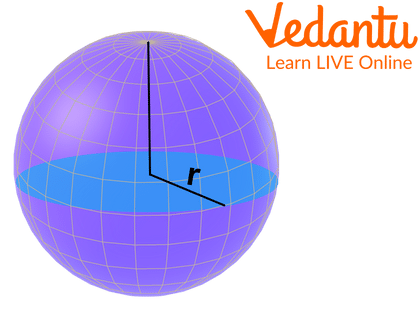
Sphere
2. Cube and Cuboid
Cubes and cuboids are three-dimensional shapes with the same number of faces(6), vertices(8), and edges(12). The main difference between a cube and a cuboid is that a cube has all six faces square and a cuboid has all six faces as a rectangle. Cubes and cuboids have different volumes and different surface areas. The length, width, and height of a cube are the same, but the length, height, and width of a cuboid are different.
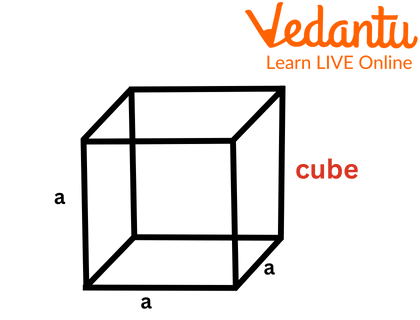
Cube
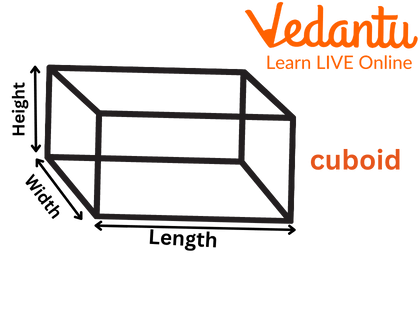
Cuboid
3. Cylinder
A cylinder is a three-dimensional shape with two round faces (one at the top and one at the bottom) and one curved surface. The bases are always parallel to one another and are either oval or circular in shape. A cylinder has a height and a radius. The height of a cylinder is the vertical distance between its top and bottom faces. It has one curved edge. The shape remains the same from bottom to top.
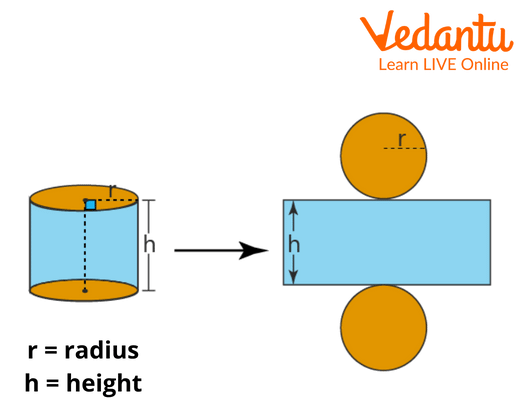
Cylinder
4. Cone
A cone is another three-dimensional shape (3D shape) with a flat bottom (round shape) and a pointed tip on the top. Its shape is similar to a rotated triangle. The sharp end of the top of the cone is called the "top". A cone also has a curved surface. A cone has a height and a radius. In addition to height, cones have an oblique height, which is the distance between a vertex and a point on the perimeter of the cone's circular base.
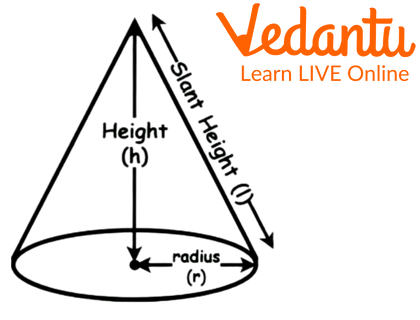
Cone
Difference Between Solid Figures And Plane Figures
Solved Examples
1. What is the 2D shape of a sphere?
a. Rectangle
b. Triangle
c. Square
d. Circle
Ans: Circle
2. What is the 2D shape of a cube?
a. Rectangle
b. Triangle
c. Square
d. Circle
Ans: Square
Conclusion
Solids, or three-dimensional things, are composed of length, width, and height. Faces, edges, and vertices are all characteristics of solid forms. Learning about solid forms can benefit us in our daily lives because they are used in so many of our activities and their area can be calculated giving us an idea about how much space they will occupy in any place.
FAQs on Solid Figures in Geometry Explained Clearly
1. What is a solid figure in mathematics?
A solid figure is a three-dimensional (3D) shape that has length, width, and height and occupies space. Unlike 2D shapes, solid figures have volume and surface area.
- Examples include cube, cuboid, sphere, cylinder, and cone.
- They are also called three-dimensional shapes or 3D figures.
- They can have faces, edges, and vertices depending on the type of solid.
2. What are the main types of solid figures?
The main types of solid figures are classified as polyhedrons and non-polyhedrons.
- Polyhedrons: Solids with flat faces (e.g., cube, cuboid, pyramid, prism).
- Non-polyhedrons: Solids with curved surfaces (e.g., sphere, cylinder, cone).
3. What is the difference between 2D shapes and solid figures?
The main difference is that 2D shapes have only length and width, while solid figures have length, width, and height.
- 2D shapes (square, triangle, circle) have area only.
- 3D solid figures (cube, sphere, cylinder) have both surface area and volume.
- Solid figures occupy space, but 2D shapes do not.
4. What are faces, edges, and vertices in solid figures?
Faces, edges, and vertices are the basic parts of many solid figures.
- Face: A flat surface of a solid (e.g., a cube has 6 faces).
- Edge: A line segment where two faces meet (a cube has 12 edges).
- Vertex: A point where edges meet (a cube has 8 vertices).
5. What is the formula for the volume of common solid figures?
The volume of a solid figure measures the space it occupies and depends on its shape.
- Cube: V = a³
- Cuboid: V = l × b × h
- Cylinder: V = πr²h
- Sphere: V = (4/3)πr³
- Cone: V = (1/3)πr²h
6. How do you find the surface area of a solid figure?
The surface area of a solid figure is the total area of all its outer surfaces.
- Cube: Surface area = 6a²
- Cuboid: Surface area = 2(lb + bh + hl)
- Sphere: Surface area = 4πr²
- Cylinder (total): 2πr(h + r)
7. What is a polyhedron in solid geometry?
A polyhedron is a solid figure made entirely of flat polygonal faces joined along edges.
- Examples: cube, cuboid, prism, pyramid.
- Each face is a polygon such as a triangle or rectangle.
- Polyhedrons have faces, edges, and vertices.
8. Can you give an example of finding the volume of a cube?
The volume of a cube is calculated using the formula V = a³, where a is the side length.
- Example: If side a = 4 cm
- V = 4³ = 4 × 4 × 4
- V = 64 cm³
9. What is Euler’s formula for solid figures?
Euler’s formula for polyhedrons is F + V − E = 2, where F = faces, V = vertices, and E = edges.
- Example for a cube: F = 6, V = 8, E = 12
- 6 + 8 − 12 = 2
10. Where are solid figures used in real life?
Solid figures are used in real life to model objects that occupy space and have measurable volume and surface area.
- Buildings resemble cuboids and prisms.
- Balls are spheres.
- Cans are cylinders.
- Pyramids appear in monuments and architecture.
