








What are rectilinear shapes definition properties and examples
Any shape that you see around yourself has straight sides or edges is rectilinear. Let us assume that you are learning to drive a car for the first time. Now, as you are new to all the systems like brake, accelerator, and clutch, you need to learn to take your car ahead.
As soon as you get some hold on the ABC of the car, you need a straight road that is free of diversion so that you are comfortable to move it ahead. Now, what path have you taken while learning to drive? Well, it is a rectilinear path or a straight path.
A question arises why do we learn this concept in maths and what other properties does any shape carry while making sure that the shape is rectilinear. So, let us focus on this part!
Rectilinear Shapes in Maths
From the above text, we have got an idea of what rectilinear is, now, let us understand it through the following shapes:
Let us suppose that your friend gifted you a video game packed in a rectangular big box. Now, this rectangular box has straight edges or sides.
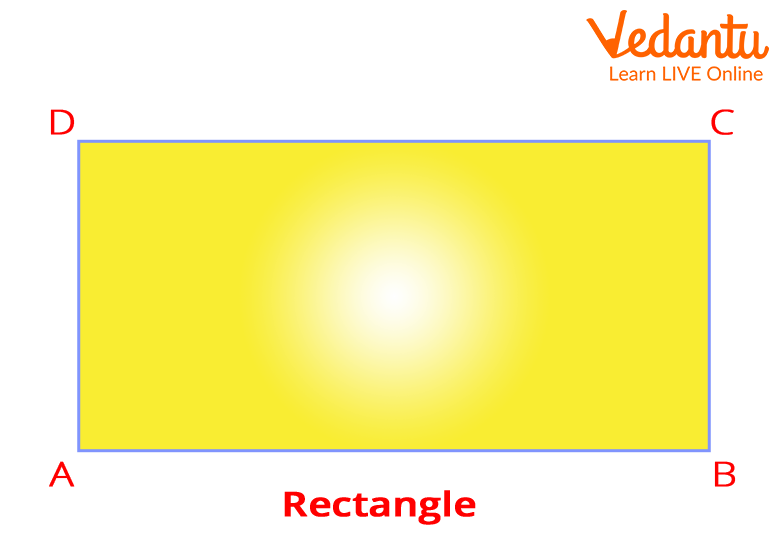
Also, between each side, there is a corner. Marking these four corners as A, B, C, and D. However, we notice that an angle between sides BA and DA or angle BAD is a right angle. Similarly, we notice in the pairs AB and CB, i.e., angle ABC = 90 degrees, BC and DC or angle BCD = 90 degrees, and lastly, we have DA and CD, i.e., angle ADC = 90 degrees.
We conclude one more thing from our above explanation that a rectilinear shape has straight edges with angular corners (here angular corners are 90 degrees).
Important Point:
Please note that rectilinear means straight like you can have a straight path or motion. Also, interior angles in these shapes are 90-degrees, or it can be 270-degrees as well.
So, the concept of rectilinear shapes is not limited to quadrilaterals (polygons of shapes having “quad” or “four” sides and angles); it also well suits other polygons as well. Let us know how.
Rectilinear Figures
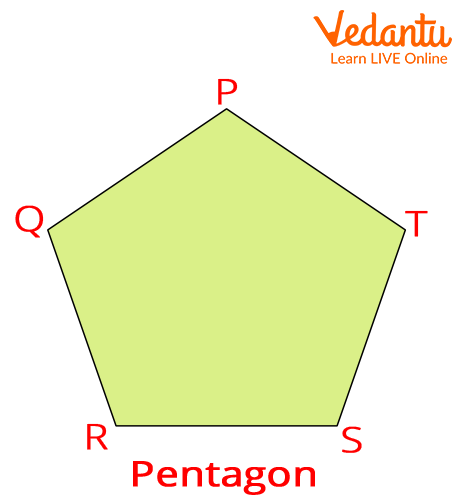
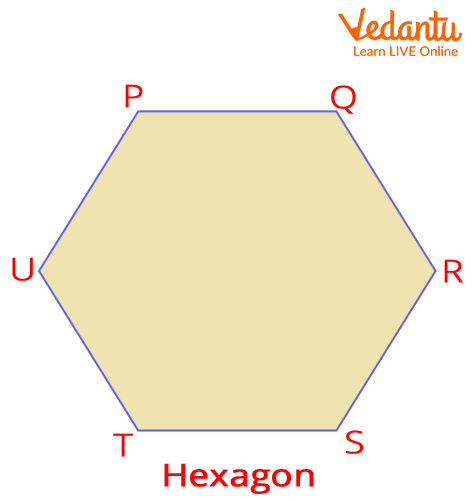
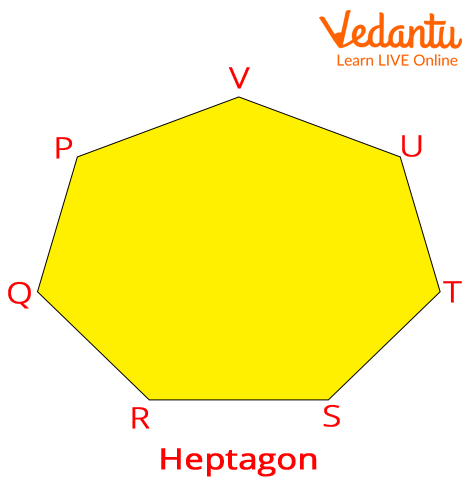
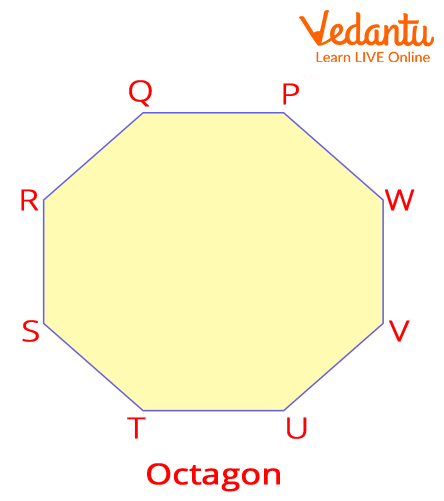
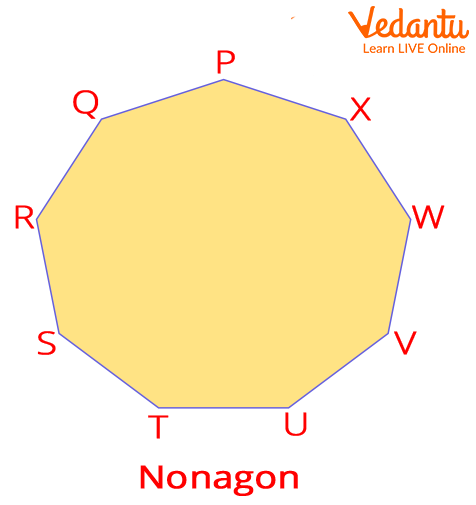
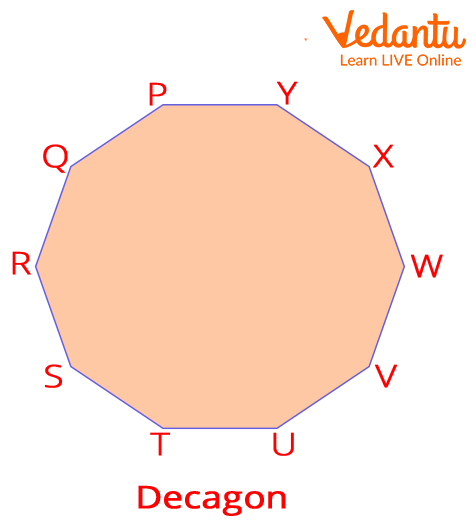
Look at the below polygons that have rectilinear shapes:
Pentagon
Hexagon
Heptagon
Octagon
Nonagon
Decagon
So, this was all about rectilinear concepts, shapes, and figures having straight sides and angular corners. Now, let us go through some FAQs on this topic.
FAQs on Rectilinear Shapes in Geometry Explained Clearly
1. What is a rectilinear shape?
A rectilinear shape is a 2D figure made only from straight line segments that meet at right angles. It is formed using horizontal and vertical lines, creating only 90° corners. Rectilinear shapes can be regular or irregular, and they are often composed of multiple rectangles joined together. They are commonly studied in geometry when learning about area and perimeter.
2. How do you find the area of a rectilinear shape?
The area of a rectilinear shape is found by dividing it into rectangles, calculating each area, and then adding them together. Follow these steps:
- Split the shape into smaller rectangles.
- Use Area = length × width for each rectangle.
- Add all the individual areas.
Example: If a shape is split into two rectangles with areas 12 cm² and 8 cm², the total area is 20 cm².
3. What is the formula for the perimeter of a rectilinear shape?
The perimeter of a rectilinear shape is the total length of all its outer sides added together. To calculate it:
- Add every exterior side length.
- Ensure no internal sides are included.
For example, if the outside boundary sides measure 4 cm, 6 cm, 4 cm, and 6 cm, the perimeter is 20 cm.
4. Are all rectilinear shapes rectangles?
No, not all rectilinear shapes are rectangles, but all rectangles are rectilinear shapes. A rectangle has four right angles and opposite sides equal, while a rectilinear shape may have more than four sides and can be irregular, as long as all angles are 90° and sides are straight.
5. What are the properties of rectilinear shapes?
The key properties of rectilinear shapes are that they are made of straight lines and contain only right angles. Their main characteristics include:
- All sides are straight line segments.
- All interior angles are 90°.
- They can have four or more sides.
- They may be regular or irregular.
6. How do you split a rectilinear shape to find its area?
To split a rectilinear shape, draw straight lines to divide it into rectangles without overlapping parts. Steps include:
- Identify corners where rectangles can be formed.
- Draw vertical or horizontal lines inside the shape.
- Calculate each rectangle’s area using length × width.
- Add the areas together.
This method simplifies complex composite shapes into manageable parts.
7. Can you give an example of finding the area of a rectilinear shape?
Yes, you can find the area of a rectilinear shape by breaking it into rectangles and adding their areas. Example:
- Rectangle A: 5 m × 3 m = 15 m²
- Rectangle B: 2 m × 3 m = 6 m²
Total area = 15 m² + 6 m² = 21 m².
8. What is the difference between rectilinear and irregular shapes?
The difference is that a rectilinear shape has only right angles, while an irregular shape can have angles of any size. Rectilinear shapes are formed using horizontal and vertical lines only, whereas irregular shapes may include slanted sides and non-90° angles.
9. Why are rectilinear shapes important in maths?
Rectilinear shapes are important because they help students understand area, perimeter, and composite shapes. They are used to:
- Develop problem-solving skills in geometry.
- Calculate floor plans and land areas.
- Prepare for more advanced topics like algebraic area problems.
They are commonly used in real-life measurements and construction layouts.
10. What are common mistakes when calculating the area of rectilinear shapes?
Common mistakes when finding the area of rectilinear shapes include missing sections or miscalculating side lengths. Typical errors are:
- Forgetting to include one of the rectangles.
- Using incorrect measurements.
- Multiplying instead of adding separate rectangle areas.
- Including internal lines in perimeter calculations.
Always double-check dimensions and ensure all parts are counted once.
