








What is Reception Numeracy Key Concepts Activities and Examples
Early maths skills are used by children in their activities and routines. This is a huge advantage because these abilities are necessary to prepare children for school. In reception numeracy, kids will understand numbers and counting, as well as start to apply basic maths terms. Arithmetic games and fun activities will develop an interest in maths and problem-solving.
We will use familiar things to help children learn about how numbers are used in everyday life, and we will also link numbers to topics. For example, if they are exploring dinosaurs, they may also create dinosaur images out of shapes. They will be encouraged to be curious about numbers and to study them. They will be exposed to the concepts of addition and subtraction by playing number games, singing counting songs, constructing models, and using the role-play area.
Numbers as Labels and for Counting
Your kid should be able to use numbers from 1 to 10, place them in order, and say which number is one more or one less than a given number by the end of the reception. They will add and subtract two single-digit numbers and count on or back to find the answer using quantities and objects.
Counting in ones, twos, fives, and tens aloud.
Estimating the number of objects and verifying with a count.
The number of objects in two groups must be matched and compared.
Taking a number of items from a larger group and counting them out.
Using ordinal numbers to position items according to their place in a group (first, second, third, etc.).
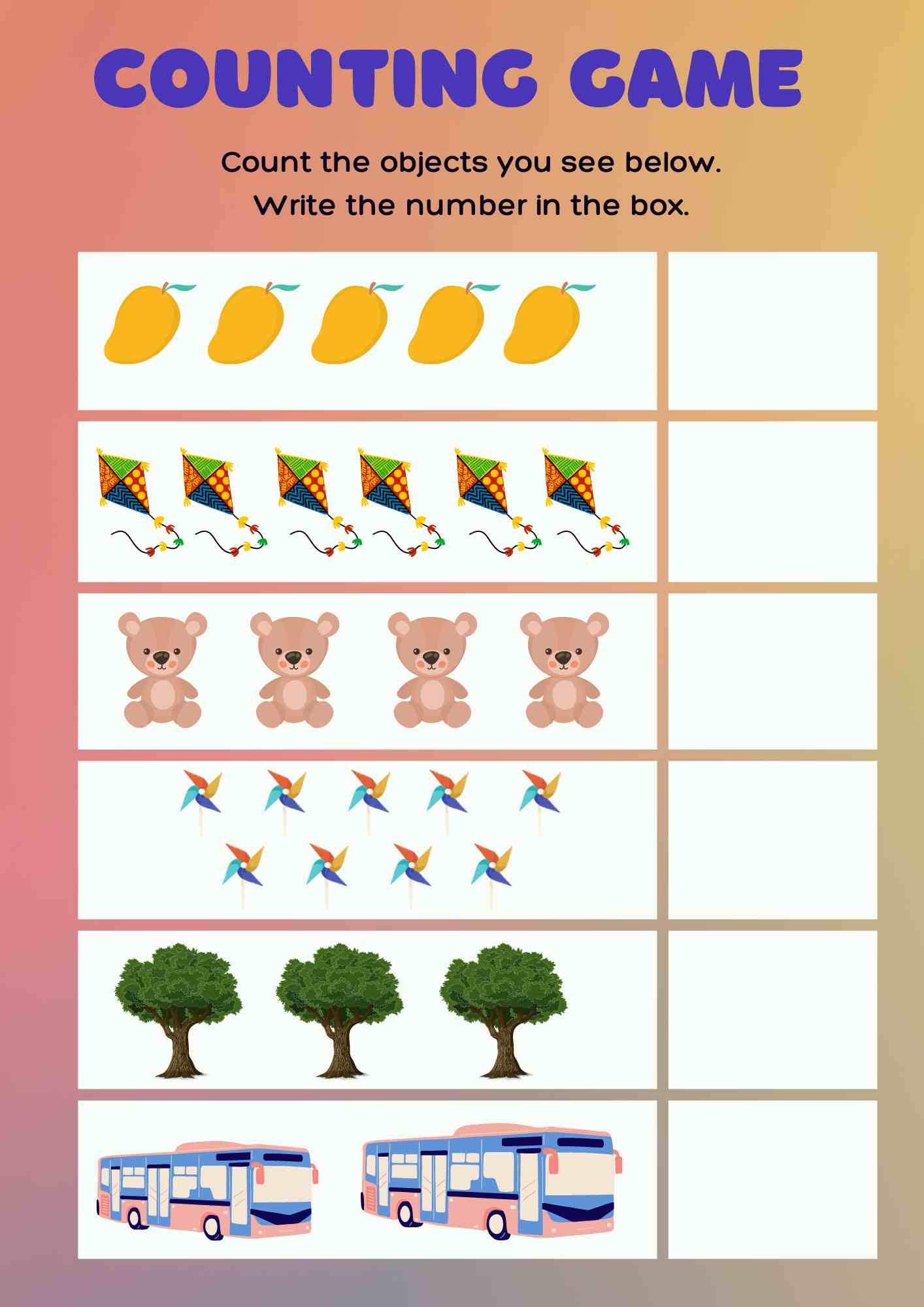
An Activity to Count the Number of Objects in the Picture
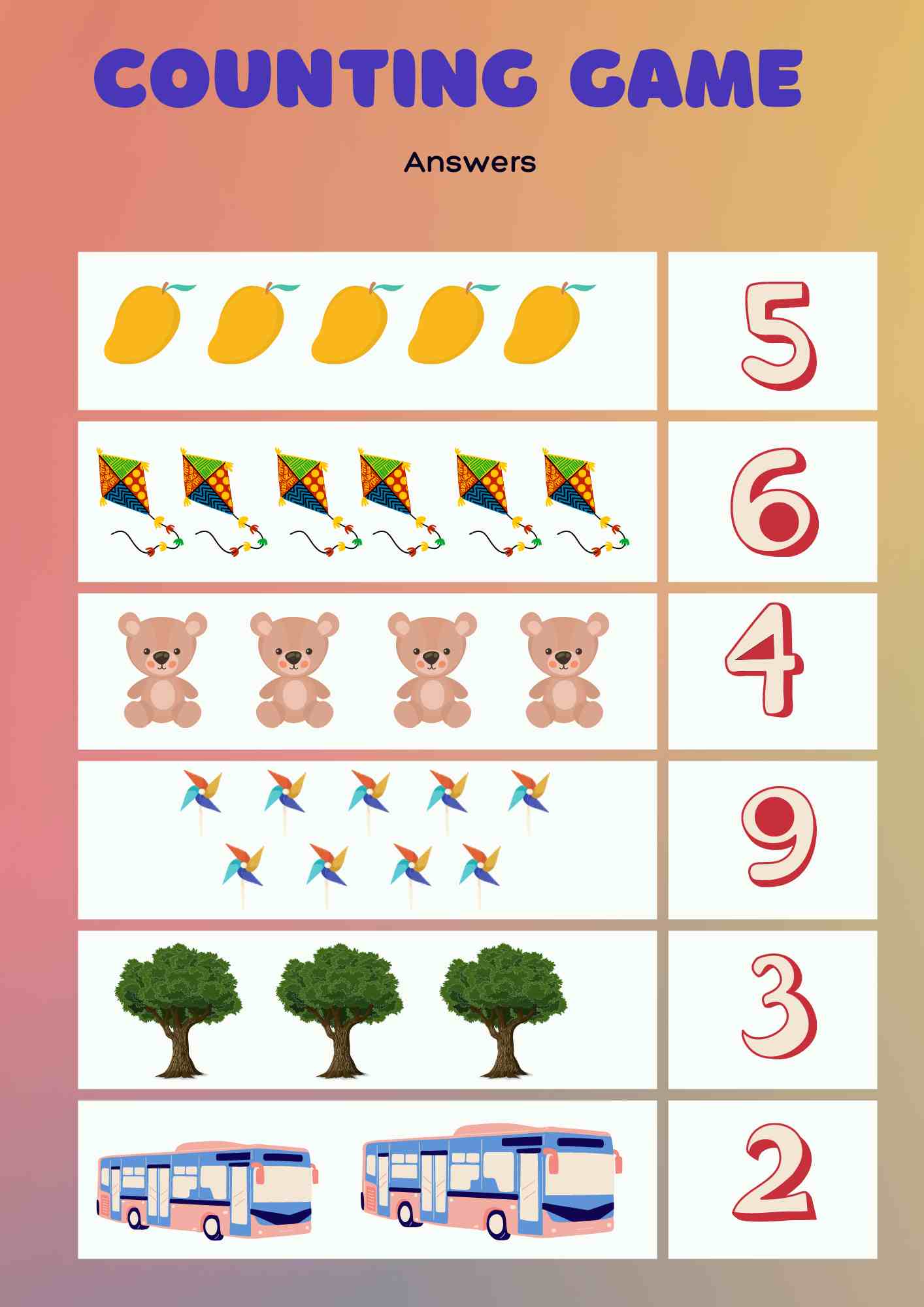
Answers for the Above Activity
Calculating
Counting on and backwards using a number line.
Finding a number from 1 to 10 that is one more or one less.
Splitting objects into equal groups and calculating the number of objects in each group.
Understanding that 'addition' refers to adding and 'subtraction' refers to subtracting.
Counting all of the things in two groups to find the total number of objects.
Comparing numbers and determining if one is 'more' or 'less'.
Learning with Shapes
Counting can be done anywhere: count toys, books, or the number of buses you see when you go out.
Play hide and seek - this is fantastic counting practice.
Models can be made using boxes and cardboard tubes. You'll think that your child is building a home, but you'll realise they're learning about shapes!
Play card games — even a basic game of snap can help you learn to recognise numbers.
Make a teddy bear picnic by counting out toys, setting out place settings, and dividing the cakes.
Place a height chart on the wall and label each family member's height.
Play with different-sized containers in the bath.
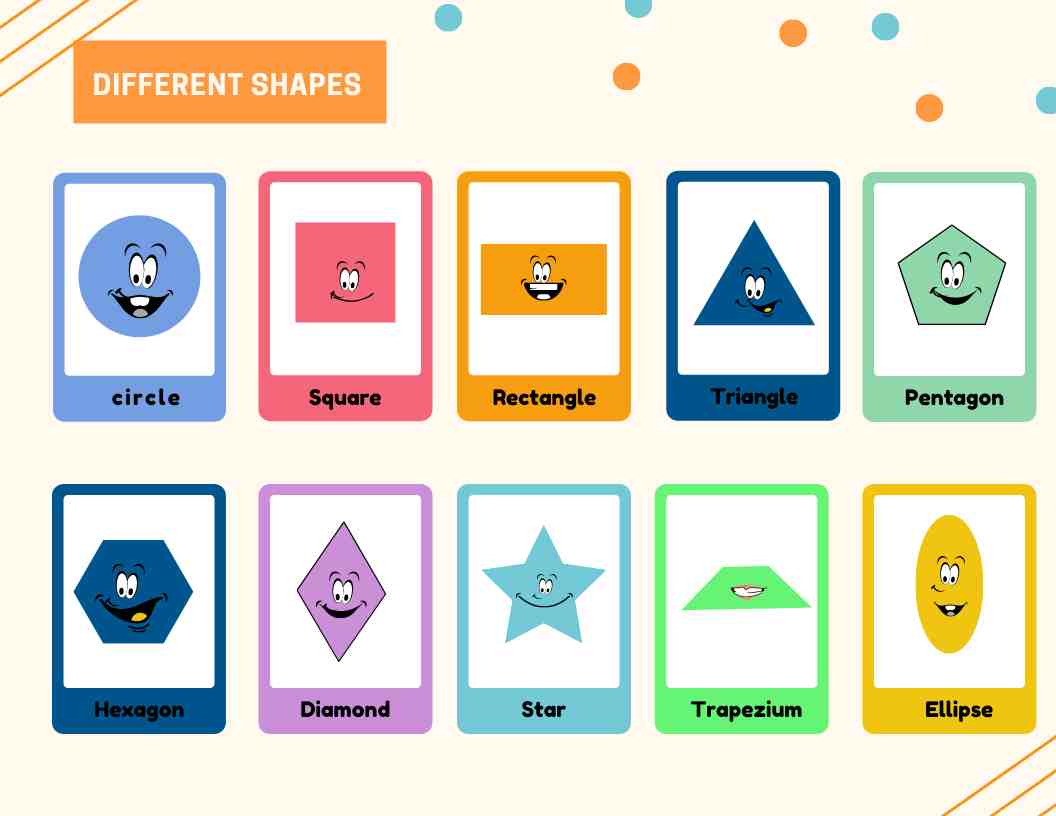
Different Shapes
How To Help Kids At Home To Understand Number Sense?
Here are a few simple but effective learning ideas that you can try with your child using everyday items at home.
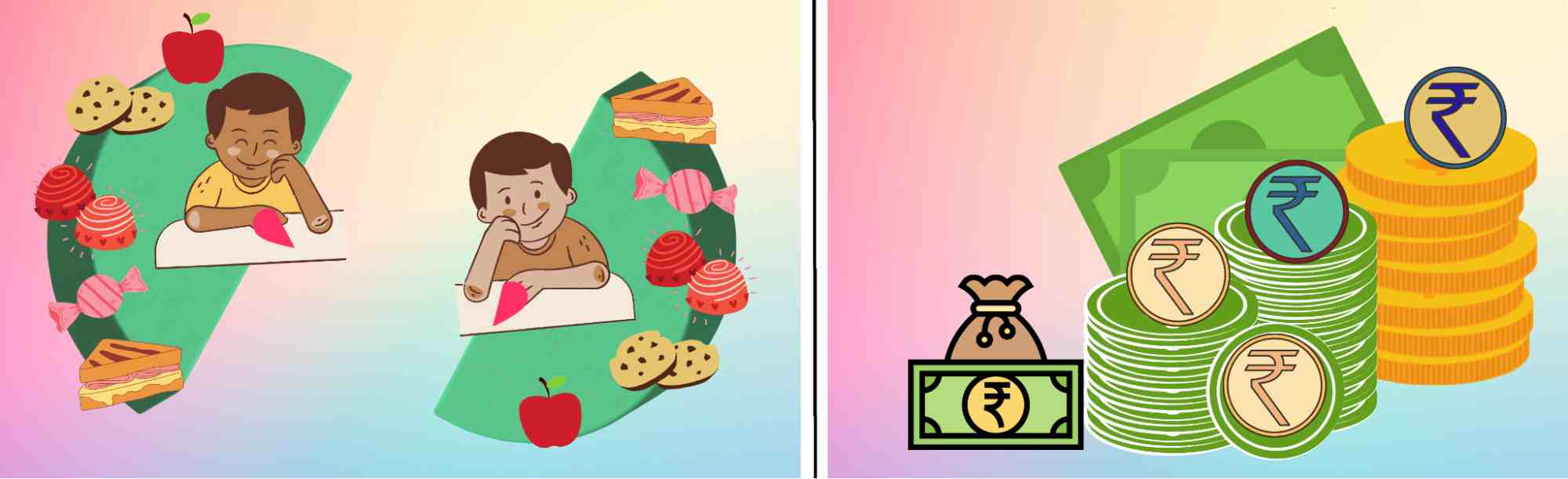
Understanding Number Sense With Sorting Objects and Counting Money
1. Have Fun with Shape Sorters
Discuss each shape with your kid, counting the sides and describing the colours. Cut large shapes out of coloured construction paper to make your own shapes. Ask your child to "jump on the red shape" or "hop on the circle."
2. Sort and Count
Collect little toys, shells, pebbles, or buttons in a basket. Make a count with your kid. Sort them according to their size, colour, or purpose.
3. Teach with a Phone
Begin teaching your 3-year-old the address and phone number of your house. Discuss with your child how each house has a number and how their home is part of a sequence of houses, each with its own number.
4. Sizes and Shapes
Take note of the sizes of the objects in your surroundings. Then ask your kid to consider his own size in relation to other items ("Do you fit under the table?"). "What's underneath the chair?").
5. When it Comes to Cooking
Even small kids can help with filling, stirring, and pouring. Children naturally learn to count, measure, add, and estimate through these activities.
6. Picture Time
For some activities, use an hourglass, stopwatch, or timer. This helps in the formation of children's sense of time and their understanding of the fact that some things take longer than others.
Questions for Children
What is the address of our home?
Are there any more numbers that you can find?
Which currency would we be able to use to purchase this item?
Which number did you choose?
Which number are you going to pick next?
Is it the butter or the eggs that are heavier?
How many apples do you have?
Could you just give me one more?
What shapes can you find in your home?
Conclusion
Children solve problems such as doubling, halving, and sharing by focusing on Reception numeracy. To compare amounts and objects, and to solve problems, children use everyday language to talk about size, weight, capacity, position, distance, time, and money. Also, patterns are recognised, created, and defined by them. They study the properties of common objects and shapes, using mathematical language to express them.
FAQs on Reception Numeracy Skills and Early Maths Learning
1. What is Reception numeracy?
Reception numeracy is the early maths learning taught in the Reception year (ages 4–5) that focuses on basic number skills and mathematical understanding. It includes:
- Counting forwards and backwards
- Recognising and writing numbers to 10 or 20
- Simple addition and subtraction
- Understanding shapes, patterns, and measures
- Comparing quantities (more, less, equal)
2. What numbers should a child know by the end of Reception?
By the end of Reception, most children should confidently recognise, count, and order numbers up to 20. They are usually expected to:
- Count reliably from 1 to 20
- Match numbers to quantities
- Write numbers to at least 10
- Understand which numbers are more or less
3. How do you teach counting in Reception?
Counting in Reception is taught by linking numbers to real objects so children understand that counting represents quantity. Effective methods include:
- Touching and counting objects one by one (1:1 correspondence)
- Singing number rhymes and songs
- Using number lines and number cards
- Counting everyday items like toys or steps
4. What is number recognition in Reception maths?
Number recognition is the ability to identify and name written numerals such as 1, 2, 3 without counting. In Reception numeracy, children learn to:
- Match numerals to quantities
- Spot numbers in the environment
- Order numbers from smallest to largest
5. How is addition taught in Reception?
Addition in Reception is introduced as combining two groups to find the total. It is taught using practical objects and simple number sentences. For example:
- If you have 2 apples and get 1 more, you count: 1, 2, 3
- The number sentence is 2 + 1 = 3
6. How is subtraction explained to Reception children?
Subtraction in Reception is explained as taking away or finding how many are left. It is taught through practical examples such as:
- Start with 5 toys
- Take away 2 toys
- Count what remains: 3
7. What shapes do children learn in Reception?
In Reception maths, children learn to recognise and name common 2D and 3D shapes. These include:
- Circle, square, triangle, rectangle
- Cube, sphere, cylinder, cuboid
8. What does comparing numbers mean in Reception?
Comparing numbers means deciding which number is greater, smaller, or equal. In Reception numeracy, children learn to:
- Use words like more, less, and equal
- Compare groups of objects by counting
- Order numbers from smallest to largest
9. Why is place value important in Reception maths?
Place value in Reception introduces the idea that numbers are made of parts, such as tens and ones. Children begin to:
- Understand numbers beyond 10 as 10 and some more
- Recognise that 14 means 10 + 4
- Use practical resources like ten frames
10. How can parents help with Reception numeracy at home?
Parents can support Reception numeracy by practising short, fun maths activities in everyday life. Helpful ideas include:
- Counting steps, toys, or snacks together
- Practising number recognition to 20
- Playing simple board games with dice
- Talking about shapes and patterns around the home
