








Ptolemys Theorem formula proof and how to use it
Ptolemy Theorem is an important component of Euclidean Geometry. It is named after the Greek Mathematician and astronomer Ptolemy. The theorem is derived by him while applying to astronomy to supplement his table of chords and trigonometry for astronomy. In this article, we will discuss the Ptolemy’s theorem proof and Ptolemy’s theorem applications. Some Ptolemy's theorem examples will also be discussed for a better understanding of the topic. The theorem is mainly focused on the concept of cyclic quadrilaterals, so knowledge of cyclic quadrilaterals is essential for a better understanding of the theorem.
Table of Contents
Ptolemy Theorem: Brief introduction
History of Claudius Ptolemy
Statement of Ptolemy Theorem
Proof of Ptolemy Theorem
Limitations of the Ptolemy Theorem
Applications of the Ptolemy Theorem
Solved Examples
Important Formulas to Remember
Important Points to Remember
History of Claudius Ptolemy

Claudius Ptolemy
Image Credit: Wikimedia
Name: Claudius Ptolemy
Born: 100 AD
Died: 170 AD
Field: Mathematics and Astronomy
Nationality: Roman
Statement of Ptolemy Theorem
Ptolemy Theorem states that when a quadrilateral is inscribed in a circle, then the product of diagonals of the quadrilateral is equal to the sum of the product of pairs of opposite sides.
Proof of Ptolemy Theorem
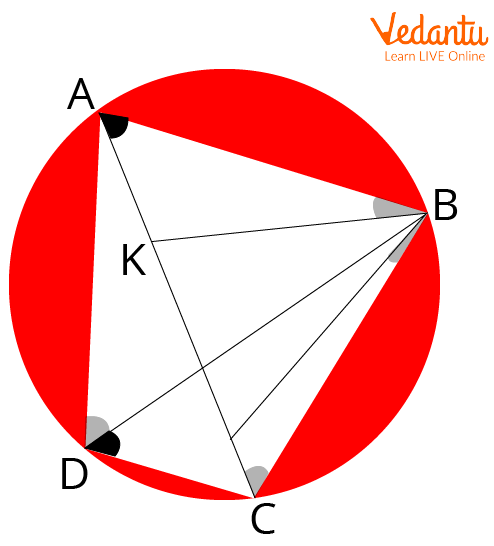
Ptolemy's Theorem
Let us consider $A B C D$ a cyclic quadrilateral.
Now we can see that the chord $B C$, the inscribed angles $\angle B A C=\ angle B D C$, and on $A B, \angle A D B=\angle A C B$.
Now, Construct $K$ on $A C$ such that $\angle A B K=\angle C B D$.
(Note that: $\angle A B K+\angle C B K=\angle A B C=\angle C B D+\angle A B D \Rightarrow \angle C B K=\angle A B D .$ )
Now, by common angles property,
$\triangle K B C \sim \triangle A B D$
Similarly,
$\triangle A B K$ is similar to $\triangle D B C$.
Thus, $\dfrac{|A K|}{|A B|}=\dfrac{|D C|}{|D B|} and \dfrac{|K C|}{|B C|}=\dfrac{|A D|}{|B D|}$ due to the similarities noted above:
{$\triangle A B K \sim \triangle D B C and \triangle K B C \sim \triangle A B D$}
So $|A K| \cdot|D B|=|A B| \cdot|D C|$, and $|K C| \cdot|B D|=|B C| \cdot|A D|$
Adding,
$\Rightarrow|A K| \cdot|D B|+|K C| \cdot|B D|=|A B| \cdot|D C|+|B C| \cdot|A D|$
Equivalently, $(|A K|+|K C|) \cdot|B D|=|A B| \cdot|C D|+|B C| \cdot|A D|$
But
$\Rightarrow|A K|+|K C|=|A C|$
So,
$\Rightarrow|A C| \cdot|B D|=|A B| \cdot|C D|+|B C| \cdot|D A|$
Hence Proved.
Limitations of the Ptolemy Theorem
It is only applicable in the case of cyclic quadrilaterals.
It only tells us about the sides and diagonal length relationship and doesn’t give any idea about the angles of the quadrilateral.
Applications of the Ptolemy Theorem
Ptolemy's Theorem has a wide range of applications in astronomy. The discovery of the theorem is done for astronomy itself.
It is used to find the value of sides or diagonals of cyclic quadrilateral using the formula stated in the theorem.
It can be used to derive the Pythagoras theorem.
Solved Examples
1. In the given figure, $A B=10 \mathrm{~cm}, D C=5 \mathrm{~cm}, B C=20 \mathrm{~cm}, A D=15 \mathrm{~cm}$ and $A C=25 \mathrm{~cm}$, then find $D B$.
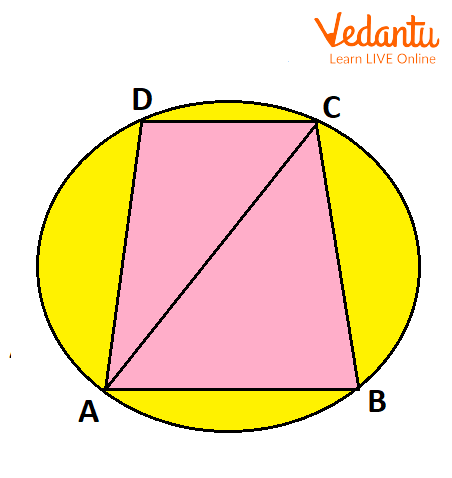
ABCD is a Cyclic Quadrilateral
Ans: By Ptolemy's Theorem, we have,
$D B \times A C=A B \times D C+A D \times B C$
Putting values, we get,
$\Rightarrow D B \times 25=10 \times 5+15 \times 20 $
$\Rightarrow 25 D B=50+300$
$25 D B=350$
$D B=\dfrac{70}{5}$
$D B=14 \mathrm{~cm}$
2. In the given figure, $A B=30 \mathrm{~cm}, D C=5 \mathrm{~cm}, B C=20 \mathrm{~cm}, A D=25 \mathrm{~cm}$ and $A C=25 \mathrm{~cm}$, then find $D B$.
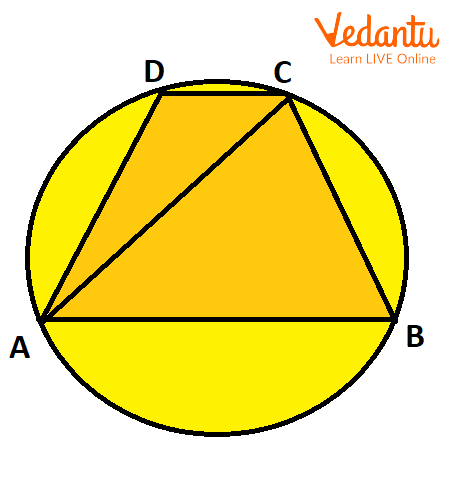
Cyclic Quad ABCD
Ans: By Ptolemy's Theorem, we have,
$D B \times A C=A B \times D C+A D \times B C$
Putting values, we get,
$\Rightarrow D B \times 25=30 \times 5+25 \times 20 $
$\Rightarrow 25 D B=150+500 $
$\Rightarrow 25 D B=650 $
$\Rightarrow D B=\dfrac{130}{5} $
$\Rightarrow D B=26 \mathrm{~cm}$
3. In given figure, $A B=10 \mathrm{~cm}, D C=15 \mathrm{~cm}, B C=35 \mathrm{~cm}, A D=40 \mathrm{~cm}$ and $D B=25 \mathrm{~cm}$, then find $A C$.
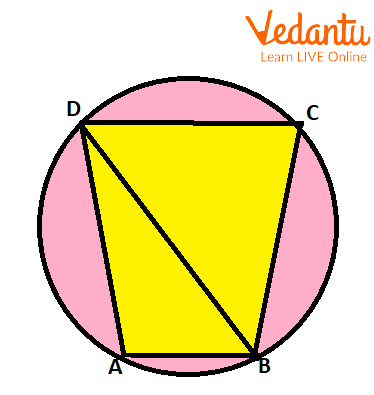
To Find the Diagonal of Cyclic Quadrilateral
Ans: By Ptolemy's Theorem, we have,
$D B \times A C=A B \times D C+A D \times B C$
Putting values, we get,
$\Rightarrow A C \times 25=10 \times 15+40 \times 35 $
$\Rightarrow 25 A C=150+1400 $
$\Rightarrow 25 A C=1550 $
$\Rightarrow A C=\dfrac{310}{5} $
$\Rightarrow A C=62 \mathrm{~cm}$
Conclusion
We have discussed the detailed proof of Ptolemy Theorem and its applications in this article. Ptolemy Theorem forms a fundamental tool for cyclic quadrilaterals. In all, we can say that Ptolemy's Theorem is a fantastic theorem which helps us in solving problems of cyclic quadrilaterals easily.
Important Formulas to Remember
For a cyclic quadrilateral ABCD, with AC and BD be the diagonals we have, $\left| {AC} \right|.\left| {BD} \right| = \left| {AB} \right|.\left| {CD} \right| + \left| {BC} \right|.\left| {DA} \right|$.
Important Points to Remember
A quadrilateral is said to be cyclic if all the vertices of the quadrilateral lie on the circumference of the circle.
List of Related Articles


FAQs on Ptolemys Theorem for Cyclic Quadrilaterals
1. What is Ptolemy’s Theorem?
Ptolemy’s Theorem states that in a cyclic quadrilateral, the product of the diagonals equals the sum of the products of opposite sides. If a quadrilateral ABCD is inscribed in a circle, then:
AC × BD = AB × CD + BC × AD
This theorem applies only to quadrilaterals whose four vertices lie on a circle and is a key result in Euclidean geometry.
2. What is the formula for Ptolemy’s Theorem?
The formula for Ptolemy’s Theorem is AC × BD = AB × CD + BC × AD for a cyclic quadrilateral ABCD. Here:
- AC and BD are the diagonals
- AB, BC, CD, AD are the sides
3. What is a cyclic quadrilateral in Ptolemy’s Theorem?
A cyclic quadrilateral is a four-sided figure whose vertices all lie on a single circle. In such a quadrilateral:
- Opposite angles are supplementary (sum to 180°).
- Ptolemy’s Theorem can be applied.
4. How do you use Ptolemy’s Theorem to find a missing side or diagonal?
To find a missing length using Ptolemy’s Theorem, substitute known values into the formula and solve algebraically. Steps:
- Write the formula: AC × BD = AB × CD + BC × AD.
- Substitute known side and diagonal lengths.
- Solve the resulting equation for the unknown value.
5. Can you give an example of Ptolemy’s Theorem with numbers?
Yes, for a cyclic quadrilateral with AB = 3, BC = 4, CD = 5, AD = 6 and diagonal AC = 7, we can find BD using Ptolemy’s Theorem. Using:
AC × BD = AB × CD + BC × AD
Substitute values:
- 7 × BD = (3 × 5) + (4 × 6)
- 7 × BD = 15 + 24 = 39
- BD = 39 / 7
6. Does Ptolemy’s Theorem work for any quadrilateral?
No, Ptolemy’s Theorem works only for a cyclic quadrilateral. If the four vertices do not lie on the same circle, then the equality AC × BD = AB × CD + BC × AD will not hold. For non-cyclic quadrilaterals, only an inequality form (Ptolemy’s inequality) applies.
7. What is Ptolemy’s inequality?
Ptolemy’s inequality states that for any quadrilateral, AC × BD ≤ AB × CD + BC × AD. Equality holds if and only if the quadrilateral is cyclic. This inequality generalizes Ptolemy’s Theorem and is important in geometry and metric space theory.
8. How is Ptolemy’s Theorem related to circles?
Ptolemy’s Theorem is directly related to circles because it applies only to quadrilaterals inscribed in a circle. The theorem depends on the cyclic property where:
- All four vertices lie on a circle.
- Opposite angles are supplementary.
9. What is the importance of Ptolemy’s Theorem in geometry?
The importance of Ptolemy’s Theorem lies in its ability to relate sides and diagonals of cyclic quadrilaterals in a single equation. It is used to:
- Prove trigonometric identities.
- Solve complex circle geometry problems.
- Derive results in coordinate and Euclidean geometry.
10. What are common mistakes when applying Ptolemy’s Theorem?
A common mistake is applying Ptolemy’s Theorem to a quadrilateral that is not cyclic. Other mistakes include:
- Confusing sides with diagonals.
- Incorrect substitution into AC × BD = AB × CD + BC × AD.
- Algebra errors while solving.
