








Triangle Properties Formulas Proofs and Solved Examples
Any three-sided polygon having three edges and three vertices is referred to as a triangle in geometry.
The fact that a triangle's interior angles add up to \[180^\circ \] is its most crucial characteristic. Certain fundamental ideas, including the Pythagorean Theorem and trigonometry, depend on the characteristics of triangles.
What are the Properties of a Triangle?
We must understand the many sorts of triangles in order to learn about the properties of triangles. Although all triangles have some characteristics, some of these characteristics depend on the sides and angles of the triangle.
Angle Sum Property:
The angle sum property states that the sum of a triangle's three interior angles is always \[180^\circ \].
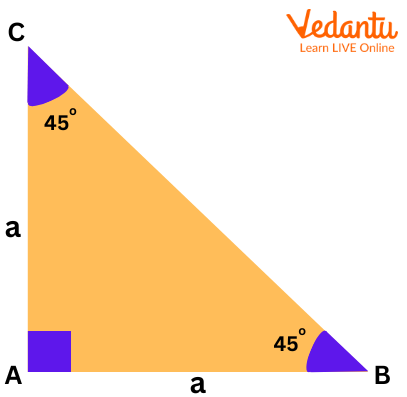
Angle Sum Property
In the given triangle, \[\angle A + \angle B + \angle C = 180^\circ \]
Triangle Inequality Property
The length of a triangle's two sides added together is longer than its third side, according to the triangle inequality theorem.
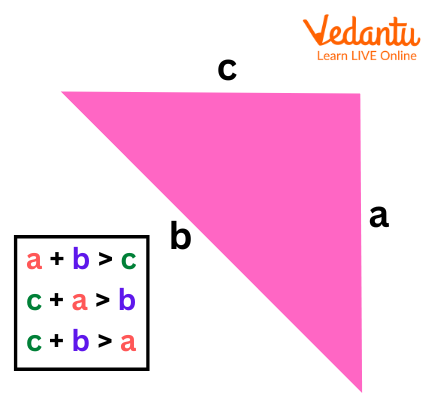
Inequality Property
Pythagoras Theorem:
The hypotenuse square of a right-angled triangle is equal to the sum of the squares of the other two sides, according to the Pythagoras theorem. Mathematically, it is expressed as \[Hypotenus{e^2} = Bas{e^2} + Altitud{e^2}\]. See the altitude, base, and hypotenuse in the illustration below.
Side Opposite to the Greater Angle is the Longest Side:
Look at the triangle below to better grasp this triangle's property that the longest side is the one that is opposite the largest angle. B is the largest angle in this triangle. The side AC is hence the longest side.
Exterior Angle Property:
The exterior angle of a triangle is always equal to the sum of the interior opposite angles, according to the outside angle theorem. Exterior angle (e) of the triangle presented is equal to \[\angle a + \angle b\]
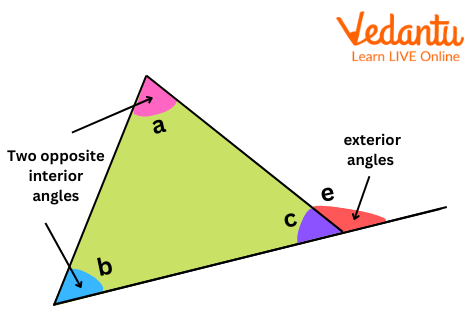
Exterior Angle Property
It should be remembered that a triangle can expand its three external angles, and the sum of all these exterior angles is \[360^\circ \].
Important Notes for Triangle:
What is the formula of triangle area? The fundamental formula for determining a triangle's area is \[{\rm{Area of triangle = }}\dfrac{1}{2} \times Base \times Height\].
A triangle's perimeter is the sum of the lengths of its three sides.
Conclusion:
To learn about the properties of triangles, we must first understand the many types of triangles. Although all triangles have some characteristics, some of these features are dependent on the triangle's sides and angles.
Solved Example:
Example 1: A triangle has two angles that are \[75^\circ \] and \[60^\circ \] in length. Determine the third angle's measurement.
Solution: Two angles in a triangle have measurements of an\[75^\circ \]and \[60^\circ \].
Sum of two angles is \[135^\circ = 75^\circ + 60^\circ \].
Using a triangle's characteristics, we can determine that the total of its three angles equals 180°.
So the third angle will be $180^\circ -135^\circ =45^\circ $.
Example 2: Tim is trying to build a triangle with sides that are 5 cm, 4 cm, and 9 cm long. Can he accomplish it?
Solution: The sides are 5 cm, 4 cm, and 9 cm long.
5 cm + 4 cm= 9 cm
In this case, the third side is equal to the total of the two smaller sides. However, according to the triangle inequality theorem, any two sides should add up to more than the third side.
Tim won't be able to build a triangle with sides of 5 cm, 4 cm, and 9 cm, according to the triangle's characteristics.
Example 3: The sides of a triangle are given as 3 cm, 4 cm, and 5 cm. Calculate the perimeter of the triangle.
Solution: Sides of the triangle are: x = 3 cm, y = 4 cm and z = 5 cm
The perimeter of the triangle is given by
\[\begin{array}{l}P = x + y + z\\P = 3 + 4 + 5\\P = 12cm\end{array}\]
Therefore, the perimeter of the given triangle is 12 cm.
FAQs on Properties of Triangles and Their Key Formulas
1. What are the basic properties of a triangle?
The basic properties of a triangle are that the sum of its interior angles is 180°, it has three sides and three vertices, and the sum of any two sides is greater than the third side.
- Angle Sum Property: A + B + C = 180°
- Triangle Inequality Theorem: a + b > c, b + c > a, a + c > b
- A triangle is the simplest polygon with exactly three sides.
2. What is the angle sum property of a triangle?
The angle sum property of a triangle states that the sum of its three interior angles is always 180 degrees.
- If angles are A, B, and C, then A + B + C = 180°.
- Example: If A = 50° and B = 60°, then C = 180° − 110° = 70°.
3. What is the formula for the area of a triangle?
The formula for the area of a triangle is Area = (1/2) × base × height.
- Base (b) is any side of the triangle.
- Height (h) is the perpendicular distance from the base to the opposite vertex.
- Example: If b = 10 cm and h = 6 cm, then Area = (1/2) × 10 × 6 = 30 cm².
4. What is Heron’s formula for the area of a triangle?
Heron’s formula states that the area of a triangle with sides a, b, and c is √[s(s − a)(s − b)(s − c)], where s is the semi-perimeter.
- s = (a + b + c) / 2
- Example: If sides are 5, 6, 7
- s = (5 + 6 + 7)/2 = 9
- Area = √[9(4)(3)(2)] = √216 = 6√6
5. What is the perimeter formula of a triangle?
The perimeter of a triangle is the sum of all its sides, given by P = a + b + c.
- a, b, and c are the three side lengths.
- Example: If sides are 4 cm, 5 cm, and 6 cm, then P = 4 + 5 + 6 = 15 cm.
6. What is the Pythagoras theorem in a right triangle?
The Pythagoras theorem states that in a right triangle, hypotenuse² = base² + height².
- If sides are a, b, and hypotenuse c, then c² = a² + b².
- Example: If a = 3 and b = 4, then c² = 9 + 16 = 25, so c = 5.
7. What is the triangle inequality theorem?
The triangle inequality theorem states that the sum of any two sides of a triangle must be greater than the third side.
- a + b > c
- b + c > a
- a + c > b
- Example: Sides 2, 3, and 6 do not form a triangle because 2 + 3 < 6.
8. What is the formula for the area of an equilateral triangle?
The area of an equilateral triangle with side a is (√3 / 4) × a².
- All sides are equal in an equilateral triangle.
- Example: If a = 4 cm, Area = (√3 / 4) × 16 = 4√3 cm².
9. How do you find the height of a triangle?
The height of a triangle can be found using h = (2 × Area) / base.
- Start with the area formula: Area = (1/2) × base × height.
- Rearrange to get height.
- Example: If Area = 20 cm² and base = 5 cm, then h = (2 × 20)/5 = 8 cm.
10. What are the different types of triangles based on sides and angles?
Triangles are classified based on sides as scalene, isosceles, and equilateral, and based on angles as acute, right, and obtuse.
- Scalene: All sides unequal
- Isosceles: Two sides equal
- Equilateral: All sides equal and each angle is 60°
- Acute triangle: All angles < 90°
- Right triangle: One angle = 90°
- Obtuse triangle: One angle > 90°
