








What Are the Properties of Multiplication with Formulas and Examples
Multiplication is an important aspect of Mathematics and involves different properties for solving differential equations. There are about six different properties of whole numbers which help in solving differential equations according to their rules. The six different properties of multiplication include the following:
Zero Property
Identity Property
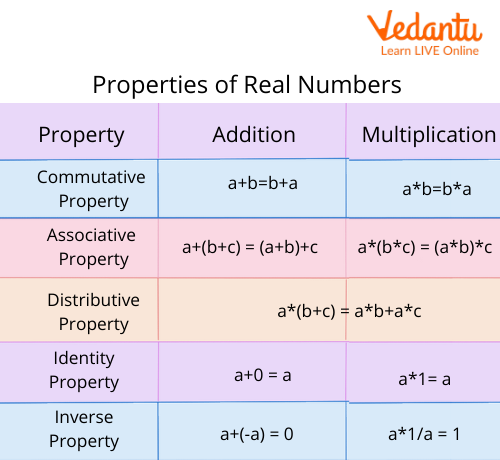
Properties of Real Numbers
The properties of multiplication have to go along with the properties of whole numbers, given above, to produce the appropriate answers and results. These properties provide accurate results when one has to solve for the long and bigger numbers. Let us dive into the properties of multiplication in detail in the next section.
Closure Property for Multiplication
In easy words, the closure property states that if two whole numbers say, a and b are multiplied together, a x b then the result of the multiplication will also be a whole number.
It's a rule that when whole numbers are multiplied then the result will also be produced as a whole number. Hence, to verify this property of multiplication, let's look at the examples.
Example: 8x9= 72
Here, both 8 and 9 are whole numbers and the result, 72 is also considered to be a whole number.
Some other examples include:
2x5= 10
5x7= 35
7x11= 77
Commutative Property for Multiplication
The commutative property states that the order of two multiplicative numbers does not change the product and the answers remain the same even if their orders are changed.
a x b = b x a
Example: 6 x 3= 18 & 3 x 6 = 18
Hence, we can prove here that the numbers multiplied in either way produce the same results irrespective of their places.
Some more of the examples include:
7 x 8 = 56 & 8 x 7 = 56
12 x 2 = 24 & 2 x 12 = 24
7 x 6 = 42 & 6 x 7 = 42
Multiplication by Zero
The property of multiplication by zero states that if any number is multiplied by zero the result is always zero.
a x 0 = 0 or 0 x a = 0
Example: 22 x 0 = 0 or 0 x 22 = 0
Therefore, the result proves that any number multiplied with zero irrespective, the result is always supposed to be 0.
Some other examples include:
37 x 0 = 0 & 0 x 37 = 0
4 x 0 = 0 & 0 x 4 = 0
Identity Property of Whole Numbers
This property states that if any whole number when multiplied by 1 produces the number as result itself.
Considering if 'a' is a whole number, which is multiplied by 1, we will get:
1 x a = a or a x 1 = a
Example:
1 x 7 = 7 ( 1+1+1+1+1+1+1 = 7)
2 x 1 = 2 ( 1+1 = 2)
1 x 342 = 342
The number 1 is considered as the multiplicative identity for the whole numbers since it does not change the value of numbers.
Associative Property of Multiplication
The associative property involves the multiplication of three whole numbers. It states that if any three whole numbers are multiplied in any manner or order, the answer always remains the same.
Let, a, b and c be three whole numbers:
(a x b) x c = a x (b x c)
The associative property ensures that the product or the answer of the multiplication remains the same irrespective of the placement of the numbers. The associative property applies to three or more numbers during multiplication.
Example:
(2 x 3) x 6 = 36
(3 x 6) x 2 = 36
(6 x 2) x 3 = 36
Distributive Property of Multiplication
The distributive property states that when the addition of two numbers is multiplied by the third number, the answer is always equal to the sum of two products.
Let a, b, and c be three whole numbers:
a x (b + c) = a x b + a x c
Thus, we say that the multiplication of numbers distributes over the addition of their numbers.
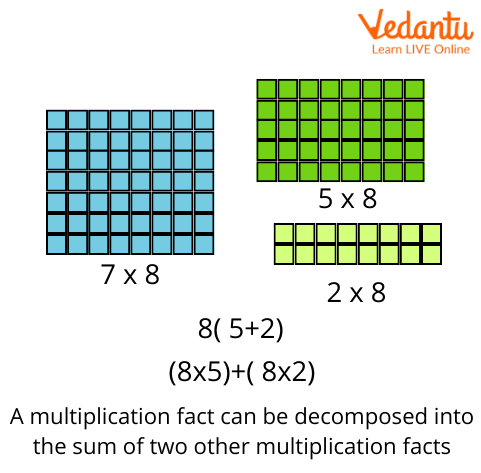
Distributive Property
Example:
2 x (7 + 3) = 20 and 2 x 7 + 2 x 3 = 20
3 x (1 + 4) = 15 and 3 x 1 + 3 x 4 = 15
Summary
The different properties of multiplication help us to solve elaborate questions efficiently and with accuracy. These different properties are quick and easy to use and can be used in different methods. We hope you now have a clear understanding of what the different properties of multiplication are and can apply them to accurately while solving problems. You can visit our website to get hold of worksheets on the topic or access other interesting Maths topics.
FAQs on Understanding the Properties of Multiplication in Math
1. What are the properties of multiplication?
The properties of multiplication are the commutative, associative, identity, zero, and distributive properties that describe how numbers behave when multiplied.
- Commutative Property: a × b = b × a
- Associative Property: (a × b) × c = a × (b × c)
- Identity Property: a × 1 = a
- Zero Property: a × 0 = 0
- Distributive Property: a × (b + c) = ab + ac
2. What is the commutative property of multiplication?
The commutative property of multiplication states that changing the order of factors does not change the product.
- Formula: a × b = b × a
- Example: 4 × 7 = 28 and 7 × 4 = 28
3. What is the associative property of multiplication?
The associative property of multiplication states that changing the grouping of factors does not change the product.
- Formula: (a × b) × c = a × (b × c)
- Example: (2 × 3) × 5 = 6 × 5 = 30 and 2 × (3 × 5) = 2 × 15 = 30
4. What is the identity property of multiplication?
The identity property of multiplication states that any number multiplied by 1 remains unchanged.
- Formula: a × 1 = a
- Example: 9 × 1 = 9
5. What is the zero property of multiplication?
The zero property of multiplication states that any number multiplied by 0 equals 0.
- Formula: a × 0 = 0
- Example: 15 × 0 = 0
6. What is the distributive property of multiplication?
The distributive property of multiplication states that multiplication distributes over addition or subtraction.
- Formula: a × (b + c) = ab + ac
- Example: 3 × (4 + 2) = 3 × 6 = 18
- Distribute: (3 × 4) + (3 × 2) = 12 + 6 = 18
7. How do you use the distributive property to solve multiplication problems?
You use the distributive property by multiplying the outside factor with each term inside the parentheses and then adding or subtracting the results.
- Step 1: Multiply the first term.
- Step 2: Multiply the second term.
- Step 3: Add or subtract the products.
- 5 × 8 = 40
- 5 × 2 = 10
- 40 + 10 = 50
8. What is the difference between the commutative and associative properties of multiplication?
The commutative property changes the order of numbers, while the associative property changes the grouping of numbers.
- Commutative: a × b = b × a (order changes)
- Associative: (a × b) × c = a × (b × c) (grouping changes)
- Example: 2 × 3 × 4
- Order change: 3 × 2 × 4
- Grouping change: (2 × 3) × 4 or 2 × (3 × 4)
9. Do the properties of multiplication apply to fractions and decimals?
Yes, the properties of multiplication apply to fractions and decimals in the same way as whole numbers.
- Commutative: 0.5 × 2 = 2 × 0.5
- Associative: (1/2 × 3) × 4 = 1/2 × (3 × 4)
- Identity: 7.3 × 1 = 7.3
- Zero: 4.6 × 0 = 0
10. Why are the properties of multiplication important in math?
The properties of multiplication are important because they help simplify calculations and solve algebraic expressions correctly.
- They make mental math easier.
- They allow flexible regrouping of numbers.
- They support solving equations using the distributive property.
- They form the foundation for algebra and higher mathematics.
