








Product of Sum formula with steps and solved examples
Multiplication of two or more integers and the result we get is known as the Product of the Sum. It is a crucial component of mathematics and has many uses. The product of a Sum is a function that computes the product of two or more numbers. The function has been used in many mathematical problems like calculating the number of combinations for a given number, finding the probability distribution, and generating random numbers.
This article will explore using the Product of Sum in different scenarios and its applications. We will also explore how it can be used to generate more efficient and accurate results.
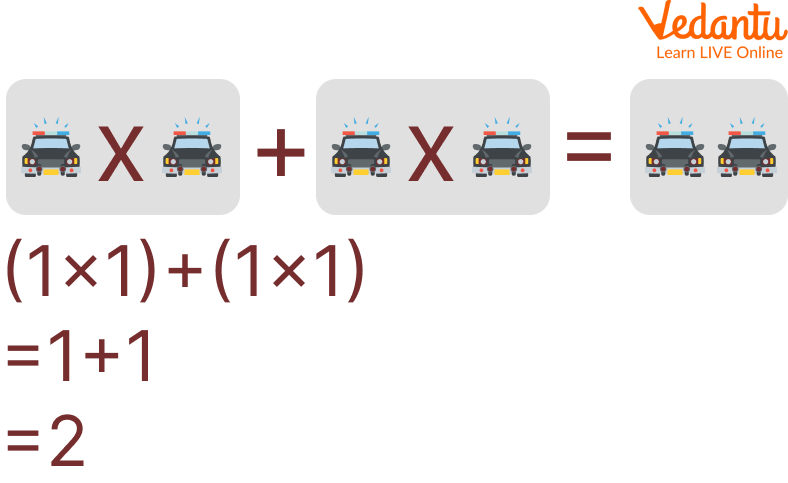
Product of Sum
What is the Sum of the Product?
The Product of Sum involves adding up the first number and then multiplying it by the sum of all other numbers and adding up all products. A sum of terms can be represented as each term being an integer greater than or equal to 0 and less than or equal to the number. For example, if we have three numbers: 5, 8, and 13, then we would calculate their product as follows:
$5\times 8 \times 13 = (5+8)\times(5 \times 8)$
$5 \times 8 \times 13=13\times(5 \times 8)=520$
This method is commonly used in mathematics for calculating products with large numbers, such as quadratic equations or polynomials. We'll utilize the Product of the Sum function to determine how many possible choices there are for a given integer. The product of Sum is a mathematical expression representing the total sum of all the terms in a series. It is denoted by the symbol " $\Sigma "$.
Product of Sum-Related Formula
The following formula for the Product of Sum has been discussed:
$(X+Y)(X-Y)=X(X-Y)+Y(X-Y)$
$(X+Y)(X-Y)=X \times X-X \times Y+Y \times X-Y \times Y$
$(X+Y)(X-Y)=X^2-X Y+X Y-Y^2$
$(X+Y)(X-Y)=X^2-Y^2$
$\text { (First term - Second term) (First term }+\text { Second term) }=\text { First term }^2 \text { - Second term }{ }^2$

Product of Sum Formula
Product of Sum Example
The following examples of the Product of Sum have been explored in this article:
Q1. Find the product (3a + 5b) (3a – 5b) by using the identity.
Ans: We know that $(X+Y)(X-Y)=X^2-Y^2$
Where $X=3 a, Y=5 b$
Then, $(3 a+5 b)(3 a-5 b)=(3 a)^2-(5 b)^2$
$(3 a+5 b)(3 a-5 b)=3 \cdot 3 \cdot a \cdot a-5 \cdot 5 \cdot b \cdot b$
Therefore,
$(3 a+5 b)(3 a-5 b)=9 a^2-25 b^2$
Q2. Evaluate $8^2-7^2$ using the identity
Ans: We know that $(X+Y)(X-Y)=X^2-Y^2$
Where $X=8, Y=7$
Then,
$X^2-Y^2=(8+7)(8-7)$
$X^2-Y^2=(15)(1)$
Therefore,
$X^2-Y^2=15$
Q3. Simplify 35 × 25 by expressing it as the product of binomial sum and difference.
Ans: We know that $(X+Y)(X-Y)=X^2-Y^2$
Then, $35 \times 25=(30+5)(30-5)$
Where $X=30, Y=5$
$(X+Y)(X-Y)=30^2-5^2$
$(X+Y)(X-Y)=900-25$
$(X+Y)(X-Y)=875$
Product of Sum Worksheet
Here the Worksheet related to the Product of the sum has been discussed, which is as follows:
Q1. Simplify $25 \times 15$ by expressing it as the product of binomial sum and difference.
Ans: 375
Q2. Using the identity, find the product $(6 a+2 b)(6 a-2 b)$.
Ans: $36 a^2-4 b^2$
Q3. Simplify $39 \times 21$ by expressing it as the product of binomial sum and difference.
Ans: 819
Q4. Evaluate $15^2-10^2$ using the identity
Ans: 125
Q5. Using the identity, find the product $(7 a+3 b)(7 a-3 b)$.
Ans: $49 a^2-9 b^2$
Summary
There are many different uses of the Product of Sum. In this article, we have discussed the Product of the Sum formula in Math. We also gave some examples to explain the concept and its use cases. The formula for finding the product of the sum is $(X+Y)(X-Y)=X^2-Y^2$. In conclusion, we can say that the Product of Sum is a useful formula in Math that students can use to solve math problems. Teachers can also use it as a tool for teaching students how to solve math problems with different types of formulas.
FAQs on Understanding the Product of Sum in Algebra
1. What is Product of Sum (POS) in Boolean algebra?
The Product of Sum (POS) is a Boolean expression written as the product (AND) of two or more sum (OR) terms. In POS form, each term inside brackets is a sum of literals, and these sum terms are multiplied together.
- General form: (A + B)(A' + C)(B + C')
- Each bracket represents a maxterm.
- The brackets are connected using logical AND (·).
2. What is the standard form of Product of Sum?
The standard POS form is a Boolean expression where every sum term contains all variables in either complemented or uncomplemented form. It is also called the canonical POS form.
- Example with variables A and B: (A + B)(A + B')(A' + B)
- Each bracket is a maxterm.
- Used when expressing a function using rows where the output is 0 in the truth table.
3. How do you convert a truth table into Product of Sum form?
To convert a truth table to POS form, write maxterms for every row where the output is 0 and multiply them together. Follow these steps:
- Step 1: Identify rows where F = 0.
- Step 2: For each row, write a sum term (maxterm).
- Step 3: Complement variables that have value 1 in that row.
- Step 4: Multiply all sum terms.
4. What is the difference between SOP and POS form?
The key difference is that SOP (Sum of Products) is an OR of AND terms, while POS (Product of Sum) is an AND of OR terms.
- SOP example: A'B + AB'
- POS example: (A + B)(A' + B')
- SOP uses minterms (output = 1).
- POS uses maxterms (output = 0).
5. What is a maxterm in Product of Sum?
A maxterm is a sum (OR) term in which each variable appears exactly once, either complemented or uncomplemented. It corresponds to a row in the truth table where the function output is 0.
- For variables A and B, possible maxterms are:
- (A + B), (A + B'), (A' + B), (A' + B')
6. Can you give an example of a Product of Sum expression?
An example of a Product of Sum expression is (A + B)(A' + C). Here:
- (A + B) is a sum term.
- (A' + C) is another sum term.
- The two terms are multiplied using AND.
7. How do you simplify a POS expression?
To simplify a POS expression, apply Boolean algebra laws or use a Karnaugh map (K-map). Common rules include:
- Idempotent Law: A + A = A
- Complement Law: A + A' = 1
- Distributive Law: (A + B)(A + C) = A + BC
8. Why is Product of Sum used in digital electronics?
Product of Sum is used in digital electronics because it directly represents logic circuits using AND gates connected to OR gates. It is especially useful when designing circuits from truth tables with output 0 conditions.
- Used in logic gate implementation.
- Helpful for NOR-based circuit design.
- Common in combinational logic simplification.
9. What is the canonical POS form?
The canonical POS form is a Product of Sum expression where each sum term contains all variables of the function exactly once. It is written as the product of all corresponding maxterms.
- Denoted as: F = ΠM(…)
- Example: F(A,B) = ΠM(1,2)
- Represents rows where output is 0.
10. How is POS related to NOR gates?
A Product of Sum expression can be implemented using only NOR gates because a NOR gate naturally performs an OR operation followed by NOT. In POS form:
- Each sum term can be implemented using a NOR gate.
- The product (AND) of sums can be realized using NOR–NOR configuration.
