








Formula for Perpendicular Distance of a Point from a Line with Derivation and Solved Examples
The shortest distance between a point and a line in geometry is the distance of a point from a line. There are an endless number of lines that can be drawn in a plane from one point to another. Drawing a perpendicular line segment on the line passing through the specified location is the only way to get the shortest distance. This is so that we can create a triangle by connecting the point and line with more than one line. Knowing the distance from a point to a line can be useful in various real-life situations-for example, to find the distance between two objects like two trees. In this article, we will study how to find the length of a perpendicular from a point to a line and solved examples.
Perpendicular Distance
The distance between two objects measured along a line perpendicular to one or both is referred to as the perpendicular distance in geometry. In two- dimensional space, the distance between two points and two lines is the perpendicular distance. For the perpendicular distance from the origin to a plane in three dimensions, the point on the plane closest to the origin.
Distance between a point and a plane in three dimensions, for the perpendicular distance between any two points.
Perpendicular Distance of a Point from a Line
The length of the perpendicular drawn from a point to a line represents the shortest separation between the two. The stages to get at the formula for calculating the perpendicular distance of a point from a line are listed below.
Step 1: In the first step, think about a line $L: A x+B y+C=0$ that is $d$ distance from the point $P\left(x_{1}, y_{1}\right)$
Step 2: As illustrated in the diagram below, draw a perpendicular PM from point $P$ to line L.
Step 3: Assume that $Q$ and $R$ are the points where the line intersects the $x, y$ - axis respectively.
Step 4: The point coordinates can be expressed as
$Q\left(\dfrac{-C}{A}, 0\right), R\left(0, \dfrac{-C}{B}\right)$
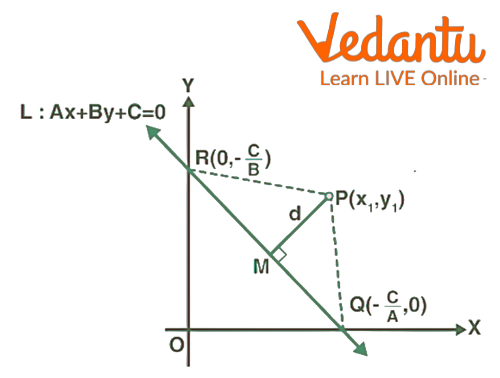
Point Coordinates
Perpendicular Distance Formula
We have the line Ax+By-C-0 i.e. DE and has a slope $\dfrac{-A}{B}$

Perpendicular Distance
Now, we have the point $\mathrm{P}$ as $\left(H^{\prime} H\right)$. So, we have to find a perpendicular distance from $\mathrm{P}$ to DE.
So, construct a line that is parallel to $D E$ and has a slope $\dfrac{-A}{B}$ as it is parallel to DE and then name it FG.
Now, we have to construct line $\mathrm{PQ}$ which passes through the origin and this line is parallel to slope $\dfrac{B}{A}$ as it is perpendicular to DE named as RS then extend it at $(0,0)$.

Slope
As FG has slope $\dfrac{-A}{B}$ and equation we have
$y-n=-\dfrac{A}{B}(x-m)$
$y=\dfrac{-A x+A m+B n}{B}$
We have
$y=\dfrac{B}{A} x$
$\dfrac{B}{A} x=\dfrac{-A x+A m+B n}{B}$
Prove that point $\mathrm{R}$ is $\left(\dfrac{A(A m+B n)}{A^{2}+B^{2}}, \dfrac{B(A m t+B n t)}{A^{2}+B^{2}}\right)$
$y=\dfrac{B}{A} x, A x+B y+C=0$
Implies $y=\dfrac{A x+C}{B}$
$=\dfrac{A x+C}{B}-\dfrac{B}{s} x$
$x=\dfrac{-A C}{A^{2}+B י}$
$y=\dfrac{B}{A} x$
$y=\dfrac{B}{A}\left(\dfrac{A C}{A^{2}+B^{2}}\right)=\dfrac{B C}{A^{2}+B^{2}}$
So, $\mathrm{S}$ is $\left(\dfrac{-A C}{A^{2}+B^{2}}, \dfrac{-B C}{A^{2}+B^{2}}\right)$
$d=\sqrt{\left(\dfrac{-A C}{A^{2}+B^{2}}-\dfrac{A(A m+B n)}{A^{2}+B^{2}}\right)^{2}+\left(\dfrac{-B C}{A^{2}+B^{2}}-\dfrac{B(A m+B n)}{A^{2}+B^{2}}\right)}$
Thus, distance RS is
$=\sqrt{\dfrac{\{-A(A m+B n+C)\}^{2}+\{-B(A m+B n+C)\}^{2}}{\left(A^{2}+B^{2}\right)^{2}}}$
$=\sqrt{\dfrac{\left(A^{2}+B^{2}\right)(A m-B n+C)^{2}}{\left(A^{2}+B^{2}\right)^{2}}}$
$=\sqrt{\dfrac{(A m+B n+C)^{2}}{A^{2}+B^{2}}}$
$=\dfrac{|A m+B n+C|}{\sqrt{A^{2}+B^{2}}}$
Thus, perpendicular distance formula is $d=\dfrac{|A m+B n+C|}{\sqrt{A^{2}+B^{2}}}$
If the perpendicular distance of point P is 5 units away from the axis perpendicularly and the foot of the perpendicular is in the opposite direction of the x-axis then point P has an ordinate which is 5 or -5. As y- coordinate of a point is equal to its perpendicular distance from the x-axis. The perpendicular distance of point P lies on the X-negative axis direction.
The point P therefore has a y-coordinate of 5 or -5.
Length of the Perpendicular from a Point to a Line
Step 1: We have a line $L: A x+B y+C=0$ that is ' $\mathrm{d}$ ' distance from the point $P\left(x_{1}, y_{1}\right)$
Step 2: As illustrated in the diagram below, draw a perpendicular PM from point $P$ to line L.
Step 3: Assume that Q and R are the points where the line intersects the x-axis and y-axis respectively i.e. the length of the perpendicular from a point to a line.
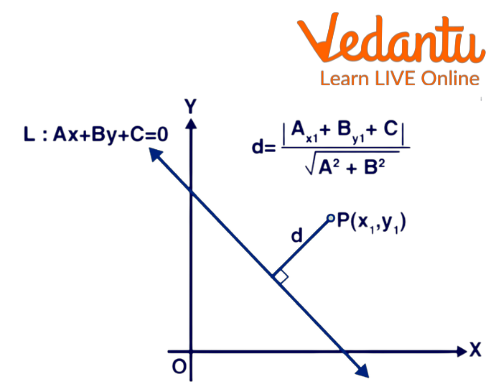
Length of the Perpendicular from a Point to a Line
Solved Examples
Q 1. Locate the distance between the point (-3, 5) and the line 4x - 3y - 26 = 0.
Ans: We have 4x-3y-26 = 0 at (-3, 5)
Implies A = 4, B = -3, C = -26, x = -3, y = 5
$d=\dfrac{|A x+B y+C|}{\sqrt{A^{2}+B^{2}}}$
$d=\dfrac{|4(-3)+(-3) 5+(-26)|}{\sqrt{4^{2}+(-3)^{2}}}=\dfrac{|-53|}{\sqrt{25}}=\dfrac{53}{5}$
Q 2. A line y = 3x + 1 and a point (5,1) must be separated by this distance.
Ans: We have y = 3x+1 at (5, 1)
Implies A = 3, B = -1, C = 1, x = 5, y = 1
$d=\dfrac{|A x+B y+C|}{\sqrt{A^{2}+B^{2}}}$
$d=\dfrac{|3.5+(-1) 1+1|}{\sqrt{3^{2}+(-1)^{2}}}=\dfrac{15}{\sqrt{10}}$
Practice Questions
Q 1. Determine the length of the perpendicular that connects the point (3,2,1) to the line.
Ans: $\dfrac{x-7}{-2}=\dfrac{y-7}{2}=\dfrac{z-6}{3}$
Q 2. Using the formula for the distance of a point from a line, determine the distance between the point K(3,7) and the line PQ.
Ans: $y=\dfrac{6}{5} x+2$
Q 3. Find the perpendicular distance of the point (−1,1) from the line 12(x+6)=5(y−2).
Ans: 5 units
Summary
As we know, the perpendicular distance between a point and a line is the shortest distance. Let that distance be ' $\mathrm{d}$ ' between $P\left(x_{1}, y_{1}\right)$ and line $L: a x+b y+c=0$ as $D=\dfrac{\left|a x_{1}+b y_{1}+c\right|}{\sqrt{a^{2}+b^{2}}}$
By calculating the perpendicular distance between any point on the line and the other, we may determine how far apart two parallel lines are from one another.


FAQs on Perpendicular Distance of a Point from a Line in Coordinate Geometry
1. What is the perpendicular distance of a point from a line?
The perpendicular distance of a point from a line is the shortest distance between the point and the line, measured along a line perpendicular to the given line. In coordinate geometry, this distance is calculated using a standard formula when the equation of the line is known. This concept is important in coordinate geometry, distance problems, and analytic geometry because the perpendicular segment always gives the minimum possible distance.
2. What is the formula for the perpendicular distance of a point from a line?
The formula for the perpendicular distance of a point (x₁, y₁) from a line ax + by + c = 0 is |ax₁ + by₁ + c| / √(a² + b²).
- Write the line in the form ax + by + c = 0.
- Substitute (x₁, y₁) into ax + by + c.
- Take the absolute value.
- Divide by √(a² + b²).
3. How do you find the perpendicular distance of a point from a line step by step?
To find the perpendicular distance of a point from a line, use the formula |ax₁ + by₁ + c| / √(a² + b²) after converting the line into standard form.
- Step 1: Write the line as ax + by + c = 0.
- Step 2: Identify a, b, and c.
- Step 3: Substitute (x₁, y₁) into ax₁ + by₁ + c.
- Step 4: Take the absolute value.
- Step 5: Divide by √(a² + b²).
4. Can you give an example of finding the perpendicular distance of a point from a line?
Yes, the perpendicular distance of point (1, 2) from the line 3x + 4y − 5 = 0 is 6/5.
- Here, a = 3, b = 4, c = −5.
- Substitute: |3(1) + 4(2) − 5| = |3 + 8 − 5| = |6| = 6.
- Compute √(3² + 4²) = √(9 + 16) = 5.
- Distance = 6/5.
5. Why do we use absolute value in the perpendicular distance formula?
We use absolute value because distance is always non-negative. When substituting the point into ax + by + c, the result may be positive or negative depending on the side of the line. Taking the absolute value ensures the perpendicular distance is always a positive quantity, which matches the geometric meaning of distance.
6. What is the perpendicular distance from a point to a vertical or horizontal line?
The perpendicular distance from a point to a vertical or horizontal line is the absolute difference in one coordinate.
- For a vertical line x = a, distance from (x₁, y₁) is |x₁ − a|.
- For a horizontal line y = b, distance from (x₁, y₁) is |y₁ − b|.
7. What is the difference between distance formula and perpendicular distance formula?
The distance formula finds the distance between two points, while the perpendicular distance formula finds the shortest distance from a point to a line.
- Distance between two points: √[(x₂ − x₁)² + (y₂ − y₁)²].
- Distance from point to line: |ax₁ + by₁ + c| / √(a² + b²).
8. How do you derive the perpendicular distance formula from a point to a line?
The perpendicular distance formula is derived using projection and properties of right triangles in coordinate geometry. Starting from the line ax + by + c = 0, the numerator |ax₁ + by₁ + c| represents the projection of the point onto the normal vector (a, b), and dividing by √(a² + b²) normalizes this vector. This gives the final formula |ax₁ + by₁ + c| / √(a² + b²).
9. In which class or topics is the perpendicular distance formula used?
The perpendicular distance formula is mainly used in coordinate geometry in high school mathematics (often Class 10 or 11). It appears in topics such as:
- Straight lines
- Distance and section formula
- Area of triangle using coordinates
- Shortest distance problems
10. What are common mistakes when finding the perpendicular distance of a point from a line?
Common mistakes when using the perpendicular distance formula include sign errors and incorrect standard form conversion.
- Not writing the line in ax + by + c = 0 form.
- Forgetting the absolute value sign.
- Miscalculating √(a² + b²).
- Substituting the wrong coordinates.
