








How to Use Pascals Triangle to Expand a Binomial with Formula and Examples
Pascal's triangle is a triangular array of binomial coefficients found in probability theory, combinatorics, and algebra. Pascal’s triangle binomial theorem helps us to calculate the expansion of ${{(a+b)}^{n}}$, which is very difficult to calculate otherwise. Pascal's Triangle is used in a variety of fields, including architecture, graphic design, banking, and mapping.
History of Blaise Pascal
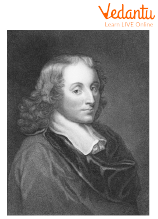
Blaise Pascal
Born: 19th June 1623
Died: 19th August 1662
Nationality: French
Contribution: He gave Pascal's Triangle Binomial Theorem to the world.
Statement of the Pascal's Triangle Binomial Theorem
The Pascal’s Triangle Binomial Theorem states that the formula to find the entry of an element in the ${{n}^{th}}$ row and ${{k}^{th}}$ column of a Pascal’s Triangle is given by
$\left( \begin{array}{*{35}{l}}n \\k \\\end{array} \right)$
The formula listed below can be used to determine the components of the following rows and columns:
$\left( \begin{array}{*{35}{l}} n \\k \\\end{array} \right)=\left( \begin{array}{*{35}{l}} n-1 \\k-1 \\\end{array} \right)+\left( \begin{matrix}n-1 \\k \\\end{matrix} \right)$
Proof of the Pascal's Triangle Binomial Theorem
Assuming\[k\le n\],
$\left( \begin{matrix}n-1 \\k-1 \\\end{matrix} \right)+\left( \begin{matrix}n-1 \\k \\\end{matrix} \right)=\frac{(n-1)!}{(k-1)!(n-k)!}+\frac{(n-1)!}{k!(n-k-1)!}$
$=(n-1)!\left( \frac{k}{k!(n-k)!}+\frac{n-k}{k!(n-k)!} \right)$
$=(n-1)!\cdot \frac{n}{k!(n-k)!}$
$=\frac{n!}{k!(n-k)!}$
$=\left( \begin{array}{*{35}{l}} n \\k \\\end{array} \right)$
Hence proved.
Application of the Pascal's Triangle Binomial Theorem
We can write big binomial expansions with the help of Pascal’s triangle and we won’t have to use the formulas for binomial expansion.
Concepts of Pascal’s Triangle are also used in so many Maths puzzles.
Limitations of the Theorem
For positive integral exponents, the theorem can’t be applied to commutative algebra.
For negative or fractional exponents, the corresponding infinite series are subject to convergence criteria.
Solved Examples
1. Expand and verify ${{\left( a+b \right)}^{2}}$.
Ans:
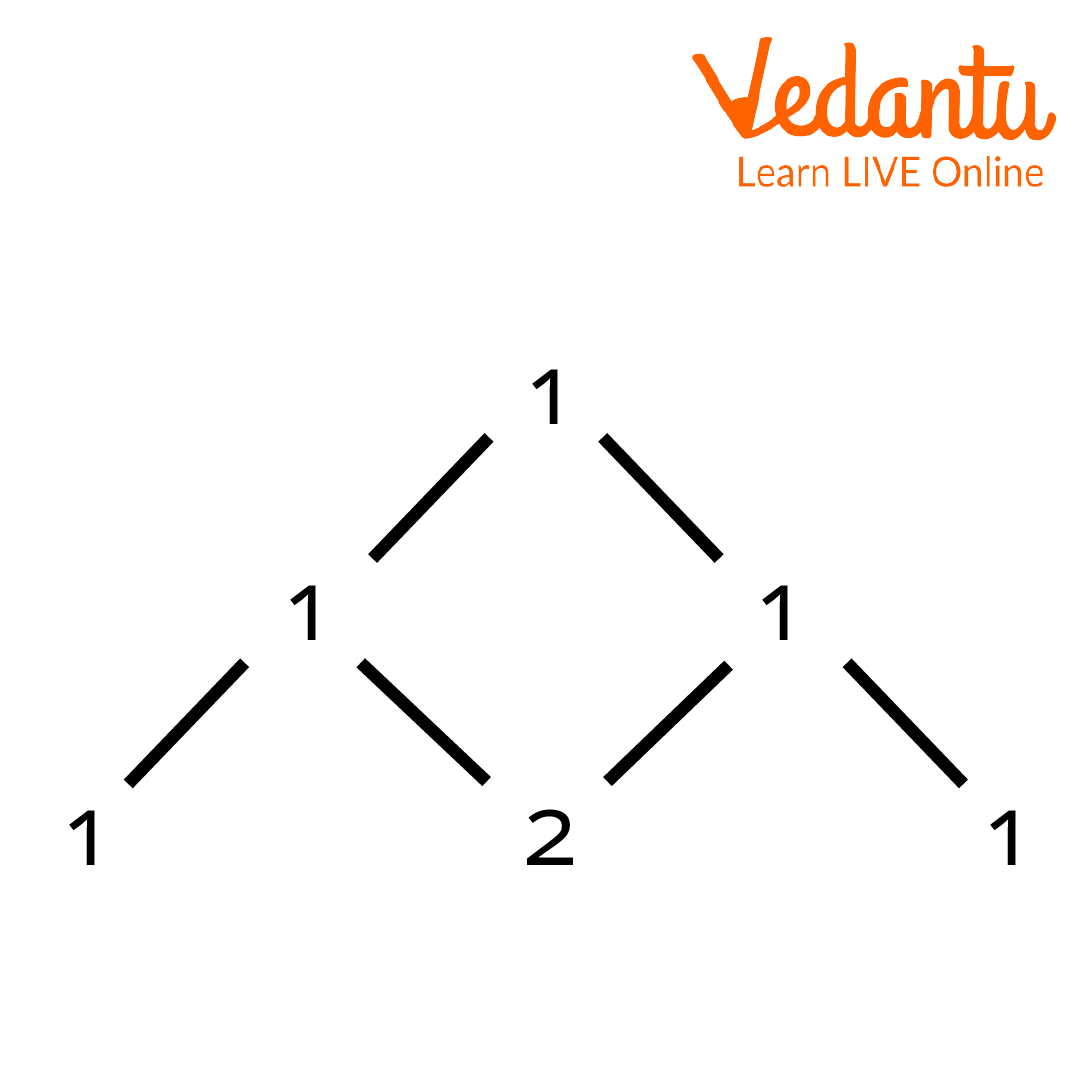
Pascal’s Triangle
First, let’s write the generic equation without the coefficients:
${{(a+b)}^{2}}={{c}_{0}}{{a}^{2}}{{b}^{0}}+{{c}_{1}}{{a}^{1}}{{b}^{1}}+{{c}_{2}}{{a}^{0}}{{b}^{2}}$
The last row of the triangle gives us the value of coefficients:
${{c}_{0}}=1$, ${{c}_{1}}=2$, ${{c}_{2}}=1$
Now, let’s write the expansion with coefficients:
${{a}^{2}}+2ab+{{b}^{2}}$
2. Expand and verify ${{(a+b)}^{4}}$.
Ans:
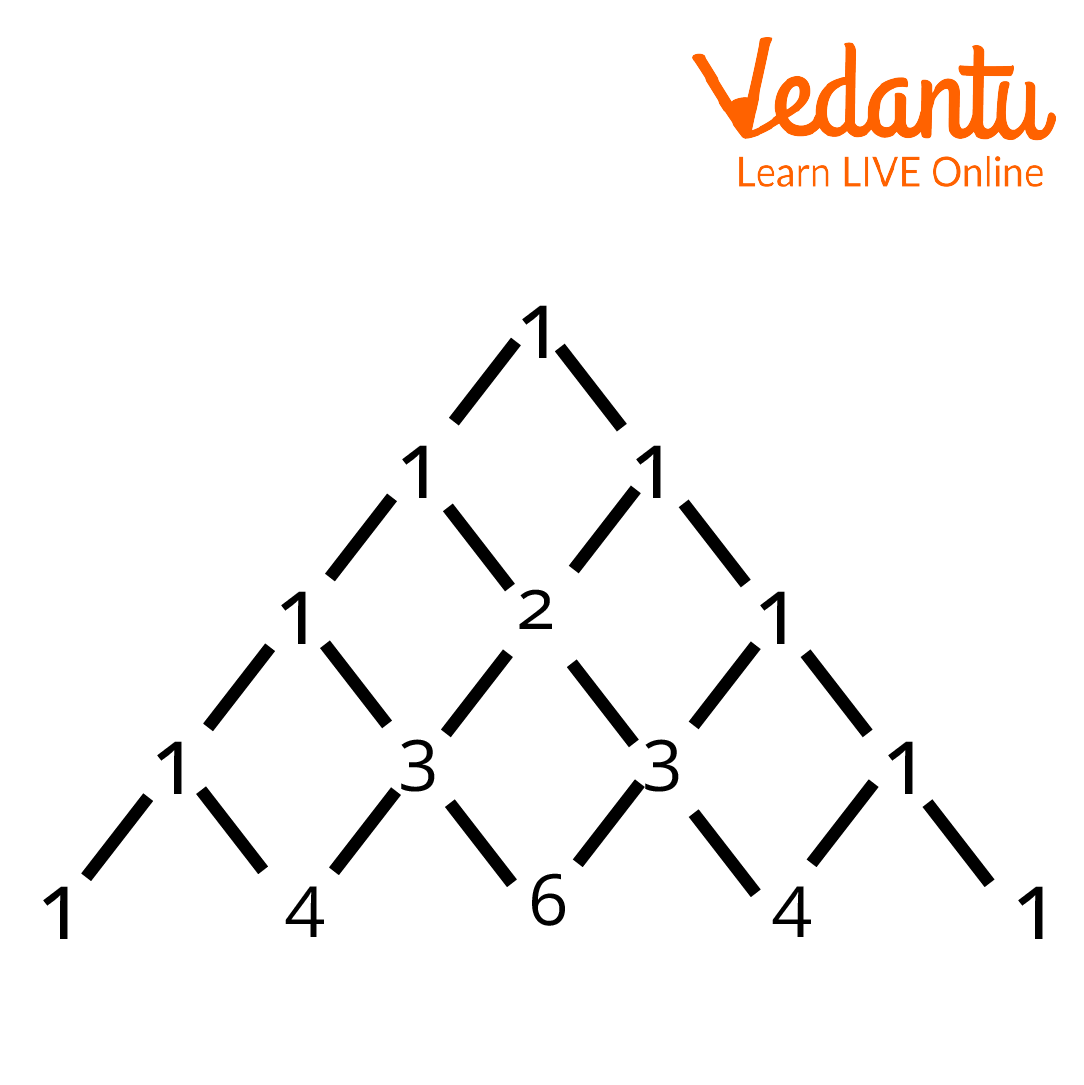
Pascal's Triangle (II)
First, let’s write the generic equation without the coefficients:
${{(a+b)}^{4}}={{c}_{0}}{{a}^{4}}{{b}^{0}}+{{c}_{1}}{{a}^{3}}{{b}^{1}}+{{c}_{2}}{{a}^{2}}{{b}^{2}}+{{c}_{3}}{{a}^{1}}{{b}^{3}}+{{c}_{4}}{{a}^{0}}{{b}^{4}}$
The last row of the triangle gives us the value of coefficients:
${{c}_{0}}=1,{{c}_{1}}=4,{{c}_{2}}=6,{{c}_{3}}=4\text{ }\!\!~\!\!\text{ and }\!\!~\!\!\text{ }{{c}_{4}}=1$
Now let’s write the expansion with coefficients:
${{(a+b)}^{4}}={{a}^{4}}{{b}^{0}}+4{{a}^{3}}{{b}^{1}}+6{{a}^{2}}{{b}^{2}}+4{{a}^{1}}{{b}^{3}}+{{a}^{0}}{{b}^{4}}$
3. Expand ${{(a+b)}^{5}}$.
Ans:
Pascal’s Triangle III
First, let’s write the generic equation without the coefficients:
${{(a+b)}^{5}}={{c}_{0}}{{a}^{5}}{{b}^{0}}+{{c}_{1}}{{a}^{4}}{{b}^{1}}+{{c}_{2}}{{a}^{3}}{{b}^{2}}+{{c}_{3}}{{a}^{2}}{{b}^{3}}+{{c}_{4}}{{a}^{1}}{{b}^{4}}+{{c}_{5}}{{a}^{0}}{{b}^{5}}$
The last row of the triangle gives us the value of coefficients:
${{c}_{0}}=1,{{c}_{1}}=5,{{c}_{2}}=10,{{c}_{3}}=10,{{c}_{4}}=5\text{ }\!\!~\!\!\text{ and }\!\!~\!\!\text{ }{{c}_{5}}=1.$
Now let’s write the expansion with coefficients:
${{(a+b)}^{5}}={{a}^{5}}{{b}^{0}}+5{{a}^{4}}{{b}^{1}}+10{{a}^{3}}{{b}^{2}}+10{{a}^{2}}{{b}^{3}}+5{{a}^{1}}{{b}^{4}}+{{a}^{0}}{{b}^{5}}$
Conclusion
Pascal's Triangle gives us the coefficients for an expanded binomial of the form ${{(a+b)}^{n}}$, where $n$ is the row of the triangle. The Binomial Theorem tells us we can use these coefficients to find the entire expanded binomial, with a couple of extra tricks thrown in.
Important Points to Remember
Each row's integers represent binomial coefficients.
The figures on the second diagonal are composed of counting figures.
The third diagonal numbers are triangular numbers.
Tetrahedral numbers make up the fourth diagonal numbers.
Pentatone numbers make up the fifth diagonal.
The sum of the numbers on each row is a power of 2.


FAQs on Pascals Triangle and the Binomial Theorem Explained
1. What is Pascal’s Triangle?
Pascal’s Triangle is a triangular arrangement of numbers where each number is the sum of the two numbers directly above it. The triangle starts with 1 at the top, and every row begins and ends with 1.
- Row 0: 1
- Row 1: 1 1
- Row 2: 1 2 1
- Row 3: 1 3 3 1
2. What is the Binomial Theorem?
The Binomial Theorem gives a formula to expand expressions of the form (a + b)n. The general formula is:
(a + b)n = Σ [nCr · an−r · br], where r = 0 to n.
- nCr are the binomial coefficients.
- The coefficients come directly from Pascal’s Triangle.
- It applies when n is a non-negative integer.
3. How do you use Pascal’s Triangle to expand a binomial?
To expand a binomial using Pascal’s Triangle, use the row corresponding to the power as the coefficients. For example, to expand (x + y)3:
- Row 3 of Pascal’s Triangle is: 1, 3, 3, 1
- Write terms in descending powers of x and ascending powers of y
4. What is the formula for nCr in the Binomial Theorem?
The formula for nCr (binomial coefficient) is nCr = n! / [r!(n − r)!]. Here:
- n! means factorial of n
- r is the term number starting from 0
5. What is the pattern in Pascal’s Triangle?
The main pattern in Pascal’s Triangle is that each interior number equals the sum of the two numbers directly above it. Key patterns include:
- Each row starts and ends with 1
- Rows are symmetric
- The sum of row n is 2n
- Diagonal numbers form counting numbers and triangular numbers
6. How do you find a specific term in a binomial expansion?
The general term in the expansion of (a + b)n is Tr+1 = nCr · an−r · br. Steps to find a specific term:
- Identify n and r
- Compute nCr using the formula
- Substitute into the general term
T3 = 5C2 · x3 · y2 = 10x3y2.
7. Why is Pascal’s Triangle important in probability?
Pascal’s Triangle is important in probability because it provides the binomial coefficients used in the binomial distribution. In probability:
- Each coefficient nCr counts combinations
- It helps calculate probabilities of successes in repeated trials
8. What is the relationship between Pascal’s Triangle and combinations?
Each entry in Pascal’s Triangle represents a combination value nCr. The number in row n and position r equals nCr, which counts the ways to choose r objects from n objects.
- Example: Row 4 is 1, 4, 6, 4, 1
- The number 6 represents 4C2
9. Can you give an example of expanding a binomial using the Binomial Theorem?
Yes, for example, to expand (2x + 3)2, use the Binomial Theorem. Using coefficients from row 2 (1, 2, 1):
- First term: 1 · (2x)2 = 4x2
- Second term: 2 · (2x)(3) = 12x
- Third term: 1 · 32 = 9
10. What are common mistakes when using Pascal’s Triangle and the Binomial Theorem?
Common mistakes when using Pascal’s Triangle and the Binomial Theorem include incorrect coefficients and wrong powers of variables. Frequent errors are:
- Using the wrong row of Pascal’s Triangle
- Not decreasing the power of the first term correctly
- Not increasing the power of the second term correctly
- Miscomputing nCr values
