








What is the Parametric Form of a Hyperbola Formula Derivation and Solved Examples
Hyperbola is a subdivision of conic sections in the field of Mathematics. When the surface of a cone intersects a plane, curves are formed, and these curves are known as conic sections. There are three categories of conic sections: the eclipse, the hyperbola, and the parabola.
We use conic sections to study 3D geometry which has a vast number of applications in various fields of engineering. Also, when a spacecraft uses the gravitational slingshot technique, the path followed by the craft is a hyperbola. In this article, we will get to know about the parametric form of the hyperbola. We will also see some interesting facts about the hyperbola and also answer some of the questions.
Parametric Coordinates of Hyperbola
In this topic, we will find how to calculate the parametric equation of the hyperbola.
To understand this in a simple way, let’s take the help of the following diagram.
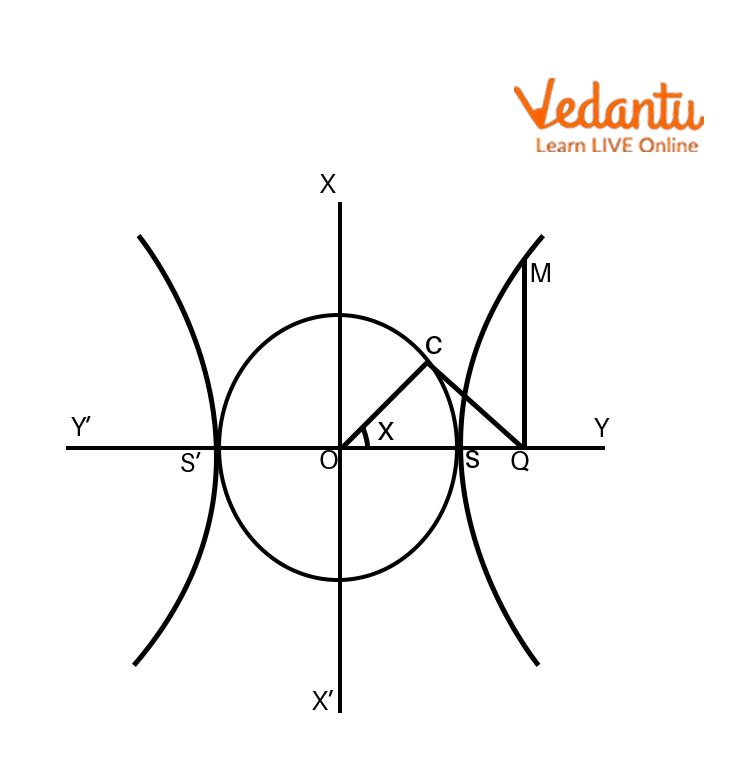
Parametric Coordinates of Hyperbola
The circle inscribed in between the hyperbola and on the transverse axis is called an auxiliary circle. If the equation of the hyperbola shown in the figure is $\dfrac{x^{2}}{a^{2}}-\dfrac{y^{2}}{b^{2}}=1$ then the equation of the auxiliary circle inscribed between the auxiliary circle will be $x^{2}+y^{2}=a^{2}$.
Let M$(x,y)$ be any point on the hyperbola $\dfrac{x^{2}}{a^{2}}-\dfrac{y^{2}}{b^{2}}=1$.
Now, from M make a line MQ to the transverse axis such that it is perpendicular to it and then select a point on the circle $x^{2}+y^{2}=a^{2}$ such that the angle ∠OCQ is 90 degrees.
Now, join (C and Q) and (O and C), The length of OC is a. Now let the length ∠SOC,
Here the ∠SOC is called the eccentric angle of the point M on the hyperbola.
Now from the right triangle OCQ, we get
$\dfrac{OC}{OQ}=cos\Theta$
$\dfrac{a}{OQ}=\dfrac{1}{sec\Theta }$ , (The radius of the circle is a=OC)
$OQ=asec\Theta$
Therefore, the abscissa of the M(x,y) on the hyperbola is asecθ.
As the point M lies on the hyperbola $\dfrac{x^{2}}{a^{2}}-\dfrac{y^{2}}{b^{2}}=1$, so it will satisfy the equation .
So, $\dfrac{(asec\Theta )^{2}}{a^{2}}-\dfrac{y^{2}}{b^{2}}=1$ (as x = sec)
$\Rightarrow \dfrac{y^{2}}{b^{2}}=sec^{2}\Theta -1$
$\Rightarrow \dfrac{y^{2}}{b^{2}}=tan^{2}\Theta $
$\Rightarrow y^{2}=b^{2}tan^{2}\Theta $
$\Rightarrow y=btan\theta$
Hence, the coordinate of the point M is (asecθ,btanθ) and for all the values of θ This point lies on the hyperbola and hence the polar coordinates of a hyperbola is represented by $(asec\Theta ,btan\Theta )$.
Parametric Form of Hyperbola
If we want to write a parametric form of the hyperbola, we can write it as
Case 1: if the hyperbola is horizontal then:
$f(t)=(x(t),y(t))$
$x(t)=asec\Theta $
$y(t)=btan\Theta$
Case 2: if the hyperbola is vertical then:
$f(t)=(x(t),y(t))$
$x(t)=atan\Theta $
$y(t)=asec\Theta $
Interesting Facts
When an object, let's say a jet, moves faster than the speed of sound it creates a conical form of a wave in space. When that wave intersects the ground, the curve we get from that intersection is a hyperbola.
The cooling towers are generally made of hyperbolic shape to achieve 2 things; first, the least amount of material used to make it and second, the structure should be strong enough to withstand strong winds.
Solved Examples
Q1. Find the parametric coordinates of the point $(3\sqrt{2},2)$ on the hyperbola $\dfrac{x^{2}}{9}-\dfrac{y^{2}}{4}=1$.
Ans The equation of the hyperbola is $\dfrac{x^{2}}{9}-\dfrac{y^{2}}{4}=1$.
If we compare it with general equation of hyperbola
$\dfrac{x^{2}}{a^{2}}-\dfrac{y^{2}}{b^{2}}=1$ we get
$a^{2}=9\Rightarrow a=3$
$b^{2}=4\Rightarrow b=2$
So the parametric coordinates of the hyperbola will be $(3sec\Theta ,2tan\Theta )$.
Now, to calculate the parametric coordinates,
$3sec\Theta =3\sqrt{2}\Rightarrow sec\Theta =\sqrt{2}\Rightarrow \Theta =45^{\circ}$
$2tan\Theta =2\Rightarrow tan\Theta =1\Rightarrow \Theta =45^{\circ}$
So the parametric coordinates will be $(3sec45^{\circ},2tan45^{\circ})$.
Practice Questions
Question Write parametric for each of the hyperbolas below:
1. $\dfrac{(x-3)^{2}}{256}-\dfrac{(y+3)^{2}}{625}=1$
Ans:
$x=3+16sect$
$y=-5+25tant$
2. $\dfrac{(y+7)^{2}}{324}-\dfrac{(x-8)^{2}}{169}=1$
Ans:
$x=8+13sect$
$y=-7+18tant$
Summary
The article summarises the concept of parametric coordinates of hyperbola and its form.
Now we know that if the equation a hyperbola is
$\dfrac{x^{2}}{a^{2}}-\dfrac{y^{2}}{b^{2}}=1$ then the parametric coordinates will be
$(x(t)=asec\Theta,y(t)=btan\Theta)$ where $\theta$ is the parameter.


FAQs on Parametric Form of Hyperbola Explained with Equations
1. What is the parametric form of a hyperbola?
The parametric form of a hyperbola expresses the coordinates of points on the hyperbola in terms of a parameter, usually θ or t. For the standard hyperbola x²/a² − y²/b² = 1, the parametric equations are:
- x = a sec θ
- y = b tan θ
2. What is the parametric equation of the hyperbola x²/a² − y²/b² = 1?
The parametric equation of the hyperbola x²/a² − y²/b² = 1 is given by:
- x = a sec θ
- y = b tan θ
3. What is the parametric form of the hyperbola y²/b² − x²/a² = 1?
For the hyperbola y²/b² − x²/a² = 1, the parametric form is:
- y = b sec θ
- x = a tan θ
4. How do you derive the parametric equations of a hyperbola?
The parametric equations of a hyperbola are derived using the identity sec²θ − tan²θ = 1. For example, starting with x²/a² − y²/b² = 1:
- Let x/a = sec θ
- Let y/b = tan θ
- Multiply to get x = a sec θ and y = b tan θ
5. What is the hyperbolic parametric form using sinh and cosh?
The hyperbolic parametric form of x²/a² − y²/b² = 1 is:
- x = a cosh t
- y = b sinh t
6. Can you give an example of a parametric form of a hyperbola?
Yes, for the hyperbola x²/9 − y²/4 = 1, the parametric equations are:
- x = 3 sec θ
- y = 2 tan θ
7. What is the parameter range in the parametric form of a hyperbola?
In the parametric form x = a sec θ, y = b tan θ, the parameter θ takes all real values except where cos θ = 0. Specifically:
- θ ≠ (2n+1)π/2, where n is an integer
8. What is the difference between parametric and Cartesian form of a hyperbola?
The Cartesian form of a hyperbola is an equation like x²/a² − y²/b² = 1, while the parametric form expresses x and y separately in terms of a parameter. For example:
- Cartesian form: x²/a² − y²/b² = 1
- Parametric form: x = a sec θ, y = b tan θ
9. Why do we use sec θ and tan θ in the parametric form of a hyperbola?
We use sec θ and tan θ because they satisfy the identity sec²θ − tan²θ = 1, which matches the standard hyperbola equation. Since the hyperbola has the form x²/a² − y²/b² = 1, choosing x/a = sec θ and y/b = tan θ ensures the equation is automatically satisfied.
10. How do you convert parametric equations of a hyperbola into Cartesian form?
To convert parametric equations into Cartesian form, eliminate the parameter using trigonometric identities. For example, given:
- x = a sec θ
- y = b tan θ
