









What Are Open and Closed Figures Definition Properties and Examples
Learning shapes and figures at an early age is an important part of academic training. Identification of the different shapes is considered one of the fundamental prerequisites in Mathematics. Apart from being crucial for the understanding of Mathematics, kids also greatly enjoy learning about different shapes and figures.
Kids have a dynamic curiosity about learning new things like the different shapes that can be found in nature which is a fun way to learn new concepts. Learning about different shapes and figures can enable the students to become more aware of their surroundings and recognise similarities amongst things and also comprehend artistic works thoroughly.
The article focuses on creating an understanding of the closed figure. It also mentions the difference between closed figures and open figures.
What is a Closed Figure?
Let us start our discussion by understanding what is a closed figure. A closed figure is defined as a shape where there are no open endings. In a more mathematical sense, it can be defined as a shape or curve where the line segments are connected and have the same starting and ending point. Some of the examples of the closed shape are mentioned below.
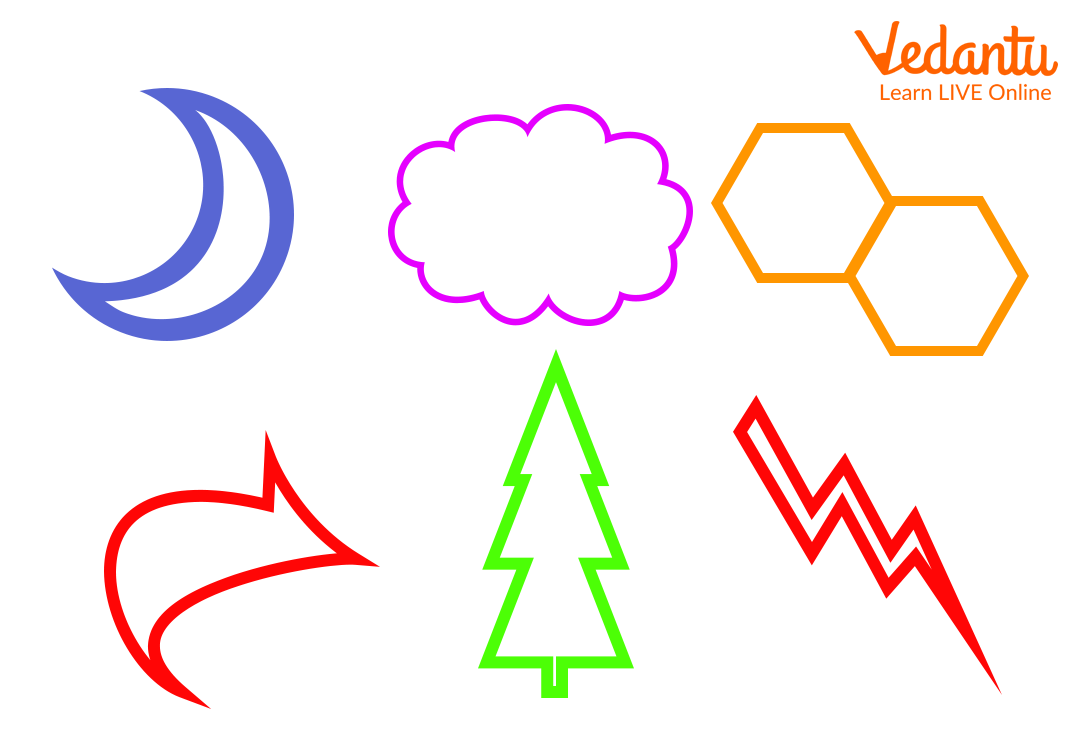
Figures that represent the closed shape
What is an Open Figure?
Since we have understood what are closed figures, let us look into the definition of open figures. An important trick to identifying the shape is to remember that the open figure is the opposite of the closed figure. Open figures are categorised by having open ends. A more precise definition of the closed figure defines it as the shapes and figures where the line segment forming it is not connected. The line segments do not have the same end points. The figure mentioned below provides examples of the open figure.
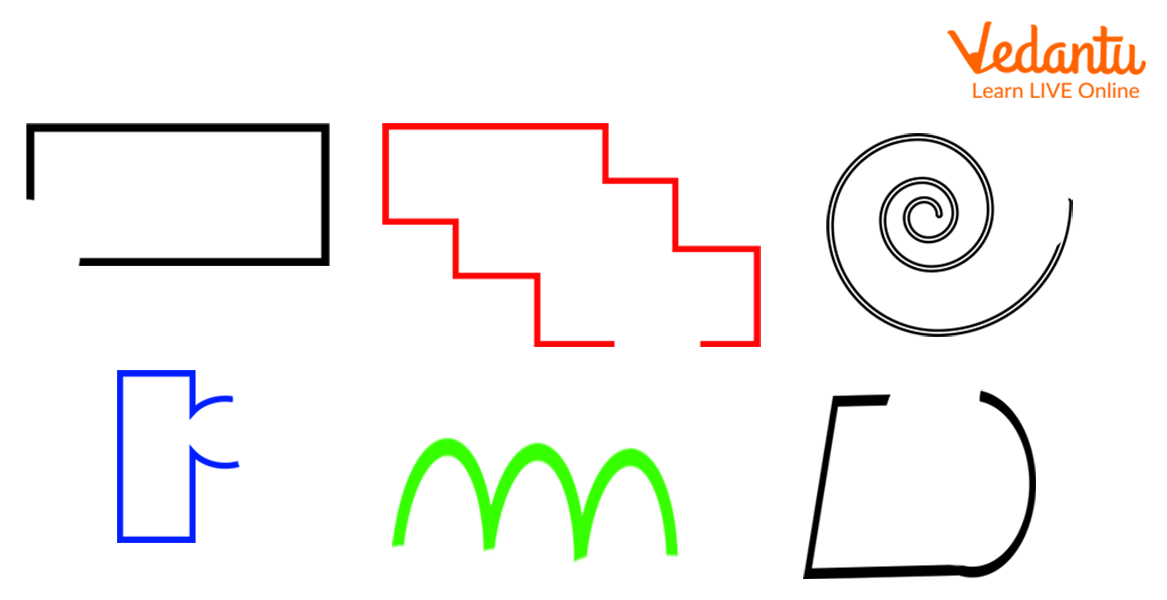
illustrations showing examples of open figures
Identification of Shapes
As we have learnt about both the open and closed figure, let us practice some questions that can help kids better understand the closed figure and open figure.
1. Is the shape shown below a closed figure or an open figure?
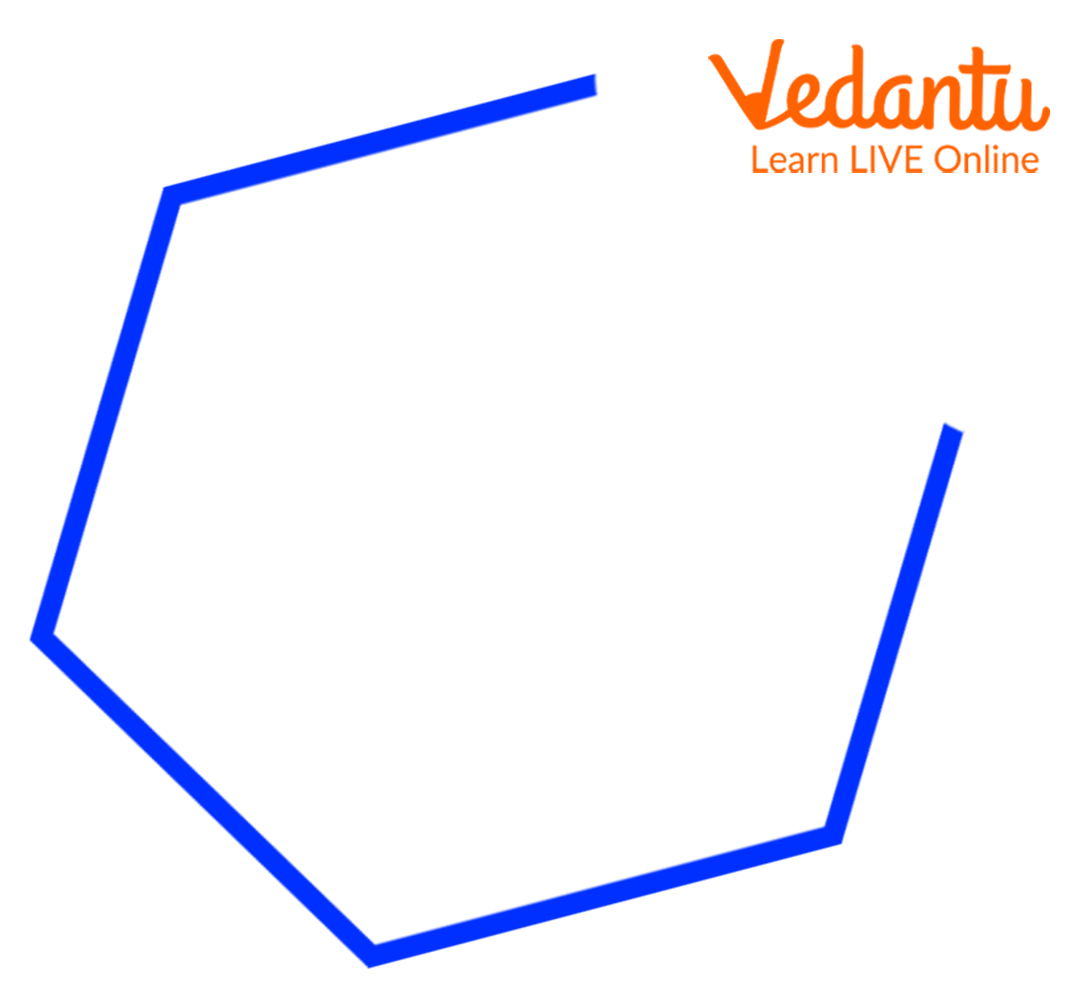
Solution: Since the image shown above has different start and end points, it can be classified as an open image.
2. Identify the image given below.
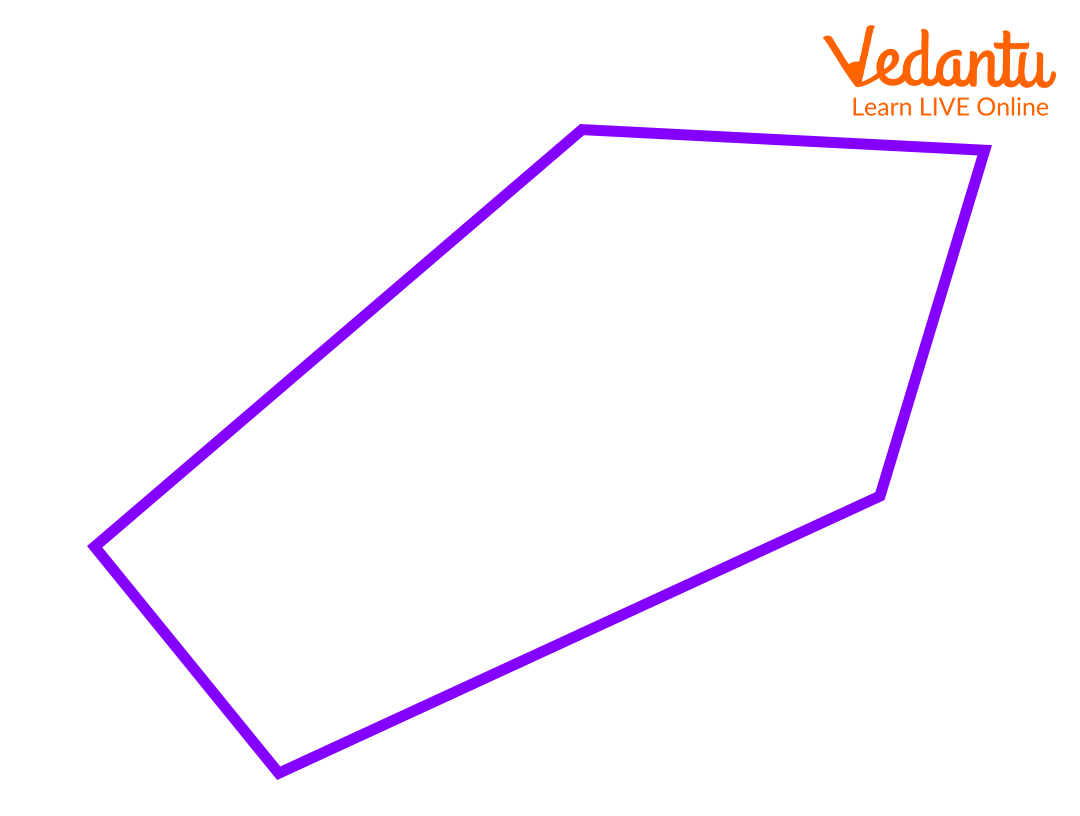
Solution: As the shape provided has all the sides closed and the end and start points are the same, it is categorised as a closed figure.
Fun Fact about Open and Closed Figures
When a structure is defined as a closed figure, it may be traced with a pencil all the way back to the start, with no breaks. The case does not hold true for open figures.
Conclusion
In former sections of the article, we mentioned what are open and closed figures, we also learnt some examples of the identification of shapes. Teaching kids about different shapes and structures is one of the most important lessons in kindergarten. A small tip that parents can use for better understanding is the introduction of fun ways to practise the lessons. Even though the lessons are taught in school, practising the lessons at home via activities can help kids to develop a clear understanding of concepts.
FAQs on Understanding Open and Closed Figures in Geometry
1. What are open and closed figures in geometry?
An open figure is a shape whose lines do not meet at the ends, while a closed figure is a shape whose lines join to form a complete boundary.
- An open figure has at least one gap.
- A closed figure has no gaps and encloses a region.
- Closed figures can have area, but open figures cannot.
- Examples: A line segment arrangement with a gap (open), triangle or square (closed).
2. How do you identify whether a figure is open or closed?
You can identify a figure as closed if all its endpoints join and it forms a complete boundary; otherwise, it is open.
- Check if the starting and ending points meet.
- Look for any gaps or breaks in the boundary.
- If it encloses space, it is a closed figure.
- If it does not enclose space, it is an open figure.
3. What are examples of open figures?
Examples of open figures include shapes that do not form a complete loop.
- Line segments that do not connect at both ends
- An open curve
- A broken rectangle with one side missing
- A zigzag line
4. What are examples of closed figures?
Examples of closed figures include shapes whose sides connect completely to enclose a region.
- Triangle
- Square
- Rectangle
- Circle
- Polygon (pentagon, hexagon, etc.)
5. Can an open figure have area?
No, an open figure cannot have area because it does not enclose any region.
- Area measures the space inside a boundary.
- Only closed figures form a bounded region.
- For example, a triangle (closed) has area, but three unconnected lines do not.
6. What is the difference between open and closed shapes?
The main difference is that a closed shape forms a complete boundary and encloses space, while an open shape does not.
- Closed shapes have area; open shapes do not.
- Closed shapes have all endpoints connected.
- Open shapes have at least one free endpoint.
7. Is a circle an open or closed figure?
A circle is a closed figure because its curved boundary forms a complete loop.
- It has no gaps or endpoints.
- It encloses a region inside.
- The enclosed space can be measured using the formula Area = πr².
8. Are polygons open or closed figures?
A polygon is always a closed figure made of three or more connected line segments.
- All sides meet at endpoints called vertices.
- It forms a closed boundary.
- Examples: triangle (3 sides), quadrilateral (4 sides), pentagon (5 sides).
9. Why are closed figures important in geometry?
Closed figures are important because they allow us to calculate area, perimeter, and other geometric properties.
- Area can only be found for closed shapes.
- Perimeter measures the total boundary length.
- Most geometric formulas apply to closed figures like rectangles and circles.
10. Can a figure be both open and closed?
No, a figure cannot be both open and closed at the same time because these are mutually exclusive properties.
- If even one endpoint is not connected, the figure is open.
- If all endpoints are connected forming a loop, the figure is closed.
- A shape must satisfy only one of these conditions.
