









What Are Ones Tens and Hundreds with Definitions and Examples
Understanding place value is crucial once we begin learning about the number system. One digit, two, three, and so on are all possible for a number. In the number system, each digit of a number has a unique position and value.
In Mathematics, the place values of the digits that follow the decimal point are designated as tenths and hundredths. Moving from right to left, the place values of a number's digits are ones, tens, and hundreds. In this article, we will study how to determine the place value for a number.
How to Determine the Place Value?
We have already explained that each digit in a number has a unique place and value. We'll start by providing a basic example of a two-digit number to explain this: 45 further
This number has two digits, as can be seen. Beginning on the right side, please. "4" is the first number. This is at one's location. Hence its value is 5. "5" is the second number from the right. Since it is in the tens place, its value is 40. Instead of saying that 45 is composed of 4 and 5, we might say that it is composed of 40 and 5. Another way to put it is that it is composed of 4 tens and 5 ones.
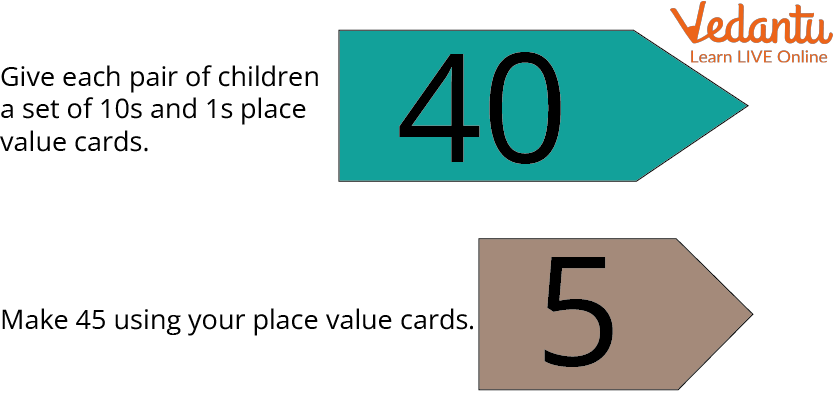
Tens and Ones
Now, if the larger number includes three digits, we will start at the right and assign a value to each position. We'll further explain this with a three-digit number example. Let's say that we have the number 786.
Once more, we'll start on the right. One is represented by the initial digit, "6," which has the value 6. The value of the second "8" digit, which contains ten places, is 80. The value of the third "7" digit, which is in hundreds, is 700.
Instead of saying that the number is composed of 1, 2, and 3, we might say that it is composed of 700, 80, and 6. We can also see from the diagram below that it is composed of 6 ones, 8 tens, and 7 hundred.
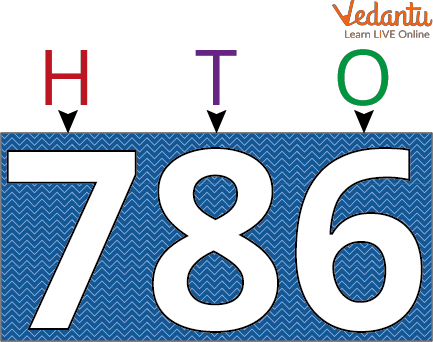
Ones Tens Hundred
Examples Showing the Place Values of a Number in One's Tens Hundred
Suppose we have 2-digit numbers; let’s determine their place value.
With the first number, 24, we shall begin. There are two digits. In this illustration, the value of 4 is present at one's position. The value of 2 in the tens place is twenty. So, when 20 and 4 are added together, we get 24.
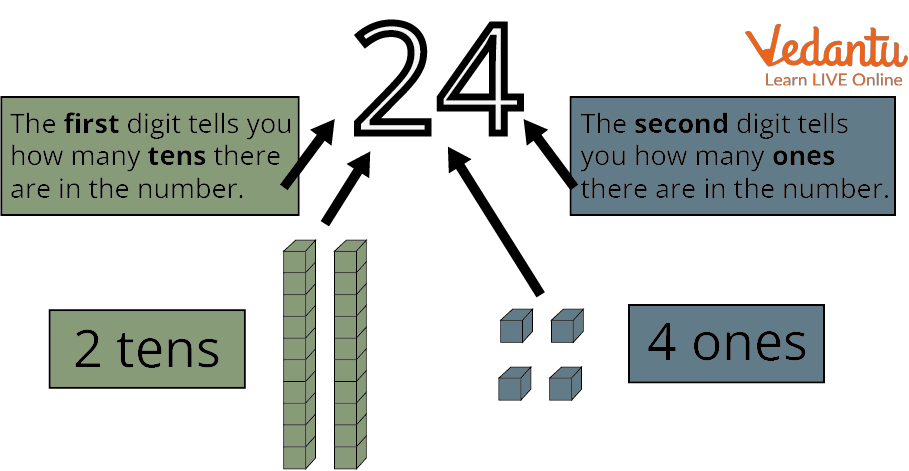
Place value of 24
Additionally, the number 44 has two digits. 4 is at one's position, starting from the right, and its value is 4. The following four are in the tens position and have a value of 40. So we get 44 when we add 40 and 4.
The last illustration uses the number 89. This two-digit number is worth nine and has nine at the one position. Its value is 80, and it has an 8 at the tens position. We obtain 89 by adding 80 and 9.
Let's now determine the place value (hundreds, tens and units) of the three-digit numbers below:
The first number is 127- The first number is worth 7, and it has a 7 at the position of the one. Its value is 20, and it has a 2 at the tens position. At hundreds, it has 1 whose value is 100. Thus, we can say that by joining 100, 20, and 7, we get 127.
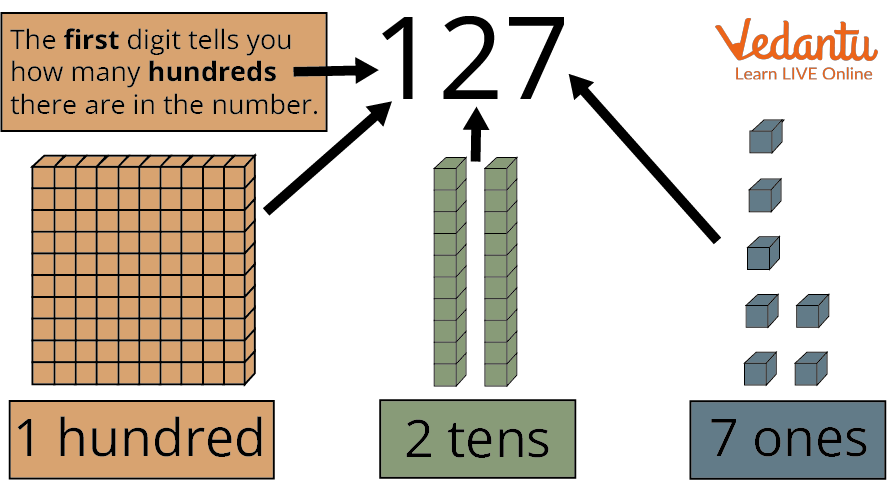
Place Value of 127
The second number is 240- At one place, the value given is 0. Its value is 40, and it has 4 at ten places. Its value is 200, and it has 2 in the hundreds position. We obtain 240 by adding 200 and 40.
The third number we can use is 609. The third number in one place is 9. Its value is 0, and it has 0 at 10 places. Its value is 600, and it has 6 in the hundreds position. Thus, by adding 600 and 9, we obtain 609.
Worksheet for Practise
Given below are a few questions which you need to solve and test your learning so far.
Q1. Write how many hundreds, tens and units are there in the given numbers. Here units are termed as ones.
21
34
40
12
87
457
768
Ans: 1. 20, 1
2. 30, 4
3. 40,0
4. 10, 2
5. 80, 7
6. 400, 50, 7
7. 700, 60, 8
Q2. Write them as decimals-
Five ones and one-tenths
Forty and seven-tenth
Twenty and five- tenth
Ans: 1. 5.10
2. 40.7
3. 20.5
Q3. How to write 2 rupees in paisa?
Ans: 200 paise.
Q4. Find the place value of the 124.
Ans: The first number has 4 at one's place, and its value is 4. It has 2 at tens place, and its value is 20. It has 1 at hundreds number place, and its value is 100.
Summary
Thus, it is crucial to comprehend the place value to understand the meaning of a number fully. If we learn about place values, we can use numbers more efficiently. Students can view the value of digits, integers, and decimals in our base ten number system using a place value chart. The idea of place value in mathematics is crucial because it determines the value of each digit in a number based on where it is in the number.
FAQs on Ones Tens and Hundreds in Place Value System
1. What are ones, tens, and hundreds in maths?
In maths, ones, tens, and hundreds are place values that show the value of each digit in a number based on its position. In the place value system:
- Ones represent single units (1–9).
- Tens represent groups of 10 ones.
- Hundreds represent groups of 10 tens or 100 ones.
- 5 is in the ones place = 5
- 4 is in the tens place = 40
- 3 is in the hundreds place = 300
2. How do you identify ones, tens, and hundreds in a number?
You identify ones, tens, and hundreds by reading digits from right to left in a number. The place values are arranged as follows:
- The rightmost digit is the ones place.
- The digit to its left is the tens place.
- The next digit to the left is the hundreds place.
- 2 is ones
- 8 is tens
- 5 is hundreds
3. What is the place value of a digit in ones, tens, and hundreds?
The place value of a digit is the digit multiplied by the value of its position (1, 10, or 100). The formula is:
- Place Value = Digit × Place
- 4 × 1 = 4 (ones)
- 6 × 10 = 60 (tens)
- 7 × 100 = 700 (hundreds)
4. How do you write a number in expanded form using ones, tens, and hundreds?
You write a number in expanded form by separating it according to its ones, tens, and hundreds place values. Follow these steps:
- Multiply each digit by its place value.
- Add the results.
- 4 × 100 = 400
- 5 × 10 = 50
- 6 × 1 = 6
5. How many ones are there in a ten and a hundred?
There are 10 ones in one ten and 100 ones in one hundred. This is because:
- 1 ten = 10 × 1 = 10 ones
- 1 hundred = 10 tens = 100 ones
6. How many tens are there in a hundred?
There are 10 tens in one hundred. Since each ten equals 10, we calculate:
- 100 ÷ 10 = 10
7. What is the difference between face value and place value?
The face value of a digit is the digit itself, while the place value depends on its position in the number. For example, in 349:
- Face value of 4 = 4
- Place value of 4 = 4 × 10 = 40
8. Can you give an example of a number showing ones, tens, and hundreds?
Yes, the number 823 clearly shows ones, tens, and hundreds. Break it down as:
- 8 in the hundreds place = 800
- 2 in the tens place = 20
- 3 in the ones place = 3
9. Why is understanding ones, tens, and hundreds important?
Understanding ones, tens, and hundreds is important because it builds the foundation for addition, subtraction, multiplication, and division. It helps students:
- Read and write numbers correctly
- Perform regrouping (carrying and borrowing)
- Understand expanded form and number comparison
10. What are common mistakes when learning ones, tens, and hundreds?
A common mistake in ones, tens, and hundreds is confusing the digit with its place value. Students often:
- Read 507 as fifty-seven instead of five hundred seven.
- Forget that 0 acts as a placeholder (e.g., 504).
- Mix up tens and hundreds positions.
