








What Is the Difference Between Numerator and Denominator in a Fraction
We often speak of quantities as half, or one-third, or one-fifth, and so on. Well, these are “parts of a whole quantity”, and are represented as fractions, $\frac{1}{2}, \frac{1}{3}, \frac{1}{5}$. A fraction has two parts, numerator and denominator, separated by a horizontal line. The horizontal line is called the vinculum. The numerator refers to the part of the fraction above the vinculum and the denominator refers to the part of the fraction below the vinculum. For any given fraction, the denominator represents the whole quantity and the numerator represents a part of the whole quantity.
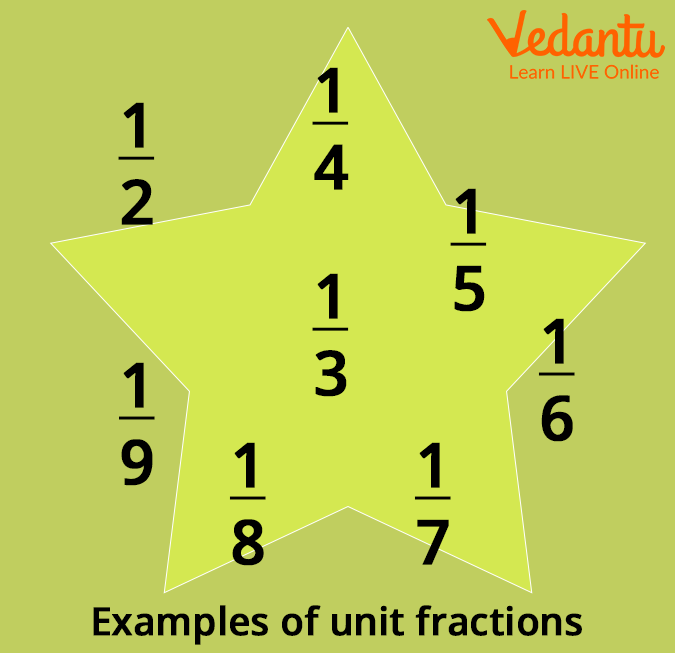
Examples of Fractions
Let us now understand the concept of numerator and denominator in a detailed manner, with the help of some examples.
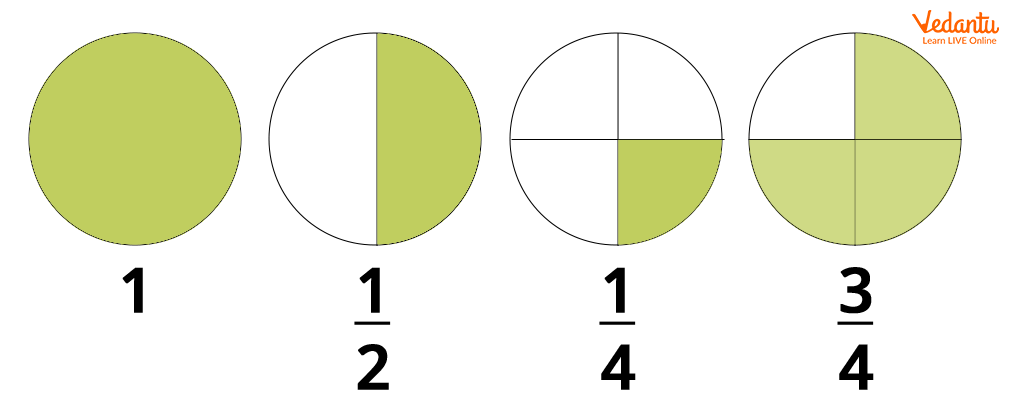
A Diagrammatic Representation of Fractions
In the figure above, a circle represents the total given quantity. The green parts of each circle represent the numerator of the respective fraction whereas the white parts represent the denominator. When the numerator and denominator are equal, that is, the number of green parts is equal to the number of white parts, the value of the fraction becomes 1.
Example of Pizza: Numerator and Denominator
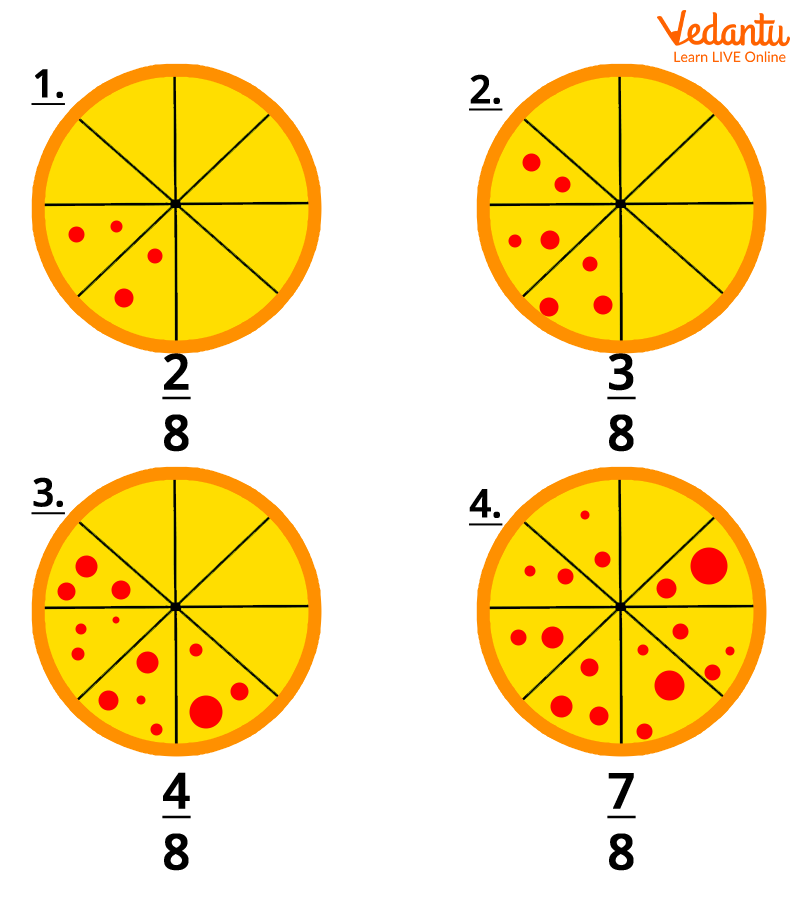
Pizza Example for Numerator and Denominator
Let’s assume you order a pizza for 8 of your friends, but when the pizza is delivered, you find that it is not cut into equal parts. Before sharing the pizza equally among all, you will have to divide the pizza into 8 equal parts. To determine the fraction of pizza each of your friends had, consider 8 as the denominator of the fraction, and the number of equal slices of the pizza one has will be the numerator. For example, the third circle has 4 in the numerator and 8 in the denominator. Therefore, 4 slices of pizza are considered out of the 8 slices for this fraction.
Solved Examples
I. Identify the numerator and denominator in the following fractions:
$\frac{3}{5}, \frac{23}{16}, \frac{27}{9}, \frac{2}{16}, \frac{24}{48}$
Solution:
The numerator and the denominator of the given fractions are as follows:
$\frac{3}{5}$
Numerator = 3, Denominator = 5
$\frac{23}{16}$
Numerator = 23, Denominator = 16
$\frac{27}{9}$
Reducing the fraction to its simplest form, we will divide the numerator and denominator by 9. We get
$\frac{3}{1}$
Therefore, numerator = 3, denominator = 1
$\frac{2}{16}$
Reducing the fraction to its simplest form, we will divide the numerator and denominator by 2. We get
$\frac{1}{8}$
Numerator = 1, Denominator = 8
$\frac{24}{48}$
Reducing the fraction to its simplest form, we will divide the numerator and denominator by 24. We get
$\frac{1}{2}$
Numerator = 1, Denominator = 2
Understanding the concept of numerator and denominator will help kids express various quantities in the form of fractions and analyse their value. With good practice, as soon as they see a fraction, they will be able to reduce its numerator and denominator fractions to the simplest form. There are several applications of fractions in subjects other than Mathematics. Therefore, the knowledge of numerator and denominator will enhance the analytical and problem-solving skills of kids for the other subjects as well.
FAQs on Numerator and Denominator in Fractions with Clear Explanation
1. What is the numerator and denominator in a fraction?
The numerator is the top number of a fraction, and the denominator is the bottom number that shows the total equal parts. In a fraction written as a/b:
- The numerator (a) tells how many parts are taken.
- The denominator (b) tells how many equal parts make up the whole.
2. How do you identify the numerator and denominator in a fraction?
You identify the numerator as the top number and the denominator as the bottom number in a fraction. Follow these steps:
- Look at the number above the fraction bar → this is the numerator.
- Look at the number below the fraction bar → this is the denominator.
3. What does the denominator represent in a fraction?
The denominator represents the total number of equal parts into which a whole is divided. It tells the size of each part. For example:
- In 4/8, the denominator 8 means the whole is divided into 8 equal parts.
- Each part is one-eighth (1/8) of the whole.
4. What does the numerator represent in a fraction?
The numerator represents how many equal parts are taken from the whole. It shows the counted parts. For example:
- In 5/6, the numerator 5 means 5 parts are taken.
- The denominator 6 means the whole has 6 equal parts.
5. What is the difference between numerator and denominator?
The difference is that the numerator counts selected parts, while the denominator shows the total equal parts in a whole.
- Numerator: Top number, tells "how many" parts.
- Denominator: Bottom number, tells "out of how many" equal parts.
6. Can the numerator be bigger than the denominator?
Yes, when the numerator is larger than the denominator, the fraction is called an improper fraction. This means the value is greater than 1. For example:
- 7/4 has numerator 7 and denominator 4.
- It equals 1 3/4 as a mixed number.
7. What happens if the numerator and denominator are the same?
If the numerator and denominator are the same, the fraction equals 1. This is because all equal parts of the whole are taken. For example:
- 5/5 = 1
- 12/12 = 1
8. How do you write a fraction using numerator and denominator?
A fraction is written as numerator/denominator with the numerator above the fraction bar and the denominator below it. Steps:
- Decide how many parts are taken → write as the numerator.
- Determine total equal parts → write as the denominator.
9. Why can’t the denominator be zero in a fraction?
The denominator cannot be zero because division by 0 is undefined in mathematics. A fraction represents division:
- a/b = a ÷ b
10. How do numerator and denominator change when simplifying a fraction?
When simplifying a fraction, both the numerator and denominator are divided by their greatest common factor (GCF). Steps:
- Find the GCF of the numerator and denominator.
- Divide both numbers by the GCF.
- GCF of 8 and 12 is 4.
- 8 ÷ 4 = 2 and 12 ÷ 4 = 3.
