








What is the Difference Between Multiplier and Multiplicand with Examples
There are four basic operations of Mathematics – these are addition, subtraction, multiplication, and division. So, multiplication is one of the elementary operations of computation in Mathematics. In the process of multiplication, the number to be multiplied is termed the multiplicand and the number with which we multiply is called the multiplier. Product is the result of multiplication. In the below given example, the multiplication of 8 and 5 is performed where 8 is the multiplier, 5 is multiplicand, and 40 is the product. There is a ‘’ sign that is used to represent multiplication.
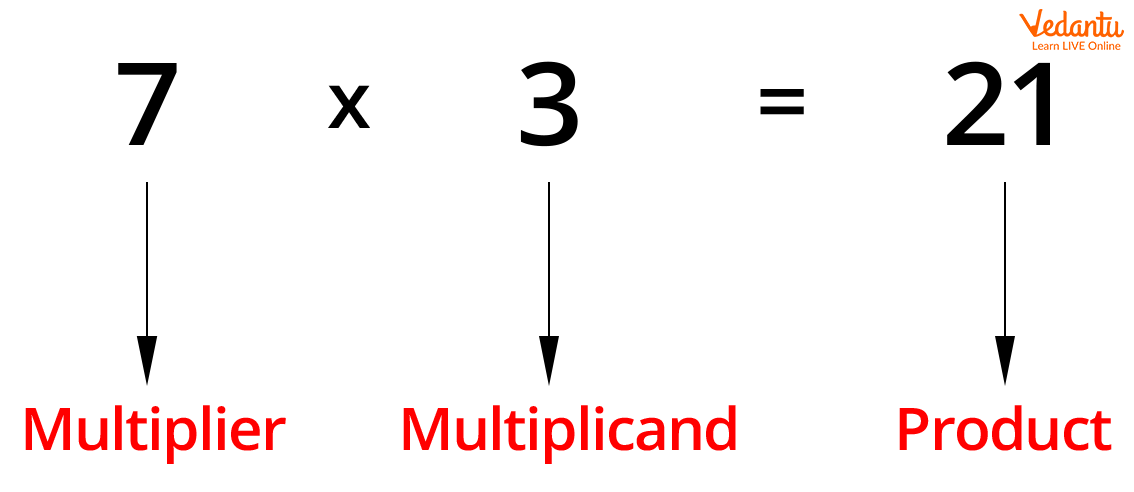
Image: Example of multiplication
Properties of Multiplication
There are some properties of multiplication which are as follows:
Commutative Property of Multiplication
According to the commutative property of multiplication, when the order of the multiplier and multiplicand are changed, the product does not change.
For example: 4 × 3 = 12 or 3 × 4 = 12
So, 4 × 3 = 3 × 4.
Associative Property of Multiplication
According to the associative property of multiplication, the product of three or more numbers does not change if we change the grouping of the numbers.
For example: (4 × 7) × 5 = 28 × 5 = 140
or, (7 × 5) × 4 = 35 × 4= 140
or, (4 × 5) × 7 = 20 × 7 = 140
One Property of Multiplication
According to one property of the multiplication, the product of a number and 1 is the number itself.
For example:
18 × 1 = 18
75 × 1 = 75
54 × 1 = 54
21 × 1 = 21
Zero Property of Multiplication
According to the zero property of multiplication, the result of multiplication of any number and zero is zero.
For example:
5 × 0 = 0
0 × 15 = 0
24 × 0 = 0
90 × 0 = 0
Distributive Property of Multiplication
According to the distributive property of multiplication, the product of a number and the sum of two numbers is always the same as the sum of the product of the numbers.
For example:
4 × (3 + 5) = 4 × 8 = 32
4 × 3 + 4 × 5 = 32
So, 4 × (3 + 5) = 4 × 3 + 4 × 5 = 32
In the same way, the product of a number and the difference of two numbers is also always the same as the difference of the product of the numbers.
For example:
4 × (6 − 5) = 4
4 × 6 − 4 × 5 = 24 − 20 = 4
So, 4 × (6 − 5) = 4 × 6 − 4 × 5 = 4
Conclusion
It is important for the students to clearly understand the concept of multiplier and multiplicand. The properties of multiplication are based on multiplier and multiplicand. Every property of multiplication is explained with examples in the above article.
FAQs on Understanding Multiplier and Multiplicand in Multiplication
1. What is a multiplier and multiplicand in multiplication?
In multiplication, the multiplicand is the number being multiplied, and the multiplier is the number by which it is multiplied. In the expression 7 × 4:
- 7 is the multiplicand (the number being multiplied).
- 4 is the multiplier (how many times 7 is taken).
- The result, 28, is called the product.
2. How do you identify the multiplier and multiplicand in a multiplication problem?
You identify the multiplicand as the number being repeated and the multiplier as the number of times it is repeated. For example, in 5 × 3:
- 5 is repeated.
- 3 tells how many times 5 is added.
- So, 5 is the multiplicand and 3 is the multiplier.
3. What is the difference between multiplier and multiplicand?
The difference is that the multiplicand is the number being multiplied, while the multiplier tells how many times it is multiplied. In 8 × 2:
- 8 is the multiplicand.
- 2 is the multiplier.
4. What is the formula for multiplier and multiplicand?
The basic multiplication formula is Multiplicand × Multiplier = Product. In general form:
- a × b = c
- a = multiplicand
- b = multiplier
- c = product
5. Can you give an example of multiplier and multiplicand?
Yes, in the example 6 × 4 = 24, 6 is the multiplicand and 4 is the multiplier. Step-by-step:
- Take 6 four times: 6 + 6 + 6 + 6
- Add them: 24
- The final answer 24 is the product.
6. Why is the multiplicand sometimes written before the multiplier?
The multiplicand is often written first because multiplication is interpreted as repeated addition of that number. For example, 9 × 3 means 9 added 3 times. However, due to the commutative property of multiplication, 9 × 3 = 3 × 9, and both give 27.
7. Does the order of multiplier and multiplicand matter?
Mathematically, the order does not change the product because of the commutative property of multiplication. For example:
- 4 × 5 = 20
- 5 × 4 = 20
8. How are multiplier and multiplicand related to repeated addition?
Multiplication is repeated addition where the multiplicand is repeatedly added according to the multiplier. For example, in 3 × 5:
- 3 is added 5 times.
- 3 + 3 + 3 + 3 + 3 = 15.
9. What is the product in relation to multiplier and multiplicand?
The product is the result obtained when the multiplicand is multiplied by the multiplier. In the equation 10 × 6 = 60:
- 10 is the multiplicand.
- 6 is the multiplier.
- 60 is the product.
10. What are common mistakes when identifying multiplier and multiplicand?
A common mistake is thinking the multiplier and multiplicand are always interchangeable in meaning, even though they give the same product. Key points to remember:
- The multiplicand is the number being multiplied.
- The multiplier tells how many times it is multiplied.
- Due to the commutative property, the product remains the same.
