








What Is Multiplication for Kids With Tables and Examples
In math, multiplication is the method of finding the product of two or more numbers. Multiplication is one of the basic and most used mathematical operations. It is a fundamental operation in mathematics that is frequently utilized in everyday life. Generally, it is shown by writing the symbol '×' or '*' in between the two assigned numbers. When we need to combine groups of similar sizes, we utilize multiplication. In this article, we will learn about multiplication and will also see the multiplication problems.
What is Multiplication?
Multiplication for class 3 is just multiplying two natural or whole numbers or integers together to obtain their product. '×' is used to denote the multiplication of two quantities. It can be stated as a method of adding the number repeatedly to acquire their product. For example: If we have to get the product of $2 \times 2$. So for it, we can add 2 + 2 to get the sum and product as 4.
Parts of Multiplication
The multiplication formula is expressed as, Multiplicand $\times$ Multiplier $=$ Product; where:
Multiplicand: The first number (factor).
Multiplier: The second number (factor).
Product: The final result after multiplying the multiplicand and multiplier.
Let us understand the multiplication parts with the help of the following expression.
35 (multiplicand) $\times 2$ (multiplier) $=70$ (product)
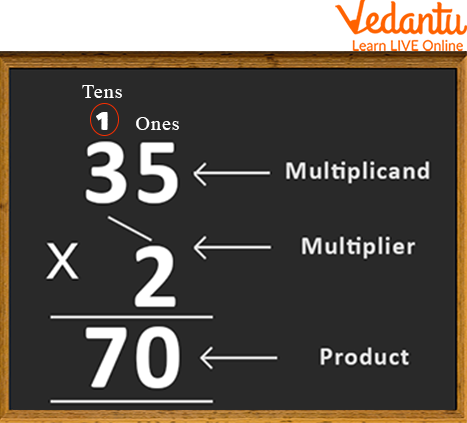
Multiplication Parts
Steps to Solve Multiplication Sums for Class 3
First, write the given multiplicand and multiplier in the column according to their place values, then put the cross sign before the multiplier. When we multiply two numbers, we always start multiplication from the left-hand side and then move to the right side.
For example (i) 35 × 2
Step 1: Write the provided numbers in columns
Step 2: Multiplying the multiplier with one place of the multiplicand, i.e. 5 × 2
Step 3: Then, multiply the tens place of multiplicand with the one's place of multiplier and add the carry to the product obtained.
Step 4: Thus, we get the required result, 35 × 2 = 70
Multiplication Facts for Class 3
The two quantities being multiplied by each other are called factors.
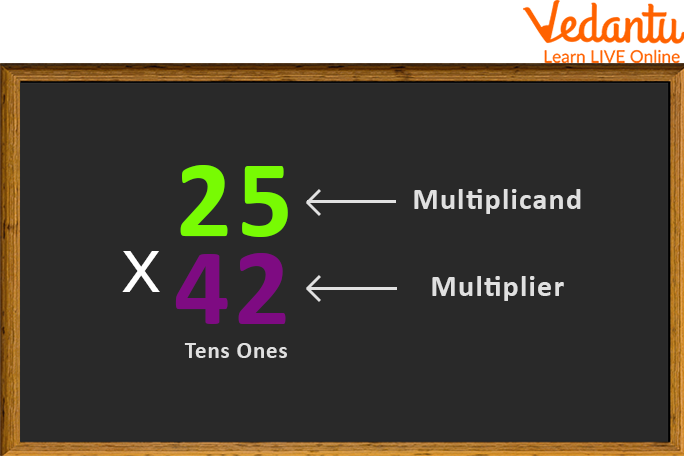
Numbers used in Multiplication
Multiplication uses a specific property called a distributive property.
Any quantity multiplied by 1 produces the number itself as a result. i.e. $15 \times 1$ = 15
Any number multiplied by 0 produces the result of 0. i.e. $15 \times 0$ = 0
Solved Examples
Q 1. 45 × 6
Ans: Align the given numbers in columns to apply the multiplication rule
Multiplying the one's place of two numbers, i.e. 5 and 6, and writing the result in one's place
Then, multiply the tens place of the multiplicand, say 4, with one's place of the multiplier, say 6 and add the carry, 3. Finally, write the result on the tens place
Thus, the product of 45 × 6 is 270.
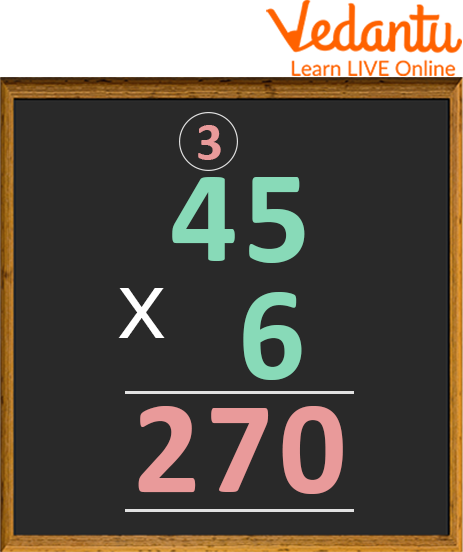
Solved Example
Q 2. 65 × 31
Ans: Write in columns both the given numbers. Multiplying the one's place of two numbers, i.e. 5 and 1, and writing the result in one's place
Then, multiply the tens place of the multiplicand, say 6, with one's place of the multiplier, say 1 and write the result on the tens place.
Multiplying the tens place of multiplier with the one's place of multiplicand i.e. 5 and 3, and writing the product so obtained from tens place, leaving one’s place empty
Now, multiply the tens place of multiplicand and multiplier together i.e. 6 and 3, and add one carry to the obtained product. Write the product in the tens place.
Adding the two partial products obtained to get the final result, i.e. 65 + 1950 = 2015.
Hence, the required product of 65 × 31 is 2015.
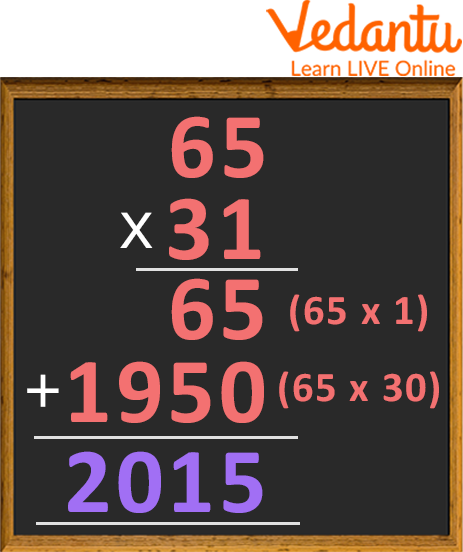
Multiplication of Two-digit Numbers
Multiplication Worksheet
Several multiplication sheets for class 3 are given below:
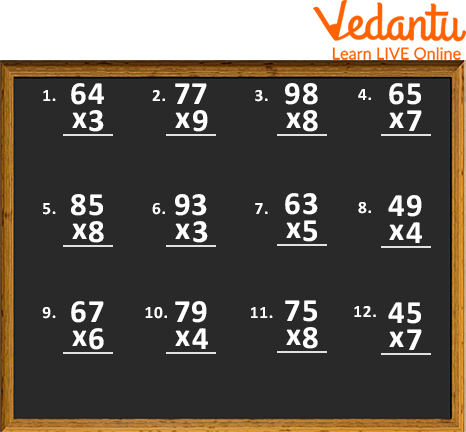
Worksheet 1
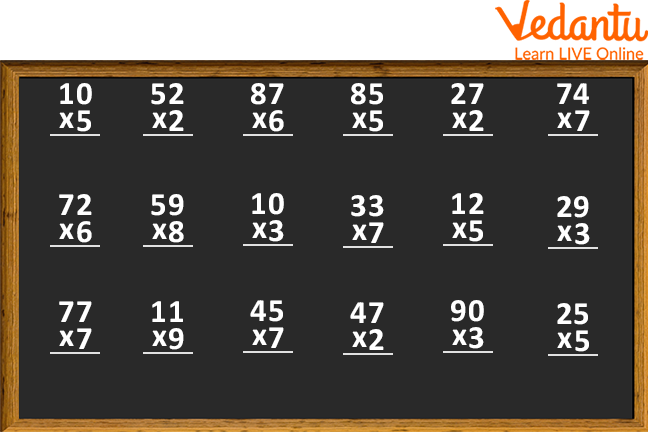
Worksheet 2
Practice Problems
Some multiplication problems to be solved on your own are given under:
Q 1. 59 × 3
Ans: 177
Q 2. 54 × 11
Ans: 594
Q 3. 29 × 8
Ans: 232
Q 4. 34 × 10
Ans: 340
Q 5. 90 × 32
Ans: 2,880
Q 6. 89 × 0
Ans: 0
Summary
To sum up here with the concept of Multiplication of Class 3. The main motive of this article is to teach the students the easiest way to multiply any two given numbers. The steps involved in multiplication sums for class 3 are explained in depth in this article using the solved examples and images. Various multiplication problems and worksheets are also specified to strengthen the basic concept of multiplication in children's minds. Hoping the article helped you understand the concept of multiplication and you enjoyed reading it.
FAQs on Multiplication for Kids Made Simple
1. What is multiplication for kids?
Multiplication is a math operation that means repeated addition of the same number. It helps kids add equal groups quickly and easily.
- Example: 3 × 4 means 3 groups of 4.
- So, 4 + 4 + 4 = 12.
- Multiplication is often called "times".
2. How do you explain multiplication in simple words?
Multiplication means adding the same number again and again. It is a faster way to find totals when numbers are repeated.
- Example: 5 + 5 + 5 = 3 × 5
- So, 3 × 5 = 15
3. What is the multiplication formula?
The basic multiplication formula is a × b = c, where a and b are factors and c is the product. The result of multiplying two numbers is called the product.
- Example: 6 × 4 = 24
- Here, 6 and 4 are factors, and 24 is the product.
4. How do you multiply numbers step by step?
To multiply numbers, you add equal groups or use multiplication tables. Follow these simple steps:
- Step 1: Write the numbers (example: 7 × 3).
- Step 2: Add 7 three times (7 + 7 + 7).
- Step 3: Count the total = 21.
5. What are multiplication tables?
Multiplication tables are lists of multiplication facts that help kids quickly find products. They show the results of multiplying a number by 1, 2, 3, and so on.
- Example (Table of 2):
- 2 × 1 = 2
- 2 × 2 = 4
- 2 × 3 = 6
6. What is the difference between multiplication and addition?
Addition combines numbers once, while multiplication adds the same number repeatedly. Multiplication is a shortcut for repeated addition.
- Addition: 4 + 4 + 4
- Multiplication: 3 × 4
- Both equal 12.
7. What are the basic properties of multiplication?
The basic properties of multiplication are the commutative, associative, and identity properties.
- Commutative: a × b = b × a (Example: 3 × 5 = 5 × 3)
- Associative: (a × b) × c = a × (b × c)
- Identity: a × 1 = a
8. How do you multiply by 10, 100, or 1000?
To multiply by 10, 100, or 1000, add zeros to the number based on how many zeros are in the multiplier.
- 6 × 10 = 60
- 6 × 100 = 600
- 6 × 1000 = 6000
9. Can you give an example of a multiplication word problem?
A multiplication word problem involves equal groups and asks for the total. Example:
- There are 4 baskets with 5 apples in each basket.
- Multiply: 4 × 5
- Total apples = 20
10. What are common mistakes kids make in multiplication?
Common multiplication mistakes include mixing up factors, skipping numbers, and not learning tables properly.
- Confusing 3 × 4 with 3 + 4
- Forgetting multiplication facts
- Making counting errors
