








What Is the Multiplication And Division Model With Formula and Examples
Students should have a clear understanding of Mathematical operations and not just memorise steps and procedures. For that, it is essential that students are able to analyse numbers and think about their relations. The algorithms of traditional multiplication and division are important to learn. To gain the full concept of this, we should start with a concrete concept and then move towards the pictorial and finally end with the abstract which will help students develop full mastery. In this article, there are some models that will be discussed which will help students to understand the relationship between multiplication and division.
Examples of Multiplication and Division Models
The multiplication and division models are discussed below with examples.
Arrays
Array Model is one of the earliest models which is helpful in understanding the concept of multiplication and division. In this model, we can observe the connection between the two operations and can visually see the concept of “grouping” or “sharing”. An example of multiplication of 3 and 6 and division of 18 by 3 is given in the array model.
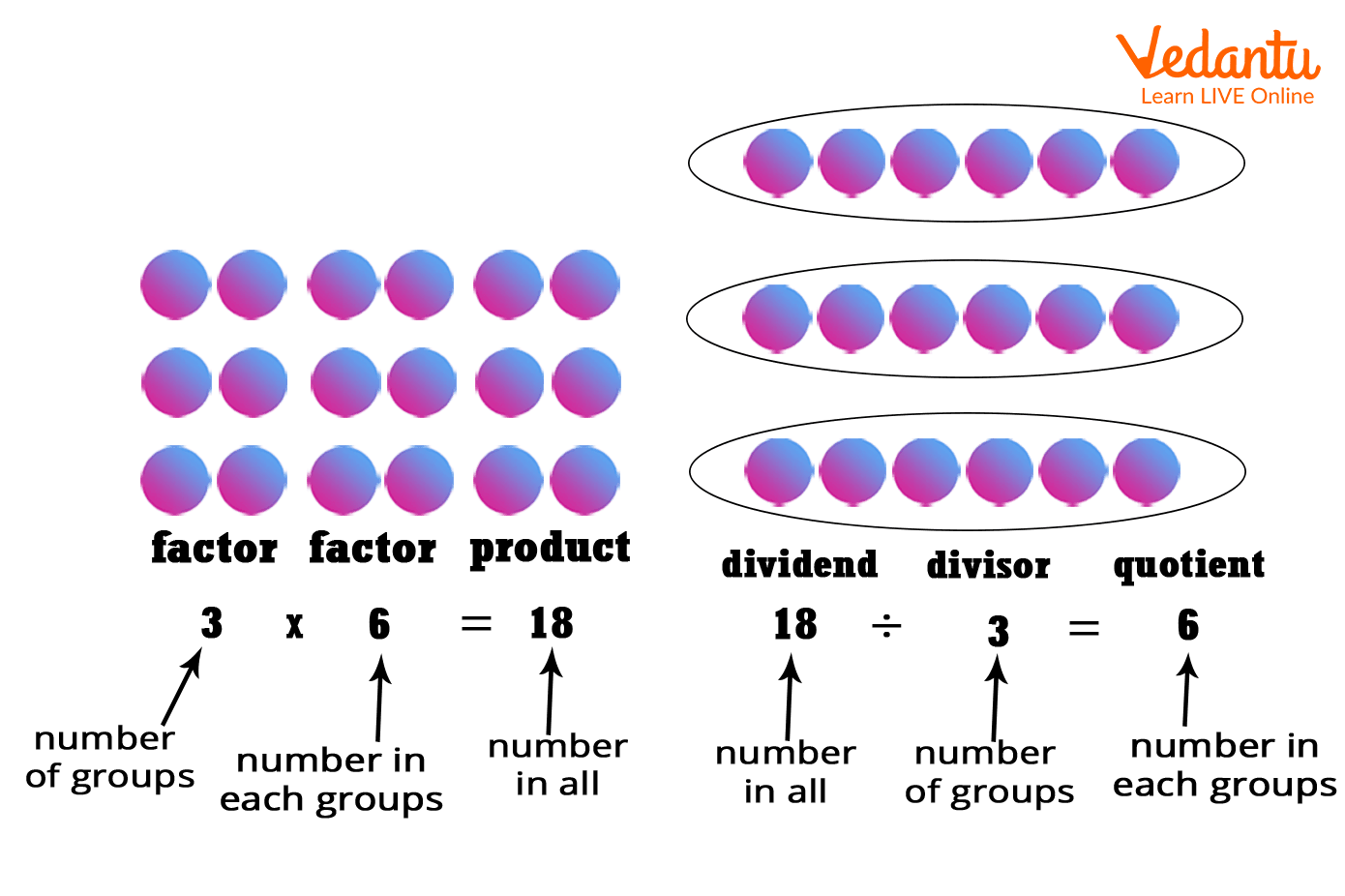
Image: Example of arrays model of multiplication and division
Area Models
The area model is closely related to the computation with the standard algorithm. In this model, the difference is the visual representation and connection to the Base 10 System, and the understanding of place value. We can visually see the actual size of each computation and learn how to interpret the partial products. An example of multiplication of 7 and 16 is given below through the area model.
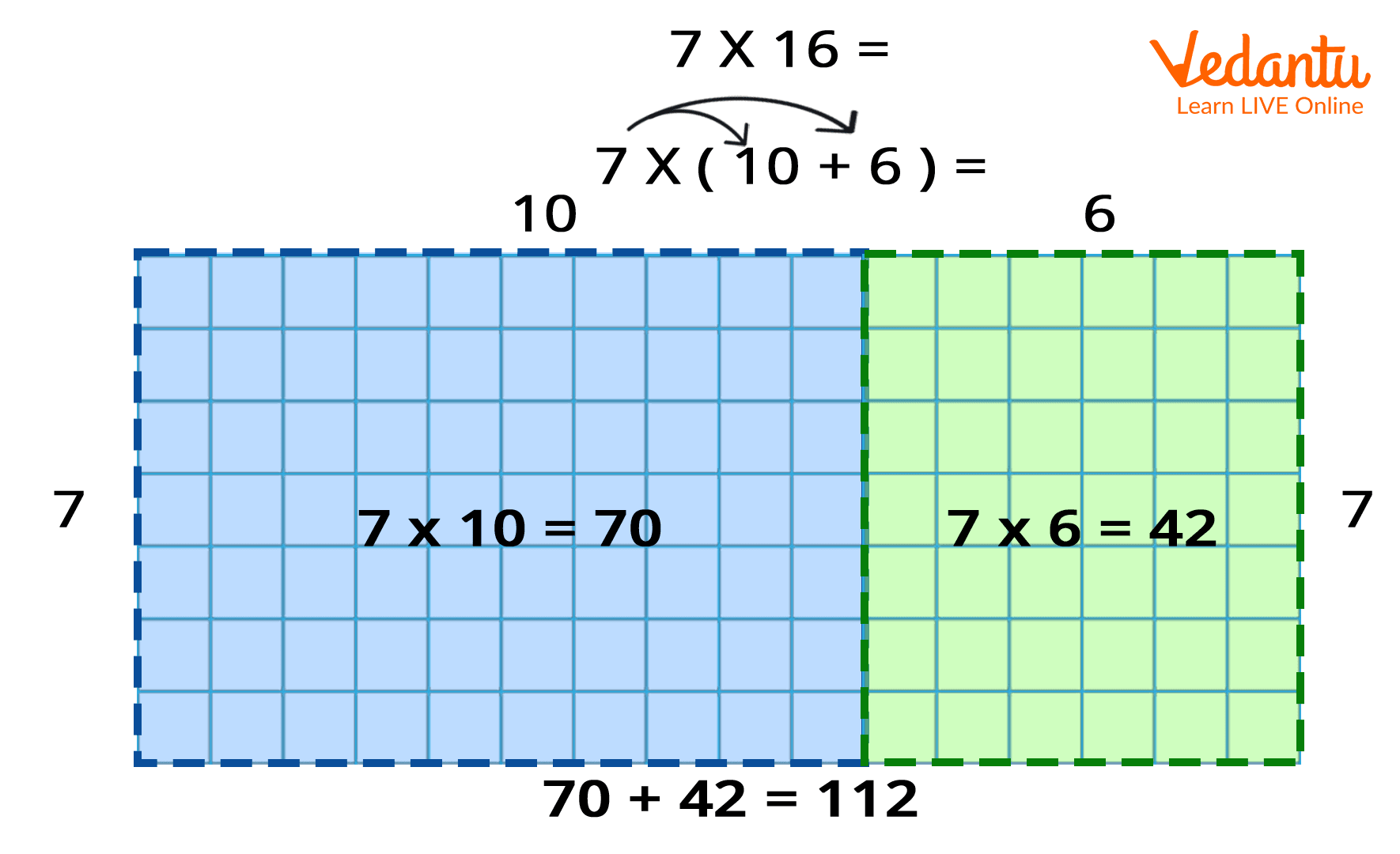
Image: Example of area model
Bar Models
This model is based on the concept of equal groups and part-part-wholes. This model is helpful in moving away from the concrete phase and makes us familiar with the pictorial stage. Bar models are a good method for the students to show their thinking when problem-solving, especially when solving two-step problems. An example of multiplication of 30 and 4 is given below with the help of the bar model.
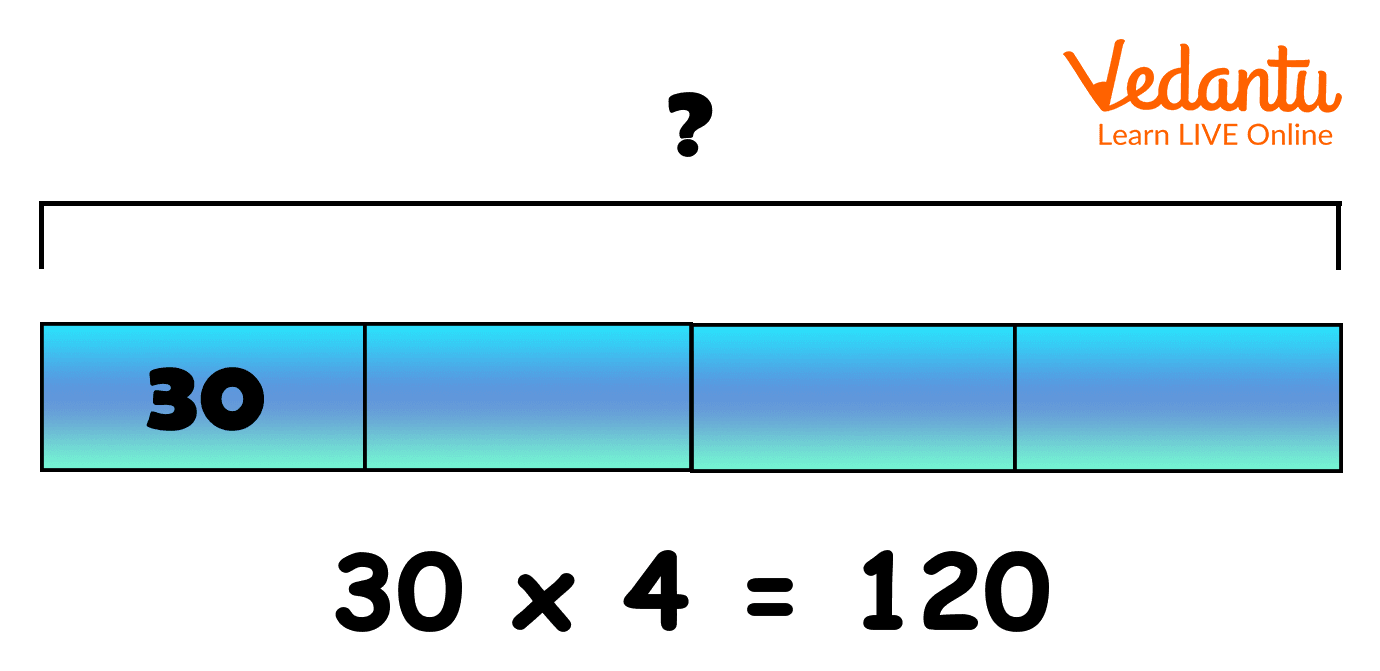
Image: An example of the bar model of multiplication
Number Lines
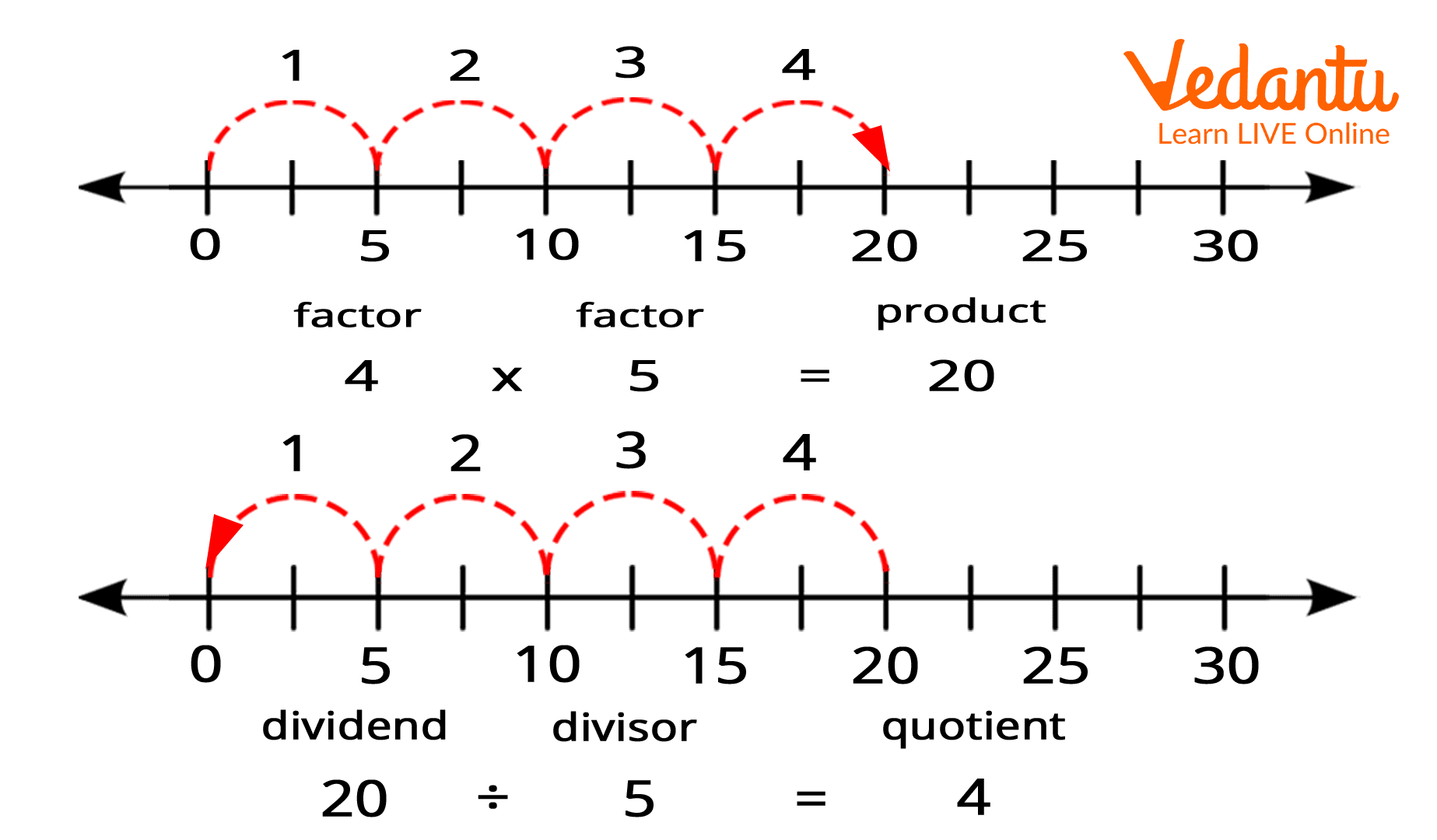
Number lines help students to know the abstract stage of multiplication and division. They are allowed here to “skip” forwards or backwards direction distances to represent the inverse operation. Number lines are a traditional model which is taught to students to develop their thinking and explain the reasoning of multiplication and division. An example of multiplication of 4 and 5 and division of 20 by 5 is given below with the help of a number line.
Conclusion
It is very important for the students to understand the actual meaning of the Mathematical operation. Just following the procedure of performing these operations is not enough. Hence, the models that describe the Mathematical operation are essential. In this article, we have discussed multiplication and division models with examples.
FAQs on Multiplication And Division Model in Mathematics
1. What is a multiplication and division model in Maths?
A multiplication and division model is a visual or mathematical representation used to show how numbers are multiplied or divided using groups, arrays, or equal sharing. It helps learners understand how quantities combine or split.
- Multiplication model: Shows equal groups (e.g., 4 groups of 3 = 12).
- Division model: Shows equal sharing or grouping (e.g., 12 ÷ 3 = 4 groups).
- Common models include arrays, number lines, bar models, and area models.
2. How do you represent multiplication using a model?
You represent multiplication using a model by showing equal groups or an array that matches the multiplication sentence. For example, 3 × 4 means 3 groups of 4.
- Draw 3 circles (groups).
- Put 4 objects in each circle.
- Count total objects: 3 × 4 = 12.
3. How do you represent division using a model?
You represent division using a model by showing equal sharing or equal grouping of a total number. For example, 12 ÷ 3 means dividing 12 into 3 equal groups.
- Start with 12 objects.
- Divide them into 3 equal groups.
- Each group has 4 objects.
4. What is the relationship between multiplication and division?
Multiplication and division are inverse operations, meaning one undoes the other. If 4 × 5 = 20, then 20 ÷ 5 = 4 and 20 ÷ 4 = 5.
- Multiplication combines equal groups.
- Division separates into equal groups.
- They form a fact family: 4 × 5 = 20, 5 × 4 = 20, 20 ÷ 5 = 4, 20 ÷ 4 = 5.
5. What is the area model for multiplication?
The area model for multiplication represents multiplication as the area of a rectangle with given length and width. For example, 6 × 4 is shown as a rectangle with sides 6 and 4.
- Length = 6 units
- Width = 4 units
- Area = 6 × 4 = 24 square units
6. What is the formula for multiplication and division?
The basic formulas are Product = Multiplier × Multiplicand and Dividend ÷ Divisor = Quotient. These formulas describe how numbers relate in multiplication and division.
- Multiplication example: 7 × 3 = 21
- Division example: 21 ÷ 7 = 3
7. Can you give an example of a multiplication and division word problem using a model?
A multiplication and division word problem can be solved using equal groups or sharing models. Example: "There are 5 bags with 6 apples each. How many apples are there?"
- Multiplication model: 5 groups of 6
- 5 × 6 = 30 apples
- 30 ÷ 5 = 6 apples per bag
8. What is the difference between grouping and sharing in division models?
The difference is that sharing division splits a total into a known number of groups, while grouping division finds how many groups can be made. Both give the same quotient but use different thinking.
- Sharing: 12 ÷ 3 means 12 shared into 3 groups → 4 in each.
- Grouping: 12 ÷ 3 means how many groups of 3 fit into 12 → 4 groups.
9. What are common mistakes in multiplication and division models?
Common mistakes include confusing the number of groups with the number in each group. Students may also miscount items in arrays or reverse dividend and divisor.
- Mixing up 3 × 4 and 4 × 3 in word problems.
- Incorrectly grouping objects in division.
- Forgetting that division by zero is undefined.
10. Why are multiplication and division models important for learning Maths?
Multiplication and division models are important because they build strong conceptual understanding of equal groups, arrays, and inverse operations. They connect visual learning with numerical calculations.
- Improve problem-solving skills.
- Prepare students for fractions, ratios, and algebra.
- Make abstract concepts concrete and easier to remember.
